From the CEO

Growth is supposed to bring more clarity. More data, better reporting, sharper decisions.


In practice, it often does the opposite.


The businesses we work with are not struggling because they lack information. They are struggling because the systems they started with were built for a simpler version of the company. As entities are added, as inventory grows more complex, as operations stretch across more locations, the gaps quietly widen. Reporting takes longer. Numbers stop agreeing with each other. Spreadsheets fill in for what the system should be doing on its own.


None of this happens overnight. That is precisely why it is easy to miss until it is already costing real time and real confidence.


What I want to focus on this edition is the moment most owners recognize but rarely name out loud. It is the point when the business stops being supported by its systems and starts compensating for them. That is when financial visibility breaks down, when data becomes harder to trust, and when adding more tools tends to make the problem worse, not better.


The pieces in this edition are meant to help you see that pattern clearly, and more importantly, to give you a practical sense of what changes when the foundation is built to match the business you are actually running today.

Sincerely, 

Mario Nowogrodzki, CPA.CITP 

CEO and Founder


Your QuickBooks Data Holds More

Than You Think

Most businesses running QuickBooks Enterprise are sitting on years of valuable financial and operational data. Very few are actually using it to make better decisions.


Instead, the data lives in exports, spreadsheets, and disconnected reports that take longer to produce every quarter. What started as a workaround eventually becomes the bottleneck. Reporting slows down. Confidence in the numbers drops. AI and analytics initiatives stall before they get off the ground.


The issue is rarely the software. It is the lack of a structured foundation underneath it.


Read the full article →


The Quiet Cost of Outgrowing Your Systems

Reporting takes a little longer each quarter. Numbers across systems stop fully agreeing. Teams lean harder on spreadsheets to fill in the gaps.


None of it feels urgent on its own. That is exactly what makes it expensive. By the time the pattern is impossible to ignore, the cost has already been absorbed into how the business runs every day.


The fix is rarely more process or tighter controls. It is alignment between how the business actually operates today and the foundation supporting it.


Read the full article →


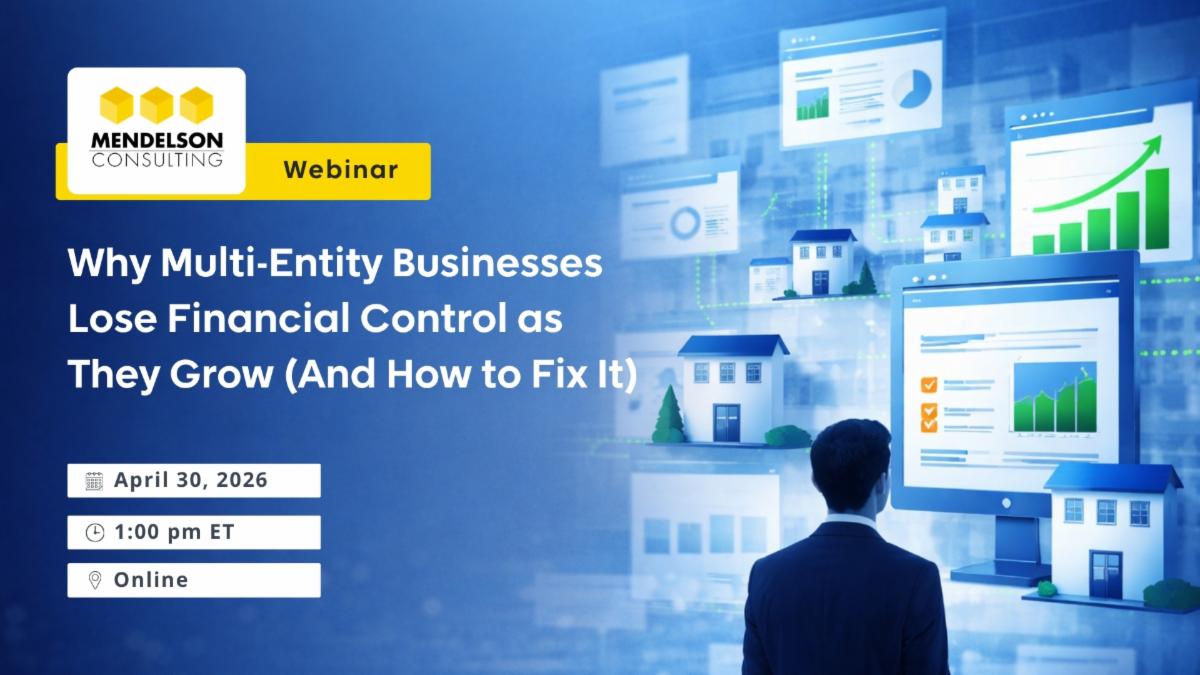
Live Webinar | April 30 at 1:00 PM ET


If you are managing multiple companies, locations, or business units, the pattern is familiar. Intercompany entries pile up. Consolidated reporting takes too long. Visibility depends on whoever owns the spreadsheet that month.


Join Keith Fileccia (COO, Mendelson Consulting) and Matt Bright (Senior Product Specialist, Intuit) for a focused session on what typically breaks as multi-entity operations scale, and what a more structured approach looks like in practice.


You will learn:


  • Why financial visibility breaks down as you add entities
  • The hidden risks behind manual intercompany processes
  • How Intuit Enterprise Suite supports multi-entity operations at scale


Reserve your spot →


Named Katana Cloud Inventory's Partner of the Month

Katana Cloud Inventory recently named Mendelson Consulting their Partner of the Month, recognizing the work we do helping growing businesses connect inventory, operations, and financials into a single, reliable system.


The recognition reinforces what this edition is really about. Inventory and financial data should not live in separate worlds. When they do, visibility breaks down and decisions slow. When they are aligned, the business runs on one set of numbers everyone can trust.


If inventory complexity is starting to outpace your current setup, Katana paired with the right financial foundation is one of the most practical ways to regain control.


Explore our Katana partnership →


Final Thought

Most of the businesses we work with do not have a technology problem. They have an alignment problem.


The systems are doing what they were set up to do. The processes are running. The reports get produced. But the business has changed, and the foundation underneath it has not kept pace. That gap is where visibility quietly disappears, where confidence in the numbers erodes, and where every new tool added on top makes the structure heavier instead of clearer.


Recognizing that gap is not a setback. It is the moment that makes everything that follows possible. The work is not to do more. It is to make sure what you already have is built to support where the business is actually going.


That is the conversation worth having now, before the next quarter forces it.

Dynamics 365 Business Central

Cloud Services

QuickBooks

About Us

Facebook      LinkedIn      X