(Graphic image of gold Rotary-gear logo to right of blue text stating "Rotary Word Disability Advocacy".) |
|
Addressing human-rights issues for
people with disabilities around the world
Good things are going on all over the world!
|
|
Awareness betters human rights for people with disabilities |
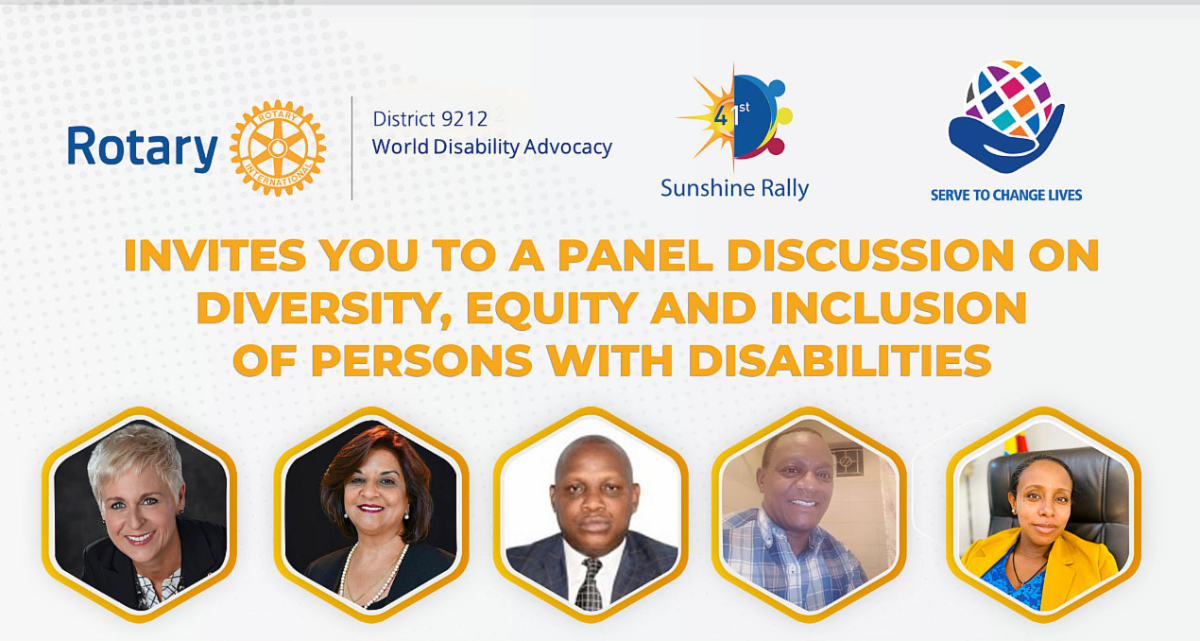
(Invitation to a November 5 panel discussion on diversity, equity and inclusion of persons with disabilities, hosted by Rotary District 9212 in Kenya, including photos of the five panelists as well as the Zoom login. The Zoom Meeting ID is 860 7009 - 0329, and the Passcode is 878143. This free online panel discussion is open to both Roytariand and non-Rotarians.)
More than one billion people worldwide - around 15 percent of the world population - are living with a disability. As Rotarians, we continue to push for diversity, equity, and inclusion in all that we do
But do your DEI efforts include people with disabilities? Do you understand their challenges? Are you part making the change that ensures there is DEI in our society?
Awareness of the human rights of people with disabilities is at the foundation of The Rotary Club of World Disability Advocacy. Awareness produces advocacy, which produces change that results in better lives for people with disabilities.
|
(Graphic image of gold Rotary gear to right of blue text stating "Rotary World Disability Advocacy, which is above graphic image of numerous people of different colors holding hands while encircling world.)
The Rotary Disabilities Advisory Group - a worldwide movement on behalf of - and by - people with disabilities - has 345 members from 20 countries. They consist of 123 Rotarians - from 49 Clubs in 23 Districts - and 222 non-Rotarians.
The Rotary Club of World Disability Advocacy has 20 active and 10 honorary members.
To learn more about Rotary International, which was founded in 1995 and has more than 34,000 clubs worldwide with a total of more than 1.2 million members, click here.
To learn more about charitable not-for-profit The Rotary Foundation, which has provided $3 billion in funding for thousands of projects since its founding in 1917, click here.
|
|
(Graphic image of blackboard with white-chalk text stating "Introduce Yourself," and red-heart icon in place of letter "O" in word "yourself.")
Please include the following regarding yourself:
1. Country of residence
2. Role in the society
3. Whether you are a person with a disability, a parent of a child with disability, and/or a diversity- and disability-rights advocate.
|
|
Experiences of persons with disabilities adapting to COVID-19
|
|
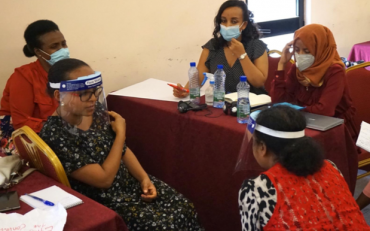
(Five women seated in a room while wearing COVID-19 protective masks or shields.)
The global COVID-19 pandemic drastically transformed human life. Many aspects have yet to be normalised.
Some countries go through waves of high infection rates, and new variations of the virus are being identified. In other regions life, is getting back to a semi-normal state due to successful vaccination plans.
Many governments are in the process of either developing or implementing recovery plans, to mitigate some of the economic and social consequences of the pandemic. These rapid changes and unstable conditions impacted particularly marginalised groups ,
including persons with disabilities.
|
|
Limiting suffering of people with disabilities while making their voices heard
By José Antonio Spotti Lopes, of the Rotary Club of São José do Rio Preto Novo Cinquentenário
|
|
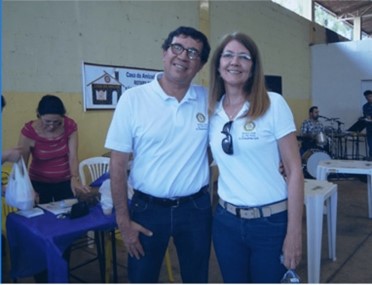
(Photo of the make author,on the left, posing with a fellow female Rotarian.)
I was very happy with the invitation to be able to share a little of my life and, who knows, humbly inspire you in this new year.
I can say that in this last decade a hurricane passed through my life, leaving marks, learning and new realities.
I was born and rooted in São José do Rio Preto, in the interior of the state of São Paulo, being the son of a lawyer and a teacher, and the second of four brothers. Vision problems have always been with me since I was a baby. I have a rare anomaly called congenital anerdia in both eyes, which causes a malformation of the iris, causing problems such as glaucoma, cataracts and others.
Therefore, since I was little I had to overcome many obstacles. But the desire to be and do more always motivated me to move forward.
At 29 years old, a graduate in civil engineering, married, and with a young daughter, I experienced a great storm. A traffic accident, followed by unsuccessful surgeries, caused me to lose sight in my left eye.
The challenge then became much greater, both personally and professionally. Just as Jorge Aragão says in the song, I got up, shook off the dust and walked over!
|
|
Deeper understanding of difficulties facing sports-interested powerchair users
By Courtney Law, Dalhousie University
|
|
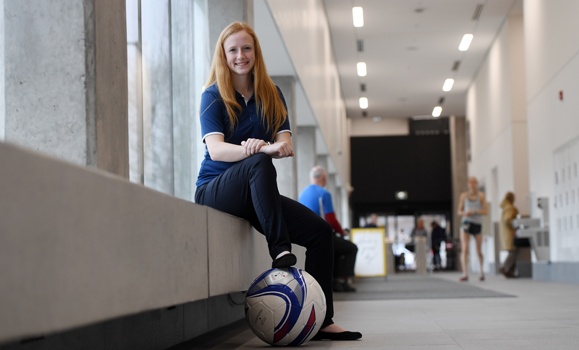
(Photo of Madison Campbell seated, with her right foot posed on a soccer ball.)
Volunteering with a youth wheelchair sports camp at Dalhousie in 2017, Madison Campbell gained a deeper understanding of the difficulties facing powerchair users interested in sports in Nova Scotia.
The fourth-year kinesiology student recalls feeling shocked upon learning of the lack of parasport options for individuals in the province in powerchairs, the motorized version of a manual wheelchair. She explains that the only powerchair sports leagues on offer are bocce ball and sailing, neither of which are team-based.
That’s about to change thanks to Madison, who has spent the past two years developing the province’s first powerchair soccer league alongside mentor Paul Tingley, a Paralympian and parasport coordinator for Nova Scotia.
“Powerchair athletes don’t have the same opportunities that I had growing up [as a non-disabled person] to be involved in the sports that I love,” says Madison, a lifelong soccer player and member of United DFC, the local grassroots soccer club for the Dartmouth region.
Madison says the lack of team parasports for powerchair users is problematic given that many people join sports specifically to participate in a team environment.
|
|
The dream of a world without barriers
Source: World Health Organization
|
|
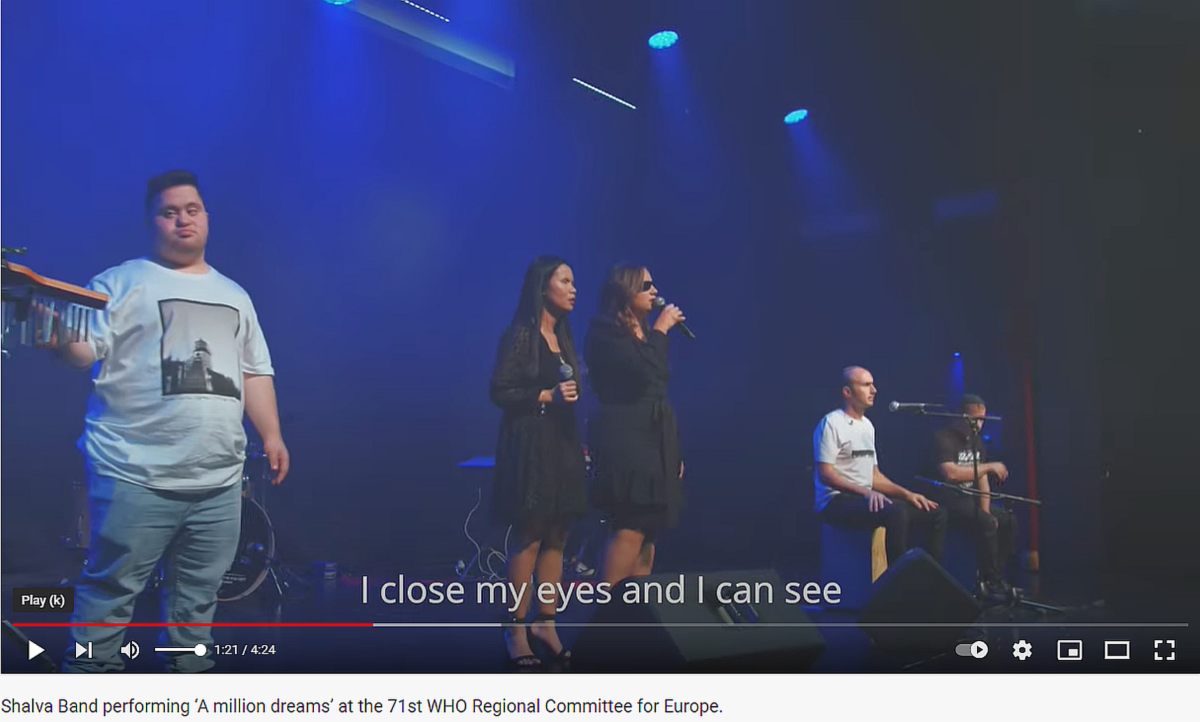
(Video screenshot of the Shalva Band on stage during a performance, with a portion of the displayed lyrics stating "I close my eyes and I can see.")
The Shalva Band, comprised primarily of eight musicians with disabilities, is a talented group who tour the world performing to huge audiences. In addition to being a delightful and inspiring musical experience, the band’s performances shatter attitudinal barriers, causing mesmerized audiences to believe in human potential and dignity.
This performance video was specially recorded for the 71st World Health Organization's Regional Committee for Europe side event on the ‘highest attainable standard of health for persons with disabilities’. The event was jointly hosted by the European Disability Forum, Germany, Israel, Norway, United Kingdom, and the WHO Regional Office for Europe.
|
|
Clubfoot Society focuses more on green economic empowerment
By Anne Onyango
|
|
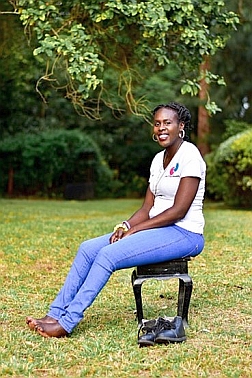
(Photo of Anne Onyango, who is club-footed, sitting on a bench on a lawn. Her shoes are on the ground next to her, and her bare feet are showing.)
After the celebration of World Clubfoot day, last June 3, the Clubfoot Society of Kenya decided to focus more on economic empowerment. As we embrace climate-change policies in our country, and with the ban of charcoal burning, the Society has rolled out an economic empowerment centered on green energy.
We have come up with a program to enable disability groups to focus on more climate-friendly charcoal/briquettes-making as a part of economic empowerment, and to also plant trees within communities to reclaim the lost forest lands. We are currently including all individuals with a disability - they do not have to be people with clubfoot - and who are interested in working as part of the economic-empowerment project under green disability. Currently, we have about 3,000 persons of different disability groups who are interested in this project.
Our pilot phase began in Kibera with about 35 people with disabilities as well as mothers of children with special needs who have currently registered as part of Clubfoot Society but belong to different CBOs within the community. Our aim is to have the participants earn a daily income that will enable them have better quality of life, and also be able to afford assistive devices without being fully dependent on government donations.
In Nairobi, we have sourced for various restaurants that will participate in the initial sampling of the product and the rollout. Here are the challenges we are trying to address:
- Roll-out to other interested groups of people with disabilities because of the costs of machinery and setup, considering the project was fully sponsored from my own savings.
- Lack of diapers, especially for the children who have cerebral palsy.
- Lack of more accommodative education centers for children with special needs.
- Lack of a wider access to markets, to sell the briquettes.
- Lack of awareness and publicity about the project.
- Lack of a more proactive support system within the organization because each one wants to have - but not also contribute towards - the expansion.
Here is our shared vision: In the world of work, most employers or business owners offer a guarantee of equal-employment opportunities.
In order to not spark controversy, let us instead question the seriousness with which we have put this equality into practice in our workplaces.
Note: All our current members do not pay dues.
For more information, contact me at either anne.oyoo@gmail.com or WhatsApp, or call me at +254 736 412355. I would love to be your speaker at a Rotary Club meeting
|
|
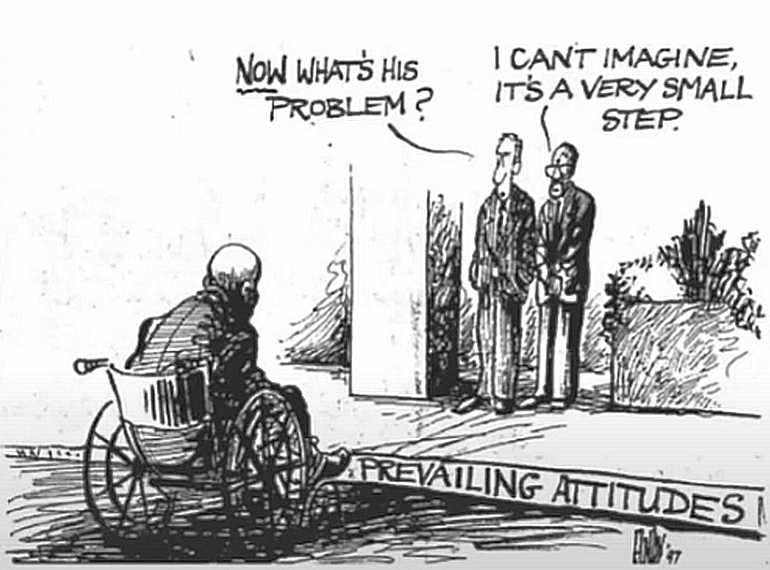
Barriers are not always physical
Interview with Jeremy Opperman
|
|
An editorial cartoon shows a man in wheelchair approaching a sidewalk curb, whose text states "Prevailing attitudes," from a street surface. One man standing on the sidewalk says to another man standing next to him, "Now what is his problem?" The other man responds, "I can't imagine. It's a very small step." |
|
Jeremy Opperman (shown on right), is founder of Opperman & Associates, in Cape Town.
In a video interview with the Low Vision Care Centre, in Johannesburg, Jeremy discusses disability equity and the employment cycle from a visually impaired perspective.
|
|
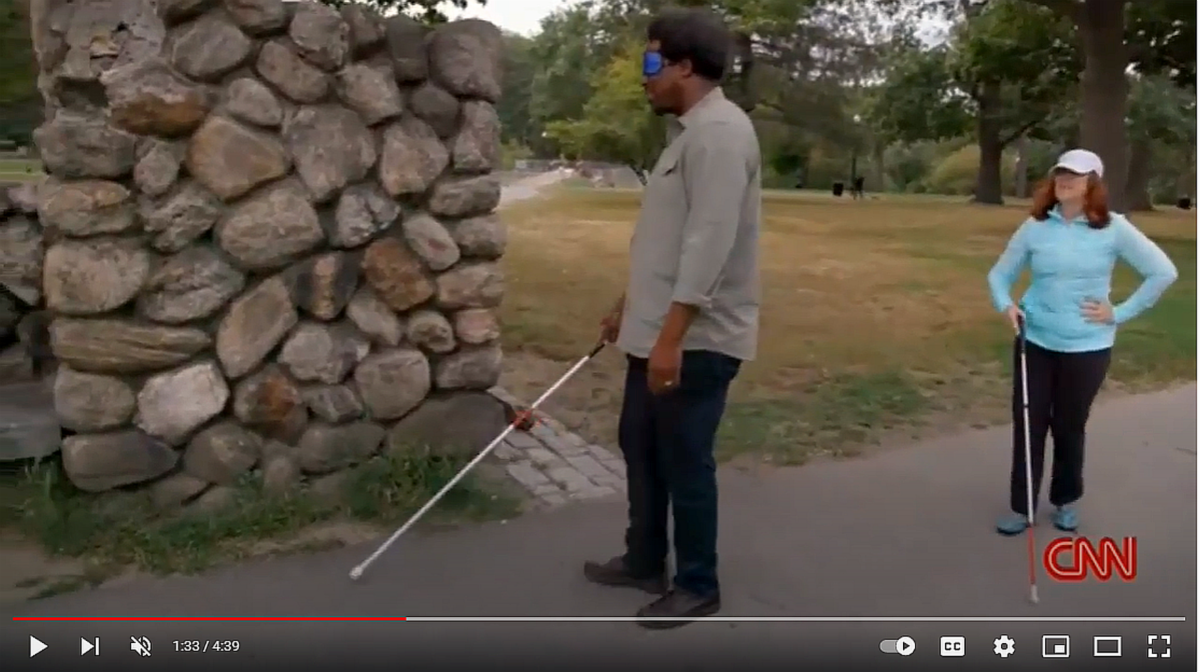
(W. Kamua Bell, who is sighted, learns how to uses a walking cane while blindfolded, to navigate a city sidewalk, with guidance from Liz Myska, who is blind and is also using a walking cane.)
Liz Myska is an attorney in Massachusetts who went blind later in life, and now has a local cable-TV show, "Connecting the Dots." She interviews local people and likes to hear their stories.
In a segment of CNN's "United Shades of America," Liz, while using a walking stick, shows host W. Kamua Bell how to navigate streets and sidewalks - in the downtown area of the city of Worcester - while is blind-folded and using a walking cane.
|
|
(Graphic image of gold Rotary-gear logo to right of blue text stating "Rotary Word Disability Advocacy)
The deadline for stories and photos/images for our November 9 Newsletter is on Saturday, November 6.
Please submit your stories and related photos/images to Newsletter Editor Ralph Hammond either via WhatsApp or at ralph.hammond@verizon.net.
All stories must be in either e-mail, PDF, WhatsApp, or Word format.
All photos/images must be in either GIF, JPG, or PNG format.
Our Newsletter team looks forward to receiving news and information from around the world about people with disabilities, and efforts to help them achieve autonomy and respect.
We encourage you to post your disability-related news, information, events, and activities on our club's WhatsApp page.
|
|
JOIN OUR UPCOMING MEETINGS |
|
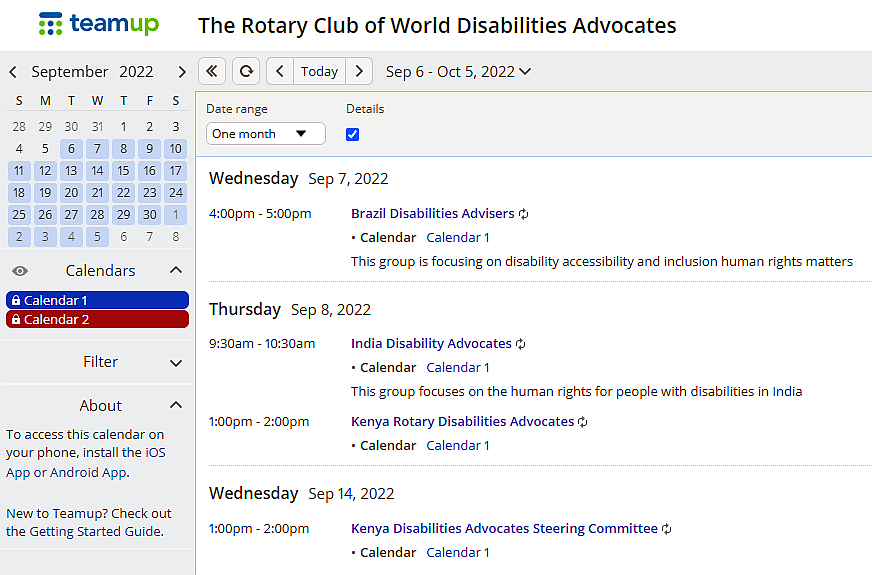
(Screenshot of online calendar of events, meetings, and activities for Rotary Club of World Disability Advocacy.)
With scores of international members, the Rotary Club of World Disability Advocacy focuses on coordinating human-rights needs for people with disabilities in countries around the world.
Our club has set up international committees in many countries to, identify needs.
We have created an online calendar (shown) for scheduling for all the meetings being held by our club, group, committees, and subcommittees.
While it does not include Zoom links, it will eventually.
|
|
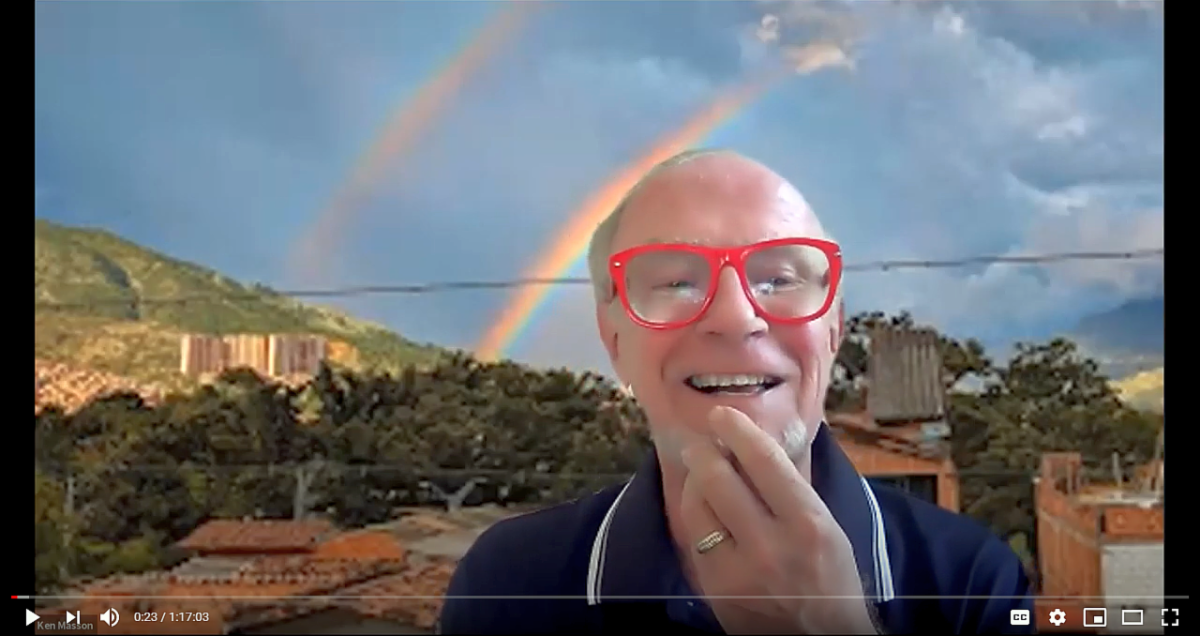
(Head and shoulders of Ken Masson against background photo of cloudy sky with double rainbow above mountainous Colombian landscape
Our monthly Club meeting - for Club members, only - is held on the third Monday at 12:00 p.m. (Eastern time).
Our monthly Group meeting - for both Club members and non-members - is held on the first Monday at 12:00 noon (Eastern time).
To convert Eastern time to your own time, click here.
To obtain the Zoom login for our Club and/or Group meetings, contact Ken Masson our Club's president for Rotary year 2021-2022, via either WhatsApp or at kennethmasson@gmail.com.
|
|
MISSED OUR LATEST MEETINGS? |
|
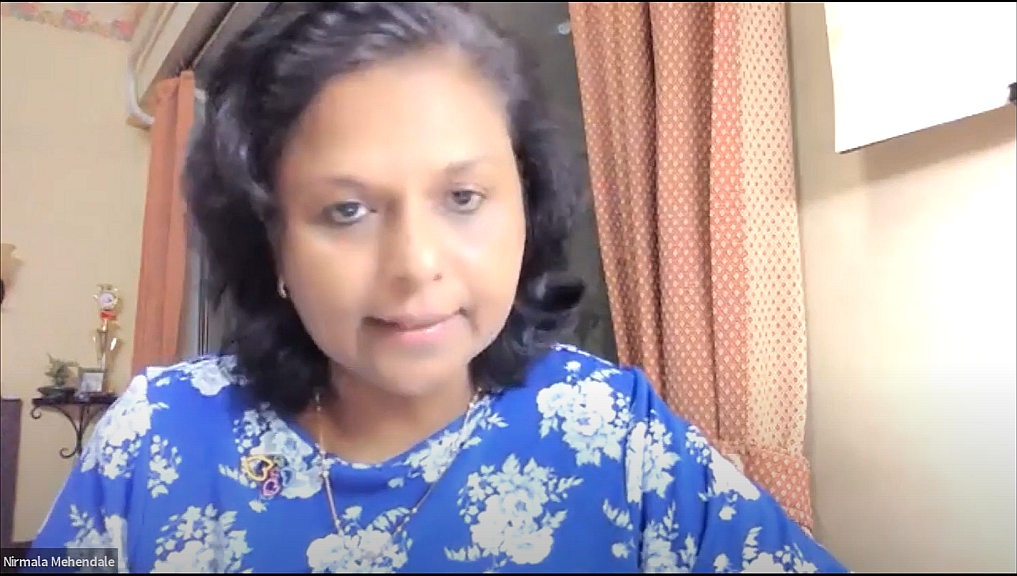
(Head and shoulders of Nirmala Mehendale, president of the India-based World Kindness Movement)
To watch this 54-minute video of the October 18 meeting of the Rotary Club of World Disability Advocacy, click here.
|
|
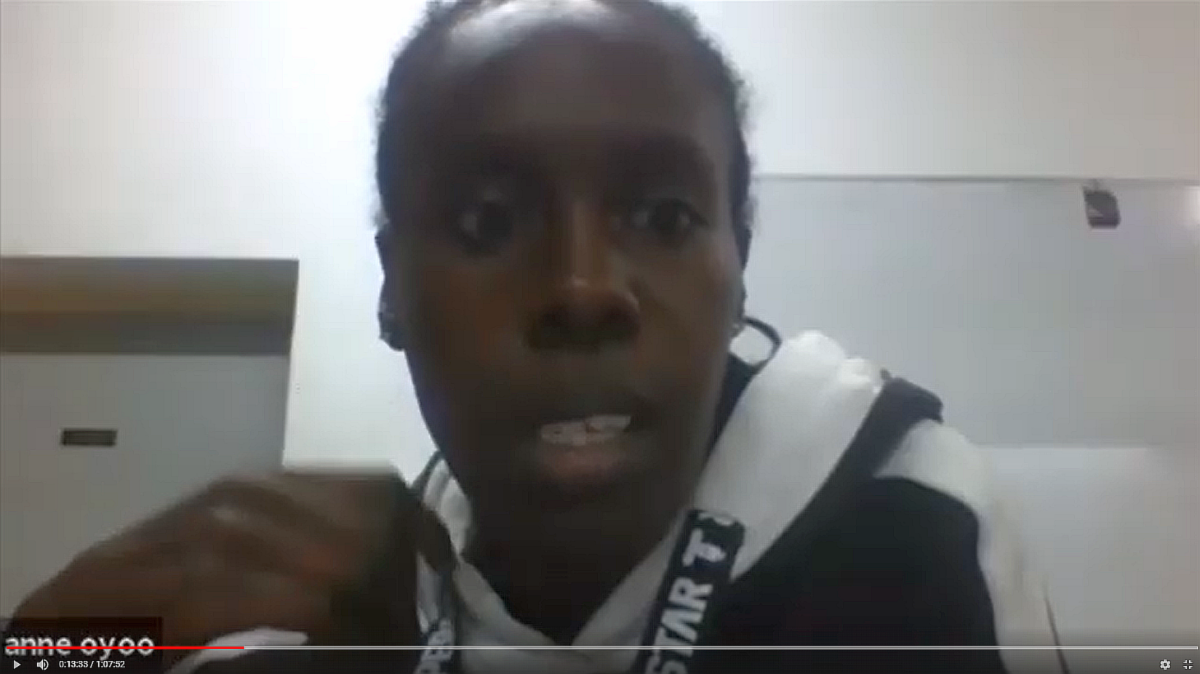
(Head and shoulders of guest speaker Anne Oyoo, who runs the Kenya-based Clubfoot Society of Kenya.)
To watch this 68-minute video of the October 4 meeting of Rotary Disabilities Advisory Group. click here.
|
|
(Head and shoulders of guest speaker Ralph Hammond, as he addresses "How to Apply for a Rotary Grant."
To watch this 65-minute video of the September 30 meeting of the Rotary Club of World Disability Advocacy, click here.
|
|
(Head and shoulders of guest speaker Carolina Barrios, as she shares her experience with"How Successful Rotary Grants Work.")
To watch this 53-minute video of the September 21 meeting of the Rotary Club of World Disability Advocacy, click here.
|
|
(Screenshot of top half of home page of blogsite for Rotary Club of World Disability Advocacy.)
Our club is dedicated to the human rights of people with disabilities.
|
|
(Graphic image of numerous people of different colors holding hands while encircling the world.)
- October 26, 2021
- October 19, 2021
- October 12, 2021 - No issue
- October 5, 2021 - No Issue
- September 28, 2021 - No issue
- September 21, 2021 - No issue
- September 14, 2021
- September 7, 2021
- August 31, 2021
- August 24, 2021
- August 17, 2021
- August 10, 2021
- August 3, 2021
|
|
(Graphic image of YouTube logo)
|
|
(Graphic image of Facebook logo)
|
|
(Graphic image of LinkedIn logo)
|
|
WE FOLLOW ROTARY'S FOUR-WAY TEST |
|
(Graphic image of gold Rotary-gear logo to right of blue text stating "Rotary Word Disability Advocacy.")
Our Rotary Club follows Rotary International's Four-Way Test, a non-partisan and non-sectarian ethical guide for Rotarians to use for their personal and professional relationships. The Test has been translated into more than 100 languages, and Rotarians recite it at Club meetings:
Of the things we think, say, or do
-
Is it the truth?
-
Is it fair to all concerned?
-
Will it build goodwill and better friendships?
-
Will it be beneficial to all concerned?
To learn more on Rotary's Guiding Principles, click here.
To contact Ken Masson, our Club's 2021-2022 president, click here.
|
|
|
|
|
|
|