|
PHOTO BY LUIS TORRES
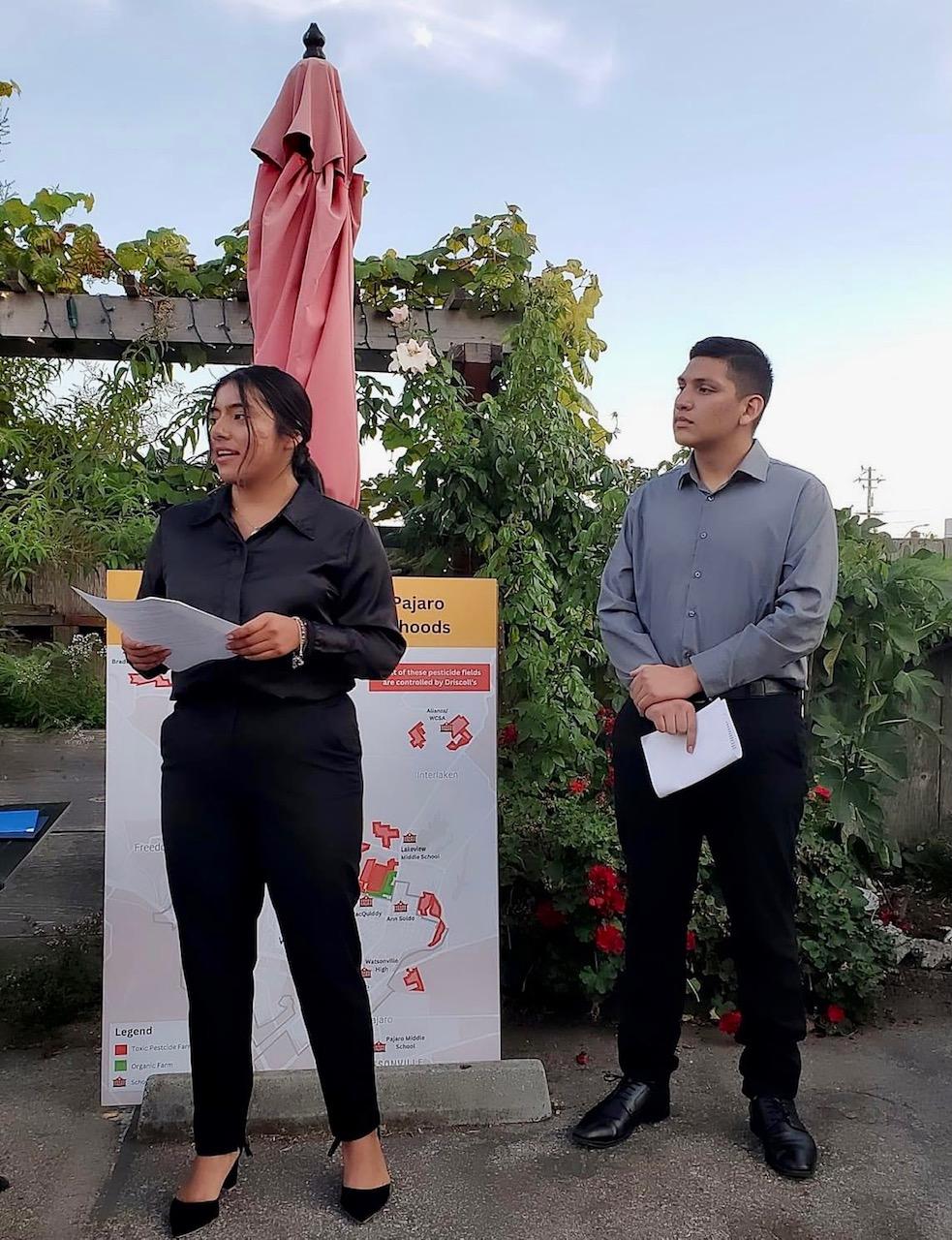
Rocio Ortiz and Victor Torres representing Future Leaders for Change speaking at La Posta, Sept. 23 about the importance of keeping pesticides off of agricultural fields that abut schools.
Honoring Local Organic Farmers and Dreaming of an All Organic Pajaro Valley
BY WOODY REHANEK
On the afternoon of Sept. 23, Charlie Hong Kong restaurant owner Carolyn Rudolph and La Posta restaurant owner Patrice Boyle hosted a meet-and-greet event honoring area organic farmers for their significant contributions to healthy soils, farmworkers, communities, and ecosystems, as well as their climate-smart contributions to GHG reduction.
On La Posta's patio, 65 people enjoyed fine wine and tasty hors d'oeuvres with live fiddle and guitar music. Notable farmers included Dick Peixoto of Lakeside Organic Gardens, who farms 2,000 acres in the Pajaro Valley, as well as Mireya Gomez-Contreras, co-leader of community-based Esperanza Farm near Pajaro Valley High School in Watsonville, Dr. Joji Muramoto, organic extension specialist at UC Santa Cruz, was also present, as well as many small farmers, like Sandra Ward and Ken Kimes of New Native Microgreens, and Farmers of the Year Sylvia and Nick Prevedelli; they form the backbone of our county's 160 registered organic farms growing on 9,287 acres (as of 2023), earning $147.6 million. Organic farms make up only 14.5% of our county's total 64,000 acres of farm and ranchland —100 square miles, an area twice the size of San Francisco — but earned 22.5% of gross farm income ($654.7M) in 2023.
Standing by a large map of Pajaro Valley Schools with conventional chemical farms within 1/4 mile marked in red and organic farms marked in green, CORA (Campaign for Organic and Regenerative Agriculture) member Carolyn Rudolph emceed a host of speakers. Mayor Fred Keeley read a proclamation honoring the county's organic farmers and endorsing the vision of an all-organic county; Santa Cruz councilmember, Sonja Brunner, agreed. Watsonville Mayor Vanessa Quiroz-Carter heartily supported the vision of an all-organic Santa Cruz County, and noted that Watsonville City Council already passed a resolution in support of a one-mile organic zone of innovation around the city's perimeter.
CORA spokesperson, Pajaro Valley Unified School District Trustee Adam Scow, walked attendees through the map, urging Driscoll's conventional chemical growers to go organic at farms within 1/4 mile of schools and homes. Scow said that, although the community is grateful for Driscoll's contributions, the company needs to do more to protect public health, particularly that of farmworkers and children, who are most vulnerable to pesticide exposures. Currently, Driscoll's claims that 20% of its overall berry production is organic. An upcoming CORA action on this issue is planned for Nov. 9.
Greenfield City Councilperson and Safe Ag Safe Schools coordinator Yaneli Martinez was present, and hosted speakers Victor Torres and Rocio Ortiz of Future Leaders of Change. Rocio Ortiz read a moving poem in Spanish and English, about what it's like to work the fields as a child from Oaxaca; in June she graduated from Watsonville High, and was recognized by the Monterey Bay Labor Council, representing 35,000 union members, for her activism at local and state levels to reduce pesticides near schools.
College student Victor Torres, also recognized by the labor council, spoke about AB 1864, a state law which Future Leaders for Change intensively supported in the state legislature. It now awaits Gov. Newsom's signature and would tighten pesticide application restrictions near public schools while protecting private schools as well. Victor asked the group to phone Gov. Newsom at 916.445.2841 or 445.9186 to urge his signature on AB 1864. California's Dept. of Pesticide Regulation and the association of County Ag Commissioners is pushing back against his signing this bill, claiming it would be too costly to enforce and lead to cumbersome paperwork. Not factored in are costs of pesticide exposures to the health of our children, Victor said. As a ten-year-old, Victor was rushed by ambulance to the hospital from Greenfield Elementary with a life-threatening asthma attack. The trigger was a sickly sweet smell associated with the fumigant 1,3-dichloropropene.
Local organic farmers sequester significant quantities of carbon dioxide through nurturing living healthy soils according to CORA members. USDA computer models for Santa Cruz County estimate that one 8-ton-per-acre application of quality compost results in average carbon storage of 4 metric tons per acre per year for 1-3 years, and possibly longer. Multiplied by 9,287 organic acres in our county in 2023, that comes to 37,148 metric tons total per year, for just one healthy soils practice.
Other climate smart practices, such as cover cropping, mulching, and mowing instead of tilling between rows in orchards and vineyards, each store specific amounts of CO2. These metrics should be factored into our county's climate action plan. In short, healthy soils farming is climate smart farming and this is an important reason that we honor and recognize our local organic farmers and farmworkers.
Peixoto said that one of the barriers to going organic is the three year transition period. Most farmers lease the land they farm, often from absentee landowners who want a steady income from renting out their land. These landowners need to be educated as to the multiple benefits of transitioning their land to organic. Dick mentioned one landowner who was willing to forego three years worth of rental payments in order to allow Lakeside Organics to transition the land for them. This gathering made it abundantly clear that healthy, living organic soils and fields have high value and multiple co-benefits for farmers, farmworkers, and their communities.
Editor's note: Good News! Yesterday it was announced that Newsom signed AB 1864 thereby strengthening protections for school kids, staff and communities from pesticide exposure. Safe Ag Safe Schools and Future Leaders for Change are responsible. Rocio Ortiz, graduate of Watsonville Hight School and now a student at CSUMB, and Victor Torres out of Greenfield and now at Monterey Peninsula College, are leaders in FLFC.
| |
|
Supporting Kristen Brown Supports the Rail and Trail
BY TINA ANDREATTA
Support for our rail line and trail project depends on electing the most qualified Santa Cruz County Supervisors. Kristen is the only candidate rejecting Greenway support and explicitly promising to oppose abandonment and railbanking.
Lowell and Wendy Hurst are hosting a meet-and-greet this Sept. 28 at their home, and I hope you can join me. You can come any time between 2-5pm, but we'd like you to register to ensure we order enough snacks and beverages. RSVP at bit.ly/WatsonvilleRSVP
If you cannot make it, we hope you'll sign up to help her campaign by canvassing, phone banking, or donating. https://votekristenbrown.com/
| |
Vote No on Measure Q
BY NORA HOCHMAN
I'm writing to ask you to vote No on Measure Q, the alleged fire fighting measure put on November's ballot by the county. The measure is promoted by the Land Trust, an organization with $56 million in their reserves. All of the fire chiefs are opposed to the measure and have submitted a ballot rebuttal explaining why.
This is a parcel tax, applied to every parcel in every city and the unincorporated parts of the county. Unlike many other parcel taxes, the Land Trust offers no senior exemption. It will cost about $87 a year for the measure and is destined to raise about $7million. That cost will be added to the other taxes we all pay, including fire and school taxes. The cost of this and other measures will no doubt be passed onto renters.
I live exclusively on Social Security. Much to my shock, I am a bona fide senior living on a fixed income. With luck, you will be too, if you aren't already. And, you might need a senior exemption in the future. I didn't until I retired from the world of paid work. Now I do.
Many of you are long time supporters of the Land Trust. I understand that. They acquire a lot of open space that is then protected from development. I like that too.
I need those of you who are younger than me to vote No on Measure Q in solidarity with me and the other seniors living in a very expensive community. In my mind, this is institutional grift, designed to bribe cities and the county with money in order to persuade all those folks to endorse the measure; lots of them did. Those of you receiving this message who endorsed it, well, we all make mistakes.
| |
Santa Cruzan Allan Fisher Reports on El Salvador
BY ALLAN FISHER
On Oct. 8 a trial is scheduled in El Salvador against five anti-mining activists from Santa Marta who were detained in January 2023 and are being charged with a crime that allegedly took place more than 33 years ago in the context of the Salvadoran civil war.
Faith, labor, environmental, diaspora groups and solidarity allies will be mobilizing across the Americas and in Europe as part of two International Weeks of Action to say Drop the Charges against the Salvadoran Water Defenders!
After their arrest in January 2023, the Water Defenders were quickly sentenced to pre-trial detention, despite risks to their health and safety. Thanks to concerted domestic and global outcry over the arrests, the five Water Defenders were eventually released to house arrest, but the serious charges against them remain.
In February 2024, a judge allowed the case to go to trial despite the lack of evidence and a series of irregularities with the testimony of the sole secret witness presented by the Attorney General´s office. Although the ruling of the judge was appealed by the defense team on several grounds, it was upheld by the appeals chamber.
Social organizations in El Salvador have denounced that instead of pursuing justice for the victims of the war, the Government of El Salvador is manipulating the judicial system to criminalize well known environmental leaders who for over a decade played a key role in the struggle that led to the country’s ban on metal mining in 2017. The same leaders had denounced the presence of mining companies in the department of Cabañas, despite the prohibition, while members of the National Roundtable on Mining had denounced measures taken by the Bukele regime to create conditions to repeal the Special Mining Prohibition Law.
The poor economic performance of El Salvador in comparison with the rest of Central America has led the Bukele government to seek access to quick foreign investment. In 2023, the country continued to rank as the slowest growing economy in the region with the least foreign investment, the highest public debt, and poverty rates reaching over 30% of the population.
In response, the Bukele government has intensified an extractivist economic agenda including a larger tourism program that has already generated forced displacement and gentrification in designated tourist areas, and a failed policy on the mining and use of bitcoin as an official currency. The government has also announced that it will begin an oil exploration program as well as a Thorium-based nuclear energy program but has failed to call for any public consultation, nor is it providing access to public information. These policies have led environmental organizations to charge that there is strong evidence that Bukele intends to overturn the mining prohibition.
The popularity of the Bukele regime is based on its controversial public security policies rooted in the permanent suspension of constitutional rights that have resulted in the mass incarceration of tens of thousands. According to human rights organizations, more than 80,000 people have been incarcerated by the regime without a proper trial, of which more than 3,000 are minors, and at least 5,000 are innocent people. At least 351 prisoners have died under suspicious circumstances while in detention. Among those detained are hundreds of political prisoners, human rights defenders, and union leaders who are languishing under inhumane jail conditions that include overcrowding, starvation, lack of medical attention, and torture.
Such is the case of the five Water Defenders. Given that the judicial system has been co opted by the Bukele regime and lacks the judicial independence to guarantee the right to due process, supporters of the Santa Marta 5 water defenders are concerned that despite a strong legal defense and a high-profile international campaign to demand their release, they could still be condemned in an attempt to demobilize opposition to mining. However, a jail sentence could easily turn into a death sentence considering the inhumane prison conditions, and that all the accused are older adults with diagnosed chronic diseases.
Since the water defenders were charged, hundreds of national and international organizations and individuals have joined an international campaign to defend the historic mining ban, and to call for the immediate release of the Water Defenders of Santa Marta and ADES. Among those calling for their release are the UN special rapporteur on human rights defenders, 17 Representatives of the US Congress, elected members of the Spanish Congress, and hundreds of civil society organizations around the world. In January of this year, 185 prominent lawyers and academics from 30 countries signed an open letter asking the Salvadoran Attorney General to drop the charges, and in February, 245 organizations from 34 countries presented a similar petition.
Now is the time to:
- Show urgently needed solidarity with the Salvadoran social movements and the community of Santa Marta
- Attend a demonstration at the El Salvador Consulate in San Francisco
- Say no to mining in El Salvador
- Raise awareness of the broader human rights crisis
For more info about El Salvador, consult: www.cispes.org or call Allan at 415-954-2763.
Footnote: Well-known environmentalist, Juan Lopez, who fought against mining interest for clean water was recently assasinated in Honduras.
Editor's Note: Allan Fisher is a Santa Cruzan who has been active in El Salvador solidarity work since the 1980s. He a member of Bay Area CISPES.
| |
|
Censorship in Our Schools
BY SARAH RINGLER
California Governor Newsom has until Sept. 30 to veto or sign hundred of bills passed by the legislature. There are three education-related bills that in some way connects antisemitism with criticism of Israel or support for Palestinian rights. This false narrative has already been objected to by many like the South Bay Jewish Voice for Peace, Santa Cruz Panetta Vigil and others who have visited the offices of most legislators, submitted letters of opposition and have testified at committee hearings.
As a result of these actions, the three bills have been amended — some last-minute — and in response, and might seem “less bad.” But they still would waste scarce state funds to reinforce a destructive message.
The three bills are described below.
The first, SB 1277, is a dangerous bill that would put teacher training and curriculum development about genocide education for grades 7-12 in the hands of outside, anti-Palestinian groups that deny the genocide being carried out by Israel in Gaza. Genocide education should be unbiased and inclusive. It should be overseen, with the transparency required of public agencies, by educators working directly for or with the state Department of Education. It should not be outsourced to private groups, let alone ones with their own problematic political agenda.
SB 1287 is meant to stifle college student protests by ordering the CSU system to adopt new, vague “codes of conduct” and enforce them in unspecified ways. Such enforcement could well be challenged and found unconstitutional, costing the state boatloads of money it doesn’t have.The bill sends a chilling, implied message to faculty and student defenders of Palestinian rights/critics of Israel, who already face enhanced scrutiny and are more likely than others to be silenced and harshly disciplined.
AB 2925 would require public higher education institutions to train students on various forms of bias and discrimination, but based on unreliable law enforcement data to determine which are most common. Unsurprisingly, using current statistics, it would make optional the inclusion of Islamophobia, anti-Palestinian sentiment and discrimination against both groups, widely known to be underreported – in itself an indication that they need to be included.
If you agree that these bills need to be vetoed, please add your name and send this letter to Gov. Newsom before Sept. 30.
| |
|
Local Palestinian Solidarity Events
FROM PALESTIANSOLIDARITYCC
Santa Cruz Picket: Chevron Divest from Palestinian Genocide - Friday, Sept. 27, 3-6pm at the Chevron Station on the corner of Soquel Drive and Ocean Street
Accessibility info: Masks are encouraged. The Chevron station is wheelchair accessible, and though there will not be seating at the event, limited folding chairs will be provided. Event includes chants and amplified speech. Ear plugs will be available.
Will you join the pledge to boycott? Sign the petition.
"Gaza Surf Club" Screening - Saturday, Oct. 5, 1:30-4pm at the Capitola Branch Library. Join us for the film and discussion led by artist, filmmaker, and activist Yulia Gilich and Faculty for Justice in Palestine.
The Gaza Surf Club was founded in 2008 by Explore Corps to serve as an educational and community development resource for Palestinian surfers in the Gaza Strip. Explore Corps works hand in hand with the surfers to create custom tailored educational programming and opportunities with an emphasis on local resource development, training and international outreach.
The documentary film, "Gaza Surf Club" is a 2016 film which follows several surfers from Gaza and documents their efforts to surf and survive. The film takes a "day in the life" approach and does not discuss the Gaza Surf Club project and its history but instead focuses on some the characters that make up the Gaza Surf Club community.
Sponsored by Palestine Solidarity Central Coast and Faculty for Justice in Palestine. Light refreshments will be provided. Registration is recommended as 30 out of 60 seats are already taken. SAVE YOUR SEAT HERE!
|  |  | |
|
Elizabeth Williams
FOLK ART
Assemblage Dolls and Painted Cut Outs
Fruition Brewery
918 East Lake Ave.
Watsonville
fruitionbrrewing.com
Oct. 4-31
Reception: Friday, Oct. 4, 6-9pm
@ewilliamsart6
elizabethwilliams-art.com
EW text: 831-722-3068
| CARTOON BY ELIZABETH WILLIAMS | |
|
She Dreamt a Liquid Dream
BY WOODY REHANEK
She dreamt a liquid dream
while trying to think
of words that rhyme with orange.
Imagine liquid spray-on homes
that harden into solids--
no, not quite solids--
gelatinous structures, soft & pliant.
Not gooey. Welcoming cocoons.
That was her dream.
As the sun rose she found near-rhymes:
orange forms, orange Des Moines,
orange coins, orange goings.
orange joins, orange loins.
Orange coins joined in Des Moines.
Homes made--no, sprayed--by 3-D printers
embracing the homeless. And on the horizon,
awakened habitats of strange,
tawny, friendly creatures.
And reefers that sang robotic songs.
.
| |
|
Photo by TARMO HANNULA
A green heron searches the waters of Watsonville Slough.
| |
|
Santa Cruz County Covid-19 Report
By SARAH RINGLER
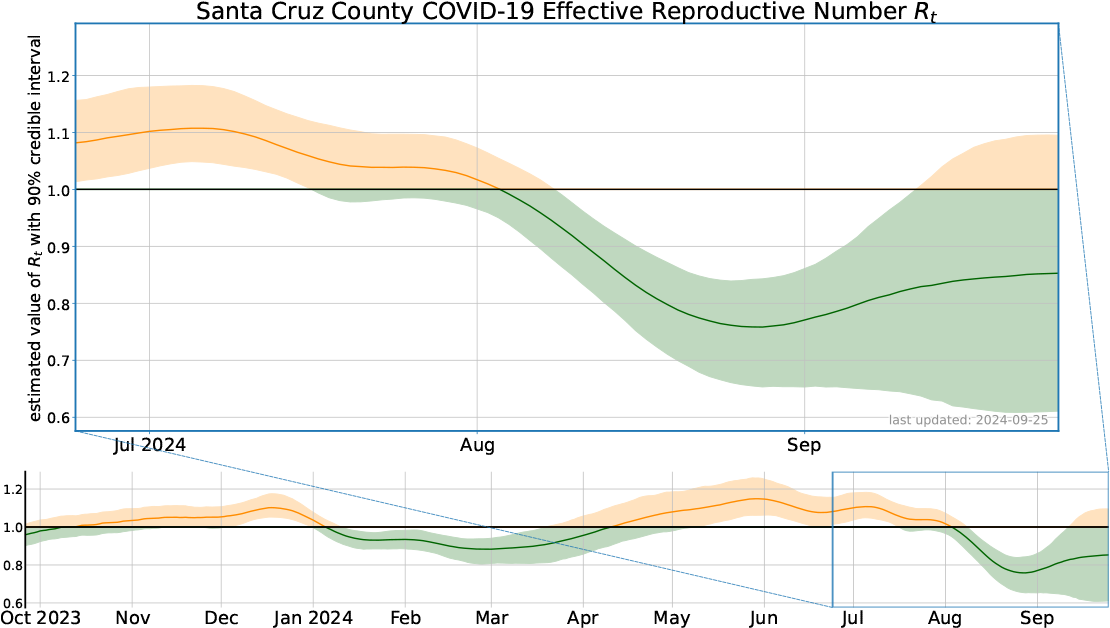
The California Department of Public Health and Santa Cruz County Health Department regularly release data on the current status of Covid-19 in the county as well as information on influenza, Respiratory Syncytial Virus (RSV), and Mpox. Since cases of Covid are still appearing, and there are still vulnerable people, I will continue reporting the graphs below.
The three graphs below were updated on Sept. 25.
The first graph is the Effective Reproductive Number. When the line rises above one, it shows that the spread of the virus is increasing. Below one means the spread is decreasing.
The second graph below shows data that the Health Department collects for Covid from wastewater at the City Influent, for the city of Santa Cruz, and from the Lode Street pump stations for the county.
The third graph below shows hospitalizations.
| |
|
Photo TARMO HANNULA
Fashion Street - A watermelon escaped from someone's shopping cart and ended its seedy life in the gutter.
| |
|
Labor History Calendar - Sept. 27- Oct. 3, 2024
a.k.a Know Our History Lest We Forget
Sept. 27, 1875: Striking textile workers demand bread for starving children in Fall River, Massachusetts.
Sept. 27, 1933: IWW strikes Murray Body plant in Highland Park, Michigan.
Sept. 28. 1864: International Workingmen’s Association founded in London.
Sept. 28, 1917: 166 IWWs indicted on charge of interfering with war effort.
Sept. 28, 1995: 329 Liverpool dockers fired for honoring picket line.
Sept. 29, 1883: English publication Johann Most’s “Hymn of the Proletariat”
Sept. 29, 1931: RCMP fire into coal miners’ parade killing 3 in Bienfait, Sask.
Sept. 29, 2007: Tens of thousands of textile workers start illegal strike in Ghazl el-Mahalla, Egypt, and win demands.
Sept. 30, 1911: national strike of more than 40,000 railway shopmen inspire Joe Hill’s song, “Casey Jones – The Union Scab.”
Oct. 1, LA Times building blown up; McNamara arrested.
Oct. 1, 1949: 500,000 steel workers’ strike.
Oct. 1, 1997: Pickets in solidarity with striking Liverpool dockers turn back Neptune Jade, a scab-loaded ship from Oakland’s port.
Oct. 2, 1889: London tailors win shorter hours.
Oct. 2, 1968: Massacre in Tlatelolco in Mexico City with 500 killed by Mexican troops.
Oct. 3, 1909: Elisabeth Gurley Flynn arrested in Missoula, Montana in free-speech fight.
Oct. 3, 1945: Seven-state Greyhound bus strike begins.
Labor History Calendar has been published yearly by the Hungarian Literature Fund since 1985.
| |
|
"There is a price to pay for speaking the truth. There is a bigger price for living a lie."
Cornell West
| |
 | |
Photo by TARMO HANNULA
Pasta with Caramelized Oranges
By SARAH RINGLER
Watsonville Library has fantastic cookbooks; one is “Pasta Modern” by Francine Segan. Especially if you like pasta and Italian food, this book goes all out. The recipes contain kinds of pasta I have never heard of. Luckily, Segan offers alternative suggestions.
This particular recipe calls for orecchiette, a pasta that translates as “little ear.” I found it at Safeway. As the pasta was finally stirred into the sauce, the little bits of cooked pancetta hid in the ears of the pasta, making each bite rich with flavor. The sweet and fragrant orange sauce coats the pasta almost making this a dessert. That’s why I added thinly cut strips of fresh kale to make this more like a dinner. It was not in the original recipe.
Cooking Italian is like cooking Chinese food and since Italians got pasta from the Chinese it makes sense. You have to prepare all the ingredients before you start cooking. Once the frying pan heats up, things go fast. Which is why I usually don’t cook like this for friends. I like to plan a meal where everything is so I can enjoy their company when they arrive. It’s also why it would never work for me to be in one of those competitive cooking shows that are so popular on TV.
Pecorino is an aged cheese made out of sheep’s milk. Recently, I have only found it at Shopper's Corner. It is similar to Parmesan and asiago in that it is a hard cheese that is usually grated or shaved, and sprinkled over a dish. You could substitute either of the two cheeses formerly mentioned. The differences in flavor are subtle.
Pasta all’arancia
3-4 ounces pancetta or bacon
olive oil
2 medium leeks
1 cup orange juice, fresh squeezed if possible
1 orange rind worth of zest
1 tablespoon sugar
1/2 pound orecchiette or other short pasta
Salt and freshly ground pepper
1 cup thinly sliced kale, optional
Pecorino romano cheese or asiago, grated
In a large frying pan that will later hold a pound of the cooked pasta, cook the pancetta in 3 tablespoons of olive oil over medium high heat until it is crispy.
Put a large pot of salted water on the stove and turn on the heat.
Cut the roots and the dark green tops off the leeks. Slice the cylinder lengthwise and then into thin slices. Submerge in water to get out any dirt and then drain. You should have about 1½ cups.
Add the leeks to the pancetta and cook until tender in about 5 minutes. Add ½ cup of the orange juice and turn up the heat. Cook until the sauce is syrupy. Then add the sugar and the rest of the juice a few tablespoons at a time, keeping the sauce thick. It should stick to the back of the wooden spoon.
The pasta water should be hot now. Bring to a boil and cook the pasta in salted water a minute less than the package directions. Drain. Toss into the pan with the sauce and cook over high heat until pasta is just done and covered in a thick glaze. Add the thinly sliced kale and cook a little more to soften the kale. Season with salt. Top with the zest, freshly ground pepper and some cheese. Serves about four.
| |
|
Send your story, poetry or art: Please submit a story, poem or photo of your art that you think would be of interest to the people of Santa Cruz County. Try and keep the word count to around 400. Also, there should be suggested actions if this is a political issue. Submit to
coluyaki@gmail.com
Send comments to coluyaki@gmail.com
If you are enjoying the Serf City Times, forward it on to others.
Subscribe, contact or find back issues at the website https://serf-city-times.constantcontactsites.com
Thanks, Sarah Ringler
| | | | |