An alert from the US Section of the Women's International League for Peace and Freedom | | |
Dear WILPF US members,
I hope you are surrounded by supportive community, and if you need more community to lift you, may you find it here at WILPF. If you need something, reach out to your branch, fellow WILPF members, or to me directly. WILPF women have been resisting for 111 years. We are each other’s greatest resource.
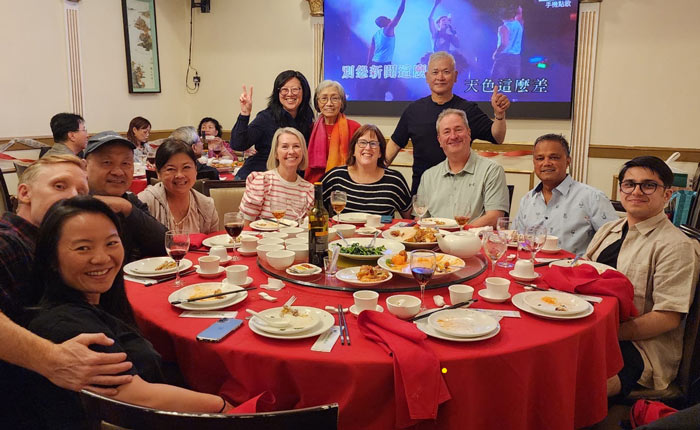
Last week, I celebrated my stepdad’s 70th birthday with a joyful Chinese feast and karaoke gathering (that’s my mom standing to the right of me in the picture above, and my stepdad to the right of her). It reminded me of my family’s immigrant journey, how far we’ve come, and how heartbreakingly backwards the world is moving. My stepdad, a refugee from Vietnam, was sheltered by the International Red Cross, welcomed by a faith community, and supported by government policies that enabled him to build a new life and contribute to his community. Today, I wonder: if he were fleeing danger now, would he make it here? Would he thrive? Amidst the white nationalist rhetoric enabling the authoritarianism we are resisting, the answer is likely “no.” It is the same system enabling war in the name of peace. Yet we know different. Peace is not war.
I continue to be uplifted by the many ways WILPF members are mobilizing for peace. Beyond protesting and writing and calling campaigns, members from our New York and New Jersey branches are organizing an artivism pop-up on peace. Some yogis in WILPF are discussing a Yoga for Peace event. Young WILPF members are developing a Megaphone Awards project to uplift local peacebuilders. Members of our Cuba and Bolivarian Alliance issue committee advised Congresswoman Pramila Jayapal on her Cuba solidarity mission. And our Disarm/End Wars issue committee is expanding Hiroshima and Nagasaki commemorations to renew the call for no nuclear bombs ever again.
How are you mobilizing in your community? With friends, WILPF, or other groups? Please write to me at lindalow@wilpfus.org and share your stories. I want to hear how you are creating change, in both small and big ways, so we can inspire others and perhaps even help scale your work. It will take all of us, and all the creative ways we are meeting this moment, to turn the tides.
Finally, please save June 7 for the second edition of WILPF’s School of Peace and Freedom. The topic: Authoritarianism and Antidotes. Speakers include WILPF’s Cindy Domingo on lessons from the Philippines, freedom advocate Chenai Kadungure on Zimbabwe, and Kate Bitz from the Western States Center on countering white nationalism in the US. Together, we’ll explore lessons and strategies for resisting authoritarianism in our communities. Register here.
| | Nuclear bombs never again | | |
“I am an advocate of non-proliferation. Yet in some part of my mind, I took solace in believing the US would never use nuclear weapons again. That illusion has been punctured.” Lisa Graves, an expert on far-right influence on the US Supreme Court, spoke these words at WILPF US’s Women, Peace & Democracy event last month, against the backdrop of the US war on Iran. That same week, members of WILPF’s Disarm/End Wars committee mobilized at the UN Review Conference on the Non-Proliferation Treaty (NPT).
The NPT, which entered into force in 1970, remains the cornerstone of global nuclear non-proliferation efforts. Under the treaty, countries without nuclear weapons agree not to acquire them, while nuclear-weapon states commit to eventual disarmament. Five countries are formally recognized as nuclear-weapon states under the treaty: the US, Russia, China, the United Kingdom, and France. Four UN member states have never signed the treaty: India, Pakistan, Israel, and South Sudan. Yet while the NPT has helped limit proliferation, nuclear-armed states continue modernizing their arsenals rather than dismantling them. WILPF’s global think tank, Reaching Critical Will, continues to advocate for meaningful disarmament and public action.
At the conference, WILPF’s Global Disarmament Working Group urged governments to recommit to the treaty’s promises and “deliver a world without nuclear weapons to future generations.” Thank you, Cherrill Spencer, our Disarm/End Wars co-chair at WILPF US, for your bold leadership in personally placing this statement in the hands of diplomats and decisionmakers, including US delegates representing the Department of Defense and other agencies. View the WILPF working group’s full NPT statement here.
According to the Union of Concerned Scientists, the US possesses approximately 5,400 nuclear weapons, many capable of launching within minutes. Some deployed weapons are more than 80 times stronger than the bomb dropped on Hiroshima. Thank you to all WILPF US advocates who participated in the UN review conference this year, including Helen Young, Eileen Kurkoski, Sally Brown, Julie Leak, and Cherrill Spencer. We look forward to learning from you on the outcomes of the conference and how we can mobilize toward a world where no nuclear bomb is ever used again.
| | Advancing social justice, stopping war with Boston WILPF | | |
Last month, in my role as a Rotary Peace Fellow, Rotary invited me to facilitate community dialogues on polarization and war. I opened each dialogue with the question: “Tell us about a time when you or someone you know was impacted by war.” The stories were powerful. One person spoke about a brother who returned from war forever changed, impacting their entire family. Another shared their experience fleeing conflict and rebuilding life as a refugee. Someone else reflected on how war now feels ever-present, from global headlines to military presence on local streets.
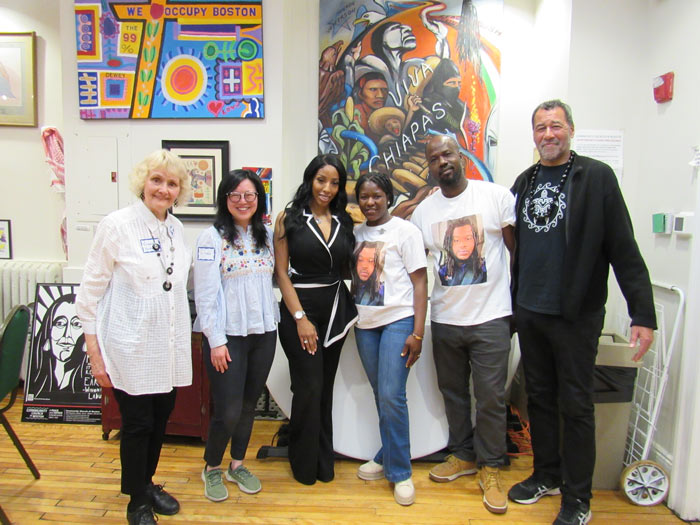
During a stop in Boston, I partnered with WILPF Boston to host a public panel on advancing social justice. Panelists included AFSC’s Healing Justice Program Director King Downing, Wellesley College student and union advocate Peyton Durkee, and Boston Climate Action Network board member Loie Hayes. Nickenley Turenne’s family also joined us to share their lived experience of violence here at home. In December 2025, Nickenley, a young unarmed Black man, was shot and killed by police in Manchester, New Hampshire. His family continues to seek answers and accountability. Their story reminded us that when justice is absent, the consequences can be devastating. We stand with them in calling for justice. Pictured above in community are: WILPF’s Eileen Kurkoski, me, AFSC’s Ophelia Burnett, Nickenley’s parents Wilda and Enick Turenne, and AFSC’s King Downing.
That same day, I spoke at Northeastern University during Professor and WILPF member Val Moghadam’s Women and Political History class. I shared WILPF’s history, our organizing today, and my own journey as a peacebuilder, advocate, and activist with WILPF. Students spoke openly about war’s impact on their families in Lebanon and Palestine and asked how they could move beyond protest into sustained action. I invited them to mobilize with WILPF.
| |
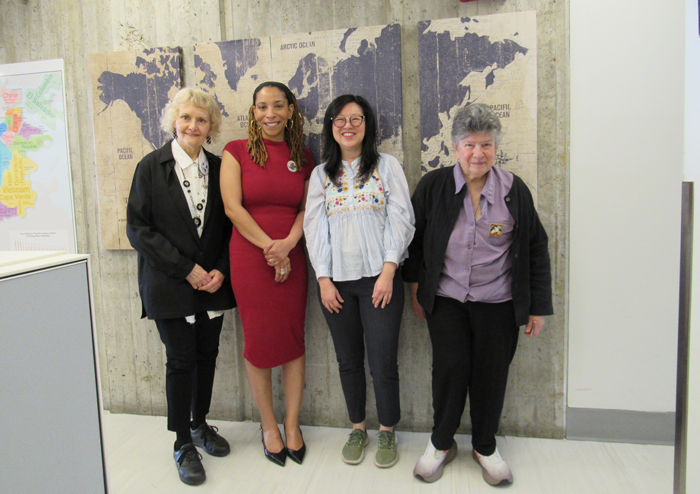
WILPFers Ellen Mass, Eileen Kurkoski, and I also met with Dana Alas, Executive Director of Women’s Advancement at the City of Boston (pictured above), to advocate for a plaque commemorating 6 Byron Street, the site where Emily Greene Balch—WILPF’s first International Secretary-Treasurer—worked. Emily consistently opposed war, warned against fascism, and later won the Nobel Peace Prize, despite being viewed by the US government as a dangerous radical in her time. We also advocated for a public statue honoring her legacy and the importance of preserving women’s contributions to social justice history.
A special highlight was touring the original Balch family home with local WILPF members. Deep thanks to WILPF Boston branch members Ellen Mass, Eileen Kurkoski, Virginia Pratt, Val Moghadam, Ginger Harris, and Mark Harris for their outreach, organizing, and community engagement that made our time together so meaningful.
| | Crafting justice for Gaza | | |
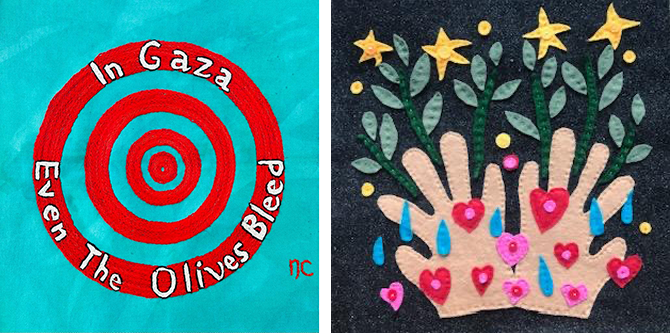
While Palestine has seemingly disappeared from headlines, WILPF women remember that the genocide continues in Gaza. More than 150 people have signed up to participate in WILPF US’s Crafting Justice Memorial Quilt for Gaza, being assembled in partnership with City of Asylum Detroit and Gazan artist Taimaa Salama. As tiles have poured in, we have been overwhelmed by the beauty, intention and love that has gone into these tiles.
I’m honored to provide a sneak peek of a couple of the quilt tiles, each their own work of art. Pictured above on the left is a tile created by Niamh Cunningham in Carlow, Ireland. On the right is a tile created by WILPF member Kerry Livingston and her co-workers in Inverness, California. Craftivist influencers are mobilizing with us too, such as Leslie Tyger who posted an Instagram video about Crafting Justice which garnered more than 350 interactions from people who had never engaged with WILPF before. A number of WILPFers asked for an extension to the deadline so you still have time to participate! Create a tile in your spare time or convene friends and create them together. Register here (we’ll send you instructions upon registration) and mail your tile by May 30.
Separately, late last month, the civilian led Global Sumud Flotilla of more than 50 vessels departed Italy to Israel to break the siege on Gaza. A few days after the flotilla set sail, Ukrainian peace activist Nina Potarska, former WILPF Ukraine Consultant, was among hundreds of civilians aboard the flotilla intercepted by Israeli forces in international waters, hundreds of miles from Gaza and Palestine. Nina is not alone. She is one of more than 400 activists, human rights defenders, and civilians from across the world, all on a nonviolent humanitarian mission to deliver aid to Gaza, in the face of intimidation, detention, and violence at sea. The flotilla perseveres. Last week, organizers announced that 30 vessels were sailing from Greece towards Turkey. Follow the flotilla with this online tracker.
| | Water for peace in Durham | | |
I also traveled to Durham last month in my role as a Rotary Peace Fellow. While I was in Durham, I spoke on a panel at the WILPF Triangle Water for Peace event. Local activists spoke about their opposition to data centers in the region (a large data center can use millions of gallons of water per day). I iterated that water justice is not only about access—it is a human right tied to peace, equity, and shared power. Yet women often carry the burden of water insecurity and war without equal representation in decision-making. Research from Planet Women shows that greater representation of women strengthens environmental policy outcomes. On water for peace, the path forward is clear: protect water, center women in leadership, and build systems rooted in care and justice. Because peace is not possible without water. And lasting peace is not possible without women leading the way.
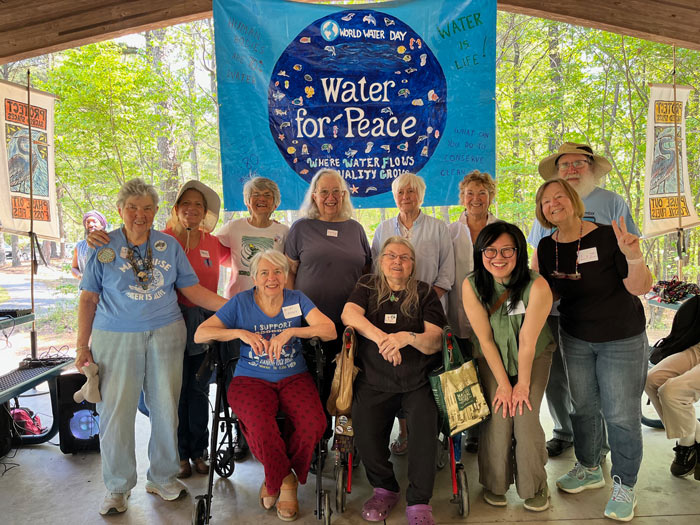
On a separate but related note, WILPF Triangle branch has been mobilizing for more than 90 years! Thank you for leading the way. Pictured above in back are WILPF Triangle members Lib Hutchby, Steevie Parks, Libby Johnson, Lucy Lewis, Mary Jenne, Tana Hartman, John Wagner and in front Vicki Ryder, Liz Evans and Liz Wildermann. Your lifelong commitment to peacebuilding is inspiring. Read more about WILPF Triangle’s Water for Peace event, and my panel remarks, here.
I was also invited to speak about WILPF at Education Hour at St. Phillips Church established in 1880. This faith community is known for its diversity and deep commitment to social justice throughout history. I admit I felt intimidated walking into that room. What could I possibly share that these social justice warriors – who have been rallying long before me – haven’t already heard? In fact, they enjoyed learning about WILPF’s history, and equally, how we’re creating new ways plus continuing tried-and-true ways of mobilizing. So that we can welcome new people into the activism space and provide connection and community in these chaotic times.
That same weekend, I co-hosted a WILPF “friend-raiser” in Durham with a community leader in her home. We introduced WILPF to 20 people comprised of local activists, folks who had never engaged with WILPF before, and cross-generational women and men wanting to do more in this moment. The topics that this eclectic group tackled were diverse including deep concern that women’s rights are in decline, the importance of feminist allies in response to the rising manosphere, and acknowledgement that activism – because of the very nature of the work – is not likely the vehicle that will bridge political divides but can move people toward action for justice. By the end of the evening, WILPF had gained new friends, a couple new members, and commitments to stay connected and lift each other’s work.
| | Young WILPF US: Peace work is real work | | |
It’s that time of year when young people across the country are celebrating one of life’s biggest milestones: graduation! A time of reflection and dreams for the future. Yet in these times we’re in, young people are facing a world that can feel overwhelming and finding the job market especially challenging right now, with increasing numbers having to rethink or transition their career paths.
I was invited to dialogue with Young WILPF members for an unfiltered conversation about working in social justice. I shared my journey – from the corporate sector to transitioning to humanitarian work with the Red Cross to peacebuilding as a Rotary Peace Fellow. And being pulled to activism with WILPF, which has pushed me out of my comfort zone and empowered me to take bolder and braver action in these challenging times. My key message to Young WILPF US was this: Trust your instincts. You are your best advocate, and you are braver and smarter than you probably give yourself credit for.
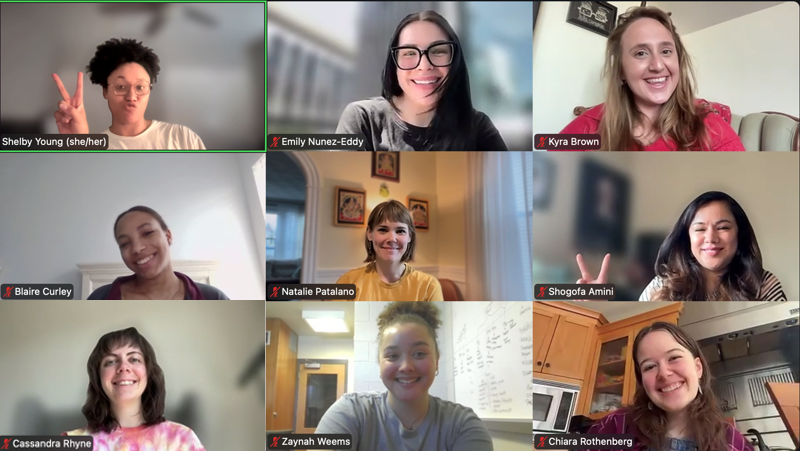
It was an honor to share the Zoom microphone with my friend and Young WILPF US member Shogofa Amini, a human rights advocate when she was living in Afghanistan who now deploys her advocacy skills to support vulnerable children and families, many of them immigrants, as a Case Manager at a hospital. Shogofa spoke about her belief in creating a world where everyone has dignity and every voice has the power to create change. Emily Nunez-Eddy, Programs Designs Manager at Instituto, spoke about how she works to build sustained political power and capacity in low-income communities through electoral and advocacy campaigns, and coalition and capacity building.
Reflecting on the dialogue after, Young WILPF US member, Natalie Patalano, said: “I valued how the speakers stated that it’s okay to say what you don’t know, to lean on others for their expertise, and that the journey to social justice work doesn’t have to be linear. Pivoting, meandering, and reinventing ourselves is a good thing.”
Indeed, we all took very different paths to the peace work we’re doing today. Yet we all agreed that peace work is real work, and the importance of valuing this work. That people need to get paid for the work, so they can sustain themselves to help sustain others. Participants agreed to continue to check in with each other, share networks, and continue the dialogue in a future meet-up.
| | Please give to WILPF’s Spring Appeal – for Women, Peace & Democracy | | |
WILPF US can speak out when others cannot because our member-led organization does not receive funds from corporations or government agencies. We must keep the momentum and outreach going now, for the next three years of this Administration, and beyond. This year, WILPF US aims to raise $250,000 to keep the lights on and scale up our collective action. Please donate if you can.
To kick off our fundraising appeal, we hosted a powerful event to reflect on the state of our democracy, peace and war – topics WILPF women state as being top of mind, all the time. Our Women, Peace & Democracy event featured insights from author Lisa Graves who spoke about the impacts of right wing-influence on the US Supreme Court and our democracy. Lisa reminded us that in our nation’s history, Administrations that polled at 30% approval ratings experienced major shifts. With this, she issued a clarion call for all of us to get out the vote for the coming midterms, everywhere, because every vote will matter.
WILPF’s second-generation anti-war movement leader Laura Dewey provided analogies between the Vietnam War and recent wars the US is waging. She shared this advice: “Build relationships with each other, talk to your neighbors, your coworkers…and connect the pro-peace movement with people's struggles at home. That means talking about money, like moving money from the Pentagon to support community needs.” Comedian Robyn Scott closed the event with a special improv moment that had us all laughing out loud. And she reminded us that Jane Addam’s Hull House is the birthplace of modern improv. Legacies by WILPF women are literally everywhere.
View the event recording here for a special combination of serious learning and heartfelt laughter. And if you can, please donate to our Spring Appeal. Or mail a check to WILPF US, P.O. Box 13075, Des Moines IA 50310. A one-time donation will give us a much-needed financial boost. A recurring donation will sustain our work for the long-term. We can’t do this without you! Thank you for all that you continue to do.
| |
WILPF network news
🗓️ View Congresswoman Pramila Jayapal’s Cuba briefing last week, introduced by WILPF US member Cindy Domingo, about the humanitarian crisis unfolding in Cuba.
🗓️ WILPF US’s next School of Peace and Freedom is June 7th at 1 PT / 4 ET. Topic: Authoritarianism and Antidotes. Register here.
🗓️WILPF US’s Peace is / Peace is Not campaign graphics to support your protests, tabling, and social media efforts are available to you anytime. Access them here.
| | Wise words from WILPF members and allies | | |
I believe in the wisdom of the crowd, so I continue to seek insights and inspiration from WILPF US members, allies, and feminist leaders. Here are some of the wise words I’ve recently heard.
"What is not named doesn't exist. It’s necessary to capture women’s testimonies in war. To give voice to survivors is a form of justice."
– Monica Rojas, author and advocate for women and children in war
“I will hold this experience in my memory as a source of courage.”
– Mark Harris, after participating in WILPF’s social justice event in Boston
“You change the world when you change your mind.”
– Cindy Lauper
Take care of yourselves, fearless WILPF women and WILPF allies, and let’s continue to take care of each other.
Linda Low
WILPF US Executive Director
| | | | |