Changes to the Federal Statistical System: Monthly Update
| | |
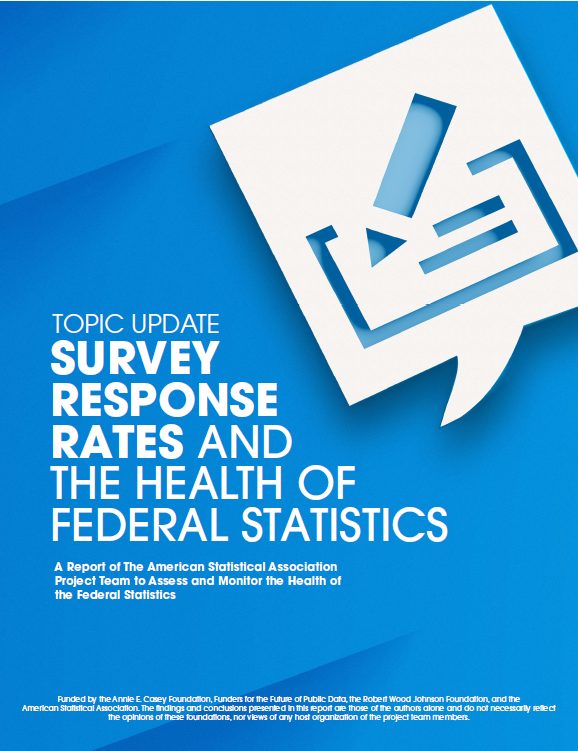
New Report: Survey Response Rates and the Health of Federal Statistics
Mid-Year Update Release: Today, we are releasing a report that examines how response rates have changed across federal statistical agencies and what the trends could mean for the future accuracy of the nation's statistics. We document how household survey response rates generally declined more quickly from 2013 to 2023 than previously and how establishment surveys are also declining. The update pairs the analysis with an online spreadsheet of response rates and an appendix of response-rate graphs and tables for 42 surveys at 10 statistical agencies, grouped by agency and labeled as household or establishment surveys. The new document also includes discussions on the role of surveys in federal statistics, factors in survey nonresponse, the relationship of response rates to quality, and statistical agency strategies to mitigate nonresponse.
| |
| |  | Census Community Expresses Strong Concern for Impacts of Proposed Rule on Quality, Timeliness, Utility of 2030 Census Data: The US Census Bureau’s September 10 proposed rule drew nearly 150,000 public comments from state, local, and tribal governments, members of Congress, associations, and individuals. An analysis by Hands Off Our Census found that 89% of these comments oppose the rule. Commenters raised three main concerns. First, the rule would abandon the constitutional requirement to count the “whole number of persons in each State” for apportionment and count only citizens and green card holders instead. Second, dropping the race and ethnicity questions would mean losing data that census users rely on. Third, the changes would likely make the undercount worse, especially in rural areas and among households of color, and would put the quality, timeliness, and usefulness of census data at risk. The Census Bureau will now review the comments, prepare its responses, and send a final rule to the Office of Management and Budget for review. Its decisions are not expected until early 2027 at the earliest.
|
| | | Continued Concern for Agricultural Statistics: The National Agricultural Statistics Service reported in October 23 a "processing error that affected September corn plant populations, ear counts, yields, and production for Kansas and Nebraska... [and] the September 10-state averages for plant populations and ear counts, along with U.S. corn yield and production forecasts." An additional notice quantified the September production corrections and added, "Moving forward, we will implement additional pre-publication checks to verify acreage weights and validate objective yield calculations [and] are evaluating further improvements to strengthen our quality-control procedures." Separately, for a nonrepresentative October survey of 1,199 farmers, "73% rated their confidence in USDA crop data a 1 or 2 on a five-point scale, and just 4% gave it a 4 or 5." In contrast, "A matching 73% rated their local [Farm Service Agency] office a 4 or 5" on a similar scale. The article also shared, "Of 888 who described events that broke their trust [in the data], 27% cited late revisions and corrections and 26% cited market swings and timing."
| |
New Data Document Staff Loss for 2026: The Office of Personnel Management posted its final staffing numbers of fiscal year 2026, including full-time and part-time positions for five statistical agencies. The staffing levels for the Bureau of Economic Analysis, Bureau of Labor Statistics, Economic Research Service, and National Agricultural Statistics Service all declined 6% to 9% since the first OPM numbers were shared in January 2026. The decline for the US Census Bureau was less (3%), with the addition of 330 staff since June 2026, bringing its level to 10,935 as of September 30, 2026. (We could not determine how many of the Census Bureau employees were engaged in field interviewing and decennial testing and how many were full-time employees at headquarters.) Separately, the National Center for Education Statistics made three more hires over the last month, bringing its staff size to 15—still far short of its pre-2025 level of approximately 100.
| | | | |