November 2, 2026

canoe-stream.jpg

A Bucket Plan To Go With Your Bucket List


A bucket plan can help you be better prepared for a comfortable retirement.


Read More

The Markets

The bill eventually comes due.


Credit is a powerful tool. It lets families borrow to buy homes, pay for education, and afford medical care. It lets businesses expand operations, develop new products, and purchase inventory and equipment. No matter the reason for the loan, all borrowers have something in common: the money must be repaid whether the investment delivers a return or not.


Some of the biggest borrowers today are technology companies racing to build artificial intelligence (AI) infrastructure. Investors have been concerned about the scale and sustainability of this spending. Last week, earnings reports from several leading tech companies disappointed investors, and stocks in related sectors fell, reported Blake Montgomery of The Guardian. Investors were weighing:


  • AI Spending. One leading tech firm “disclosed that its free cash flow was negative $42.4 billion for the 12 months to the end of September. That’s a huge reversal from the $14.8 billion in cash it generated in the same period a year earlier,” reported Adam Clark of Barron’s.


  • AI Borrowing. Companies that deliver computing power designed to support big AI firms also have come under pressure. “These businesses live on debt. Of the ten listed…only two are profitable,” reported The Economist. These companies have borrowed $100 billion, which is about nine times their combined annual revenues.


For some, the AI boom echoes the infrastructure build-out of the 1990s.


During the dot-com era, telecommunications companies borrowed and spent billions of dollars on infrastructure to support the rapid growth of the internet. However, expectations that internet traffic would double every 90 days were never realized, reported Johnny Rice via Yahoo! Finance. When the tech bubble burst, the industry had 10 times the capacity it needed. The end result was several high-profile bankruptcies.


Whether today’s AI build-out follows a similar path remains to be seen.


A source cited by Clark saw last week’s sell-off as a healthy pause to reassess rather than a warning sign. “Investors took a moment to examine whether the recent pace of tech valuations still made sense, given all of the spending on AI development that is hitting cash flows…This is not the first tech and AI correction, and it won’t be the last. We are still in the very early stages of AI development, and pullbacks are par for the course.”


Last week, the Bureau of Economic Analysis reported that the U.S. economy grew at the fastest pace in 12 months during the third quarter of 2026. Business investment and consumer spending were the growth primary drivers. Major U.S. stock indexes finished the week down, and U.S. Treasury yields declined across most maturities during the week.

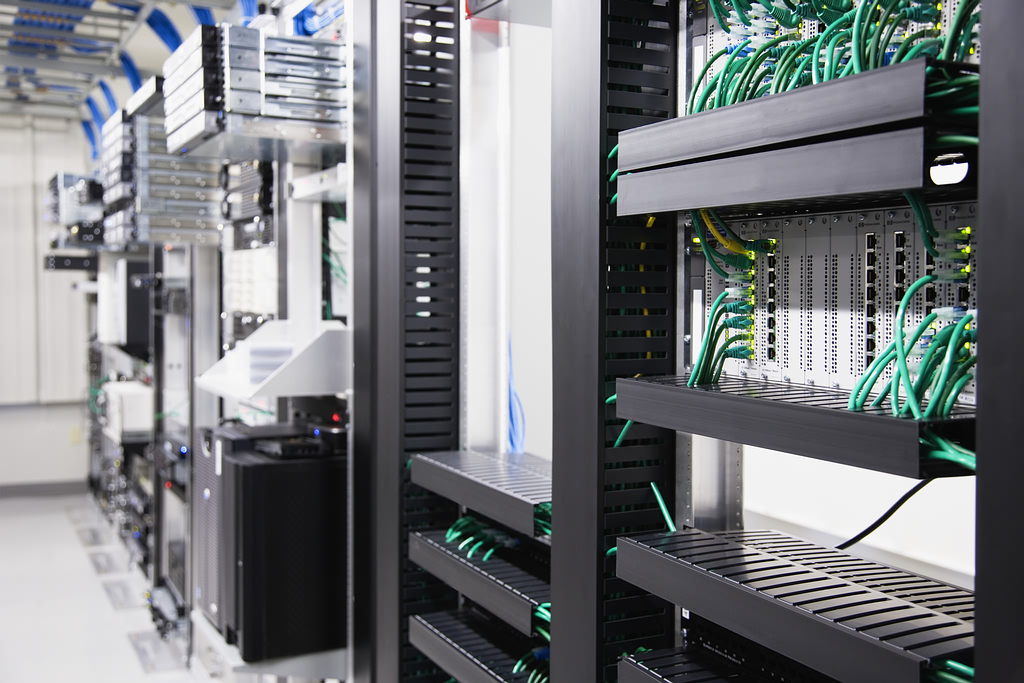
computer_server.jpg

There's A New Noun In Town: Compute


In September, the Merriam-Webster Dictionary added a new meaning to an old word. Thanks to the AI boom, “compute” is now a noun as well as a verb. It is defined as “the computational resources (such as memory and processing power) required for a computer or computer program to function.”


Compute is what fuels the artificial intelligence (AI) race.


That race is “transforming technology companies from asset-light businesses into more capital-intensive operators,” reported Moody’s Ratings. The firm estimates the largest technology companies will spend close to $1 trillion on AI expansion in 2027.


Recently, the U.S. State Department’s Pax Silica Declaration, which is its initiative addressing AI and supply chain security, stated that “compute and the minerals that feed it” are the oil and steel of the current century.


Take a look at the compute supply chain.


Like oil being refined into gasoline, compute goes through various companies before it reaches the end user. The process typically requires enormous amounts of energy. Here’s how it works:


“In the most simple form, chipmakers…sell advanced ai semiconductors to equipment manufacturers…which package the silicon into racks and servers to sell to data-center operators. Besides the hyperscalers, these include a few large “neoclouds”…and hundreds of smaller, less well-known firms. The operators, in turn, rent out access to compute to customers for a fixed period, often several years. Customers range from the hyperscalers (which supplement their in-house compute with rentals) to startups running open-source AI models,” explained The Economist.


The language of AI is growing.


As with many new endeavors, new vocabulary terms are being minted to describe AI. The Economist’s explanation included two.


  • Hyperscalers are large technology companies that operate enormous networks of data centers and can rapidly expand computing, storage, and cloud services to meet customers’ demand. “You also lean on them dozens of times a day without noticing, every time you stream a show, tap a card at checkout, back up a photo or ask a chatbot a question,” reported Robert J. Szczerba in Forbes.


  • Neoclouds are a more specialized type of company. While hyperscalers offer general-purpose services like databases, web hosting, and email storage, neoclouds are built to support the massive demands of generative AI and large language model training. They offer raw compute at a competitive price.


Compute may be a new noun, but it’s quickly becoming a valued commodity in the global economy. Knowing who makes it, packages it, and rents it can help investors better understand the AI race.

thinking_girl_idea.jpg

Weekly Focus - Think About It


“Politicians are like bad horsemen who are so preoccupied with staying in the saddle that they can’t bother about where they’re going.”

— Joseph Alois Schumpeter, Political economist

Bruce Kuehl | 763.542.8884 | bruce.kuehl@avior.com

Investment management and financial planning services offered through Avior Wealth Management, LLC a registered investment advisor. Investments involve varying degrees of risk and there can be no assurance that the future performance of any investment or investment strategy will be profitable or equal past performance results. All investments subject to loss including the loss of principle. Nothing contained herein should be construed as tax advice. Specific, individual tax questions should be asked of your CPA or accountant.


Please remember to contact Avior, In writing, if there are any changes in your personal/financial situation or investment objectives for the purpose of reviewing/evaluating/revising our previous recommendations and/or services, or if you want to impose, add, or modify any reasonable restrictions to our investment advisory services. Unless, and until, you notify us, in writing, to the contrary, we shall continue to provide services as we do currently. Please advise us if you have not been receiving account statements (at least quarterly) from the account custodian. A copy of our current written disclosure Brochure and Form CRS (Customer Relationship Summary) discussing our advisory services and fees continues to remain available upon request or at www.aviorwealthmn.com.