Wave Buoy Outreach in the Federated States of Micronesia |
|
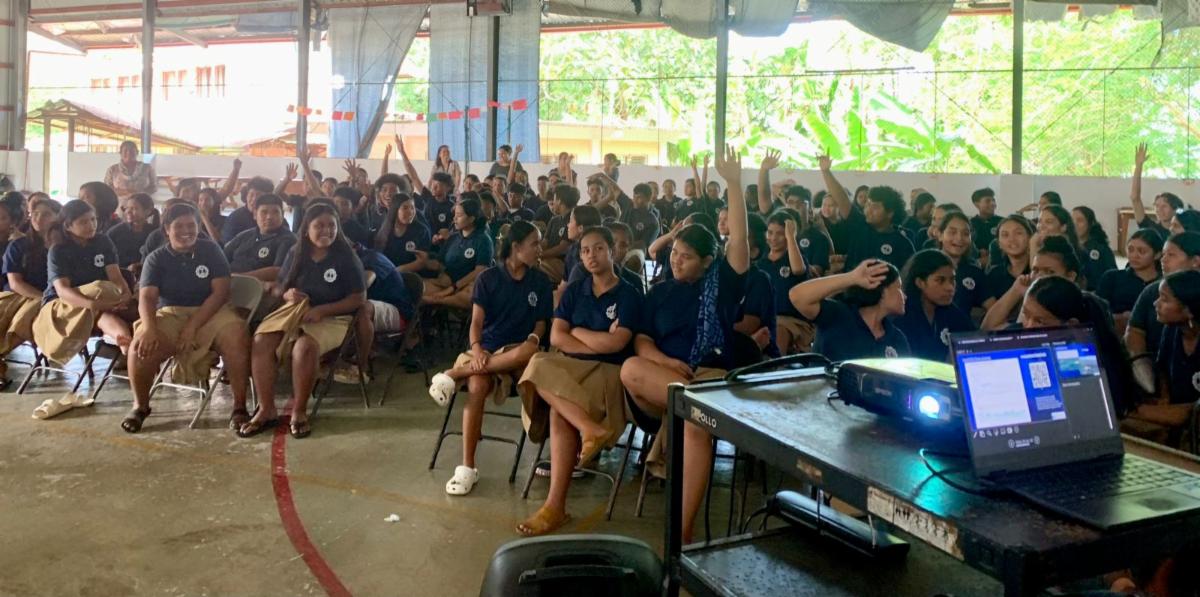
PacIOOS wave buoy team members Andreia Queima and Sarah Shows conducted outreach activities in Pohnpei and Kosrae to create awareness about proposed wave buoy deployments in the Federated States of Micronesia (FSM). In Kosrae, they met with partners from the Division of Fisheries and Marine Resources, Bruno Ned and Zackilyn George, and Disaster Coordination Officer Nena William. Zackilyn George helped organize meetings with the governor’s office and village mayors to discuss and gain support for the proposed deployments. Andreia also presented the wave buoy project at the Kosrae High School and recorded a radio segment explaining the benefits of the wave buoy to the local community. In Pohnpei, the PacIOOS team met with Jasmine Mendiola, who coordinated a presentation at Our Lady of Mercy Catholic High School, where the students showed substantial interest in the buoys and ocean observing. Jasmine is also coordinating with the local radio station and helping with social marketing. Andreia met with partners from the Conservation Society of Pohnpei (CSP), The Pacific Community (SPC) and Office of Fisheries (OFA). Andreia, Eugene Joseph (CSP), Clay Hedson and JB Paulino (OFA) participated in the Koupwelki Kitti group community meeting, where they discussed social dynamics with community members and got valuable input from fishers. [Photo: Wave Buoy Presentation at Our Lady of Mercy Catholic High School, Pohnpei. Credit: Jasmine Mendiola]
|
|
Palau Green Climate Fund Project |
|
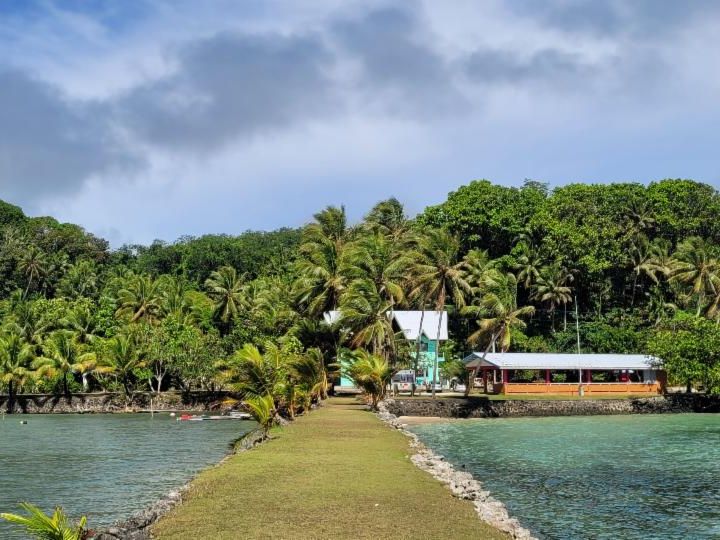
With funding from the Green Climate Fund, PacIOOS is developing a suite of models to enhance climate resilience in Palau. These include forecast models for weather, ocean ecosystems, waves, and wave run-up. During February, PacIOOS staff participated in the Sector-based Climate Services and Coordination workshop Palau, and met with local liaisons to better understand on-the-ground climate impacts. In order to provide wave run-up and inundation models that are tailored to the needs of Palau's coastal communities, PacIOOS staff visited several sites along the east and west coasts of Babeldaob Island, as well as sites on Koror, Malakal, and Meyungs islands. The input gathered during the site visits is being used to generate a wave run-up model that is catered to communities that are the most impacted by wave driven flooding during storms or high tide events. [Photo: Melekeok, Babeldaob Island]
|
|
Mariana Islands Nature Alliance's Community Recycles Plastics Program |
|
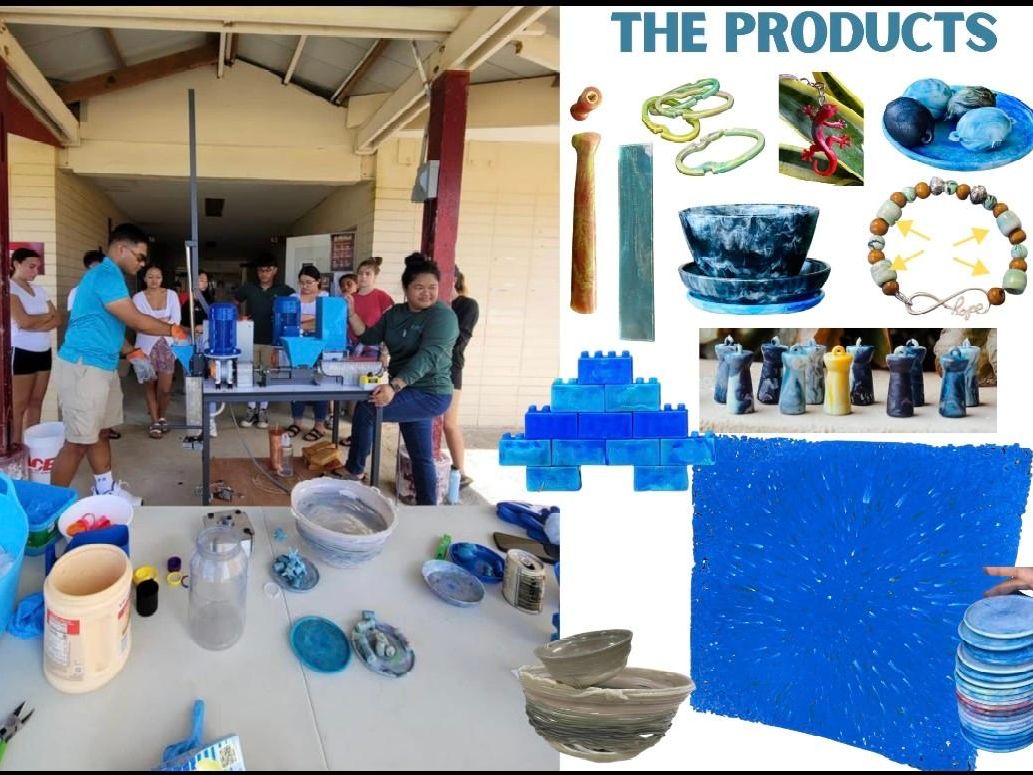
Located in the Commonwealth of the Northern Mariana Islands (CNMI), the Mariana Islands Nature Alliance (MINA) piloted the Community Recycles Plastics (CRP) program in April 2023. The CRP is a recycling initiative to introduce a circular economy mindset into CNMI communities. School partners and organizations host plastic collection bins and 3-in-1 upcycling machines that turn recyclable plastics into usable products. The 3-in-1 machines have 3 parts; a shredder, an extrusion, and an injection component. Plastics are collected, sorted, cleaned, and turned into products such as bowls, coasters, cutlery handles, fishing floaters, latte stones, rulers, gecko pendants, beads, and carabiners. The extrusion component melts shredded plastics into a malleable noodle-like material that is shaped into flower pots and decorative bowls.
Saipan International School (SIS), a CRP-partnered organization, sells the upcycled products at local shops and proceeds fund student programs and events. Dandan Middle School (DMS) and the Northern Marianas College (NMC) both use the 3-in-1 machine in their extra-curricular activities. DMS also has a spooler/shredder machine for recycling plastics into filament for 3-D printers. The Northern Marianas Trades Institute (NMTech) creates materials for their carpentry course such as timber molds for picnic tables and benches and plastic sheets for table tops, wall coverings, and additives for concrete or asphalt.
MINA has distributed 90 recycling bins to 18 locations in Saipan; ten schools, three government offices, three community hubs, and two secondary institutions. Four 3-in-1 plastic recycling machines are installed at NMC, SIS, DMS, and NMTech. To learn more about the program or inquire about becoming a CRP partner, email minaoutreach@gmail.com or visit their website. [Photo: Products created by the Community Recycles Plastics program]
|
|
PacIOOS Tools and Services |
|
Hawaiʻi Coral Bleaching Collaborative Website Launch |
|
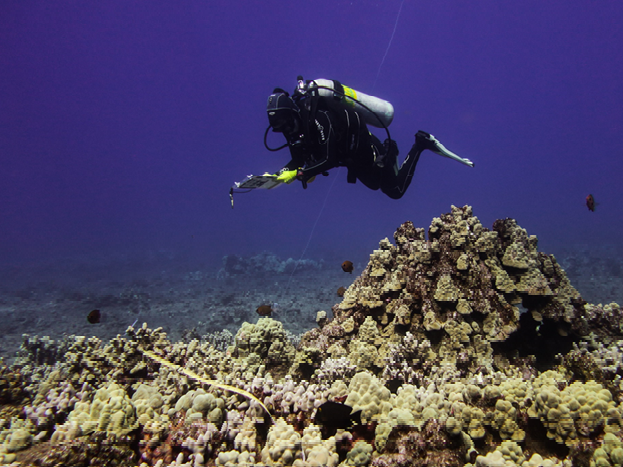
The Hawaiʻi Coral Bleaching Collaborative (HCBC) has launched its new website, featuring the coordinated survey efforts of scientists from around the state and across many organizations and agencies to document the extent and severity of coral bleaching over a broad spatial scale. Coral bleaching events in the Hawaiian Archipelago have increased in frequency and severity since 1996. Formed in 2015, HCBC works to document the extent of coral bleaching in Hawaiʻi and to lay the groundwork for tracking coral response and recovery through time by rapidly assessing bleaching stress throughout Hawaiʻi’s reefs. The data gathered is analyzed to provide answers to questions about patterns and drivers of bleaching that can be used to inform scientific knowledge, as well as management decisions designed to reduce coral mortality in Hawaiʻi’s reef ecosystems. [Photo: Coral Bleaching Survey Methods. Credit: Morgan Winston Pomeroy, NOAA Fisheries]
|
|
Meet PacIOOS' New Oceanographic Technician Sarah Shows |
|
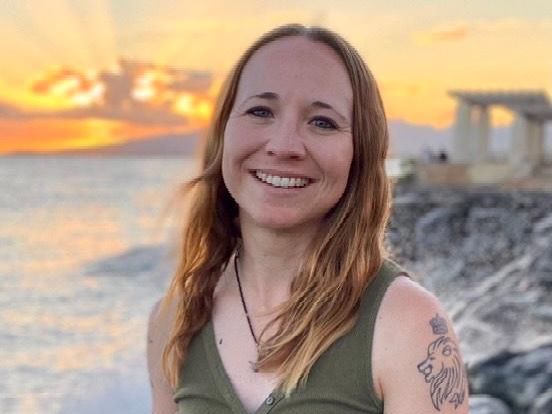
Sarah Shows is a new Oceanographic Technician involved in a range of wave buoy operations from maintenance to deployment and recoveries, within the Freely Associated States. She completed her B.S. in Marine Biology at the University of Hawaiʻi at Mānoa in December of ’23. During her time there she worked with the Marine Option Program, interned at the Hawaiʻi Institute of Marine Biology Shark Lab, and volunteered on Hawaiʻi Ocean Time-series cruises. These opportunities equipped Sarah with valuable knowledge and skills for her new role. Growing up in Southern California, she developed a deep passion for the ocean which motivated her to pursue marine biology and eventually become a SCUBA diving instructor. In her leisure time, Sarah indulges in outdoor activities such as SCUBA and freediving, paddle boarding, and hiking. She is enthusiastic about this position as it allows her to merge her passion for science, the ocean, and the outdoors while contributing essential data for ocean safety. [Sarah at Kakaʻako Beach Park] |
|
Using a Regional Ocean Modeling System to Predict Coral Heat Stressors |
|
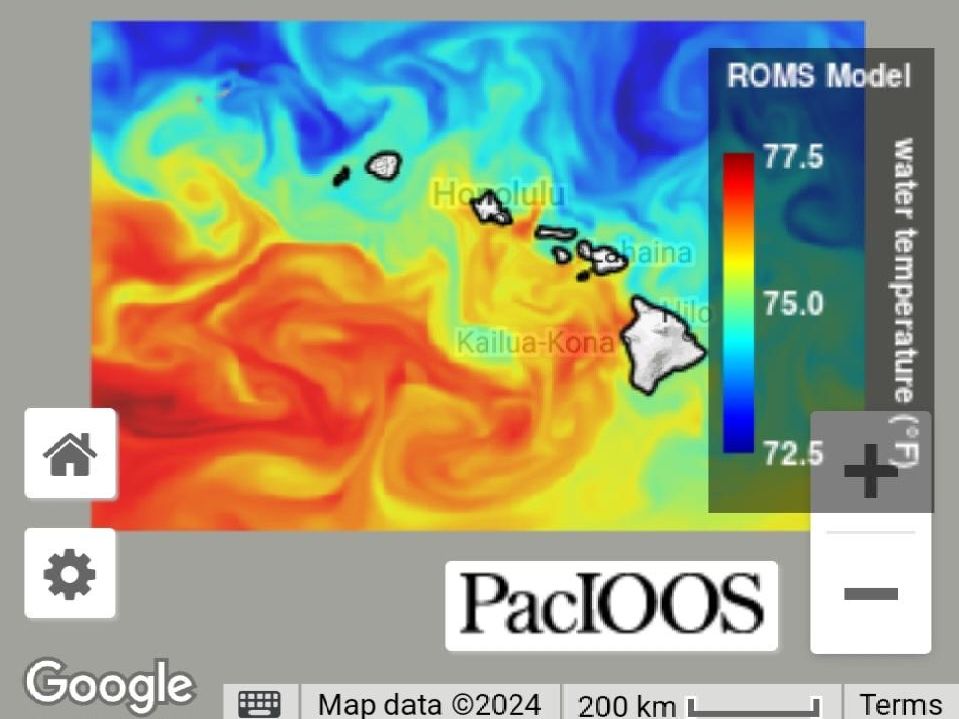
PacIOOS’ ocean circulation modeler Brian Powell contributed to an article published this month in Scientific Reports. “Subsurface temperature estimates from a Regional Ocean Modelling System (ROMS) reanalysis provide accurate coral heat stress indices across the Main Hawaiian Islands” evaluates the utility of a ROMS model as a tool for coral reef management. PacIOOS provides ROMS model forecasts of ocean salinity, currents, and temperature. Accurate temperature data at depth is critical for understanding and predicting coral responses to changing ocean conditions. Historically, scientists and resource managers have relied on in situ temperature measurements and satellite-derived sea surface temperatures to study the thermal tolerances of coral reefs around Hawaiʻi, however these methods are limited in their resolution and availability. Temperature predictions generated by the ROMS model were compared with in situ temperature measurements from around the Hawaiian Islands, and found to be an accurate predictor of subsurface temperature and observed temperature variability. [Image: ROMS water temperature forecast for the Main Hawaiian Islands]
|
|
|
|
|
|
|