Quick, Timely Reads
On the Waterfront
|
|
Eddy Fussader:
The Wealthy Barber, Bay Rat Style
|
|
Dr. David Frew, a prolific writer, author, and speaker grew up on Erie's lower west side as a proud "Bay Rat," joining neighborhood kids playing and marauding along the west bayfront. He has written for years about his beloved Presque Isle and his adventures on the Great Lakes. In this series, the JES Scholar-in-Residence takes note of life in and around the water.
|
|
“The Wealthy Barber,” by David Chilton, became one of my favorite reads but long before I read it, I knew Eddy Fussader, the barber from West Fourth Street in Erie, Pennsylvania. |
|
During the late 1980s, a Canadian friend gave me a copy of “The Wealthy Barber,” the book that had inspired his personal savings and investing program. John Mitchell was a sailing buddy from the Port Dover Yacht Club who was planning to sell everything and set off on his sailboat for an indefinite cruise across the Atlantic. John often credited the simple wisdom that he had learned from the book with his financial approach to a life that was about to allow him to retire at an early age and go on an indefinite sailing journey with his wife, Nadine.
The book is set in Sarnia, Ontario and revolves about a barber who specializes in haircuts with a side of financial advice. His advice is simple (the book is enjoying a third edition). Always save 15 percent of everything that you make and invest the money in mutual funds that are balanced between stocks and bonds. The book suggests that the mix between stocks and bonds should begin with a relatively large proportion dedicated to stocks, 60 to 70 percent depending upon risk tolerance, and slowly shift toward a larger percentage in bonds as one gets older. There is nothing magical or revolutionary about the saving and investing plan suggested by the book. Perhaps the most innovative aspect of the writing was the insistence that people resist the powerful temptation to spend rather than to save. The book lists examples of ordinary people, including the wealthy barber himself, who were able to comfortably retire or partially retire after a few decades of working at regular jobs. Chilton emphasizes the power of compound interest over long, elapsed time periods and notes that if one is able to discipline him or herself to save 15 percent, within a few years there will no longer be a need to work to earn money. Saving 15 percent of what one has been earning over a long period of time will almost certainly allow a person to retire and continue the same financial lifestyle.
I read the book eagerly and told my friend that I had been fortunate to have heard the very same advice when I was young. And based upon similar advice from my own neighborhood barber, Eddy Fussader, I was well on track to achieve similar objectives. Our neighborhood barber had preached a gospel of saving and investing to anyone who would listen from his shop near West Fourth and Liberty streets. The big difference between the book and the advice that Eddy had given was the modern development of mutual funds. During the Eddy Fussader era, investors had to purchase individual stocks, which was riskier, involved difficult decisions, and was much more costly from the perspective of brokerage fees. Eddy’s savings’ strategies were about the same as those suggested by the Wealthy Barber, but Chilton’s investing prescriptions enjoyed the relatively modern advantage of inexpensive mutual funds as opposed to stock selections.
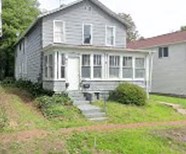
Eddy Fussader, our wealthy barber, was born in Bavaria just after World War I and experienced the trauma of an entire continent that had been gripped by war. As a result of his reactions to wartime Europe, he came to the United States to begin a new life. Eddy settled in Erie, where he was welcomed by the German community in the bayfront neighborhood and by John Kresnesky, in particular. Kresnesky, who was one of the leaders of Erie’s German community, had immigrated in the late 1800s and established a large and welcoming family home at 708 West Fourth St., where he hosted and sponsored new German arrivals for decades. The Kresnesky family sponsored and hosted my friend Dave Bierig’s grandfather when he arrived from Germany.
|
|
The Kresnesky home on West Fourth Street |
|
John Kresnesky’s son, John Jr., took over the role of informal leader of northwest Erie’s German community after his father passed away and continued to live in the West Fourth Street home, where he hosted and sponsored other immigrants. John Jr. had become a good friend of Mr. Bierig, who was a contemporary. The Fussader-Bierig connection was strengthened when Dave Bierig’s grandfather passed away in 1921 and the Kresnesky family welcomed Dave Bering’s father, Harry, to their home. At about the same time that Harry Bierig was staying with John Kresnesky, Eddy Fussader arrived from Germany and moved into the house in the 700 block of West Fourth Street. The connection between Harry Bierig and Eddy Fussader led to a friendship that continued for decades. And, naturally, Dave Bierig always had his hair cut at Fussader’s shop.
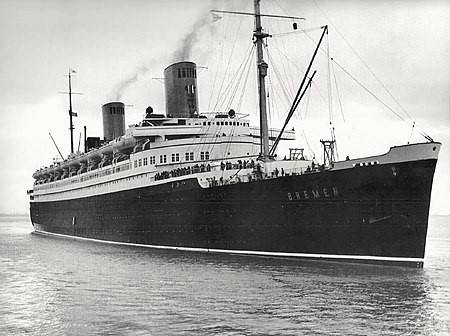
There were three general topical themes at Fussader’s Barber Shop: (1) the superiority of German engineering and technology; (2) the horrors of Adolf Hitler; and (3) saving-investing. Fussader, who spoke with a distinct accent, often cited examples of German technology and engineering that were much further advanced than similar American efforts: architecture, automobiles, engines, highways, and more. One of his favorite examples was the ship that he used to travel back to Europe to visit his parents in 1938. The S.S. Bremen was the fastest, most seaworthy, and powerful ship of her day. It was launched in 1928 and regularly crossed the Atlantic from Germany to New York City. At 950-feet in length, it displaced 55,600 tons and carried 1,700 passengers. Its four steam turbines drove the ship quietly at a cruising speed of 27 knots. Bremen won prizes for making the fastest passage between Germany and New York and was once was clocked at a speed of 31 knots, an astonishing technical achievement for the era.
|
|
Fussader often described the Bremen at the barber shop as well as his 1938 trip home to Germany. As he was enjoying time with his parents during the pre-World War II years, he learned that he was under suspicion because he had become an American citizen. Germany was changing in ways that Fussader described as evil. Friends and family advised to him to leave as soon as possible because he was no longer safe. So, he departed early, booking return passage on the Bremen. During his return, the Bremen encountered a nasty Atlantic hurricane. “No problem,” according to Fussader, who described the way that the ship pushed its way through the storm and eventually landed safely in New York. It was a classic example of superior German technology, according to Eddy.
Eddy Fussader had escaped Germany just in time. Less than a year after his departure, German and Russian forces attacked Poland and World War II was in full force. A day before the attack of Poland, Bremen’s captain received a coded message ordering him to turn around in Mid-Atlantic and return to Germany, where the ship was to become a part of the war effort. Recognizing the position that many of his passengers would be facing if they were to be taken back to Europe, the captain decided to continue to New York and discharge them. Once safely tied to the docks in New York, the captain understood that what he had done bordered on sedition and that he might be jailed if he returned to Germany. But he could not remain in New York either. There were ongoing anti-German protests at the dock, which were becoming increasingly violent.
Eventually, he departed the United States with an empty ship and headed back across the Atlantic. The Bremen’s departure in 1939 corresponded with the official declaration of World War II so the captain knew that he and his ship could easily be a target of both the Allied forces and Germany, where he would be under attack for not returning when ordered. Confident in the speed and maneuverability of his ship, he left anyway and ordered a watch for any warships. Bremen could outrun any existing ship but there were concerns about submarines. While underway, the crew repainted the hull in gray so that it would be camouflaged. The Bremen arrived safely in Russia.
Shortly after his return to Erie, Eddy Fussader, who had completed barber training prior to his trip home to Germany, opened his own shop near West Fourth and Liberty streets, less than a block from the Kresnesky house. As he worked there, he became a vocal critic of Hitler and the social destruction of Germany that the Nazi movement had spawned, telling anyone who sat in his barber chair stories about how Germany had changed and the countless ways in which Adolf Hitler had undermined one of the most advanced societies in the history of the world. His passion to describe the horrors of what had happened to family and friends in Germany eventually expanded as Eddy began speaking at any community gathering that would have him. When he spoke, either from his barber shop or at community gatherings, he emphasized the social and political division that had been festering since the days of Hitler and had spread across the ocean to Erie, noting that many local Germans were convinced that Hitler was not entirely wrong. They dismissed the outright criticisms of Hitler noting incorrectly that he had simply gone a bit too far.
As political divisions over Hitler extended to Erie, Fussader’s barber business suffered from the backlash against his extreme anti-Nazi views, opinions that he had made very public. Some members of the local German community who had supported his barber shop began to react against his outspoken opposition to Hitler. But he carried on, doing what he considered to be the right thing.
He worked by himself at his Fourth Street shop, cutting hair for almost 40 years. Fussader’s became the traditional barber shop in the neighborhood, resisting fashion fads. If you went there for a haircut, you received the cut and style that Eddie “knew” you needed. When radical new styles such as crew cuts, flat tops, and DAs (slicked back hair) arrived, Fussader was oblivious to them. If you wanted something like that you would have to find a different barber, and there were several in the neighborhood.
As the 1950s and 1960s marched on, Fussader’s primary discussion theme shifted. Thrift, savings, and investing became core issues, replacing Germany and the war. I recall sitting in the chair as a kid, listening. People didn’t just get a haircut and leave. They moved back to the “waiting chairs” and took investing notes. Buy blue chip companies and hold them. Choose stocks that offer dividends. Buy GE. Invest in public utilities. Diversify. I listened but could not fully appreciate what Fussader was saying, except for the admonition to save 15 percent of everything that you make. “If someone gives you a five-dollar bill as a birthday or holiday gift,” he once told me, “run, don’t walk, to the bank and add 75 cents to your saving account.”
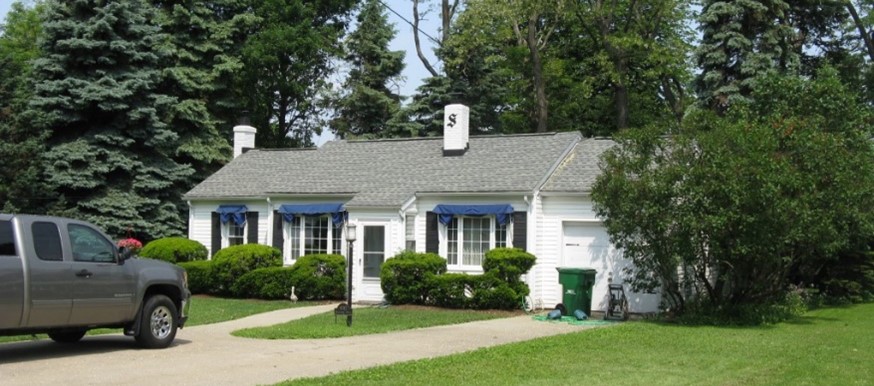
Apparently, Eddy Fussader followed his own advice. He retired one day during the late 1970s and disappeared from West Fourth Street. After he retired, he continued to focus attention on the lakeside property that he had purchased in Harborcreek. Fussader was one of the first residents of a lovely development that overlooked Lake Erie and spent winters in Florida. Eddy Fussader passed away in 1989 and was buried in Erie Cemetery with his first wife, Barbara. He left a large endowment to Presque Isle State Park when he died because of an infatuation with the peninsula that came from the fact that his American sponsor, John Karasnesky’s father-in-law, had worked on the construction of the lighthouse. He also left substantial endowments to the Bierig and Krasnesky families. Fussader’s beloved ship, the Bremen, did not survive World War II. It was returned to Germany, where it was used as a troop barracks for several years, but an angry crewmember set it on fire near the end of the war and the interior was destroyed. Eventually, the charred hull was hauled up a port river and sunk.
|
|
Eddy Fussader’s Harborcreek home |
|
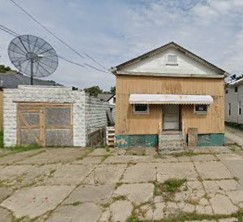
Fussader’s Barber Shop was located in this building, which included the detached garage at the left, where Eddy Fussader parked his Cadillac. During the 1950s, the building was in much nicer shape and the windows were larger |
|
While I did not fully comprehend the nuances of Eddy Fussader’s investing strategies, I understood the advice about saving. At an early age, I opened a bank account and began to faithfully save 15 percent of whatever I made. It was difficult at the beginning and the paltry amounts that I was able to set aside did not seem to be worthwhile. But I was faithful. Beginning with a paper route and continuing through my (bowling) pin-setting career, I saved. And the habit that I formed went with me after graduating from college and into my first professional job.
Years passed and the paltry amounts began to grow thanks to the “magic of compound interest.” Eventually I discovered mutual funds, index funds, and portfolio managers. Thanks to Eddy Fussader, my “wealthy barber.”
|
|
Author’s note: Wally Knox suggested that I write about Eddy Fussader, who was his barber as well as mine. Dave Bierig filled in many of the details about the local German community and Eddie’s arrival in Erie. |
|
|
|
Accidental Paradise Available at TRECF!
Accidental Paradise
by Dr. David Frew and Jerry Skrypzak
|
|
The beautiful book on Presque Isle published by authors David Frew and Jerry Skrypzak – “Accidental Paradise: 13,000-Year History of Presque Isle” – is on sale at the Tom Ridge Environmental Center’s gift shop and through a special website, AccidentalParadise.com.
The book, priced at $35 plus tax and shipping, can be ordered now through the website sponsored by the TREC Foundation, AccidentalParadise.com.
Presque Isle Gallery and Gifts on the main floor of TREC, located at 301 Peninsula Drive, Suite #2, Erie, PA 16505 will also handle sales daily from 10 a.m. to 4 p.m.
For more information, send an email to aperino@TRECF.org.
To watch "Accidental Paradise: Stories Behind The Stories" click here.
|
|
ABOUT THE AUTHOR
Historian and author David Frew, Ph.D., is a Scholar-in-Residence at the JES. An emeritus professor at Gannon University, he held a variety of administrative positions during a 33-year career. He is also emeritus director of the Erie County Historical Society/Hagen History Center and is president of his own management consulting business. Frew has written or co-written 35 books and more than 100 articles, cases, and papers.
|
|
|
|
|
|
|