Visit Us at Central Plains Dairy Expo | | | | |
Dairyland Labs will be attending the Central Plains Dairy Expo in Sioux Falls, SD: March 25-27. You will find our booth (C604) in the main convention center exhibit hall.
Be sure to talk with Dave, Tyler and Laura about any of the content in this newsletter and more.
| | |
Welcome to The Dairy Authority (TDA)
in Greeley, Colorado
| | Dairyland Laboratories growing NIR network | | |
This new relationship combines the excellent local service of The Dairy Authority (TDA) with the technical support and extensive analysis options from Dairyland Laboratories Inc. TDA will receive samples through the Greely Colorado location while offering the complete range of Dairyland services. This includes advanced NIR services, web-based data handling tools, user friendly sample submission app and reporting options. Dairyland will be handling all sample submission forms, NIR predictions, quality control, reporting of results and billing for feed and forage accounts.
For more information from Dairyland Laboratories regarding The Dairy Authority please contact Laura Kieser by email or phone.
| | Grain Particle Size Methods | | |
Method differences in grain particle size measurements cause confusion in the field between buyers and suppliers and in diet formation. Like other tests used in feed labs (ex. ADF, NDF, or crude fiber), grain particle size measurements are dependent on the method’s conditions, as opposed to chemically defined analytes like calcium or amino acids. Including sodium sulfite, amylase, or filters and filtration aids, and applying ash correction change what the “right” value of fiber is. Similarly, the “right” value of grain particle size depends on method conditions including:
- The number of sieves used
- Presence or absence of sieving aids (balls and brushes)
- Presence or absence of flow agents
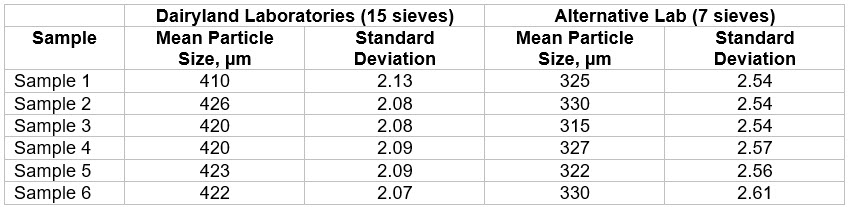
Dairyland follows a traditional method (ASABE, 2006), utilizing 15 sieves with sieve aids (brushes and balls), a bottom pan and no additional flow agents. Methods used in other labs may utilize fewer sieves
along with sieve aids as described by Goeser and Shaver (2020).
Generally:
- More sieves result in higher mean particle size and lower standard deviations, because they give particles more opportunities to be captured at different sizes and sort them into narrower, more precise ranges.
- Flow agents result in smaller mean particle size and larger standard deviations because they assist particles in reaching smaller sieves.
A method comparison analyzed six processed corn samples that were split and tested by two labs using their respective methods. The results of this side-by-side analysis are listed below:
| | Like other tests used in feed labs, comparing samples tested at different labs is difficult without a deep understanding of the methods implemented at each lab and the consequences of those differences. For more details on grain particle size as it applies to Dairyland's Mill Quality Assurance program, check out our website. | | |
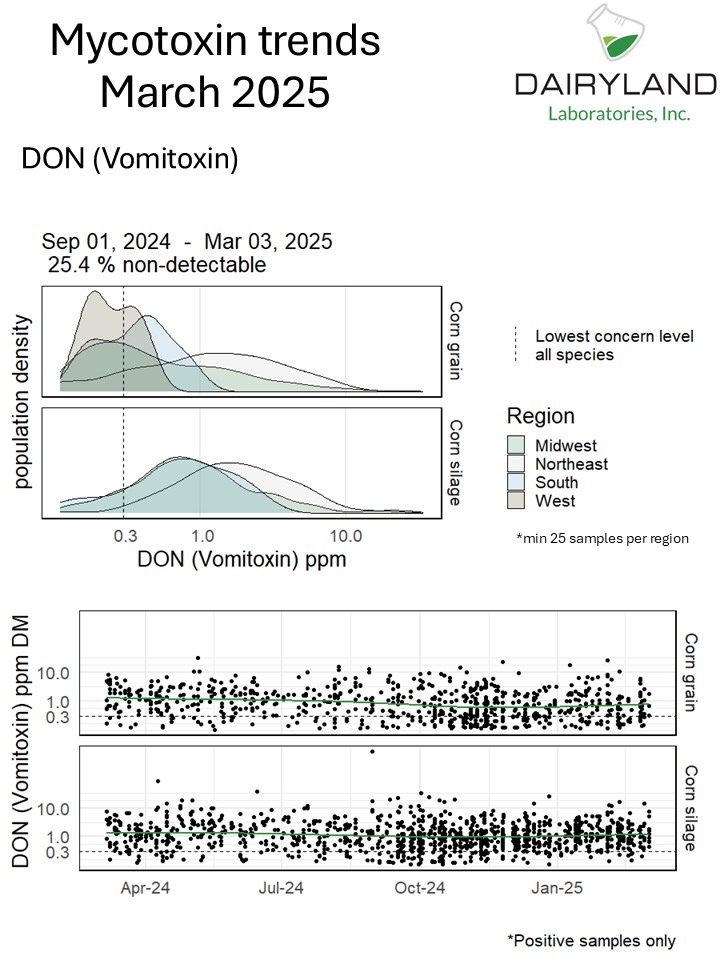
While overall prevalence of mycotoxins in corn silage and corn grain remains similar to previous crop years, samples from the Northeast U.S. continue to show higher prevalence and concentration of Vomitoxin and Zearalenone than other regions.
Across all regions, HT2 continues to be a more common issue than T2, with HT2 present in 35% of corn and corn silage samples while T2 has only been found in ~6% of the same samples.
See graphs for individual toxins here.
| | Silage Hygiene Packages Available | | |
Hygienic feed is free of pathogens, mold, and mycotoxins. These contaminants reduce the nutritional value of silage and can cause digestive disorders that result in productivity issues.
Pathogens:
- Gaps in management practices are the primary cause of pathogens in silage.
- Clostridial growth is promoted by high moisture levels, soil contamination, and insufficient drop in pH which can be caused by a variety of mis-management practices.
- Bacterial contamination from Coliform, E. Coli, and Enterobacteriaceae is primarily caused by manure contamination through in-field fertilization and equipment that is used for both feed and manure handling.
- Risks can be mitigated by following silage management best practices, maintaining cleanliness of feed alleys, waterers, bunks, and feed equipment, and ensuring that equipment used for soil or manure handling is not used for feed.
Yeast, mold & mycotoxins:
Crops damaged by flooding, hail, drought, or pests are vulnerable to yeast and mold growth, and subsequent mycotoxin production. Both yeast and mold growth increase during the aerobic phase of ensiling, which can further promote mycotoxin production if conditions remain favorable. Yeast typically grows first, causing heating and depleting much of the crop’s digestible nutrients. Harvesting the crop too dry, poor compaction or chop length, slow filling, and not covering the silo all increase the susceptibility for yeast and mold growth during ensiling. Visible mold is not a reliable indicator of mycotoxin contamination, and an increase in mold growth does not necessarily correlate with higher mycotoxin levels.
When to suspect a silage hygiene issue:
If you notice a putrid smell, slimy texture, dark discoloration, visible mold, or heating in your silage, contamination may be present. Feeding compromised silage can lead to reduced intake and production as well as serious health concerns in livestock.
Available analyses include (3 to 5-day turnaround time):
| | | Test Type | Specific Test | Price | | Bacteria | Total clostridia | $60.00 | |
| C. perfringens | $60.00 | |
| Coliform/E. Coli | $30.00 | |
| Enterobacteriaceae | $30.00 | | Mold & Yeast | Count | $35.00 | |
| Count & ID | $49.00 | | Mycotoxin | Basic package
(13 mycotoxins) | $175 | |
| Select package
(17 mycotoxins) | $230 | |
| Complete package
(22 mycotoxins) | $300 | | | Fecal Starch: 3 Times to Test | | |
Fecal starch is one of the most cost-effective tools available for monitoring diet performance but is often overlooked because it isn’t a high frequency standard practice like forage testing. Here are 3 times to consider fecal starch testing on dairy farms:
-
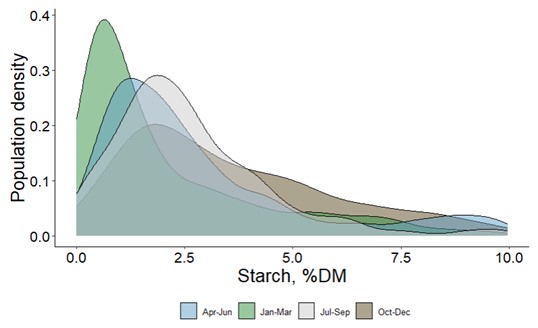
December, March, and June - Starch digestibility changes over time as the ensiling process breaks down the protein matrix that naturally inhibits starch digestion. December, March, and June are good months to benchmark how much starch digestion has improved in ensiled feeds. (Figure 1.)
-
When intakes outpace production - When dry matter intakes are high relative to production, the root cause can be a lack of rapidly fermentable carbohydrates. In these situations, a fecal starch test can confirm if one or more of the starch sources is passing through undigested.
-
When changing starch sources - Testing fecal starch before and after switching silos, or changing between high moisture, dry, or steam-flaked corn or suppliers, is an easy way to compare how the new source performs to the previous.
| | |
Figure 1. Quarterly distributions of fecal starch
For more information regarding fecal starch testing, contact Dairyland Labs at 608-323-2123 or info@dairylandlabs.com.
| | If someone sent you this newsletter, or you found it via social media, and want to subscribe, please use the link below. | | Dairyland Laboratories, Inc. | 608-323-2123 | Email | | | | |