MARCH 2026

Your Monthly Peek Into Sacramento’s Coordinated Access System


Stories, updates, and data from Sacramento’s front door to homelessness services.


February Data & Analysis


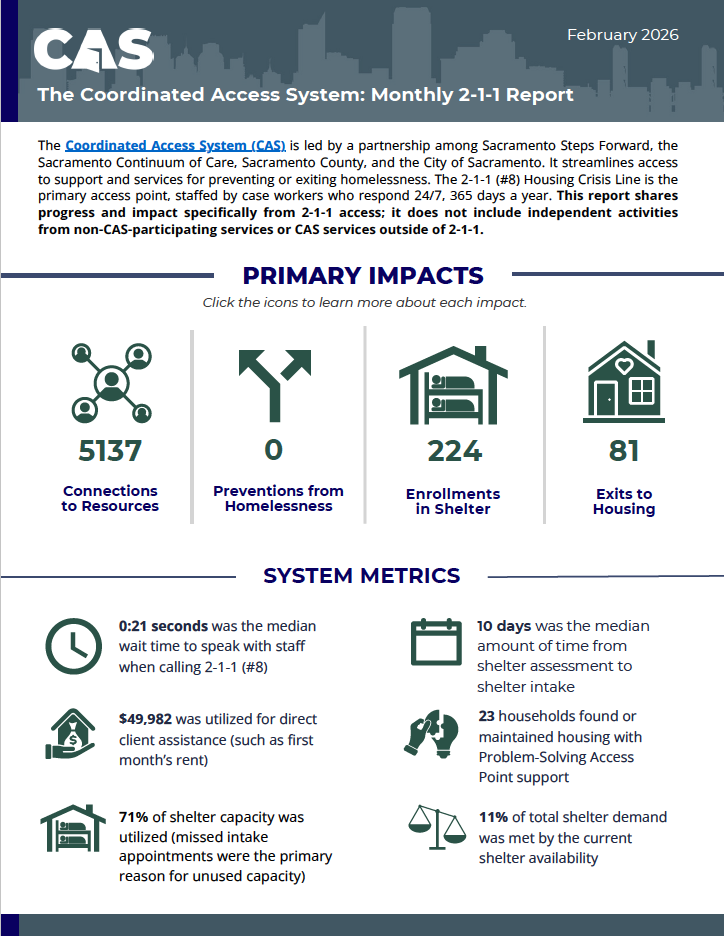
2-1-1 is the primary path people take to enter Sacramento's Coordinated Access System (CAS) in search of homelessness and housing services. In February, it connected 5,137 people to support, helped 81 to become housed, and enrolled 224 in shelter.


At the same time, the report highlights some of the ongoing challenges the system is working to address. Only 11% of the total demand for shelter was met, and it took a median of 10 days for individuals to move from assessment to placement. While most shelter capacity was utilized, missed intake appointments meant that some beds still went unused, pointing to opportunities to improve coordination and access.


READ THE FULL REPORT & ANALYSIS ➜

Understanding How Assessments Guide Support in the CAS


Each month, we will take a closer look at one part of the Coordinated Access System and how it supports people experiencing or at risk of homelessness.


The Coordinated Access System (CAS) uses two client key assessments to help connect people to the services they need:  


Crisis Assessment – Identifies clients who need homeless prevention assistance or shelter services.  


Housing Conversation Tool (HCT) – Identifies clients who are seeking housing services.  


Both assessments ask questions that determine eligibility criteria that help prioritize clients for the right programs. 


Eligibility Screen: Making Access Transparent 


To improve transparency, the HMIS team added an eligibility screen for each assessment. This screen shows which programs a client can access:  


  • “100+” = Client is eligible for the program.
  • Any number below 100 = Client is not eligible.  
  • “0” = The assessment needs to be updated or a new one completed. This usually happens when new questions are added to better assess eligibility.  


This feature helps stakeholders see clearly how clients qualify for each program, making the system more open and accountable.  


Prioritizing Support: Serving the Most Vulnerable 


The CAS uses assessment data to ensure that resources go to those who need them most. Clients are prioritized based on:  


  • Program eligibility – Only eligible clients are considered for each program.  
  • Vulnerability score – Those with higher needs are prioritized.  
  • Barrier score – Factors that make housing access more difficult.  
  • Length of homelessness – How long clients have been experiencing homelessness.  


This structured approach ensures fair, data-driven decision-making and helps the community’s most vulnerable receive timely support.  


Tip for Staff and Stakeholders


Whenever assessment questions are updated, HCT results may change. Regular review ensures that clients are matched to the programs they qualify for.


READ THE THIS ARTICLE ON OUR WEBSITE ➜

Here's what's new:


The Sacramento Continuum of Care Committee has approved the Coordinated Access System (CAS) Operations team to write and implement the Self-Select Policy. The purpose of this policy is to allow clients, through the Housing Conversation Tool (HCT), to “self-select” Rapid Rehousing by choosing housing subsidies ranging from 0–24 months. 


This approach was initially piloted with the Family Rapid Rehousing groups, yielding positive outcomes. Based on these results, we are now ready to implement the policy across all Rapid Rehousing. 


Under this policy, clients who self-select are given the highest priority for Rapid Rehousing programs and are further prioritized according to the established prioritization schema. 


In the coming months, the CAS will develop the full policy and share it with the community. Until the policy is finalized, implementation is on hold. 

The People Behind

the Progress


Behind every referral and placement are people working together to make it possible.


This Month’s Spotlight: Shaitra Ken, Program Analyst III at Sacramento Steps Forward.


“Openings are limited compared to the number of people who need help, but even small, steady progress matters. Every client we house is one fewer person living on the streets.”


READ THE SPOTLIGHT ➜

The Q&A Corner


Three of this month’s most-asked questions.


Q: What is prevention? 


A: Prevention is one of the three main approaches to addressing homelessness in our community’s Regionally Coordinated Homelessness Action Plan: Prevent, Respond, and Resolve. 


Prevention includes a range of efforts to keep individuals and families safely housed by helping to address crises that could lead to homelessness. It is an approach that responds to a household’s specific situation and risk factors. Prevention initiatives can include short-term rental assistance or help with utilities, support with landlord negotiations and lease concerns, legal assistance related to evictions or notices, or problem-solving navigation conversations.


Q: What does Prevention look like in Sacramento? 


A: Prevention is not a single project or program. Specific prevention programs and service types in our community include: 


Q: How can community members access Homeless Prevention or Shelter programs? 


A: CAS Assessors can screen for CAS program eligibility and enter participants to the shelter waitlist by administering the Crisis Assessment (CA). Non-CAS Assessors or community members can call 2-1-1 (press 8) for over-the-phone access to the CA and explore available programs.  

🏠︎ Housing Highlight


We are excited to share that the Sacramento Rehousing Development Agency (SHRA) has been awarded 30 vouchers for the Foster Youth to Independence Program, designed for Transition Age Youth (TAY, youth aged 18-24). Many TAY do not meet the high vulnerability thresholds for permanent housing programs, making supportive resources scarce. This program addresses that gap by providing housing subsidies to a population that typically has limited access to such services. While the vouchers are time-limited, they are a critical tool to help youth stabilize their living situation, gain independence, and build self-reliance over a 3–5 year period. For CAS partners and referral agencies, understanding and leveraging this program is vital, as it allows them to connect eligible youth to a resource that can dramatically improve housing stability and long-term outcomes. 


Thank you for being part of this work.


Questions about the Coordinated Access System?

Contact: CAS@sacstepsforward.org