Five Disciplines for Library Planning


Libraries run on space (print and digital).


Research professionals need to be knowledgeable about reshaping strategies to support collection growth and development. 


1 - Reinvent Catalog of the Content Your Library Owns


The first step in design is knowing what the library contains.


For example, research collections are not an undifferentiated mass of boxes, books, archive notes, scans, emails, notes, images, videos, and resource files. Each content category has its own spatial, technical, and service requirements. Each has potential engage a reader.


Think about how heavy a bound volume is and how it is moved differently from manuscript in a box. Indeed, the digital image collection behaves differently from an email archive, and a rare book requires different environmental standards. How do you display digital collections? Do you provide interactivity?  


Note, film and photographs require cold access conditions than a current-use monograph needs.


Classification is therefore not merely bibliographic. It is architectural; reshaped for the next generation users.

2 - Right-Size the Physical and Digital Repository


The second discipline is right-sizing. In the digital world we call it scaling, but its really another way of looking at right-sizing for the future.


Our research of library repositories and architecture is that open and closed stacks require updated management and strategy plans.


The library is not a warehouse. It is a service platform. Its physical and digital services must be sized according to how the collection is used, how it is accessed, and how the institution intends to support research over time.


3 - Test the Assumptions Through Pilot Project


Future collection modeling is a hypothesis until it is tested. The storage requirements are tested to understand the options. User access is tested to understand how to streamline services.


The third discipline is the pilot project. For example, one government library pilot project determined logistics before capital was committed. It tested whether the proposed storage configuration fit-in with the actual collection. We proved the requirements and funding was provided.


We test whether researchers or library staff can retrieve materials efficiently and safely. We test whether user access patterns supported the proposed service model.


We test whether the digital access points were integrated so the researcher could see digital scans, emails, notes, resource files, images, and videos as part of the discovery layer.


4 - Develop Master Library Plan

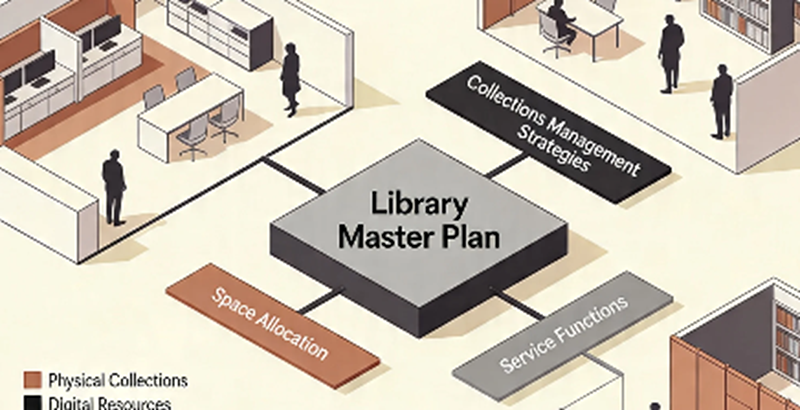
When we support pilot research for library project leaders, we produce evidence on what is and what is possible. Basically, our master library plans convert that evidence into institutional action or strategic service planning reports.


Yes, the fourth discipline is master planning; taking the time with a strong methodology to build an outcomes based future. For example, a master library plan establishes the phasing, scheduling, resource allocation, budget framework, financing strategy, fundraising opportunities, grantmaking path, and service priorities. It outlines the requirements to implement repository access strategy over multiple years.


This plan should include both physical and digital collections acquisitions. It recognizes that the physical library, and the digital library have many of the same institutional issues; resources, staff time, systems support, capital investment, preservation planning, and user education.


Through our methodology we sequence the decisions and timelines.


5 - Sell the Idea Through Library Service Plan

Research Library projects fail when they are presented only as facilities projects and not as integrated service models.


The fifth discipline is the library service plan. This is the document that connects repository decisions to institutional value and solid outcomes. It explains why the library research collection is needed, how the collection will be used, what services will be provided, what technologies are required, and what time and funds required.


The service plan addresses the physical and digital programming needs. It defines user behavior and/or functional service planning for the repository. Basically, we focus on actual and potential collection usage, user behavior, access expectations, staff capabilities, operations, overlaps, and quantifiable outcomes. The idea needs to be a no-brainer; you probably already know the answer / now is the time to act on it.


Facebook  Web