In this series, I’ll share my tidbits on “how to” constructively work in meetings with “difficult” people.
Setting the Stage
Never label someone as a “difficult” person. This person may have an issue that is causing him or her to display difficult behavior. Identify the problem, not the “problem person”. People are motivated by needs: the need to control, to excel, and to bond. Whenever any of these needs are not met, people display difficult behavior. A basic underlying assumption in working with people is that people can be reasonable, don’t like to be blamed or embarrassed, and want to be respected.
The “How to” …
When in meetings, determine first what is the motivating factor and correct what is causing the behavior (see Setting the Stage). If you cannot correct the cause of the problem, then:
Mitigate the symptom:
Establish and enforce norms (see Tidbit #1 - Norms).
Use body positioning – stand near or in front of the “difficult” person.
Use eye contact – it lets the person know that you are aware of his or her behavior.
During a break talk to the person. Don’t say, “You have been distracting. What is your problem?” You won’t get a useful response. Instead, say, “I noticed something is bothering you. What is happening?”
As a last resort, have the problem person removed. A “problem person” can disrupt the entire meeting with his or her behavior.
Tidbit #1 – Norms
When in meetings, establish behavior ‘norms’ with the people. Ask them to define what ‘norms’ they would like to follow, e.g., respect all views, one conversation at a time, etc. Keep it simple (KIS) and keep the norms positive, e.g., phones on mute (positive), no phone calls (negative). The people will support enforcing the norms so that the norms become theirs.
Tidbit #2 – The Latecomer
Characteristics… The Latecomer always comes in late, makes a “show” of arrival, insists on “catching up” disrupting the meeting midstream.
What to Do… Establish and enforce the punctuality norm “Be on Time”; do not allow The Latecomer to disrupt the meeting. Talk to The Latecomer during a break to determine the cause.
Our FoCuSeD™ Facilitator classes support the International Association of Facilitators (IAF) Core Facilitator Competencies and what students need to learn to achieve them, enabling those who wish to pursue their IAF Certified™ Professional Facilitator (CPF) designation. CPFs receive professional recognition that provides a competitive edge. You can receive a professional CPF certification from the IAF - read FacilitatorCertification. I also provide a "Certificate of Completion" attesting to evidence of a successful class completion - read Certificate vs Certification.
I founded MGR Consulting in 1985, a learning and collaborative leadership development consulting firm, and used my subject matter expertise about group facilitation and designed, developed, and taught the first structured facilitation-training program - FAST. In 2007, I then revolutionized my facilitation-training program with FoCuSeD™ - the 1st Holistic Structured Facilitation™ Technique - by being the first to see and describe how People and Process skills can be seamlessly integrated to drive consensus-based decisions.
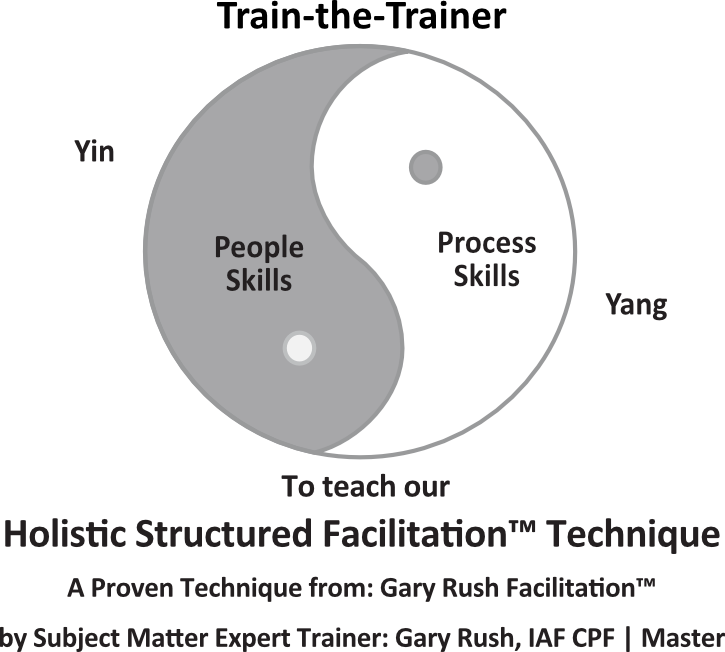
I develop, conduct, and deliver learning programs with FoCuSeD™guide books that train employees and improve their job performance to work with a group to produce better outcomes - online, in-person, virtual, and on-site. Check out my Train-the-Trainer program to teach our Holistic Structured Facilitation™ Technique - I want everyone to succeed...
"Continues to be the leading edge in the industry by continuing as a practicing FoCuSeD™ Group Facilitator."