RETIREMENT SECURITY MATTERS
A forum for retirement innovation information sharing focused on
states, supporters, and service providers.
Vol 41 | November 4, 2021
|
|
Greetings! welcome! to Retirement Security Matters – where we talk about retirement readiness innovation by states, supporters, and service providers.
|
Happy November! If that sounds like the year is moving way too fast, we agree. Small solace: this means ski season is right around the corner. Time to get those legs in shape. Here’s something to read while you’re working on your knee bends:
- NIRS’ Tyler Bond shares the latest on financial asset ownership – it’s sobering
- We have fresh state metrics – can you guess which measure is up 3x in a year?
- Fresh retirement security news from New York, Virginia, Connecticut and California
-
Grant B gives you a useful research roundup
-
*There is some news* in this week’s Hot Sauce section, and
- PIX PIX PIX – this week we have babies galore and two convicts
|
Comments or content suggestions? We welcome both. Have something about your program you’d like to share? We are all ears. |
|
Financial Asset Ownership: Only for the wealthy?
|
|
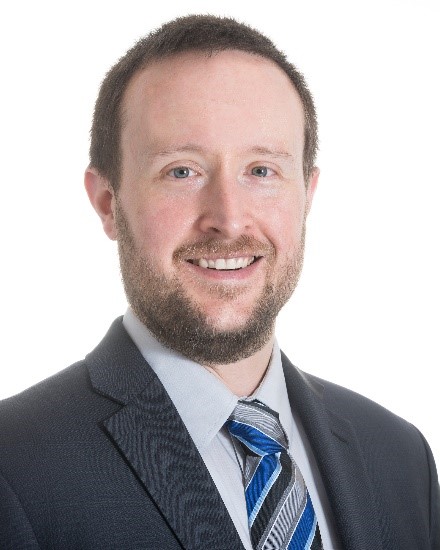
Tyler Bond, Research Manager
National Institute on Retirement Security
|
|
Our friend Tyler Bond is an accomplished advocate and researcher with experience working for political campaigns, advocacy organizations, think tanks, and on Capitol Hill. His professional focus is retirement, specifically, and economic policy, broadly. His writing has been featured in outlets such as The Hill, MarketWatch, and the Huffington Post and he has been quoted in various outlets including Barron's and The Financial Times … and Retirement Security Matters. Here we go deep on financial asset ownership – who’s got it, and who does not – and policy ideas that could make a difference. If you like data, this piece is for you! |
|
Tyler Bond, you recently published your first solo report on a hot topic: how financial asset inequality impacts retirement security. What got you focused on this?
Believe it or not, the inspiration for this report was actually work by the Government Accountability Office in 2006. At the time, there was a theory bouncing around financial news shows that when the Baby Boomers started to retire, they would withdraw all of their financial assets from the market to finance their retirement, and then the market would collapse.
Worrying. A member of Congress asked the GAO to examine whether this was an actual possibility. The GAO found that it was definitely not a possibility for a variety of reasons. One of those reasons was that the ownership of financial assets is highly concentrated at the top.
Interesting. Still true?
Yes. In 2019, Nari Rhee and I took a fresh look and found that if anything, asset concentration among wealthy Boomers had become even greater from 2004 to 2016.
I always liked that issue brief but wanted to go deeper. I wanted to expand on the research to include a more current view, to look back at Generation X over more points in time, and to add a racial component to the analysis, because that is really important when you're examining who owns financial assets in the United States.
Yes – and what are you learning?
What we find is that the concentration of ownership of financial assets becomes greater over time, and it is consistent across generations. We also see that ownership of financial assets is very heavily concentrated among white Americans in all three generations. You’ll see the results in the Stark Inequality report, released at the beginning of September.
We’ve also just released analysis looking specifically at the middle class. The Stark Inequality report really focuses on the discrepancies between the top and the bottom – meaning what the bottom 50% of the population has versus what the top 5% has.
I realized that we hadn't spent a lot of time talking about people in the middle. So I ran an analysis looking at the folks between the 30th percentile and the 70th percentile, that true middle 40%, to find out how much they own.
We’re holding our breath here. (Are you too? Click or bookmark HERE to get the scoop.)
Thank you so much for helping us get our research on, Tyler Bond! Want more? You can connect directly with Tyler here. You can follow Tyler’s work at NIRS here. You can also connect with Tyler on Facebook, Twitter, and LinkedIn.
|
|
*Fresh!* State Auto IRA Program Metrics |
|
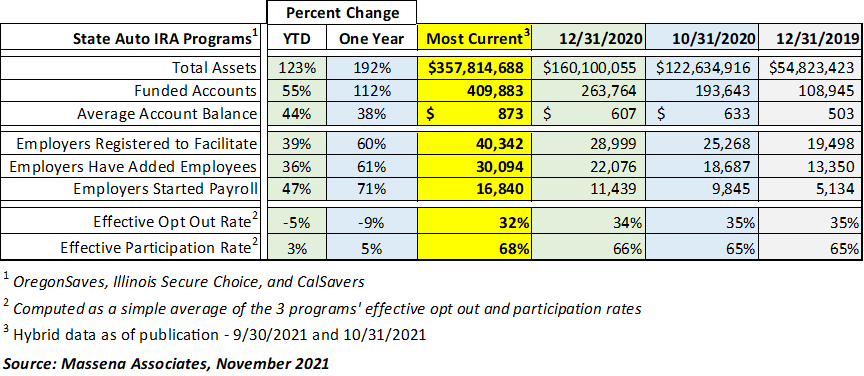
Keeping it simple: Looking at the “most current” column in yellow, we see that funded accounts across the three programs have just crossed the 400,000 mark. Today’s 409,000 funded accounts compares to about 263,000 at the start of the year, and 193,000 one year ago. Combined assets are over $357 million, almost 3x their value a year ago.
Average account balances are now at $873 and up $50 from our last report. As we report, Oregon’s average account balance is higher ($1,185) because the program has been in place longer. Average 30-day saver contribution rates are $111, $138, and $143 (Illinois, Oregon, California). Employee opt out rates are steady, at about 32%.
Employer perspective: More than 16,800 employers are now facilitating state Auto IRAs. Another 23,500 have registered to facilitate and are in the process of providing employee roster information, which is the first step in the employee engagement process, or preparing to start payroll deductions for participating employees.
|
|
State Facilitated Retirement Programs - Fresh Highlights |
|
New York (workforce 9.3 million) – *woot woot* On October 21, Governor Hochul signed AB 3213 which will require private sector employers that do not already offer their workers a retirement plan to automatically enroll their employees in the New York Secure Choice Savings Plan. The employer requirement and automatic enrollment for employees were added to strengthen New York’s state-facilitated retirement savings program by increasing potential participation. More to come.
|
|
Virginia (workforce 4.3 million) – The Virginia529 Retirement Program Advisory Committee held its inaugural meeting on Thursday, October 21. The meeting provided an orientation to the program and its history as Virginia prepares to move into implementation mode. Government Relations Director Leslie Crudele provided historical context following her work on the report analyzing the state of retirement readiness in Virginia in 2020. Consultant AKF provided an overview of trends in the state facilitated retirement savings space; new Program Director Peter Thompson shared program milestones and comments on the way forward; CEO Mary Morris set the stage and wrapped up with a focus on next steps.
|
|
California (workforce 17.9 million) –The CalSavers Board issued a Notification of Proposed Emergency Regulation Action signaling its intent to readopt regulations that will expire November 24, 2021. The regulations, originally adopted in December 2020, include provisions to clarify the default investment option, the allowable amount and frequency of non-payroll contributions, types of tax-qualified plans that could exempt employers from CalSavers and the enforcement of employer compliance.
|
|
C O M I N G U P
-
Oregon (workforce 1.9 million) – The next meeting of the OregonSaves Board is scheduled for November 9, 2021.
-
California (workforce 17.9 million) –The next meeting of the CalSavers Board is scheduled for December 13, 2021.
|
|
Catching You Up: The Latest Studies and Reports on the State of Retirement Security in the US |
|
Last month, the U.S. Senate unanimously passed a resolution declaring October as National Retirement Security Month. I decided to honor the resolution by compiling recent retirement security-related studies and reports that might be useful for those of you working on state-facilitated retirement initiatives.
What follows is a summary of key reports and studies released during the summer and fall of 2021.
|
|
We hope this piece left you smarter and better informed. And if we missed anything great, send us a comment.
Stay tuned! / Grant
|
|
Columnist and Senior Associate Grant Boyken is based in California. You’ll see his Golden State perspectives reflected here – along with 50-state insights into retirement security innovation around the country.
|
|
We think you are a financial services leader – do you agree? If so you may want to sign up for the Aspen Institute’s new newsletter. The most recent edition featured a piece on Policy Options to Automate Workplace Emergency Savings as well as a wonderful piece on the future of wealth building for everyone. Coming in the next edition: the don’t-miss-it 2022 Aspen Leadership Forum on Retirement Savings Rapporteur’s Report. This series on Expanding Access, Increasing Portability, Strengthening Retirement Cash Flow, and Centering Racial Equity in Retirement Savings is terrific – they’re pithy, loaded with the most salient stats and facts, and summarize the really deep, rich, and challenging conversations of this year’s ALFRS series.
Our friends at BNY Mellon – Sumday are on the move. In an announcement Tuesday, Vestwell Founder and CEO Aaron Schumm and BNY Mellon’s CEO of Asset Servicing and Head of Digital Roman Regelman share that Vestwell will be acquiring the Sumday unit from BNY. Managing Director Doug Magnolia has been named President of the new Vestwell unit focused on Government Savings.
And, we were very sad last week to hear that retirement security legislation hit the chopping block and is no longer part of the Build Back Better bill. Current version here. States, it is up to you to keep this train moving. And you’re doing a good job, by the way.
Is it a bad sign if most of our news and education comes from Tiktok? We’re following this guy to make sure our kid gets into a good school.
|
|
… We cannot do another deep knee bend, give us those PIX!
|
|
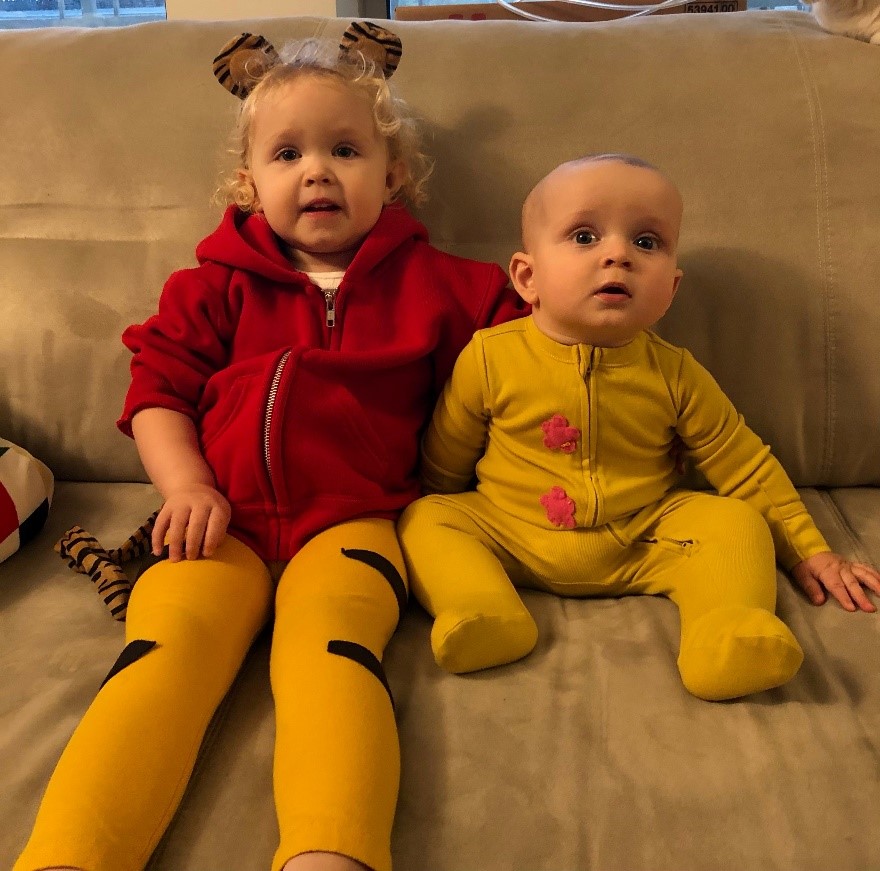
Okay okay! We recently had a chance to enjoy our new nephew’s one year baptism and birthday party. Nothing like a warm baptismal to get a kid really happy. Isn’t he cute? |
|
While we were chatting up the priest and his wife, someone/s stole our phone and used it to take a bunch of goofy selfies. Those persons should be punished. |
|
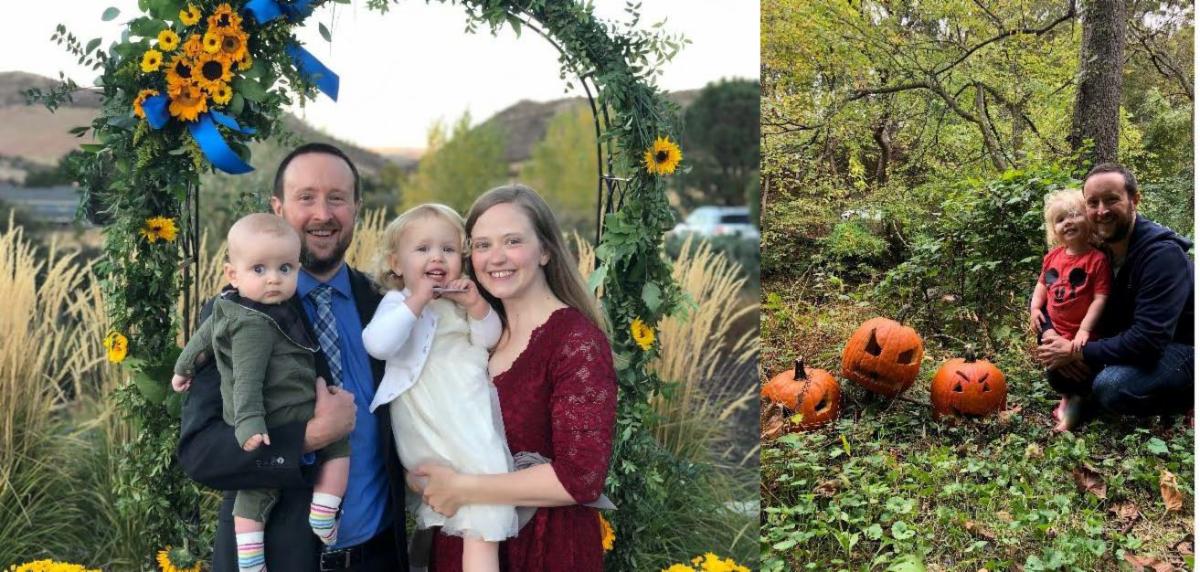
Not to worry! We have plenty of cute kids to show off today. Let’s end on a high note. Tyler Bond is kind enough to share his beautiful family – that’s son Clark in Tyler’s arms, and daughter Libby in the arms of Tyler’s wife Liz this summer. And, Libby and her Daddy get some scary pumpkins going right before Halloween.
|
|
Just. The. Cutest. Thank you Bond family! That’s it for this edition! ❤ Hug your people and change the world.
If you like this piece, please stick with us. We’ll be back in about two weeks. If you don’t like it, please unsubscribe below. Comments for us? Please let us know. Want your own subscription? Request one here. All information shared is from public sources or used with express permission.
|
|
Massena Associates provides process, policy, and implementation consulting on retirement savings programs and products.
Our clientele includes states, governments, policy organizations, and private sector providers. Our specialty – efficient, targeted results. We are an active speaker on retirement security topics, including state-facilitated programs, MEPs and more.
If you’d like to explore working together, we welcome the conversation. Connect with us here, and at 339-236-0684. |
|
Looking for a great retirement savings innovation resource? Led by Dr. Alicia Munnell, the Center for Retirement Research at Boston College develops and hosts terrific content and proprietary research related to states, financial security, social security, and more.
Pew’s Retirement Savings Project studies the challenges and opportunities for increasing retirement savings and is another great resource - check out the work of John Scott and his terrific team.
|
|
|
|
|
|
|