____________________

One story, curated by Gregory Bufithis. More about me here.

____________________


In NYC this week, a lot of AI talk, but no AI action. Because the UN is irrelevant. 


The United Nations is struggling for relevance in the immediate race to develop and deploy artificial intelligence.


But it will always be irrelevant. It cannot deal with the clash between fast-moving technology, private corporate power, and state sovereignty.


____________________


22 September 2026 (Athens, Greece) - As the global diplo-circus descended on New York City this week, there's no missing the topic du jour.


The global AI safety debate sparked by recent doom-laden warnings from current and former Anthropic researchers is now dominating chatter in briefings, receptions and buzzy dinner conversations during this week's high-level meetings of the U.N. General Assembly.


Every world leader worth their salt is in New York armed with:


  • hot-button AI talking points
  • hastily-drawn AI action plans
  • imaginary AI safety frameworks for imaginary AI coalitions


Even Trump noted it in his speech to General Assembly today. His comments? Not worth repeating.


But the main event for AI doomsters will come tomorrow when OpenAI chief Sam Altman flies in to bring some Silicon Valley glam to an open briefing for U.N. Security Council members about the risks posed by the revolutionary technology. Expect the warnings he delivers to be amplified by the grandiose setting - even if they're essentially the same ones he's been making since 2015.


But it's a telling sign of the U.N.'s diminished standing on the world stage that for all the AI chit-chat in New York this week, the most important meeting on frontier safety will be happening hundreds of miles away. Chinese President Xi Jinping arrives in the U.S. tomorrow - and he is UNGA all together. Instead he'll meet Trump in Washington D.C. for a two-day White House summit.


The state banquet thrown in Xi's honor on Wednesday night will include a who's who of AI royalty including Altman, X's Elon Musk, Google's Sundar Pichai and Nvidia's Jensen Huang. Anthropic boss Dario Amodei was not yet mentioned in the dinner invitee lists.


Trump and Xi's bilateral on Thursday will touch on AI, White House officials have confirmed, and U.S. Treasury Secretary Scott Bessent - one of the more hawkish Trump administration voices on AI regulation - met with Chinese Vice Premier He Lifeng today to tee up the talks.


But anyone expecting great leaps forward this week in terms of shared AI safety policy should probably not hold their breath. Both sides are coming to the AI conversation from such radically different places. No expect no real substance besides sort of vague notions of "yes, we should get along; yes, we should cooperate; yes, AI should be a force for good". Yadda yadda yadda.


The way AI has developed in the U.S. and China has led to deeply diverging views on where it may now be headed. In the U.S. the conversation is currently about how these private companies are taking this technology without any sort of regulation into places that could be incredibly damaging to humanity.


But in China, AI from the outset has been developed by companies that are state companies, or have very close state control. And so Beijing has always, to a certain extent, had more reins on this technology. They recognize that it’s dangerous but they are not at this sort of apocalyptic vision. They see it as needing regulation; at the same time, they see it as a valuable tool. It’s something they talk up in a positive way.


The "but, China!" reaction in the U.S. remains a critical argument for those who believe U.S. AI development must not be fettered by regulation. And that's significant, given plenty of U.S. policymakers believe any sort of meaningful deal with China is wholly unrealistic, given the fierce geopolitical competition and deep-seated lack of trust between the two sides.


Yes, both sides have an interest in ensuring that there are certain controls - so that, for example, people can’t develop new viruses, new pathogens. Both sides recognize that they don’t want this to get into the hands of dangerous, unpredictable non-state actors that can threaten them, either inside or on their borders.


So there are certain categories of cooperation which they should see as common ground, and which they could work on.


But the sort of wider, grand bargain stuff, you're not going to see anytime soon.


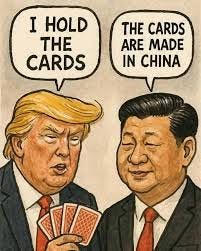
And China is in the driver's seat.


President Xi Jinping of China becomes only the second foreign leader - after King Charles III - to receive the honor of a state dinner in Trump’s second term.


How far we have come since 2016, when Trump accused China of “raping” the United States, or 2024, when he said “They are killing us as a country".


He acted on those concerns in April 2025 when he imposed heavy tariffs on China - up to 145%. China responded with restrictions on exports of rare-earth minerals, which threatened to cripple U.S. manufacturing, and Trump quickly backed down.


Not only did Trump lower tariffs on China (the effective tariff rate is now 23%), but, even more significantly, he also lowered restrictions on U.S. technology exports to China. In December 2025, he approved the sale of Nvidia’s second-most powerful artificial intelligence chip, which has helped China to gain ground on the U.S. in the AI race.


That trade truce paved the way in May for a congenial Trump-Xi summit in Beijing, where Trump gushed to Xi:


“We’re going to have a fantastic future together. It’s an honor to be your friend".


As with North Korean dictator Kim Jong Un, Trump doesn’t seem to notice that the bromance is entirely one-sided; Xi said nothing about being Trump’s pal.


Yet, as a token of his unrequited friendship, the Trump administration announced in May that it was pausing a $14 billion arms sales to Taiwan. He described it as a “negotiating chip” with China - thereby giving Beijing, for the first time, a say in whether the U.S. aids the embattled island democracy.


Trump has delivered even bigger gifts to China this year without meaning to. His unnecessary war with Iran, now in its 7th month, has badly depleted the weapons systems the U.S. would need to fight China. The Congressional Budget Office warns that “the large expenditure of missile defense interceptors” will take years to replenish, while Bloomberg reports that the blockade of Iran requires more than 30 percent of the U.S. Navy’s warships.


Many of those ships come from the 7th Fleet. The redeployment of the USS George Washington to the Middle East has left the Pacific without a single U.S. aircraft carrier.


So much for President Barack Obama’s “pivot to Asia”; Trump is pivoting from Asia.


In another sign of his China weakness, Trump gave Xi a pass despite recent reports that China (along with Russia) has provided satellite imagery that allowed Iran to target U.S. military bases:


“They basically do what we do. We spy on them, too”.


Well, yeah, true. The U.S. does spy on China. But it isn’t helping to kill Chinese soldiers or blow up Chinese bases. Do you get that?


Trump’s shrug about the Chinese threat is mirrored in U.S. strategy documents. Whereas Trump’s 2017 National Security Strategy described China and Russia as America’s primary threats, the Wall Street Journal reported that Trump personally intervened to take out such language from the 2026 National Defense Strategy. It now says:


“President Trump seeks a stable peace, fair trade, and respectful relations with China".


The 2025 National Security Strategy does acknowledge it would be “harmful” to U.S. interests if a “potentially hostile power” were to take control of the South China Sea, but it doesn’t name China as the power in question. In a similar vein, Defense Department leaders barely mentioned China or Taiwan when giving speeches in Asia this year.


Analysts say part of the change is undoubtedly due to the composition of the second Trump administration: China hawks are out, while economic officials like Treasury Secretary Scott Bessent have taken the lead.


Also influential: tycoons such as Elon Musk and Jensen Huang, who do business with China while donating to Trump’s pet causes. Part of the explanation may also be that Trump discovered, during last year’s trade war, the high cost of confronting China; like many bullies, he shies away from a fight if he fears getting hurt.


Finally, Trump is no fan of Taiwan — he imagines that “they stole our chip industry".


Wow, how things change.


Trump is going too far in wooing Xi without getting much in return. China continues to bully U.S. allies, including the Philippines, while providing aid to U.S. enemies, such as Iran, Russia and North Korea. Beijing is also charging ahead in one state-supported technological sector after another (BYD surpassed Tesla this year as the world’s largest manufacturer of electrical vehicles), while Trump remains distracted by his war with Iran and his compulsion to build monuments to himself.


C'est la vie. Trump might want to create a more congenial summit with Xi - but it isn’t good for the long-term interests of the United States or its allies.

* * * * * * * * * * * * * * 


For the URL link to this post, please click here


If this post was forwarded to you and you'd like to subscribe,

please email me at luminative.media@gmail.com


To read my other thoughts and musings,

please see my full web site by clicking here


* * * * * * * * * * * * * * 


Megalo Chorio

Southern Aegean

Greece


To contact me: 

Luminative.Media@gmail.com