September 2026 | 75th EDITION NEWSLETTER | | While the articles selected for this newsletter may not directly represent the opinions of the Missouri Employment Conference, they have been thoughtfully curated to spark interest and engagement among HR professionals. Each piece offers unique insights and perspectives that can enhance your understanding of the dynamic field of human resources. We encourage you to approach these articles with an open mind, as they are designed to inspire dialogue and promote a deeper exploration of the trends shaping our industry today. | | |
The Invisible Labor of Likability at Work
FastCompany | Ericka Sóuter | July 20, 2026
And how to rid yourself of the burden.
We’ve all been there. You email one coworker: “I need this by Thursday.” You email another: “Hi! Just checking back in. Would you be able to have this ready for me by Thursday? Totally understand if that doesn’t work. No rush, except that, sadly, there is a rush. Thank you so much.”
And then you read the second email three more times to ensure that you don’t sound impatient, demanding, passive-aggressive, or aggressive-aggressive. All that mental work is the invisible labor of likability. It’s the time you spend trying to make requests less direct or criticism easier to swallow.
The work no one sees
Women have historically been expected to manage the feelings of others at work. But they’re not the only ones. Junior employees. People of color. LGBTQ+ employees. People with disabilities. Workers who don’t come from privileged backgrounds. Anyone who has ever been told, implicitly or explicitly, that to succeed in a professional environment, they must not be “difficult.”
They may spend their days worrying about how they come across.
| | |
Want to Avoid Being Replaced By AI? A Former Microsoft Exec Says This Is How to AI-Proof Your Career.
Entrepreneur | Sherin Shibu & edited by Jessica Thomas August 13, 2026
He admits to fearing AI at first.
Rob Collie spent 13 years at Microsoft helping lead business intelligence work in Excel. Even with that technical background, he says that AI initially scared him.
“I wasn’t immune to that,” Collie says in a new interview with Entrepreneur about the technology’s potential effect on his business and career. He says his “fear turned into excitement” after he began studying how companies can actually put AI to work.
Now, as CEO of the 50-person consulting firm P3 Adaptive, Collie is betting that AI will not simply eliminate work. It will change who gets to create software, solve operational problems and become indispensable inside a company. Collie recently published a book about organizational AI strategy called Fair Game.
| | |
Missouri Employment Conference is proud to partner with the Missouri Workforce Development Board to bring you the following important information:
| | |
Why Employers Are Vital to Missouri’s Public Workforce System
Missouri State Workforce Development Board | August 2026
September is Workforce Development Month in Missouri, a time to recognize the connection between employer and jobseeker in the state’s workforce system.
Missouri continues to expand access to training, education, and workforce services so people across the state can pursue meaningful, rewarding careers while providing employers a strong, adaptable talent pipeline to support business operations.
Employers are not just participants in the workforce system—they are essential partners whose involvement directly shapes its effectiveness. Employer engagement ensures that programs and resources truly meet the needs of Missouri’s economy.
| | |
Why Hiring Numbers Hide the Real Workforce Story
HR Executive | Jill Barth | August 13, 2026
July’s jobs report showed that payrolls fell even as layoff announcements hit a two-year low and hiring plans jumped.
For Peter Miscovich, global future of work leader at JLL, the numbers don’t offer a full explanation. “Workforce transformation is becoming more nuanced, and it cannot be fully captured by traditional headcount metrics in jobs reports.”
Miscovich says multiple shifts are happening inside companies at once, pointing to a pattern JLL’s Future of Work research has been tracking in its global survey of more than 2,200 executives, many of them working in commercial real estate. “Some roles may be reduced or eliminated while other roles will expand and then entirely new roles are also being created, often within the very same organization, and all at the same time,” he told HR Executive.
| | |
The Rise of Pro Se Employment Litigation: Why Employers Should Take Notice
MEC Sponsor McMahon Berger | Victoria Purcell | August 17, 2026
The volume of pro se employment lawsuits is surging thanks to generative artificial intelligence (“AI”) tools such as ChatGPT.
These tools have been subtly changing how those cases look. Seldom do we now see sloppy handwritten nonsensical filings by unrepresented individuals. Thanks to generative AI tools, pro se plaintiffs are filing more complaints, motions and briefs than ever before – documents that look far more polished on their face than the filings of the past. That surface polish, however, is often misleading: the work product is frequently not as sound, well-supported, or procedurally correct as the AI leads the plaintiff to believe. Even so, employers cannot ignore these filings, and responding to them generates burdensome and costly work that falls squarely on the defense.
| | |
Employment Law Is Becoming the Law of Information
Forbes | Alonzo Martinez | August 10, 2026
Lawmakers are increasingly regulating the "upstream" process of employment decisions, focusing on how information is created, maintained, and processed, rather than just the final hiring outcome. This trend addresses diverse policy concerns like criminal history, credit reports, and AI bias. Examples include Illinois' Clean Slate laws correcting criminal records, Missouri's automated expungement, New York's restrictions on credit checks, and Washington's Fair Chance Act dictating criminal history evaluation.
California's pending AI legislation further exemplifies this by requiring human corroboration and accuracy in automated hiring tools. This shift means legal interventions are occurring earlier in the information lifecycle, impacting what data reaches employers and how it's used, fundamentally reshaping the regulatory landscape before any employment decision is made.
| | |
How Employers Can Help Women Avoid The 'Daughter Tax'
Employee Benefits News | Lee Hafner | August 13, 2026
Key insight: Discover how unpaid caregiving for aging parents is impacting the careers of working daughters.
Expert quote: "The employer has an ability to give these high performers a tool, an education, so that they can get ahead." Lily Vittayarukskul, Waterlily
Supporting data: Caregivers spend an average of more than $7,000 annually on related expenses.
Daughters are nearly two times (1.9) more likely than sons to provide unpaid, hands-on care for aging parents, according to recent analysis from AI-powered long-term care prediction platform Waterlily.
If they're working at the same time, what impact does this caregiving role have on these women's careers and financial futures?
| | |
Over it! 20 Outdated Practices Driving Employees to Quit
Cha Ching Queen | July 14, 2026
In the modern workplace, retaining top talent is more important than ever. Employees today seek environments where they feel valued, empowered, and supported in their professional growth.
Yet, outdated practices persist in many organizations, creating frustration and disengagement that can lead employees to seek better opportunities elsewhere. Addressing these challenges is essential to building a workplace where employees want to stay and thrive.
A recent Gallup study highlights that 42% of employee turnover could be prevented, emphasizing the need for organizations to understand and resolve underlying causes of dissatisfaction.
These outdated practices are often at the root of the problem, making employees feel undervalued and disengaged.
| | |
A More Perfect Workplace: A Plain-English Guide to Constitutional Law for Municipal HR
Adapted from a presentation by Brent L. Hinders, J.D., MPA, | MEC Sponsor Hinders, Updegraff, Franklin & Limkemann, P.L.C.
If you do HR for a city, county, or school district, you're playing a different game than the HR manager at the factory across town.
When a private company fires someone over a Facebook post, the Constitution never comes up. When your municipality does it, the Constitution is the whole conversation, which, if handled incorrectly, can result in the employee suing you directly for violating it.
That's the core difference: you are the government. The Bill of Rights follows you into every investigation, every accommodation request, every desk search, and every termination meeting.
Here are the five areas where public employers get into the most trouble, and what to do about each one.
1. Employee Speech
An employee posts something that makes your phone ring. Your first instinct is to ask, "Was that appropriate?"
That's the wrong question. Courts ask three different ones, in this order.
Question 1: Was the employee just doing their job?
If someone said or wrote something as part of the work they're paid to do, they generally have no free-speech protection. A report you assigned, an email they sent to the department, a statement made in their official role are all subject to discipline. This is where most employee speech cases end.
| | |
Cities Need a New Workforce Strategy. Universities Should Be Part of It.
Smart Cities Dive | Michael Birzer | August 7, 2026
Local governments facing labor shortages can build stronger talent pipelines and improve public services through deeper partnerships with higher education, a criminal justice professor says.
Cities across the U.S. are struggling to recruit skilled workers, modernize government and prepare the next generation of public servants. Too often, they overlook one of the most powerful partners they already have to accomplish those goals: their local university.
The Wichita-Sedgwick County Law Enforcement Training Center is a case in point. Eight years ago, during a leg-stretching pause in a meeting between representatives from Wichita State University and the city of Wichita to select a new police chief, our city manager brought up the need for a new police academy. I saw an opportunity that would benefit Wichita State students, local law enforcement and the community.
| | |
From Data to Decisions: Why America’s Cities Turn to the American Community Survey
NLC Citispeaks Blog | George M. Cook, Performing the Duties of the Director, U.S. Census Bureau | August 7, 2026
Every day, city leaders are asked to make decisions that shape the lives of their residents: What data can help attract employers and support economic growth? Where should housing investments be targeted? How can emergency services better serve the community? Answering these questions requires reliable, high-quality data about the people who live and work in their communities.
That’s where the U.S. Census Bureau’s American Community Survey (ACS) comes in. The ACS is our nation’s premier source of detailed social, economic, housing and demographic data. And for more than two decades, it has helped cities understand the changing needs of their residents.
Conducted continuously throughout the year, the ACS provides annual insights into communities across the country, helping create a rich statistical portrait of our nation.
| | |
Small Town Sunshine Law Battles Share a Common Law Firm
Missouri Business Alert | Genevieve Smith and Annie Goldman | August 13, 2026
In a small town where everyone knows everyone, it’s hard to keep secrets.
So when local governments hide their business, it can be especially galling to the residents they represent, and faith in local governance begins to plummet.
And when transparency and accountability are absent, it’s easier for drama and intrigue to take over.
Take Belle, where a city alderman says her fellow leaders have done all they can to prevent her from communicating with the public.
Or Vienna, where a former sheriff was accused of some serious misdeeds, but it took a judge’s ruling for city leaders to hand over documents detailing those allegations.
| | |
How Municipalities are Modernizing and Funding Critical Infrastructure
Amaresco | July 21, 2026
Key Takeaways
Municipalities can modernize infrastructure without upfront capital using ESPCs and grants.
Energy projects do more than reduce costs. They unlock new revenue, improve service delivery, and fund community priorities.
Bundled projects deliver greater financial and operational impact than single-scope upgrades.
Energy upgrades can help municipalities address deferred maintenance while modernizing aging systems, improving reliability, and reducing long-term operating costs.
Early project success helps cities secure funding and scale investment.
| | |
State Association Policy Priorities
National Association of Counties | Isabella Reed | July 13, 2026
In 2026, amidst an evolving intergovernmental landscape, counties are continuing to deliver essential services and serve local communities. State associations of counties advocate for county governments at the state level in capitol buildings across the country.
State associations of counties provide a wide range of services to their members, including legislative advocacy, research, training, consultation and publications at the state level.
In advance of each state’s legislative session, most associations establish legislative priorities to guide their staff and members in addressing the most pressing issues and key pieces of legislation under consideration in their statehouses.
| |
Purpose and Responsibilities
The Missouri Association of Counties (MAC), formed in 1972, is a nonprofit, nonpartisan member service organization dedicated to the improvement of county government. It was designed and incorporated by county elected officials to provide services, research, uniformity, and coordination among member counties, in order for the county elected officials to best serve their constituents.
| |
MAC’S TRIMESTER MAGAZINE
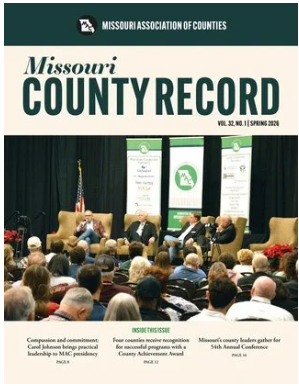
Missouri County Record
Covering all statewide news and information important to counties and county governance.
The Missouri County Record is a magazine published quarterly by the Missouri Association of Counties, a statewide lobbying group headquartered in Jefferson City, Mo. The publication generally runs 32 pages in length, and it is distributed to more than 1,400 subscribers (including county elected officials who purchase supplies, equipment, and services for Missouri county governments; all state administrative, commission, and department directors; members of the state General Assembly; as well as national affiliate associations.
| | |
Paying Ahead on Your Liabilities Can Help Stabilize Future Contributions
MO Lagers | August 6, 2026
Each month, employers make contributions to LAGERS to fund retirement benefits for their employees. Your monthly contribution amount is calculated by multiplying your LAGERS-covered payroll by your employer’s monthly contribution rate. Making this required contribution each month ensures your employees’ benefits are being properly funded.
LAGERS is designed to fund employer liabilities through your monthly contributions. An unfunded liability is not something that requires immediate payoff or should automatically be a cause for concern. Rather, your monthly contribution rate includes an amount specifically designed to pay down any liability over time.
However, employers have additional financial tools available if they choose to pay down an unfunded liability more quickly. Employers may make a voluntary lump-sum payment or voluntarily pay a higher contribution rate. While these additional payments are never required, they can be useful tools for employers who want to take a proactive approach to managing their pension liability.
| | |
As an organization with diverse functions, the U.S. Department of Labor carries out its mission through a number of offices and agencies. These are organized into major program areas, and headed by an Assistant Secretary or other official.
| |
A Simpler Way to Get Answers About Workplace Benefits
Dept of Labor Blog | Leyla Mansur, Becki Marchand | June 1, 2026
What do I do if my employer didn’t forward my 401(k) contributions? How will having a baby affect my health insurance? My employer is out of business – how do I get my retirement benefits? My insurance provider is making me jump through hoops to get depression treatment – is that legal? How long does my former employer have to send me a COBRA election notice?
The U.S. Department of Labor’s Employee Benefits Security Administration is launching a new webpage to help workers, retirees, and their families quickly find answers to these and similar questions.
| |
I-9, Employment Eligibility Verification
Use Form I-9, Employment Eligibility Verification, to verify the identity and employment authorization of individuals hired for employment in the United States. All U.S. employers must properly complete Form I-9 for every individual they hire for employment in the United States. This includes citizens and aliens. Both employees and employers (or authorized representatives of the employer) must complete the form.
| | |
Confirm with Confidence
Enroll in E-Verify for fast and efficient employment eligibility verification.
It only takes a few simple steps to enroll in E-Verify and begin confirming the employment eligibility of all of your new hires.
| | |
Missouri Revisor of Statutes
August 28, 2026
Employment of unauthorized aliens prohibited — federal work authorization program, requirements for participation in — liability of contractors and subcontractors.
1. No business entity or employer shall knowingly employ, hire for employment, or continue to employ an unauthorized alien to perform work within the state of Missouri.
2. As a condition for the award of any contract or grant in excess of five thousand dollars by the state or by any political subdivision of the state to a business entity, or for any business entity receiving a state-administered or subsidized tax credit, tax abatement, or loan from the state, the business entity shall, by sworn affidavit and provision of documentation, affirm its enrollment and participation in a federal work authorization program with respect to the employees working in connection with the contracted services.
| | |
E-Verify’s Expanded Status Change Report: What Employers Need to Know
Through the Immigration Lens | Dawn Lurie, John Mazzeo & Alexander Madrak | August 12, 2026
U.S. Citizenship and Immigration Services (USCIS) has announced a significant expansion of the E-Verify Status Change Report, creating new compliance obligations for E-Verify employers and substantially increasing the number of employees who may appear on the report. Employers should review their internal processes now to ensure they are prepared to identify affected employees and complete reverification where required.
What Has Changed?
Previously, the Status Change Report was limited to certain Employment Authorization Documents (EADs) issued to Humanitarian Parolees under EAD Category Code C11. USCIS has now expanded the report to include invalidated EADs associated with several additional categories, including Temporary Protected Status (TPS) beneficiaries (Category Codes A12 and C19), asylum applicants (Category Code C08), and adjustment of status applicants (Category Code C09).
From an employer compliance perspective, this development is noteworthy because an employee may continue to possess an EAD that appears facially valid even though the underlying employment authorization has been revoked or terminated by the Department of Homeland Security (DHS). DHS does not collect revoked EADs. Under the revised reporting framework, employers may receive notice of these status changes through E-Verify and will be expected to respond appropriately.
| | |
Training Requirements and Resources
OSHA provides information on employers' training requirements and offers resources such as free publications, videos, and other assistance to help employers protect workers against injuries and illnesses.
| | OSHA provides safety and health resources specifically designed for small businesses. Find information on complying with OSHA standards and receive advice you can trust through OSHA's no-cost and confidential On-Site Consultation Program. | | |
Compliance Assistance, Education, and Training
OSHA is committed to meeting employers where they are and empowering them to build strong safety cultures. Learn how OSHA is helping employers foster safer and healthier workplaces. Investments in worker safety and health can also reduce injuries and illnesses, and produce significant improvements to an organization's productivity and profitability.
| | |
Fifth Circuit Strikes Down OSHA’s Mental Illness Reporting Rule
HR Digest | Priyansha Mistry | August 13, 2026
A federal court ruling has created a clear legal divide between physical and mental health. Today, this ruling has led to even farther distance between dispute-heavy burden of compliance for companies and the modern medical understanding of mental illnesses.
In a July 21 ruling, the Fifth Circuit Court of Appeals said that the Occupational Safety and Health Administration (OSHA), doesn’t have the statutory authority to require employers to record employees’ work-related mental illnesses. What’s noteworthy is that it threw out the citation and penalty issued against Exxon Mobil, as well as the rule itself.
In simple terms, the federal appeals court has overturned a rule that requires employers to keep track of work-related mental illnesses.
A little history on OSHA’s record-keeping requirements
The case concerns a regulation that goes back to the Occupational Safety and Health Act of 1970, which includes a section mandating that employers record injuries or illnesses occurring on the job.
Since 2001, employers have been required to record work-related mental illnesses under the 1970 ruling, provided an employee voluntarily notifies them of their condition through an opinion from a physician or other licensed professional.
| | Monthly newsletter featuring compliance assistance, training and other workplace safety and health resources. | | |
The U.S. Equal Employment Opportunity Commission (EEOC) is responsible for enforcing federal laws that make it illegal to discriminate against a job applicant or an employee because of the person's race, color, religion, sex (including pregnancy, childbirth, or related conditions, transgender status, and sexual orientation), national origin, age (40 or older), disability or genetic information.
Most employers with at least 15 employees are covered by EEOC laws (20 employees in age discrimination cases). Most labor unions and employment agencies are also covered.
The laws apply to all types of work situations, including hiring, firing, promotions, harassment, training, wages, and benefits.
| | |
EEOC Resources
Need information about a specific discrimination topic? We've categorized EEOC material for small businesses categorized by topic, so you can find what you need quickly and easily.
| | |
Employers
The U.S. Equal Employment Opportunity Commission enforces Federal laws prohibiting employment discrimination. These laws protect employees and job applicants against employment discrimination when it involves:
- Unfair treatment because of race, color, religion, sex (including pregnancy, gender identity, and sexual orientation), national origin, age (40 or older), disability or genetic information.
- Harassment by managers, co-workers, or others in the workplace, because of race, color, religion, sex (including pregnancy), national origin, age (40 or older), disability or genetic information.
- Denial of a reasonable workplace accommodation that the employee needs because of religious beliefs, disability, or pregnancy, childbirth, or related medical conditions.
-
Retaliation because the employee complained about job discrimination or assisted with a job discrimination investigation or lawsuit.
| | |
Understanding The EEOC’s New National Enforcement Plan: Changing Priorities, Changing Risks
HR Executive | Moire Morón | August 13, 2026
Employment risks rarely arrive without warning. More often, they emerge gradually through court decisions, regulatory actions and shifts in enforcement priorities. Individually, those developments may seem incremental, but as a whole, they can significantly alter the risk landscape for employers.
The Equal Employment Opportunity Commission’s recent decision to replace the prior administration’s enforcement framework with a new National Enforcement Plan (NEP) represents one such shift. While much of the public discussion surrounding the Plan has focused on its approach to diversity, equity, and inclusion (DEI) initiatives, the Commission’s substantive priorities extend beyond DEI and include issues such as anti-American national origin discrimination, religious liberty and sex-based rights and protections.
| |
National Law Review:
Latest business law news and legal analysis...
| | |
AI in Workforce Decisions - Privilege Strategies and Policy Guardrails Every Employer Needs
National Law Review | Shirley S. Lou-Magnuson, Ballard Spahr LLP | August 19, 2026
A recent lawsuit filed in the Northern District of California alleges that AI-based tools used to score, rank, and select employees for a reduction in force discriminated against workers on protected leave and those with disabilities. The lawsuit alleges this occurred, in part, because the AI-system’s inputs, such as productivity metrics and “AI-native” ratings, could not be accumulated by employees who were absent or working under various accommodations. The complaint further asserts that, based on information and belief, the employer did not neutralize those inputs for protected leave; did not exclude protected-leave-takers or accommodation-seekers from the selection cohort; and did not pause the system for the individualized, leave- and accommodation-neutral review that the law requires.
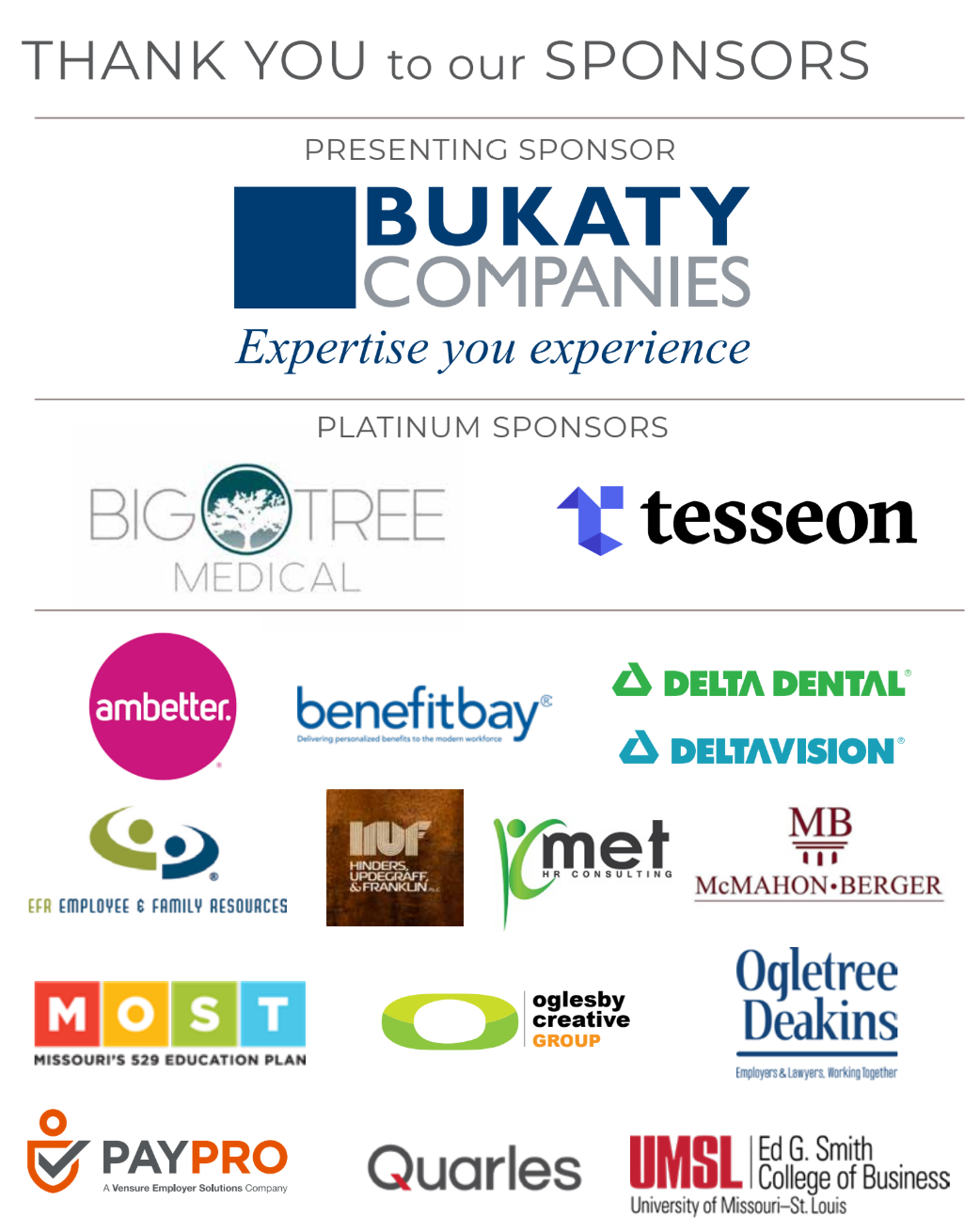
| | First 10 Sponsor Registrations Unlock This Limited‑Time Savings! | | GRATEFUL FOR THESE 2026 SPONSORS! | | | | |
Bukaty Companies is one of Kansas City’s top-ranked employee benefits and insurance brokerage firms.
Contact Kent Friend 913-777-7535 for more info!
| |
HR CONSULTING & TRAINING
Shifting rules and new regulations are complicating the human resource world. Our HR Consulting & Training team has the expertise to navigate through the catalog of compliance requirements – FMLA, FLSA, ADA, CAA, and more. We offer a wide array of services to address common challenges today’s HR professionals face.
| | |
Avoid 2027 Employer ACA Penalties
MEC Presenting Sponsor Bukaty Companies | July 22, 2026
The Affordable Care Act (ACA) creates compliance responsibilities for applicable large employers (ALEs). As healthcare costs and regulatory requirements evolve, so do the potential penalties for employers that fail to offer affordable, compliant health coverage to eligible employees.
2027 ACA penalties
For the 2027 reporting year, ACA penalty amounts have increased. ALE's may face two types of penalties.
4980H(a) Penalty – Failure to Offer Coverage
Employers that do not offer minimum essential coverage (MEC) to at least 95% of their full-time employees and their dependents may face a penalty of $3,780 per full-time employee (adjusted annually for inflation). This penalty is calculated based on the number of full-time employees, excluding the first 30 employees.
4980H(a) Penalty – Coverage That Is Not Affordable or Does Not Provide Minimum Value
Employers that offer coverage but fail to meet ACA affordability or minimum value requirements may face a penalty of $5,670 per full-time employee who receives a premium tax credit through the Marketplace.
Even employers that offer robust benefit plans can face exposure if eligibility tracking, affordability calculations or reporting processes are not managed correctly.
Common ACA compliance challenges
ACA compliance requires more than offering a health plan. Employers must maintain accurate employee classification, monitor hours worked, track eligibility, and complete annual reporting requirements.
Common areas where employers encounter challenges include
- misclassifying employee status,
- failing to monitor benefit eligibility throughout the year,
- incorrect affordability calculations,
- inaccurate Form 1094-C and 1095-C reporting, and
- inconsistent documentation of eligibility and enrollment decisions.
| | |
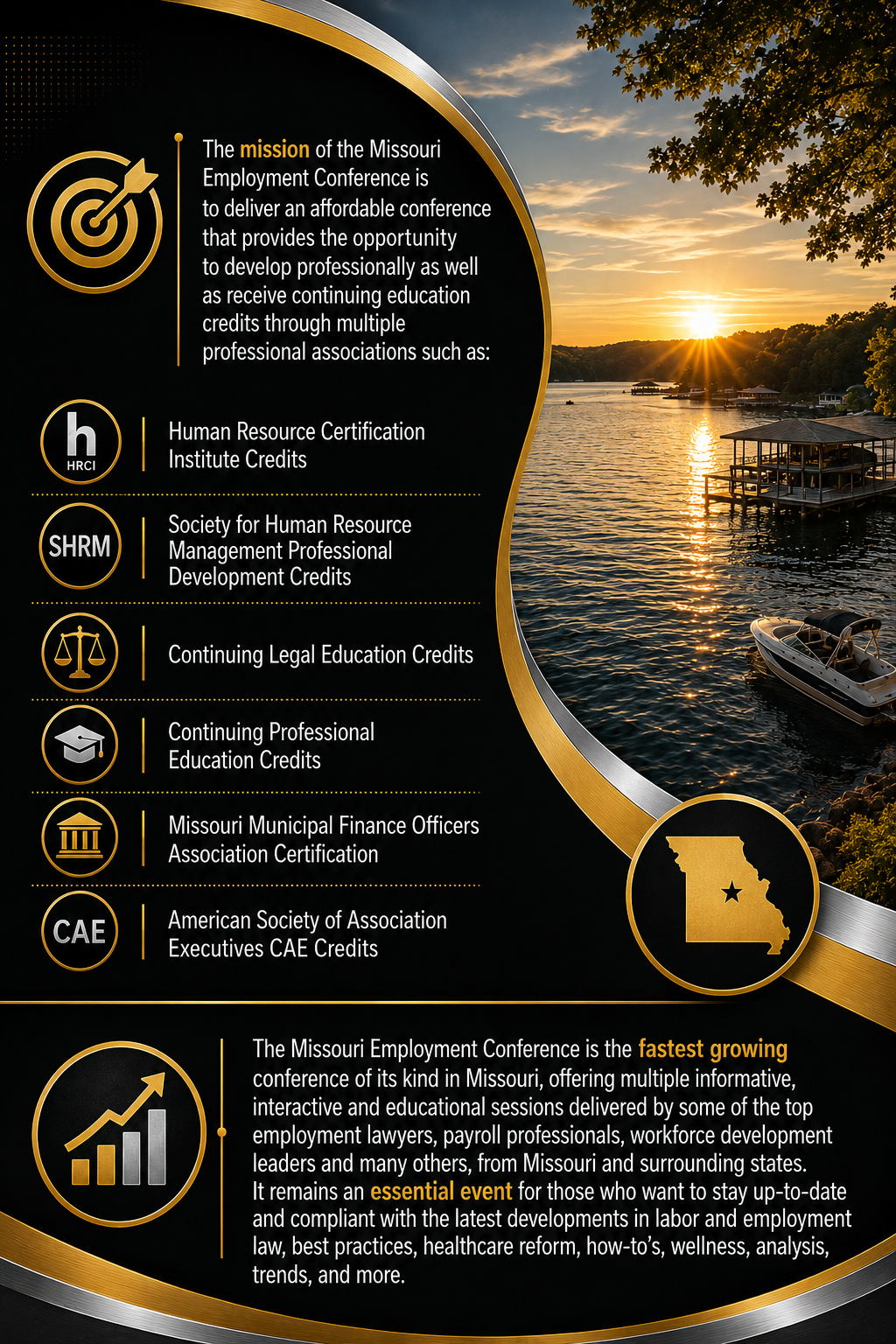
MEC is THE source for classroom instruction covering topics in the areas of employment, training, benefits & wellness education.
It remains an essential event for those who want to stay up-to-date and compliant with the latest developments in labor and employment law, best practices, healthcare reform, training, wellness, analysis, trends, and more.
Earn CEUs while networking with top industry professionals!
| | This program has been pre-approved for HR (General) recertification credit hours toward aPHR™, aPHRi™, PHR™, PHRca™, SPHR™, GPHR™, PHRi™ and SPHRi™ recertification through HR Certification Institute™ (HRCI™). | | Missouri Employment Conference is recognized by SHRM to offer Professional Development Credits (PDCs) for SHRM-CP® or SHRM-SCP® recertification activities. | | |
Resources for Mental Health Support
988 Suicide & Crisis Lifeline: Call or text 988, or chat at 988lifeline.org/chat for free and confidential support from trained crisis counselors 24/7.
Substance Abuse and Mental Health Services Administration's free help line: Call 800-662-4357 for 24/7 mental health support in English or Spanish.
| | | |
Working From Home Has a Grim Effect on Your Brain, Surprise Research Finds
Futurism | Frank Landymore | July 2026
Most people would kill for a work-from-home job, but it turns out it can have some grim effects on your mental health.
A new study published in the journal Science found that remote workers were more likely to report feeling anxious, depressed, and being socially isolated compared to people who worked in-office. No commute and having the comforts of home is undoubtedly an upside, but it seems there’s no substitute for genuine social connections.
Nicholas Epley, a professor of behavioral science at the University of Chicago’s Booth School of Business who wasn’t involved in the study, told NPR that workers might be underestimating the value of being to “reach out to connect with other people,” and that “people might be choosing poorly” in terms of their well-being.
Until now, most studies have focused on remote work’s impact on productivity and job satisfaction, according to an editor’s summary, while there’s been little insight into its relationship to loneliness and mental health.
| | |
SERVANT LEADERSHIP
By definition, Servant Leadership is a leadership philosophy in which the goal of the leader is to serve. If you are in a place where your talent and skills will help others, by all means, use them. We are proud of the work our leaders have done and hope that if you are in a place to serve, you choose to step up.
| | |
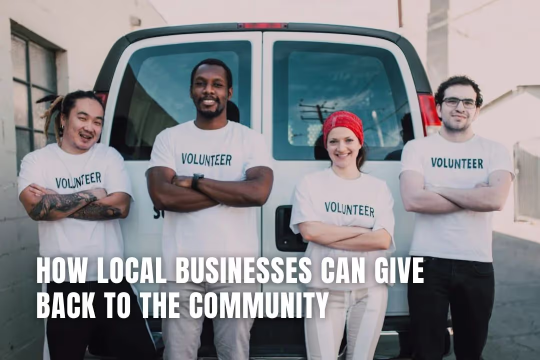
How Local Businesses Can Give Back to the Community
Robin Waite The Fearless Business Coach | February 11, 2026
Local businesses are more than just places to shop or receive services; they are an essential part of the community’s identity and well-being. Their success is closely tied to the support they receive from local residents, and giving back is a meaningful way to strengthen this bond.
Community involvement is not just a responsibility; it is an opportunity to make a real difference. Whether it’s through charitable donations, hands-on community work, or initiatives that uplift residents, businesses have the power to create lasting change.
When businesses actively engage in community work, they build trust, foster loyalty, and inspire other organisations to follow suit. Employees also benefit, as participating in these efforts creates a sense of purpose beyond their daily responsibilities.
The key is to find meaningful and sustainable ways to contribute that align with the company’s values and the community’s needs.
| | |
National Veterans Outdoors Resource HUB - Find Adventure for Veterans Across the USA
US Vet Connect Inc. is a tax-exempt 501c3.
(federal tax ID #85-0815848)
US Vet Connect Inc.'s National Veterans Outdoors Resource HUB is bridging the gap between veterans and the outdoors by providing a place to come together to find military comradery in outdoor experiences. The mission of USVetConnect.com is simple: it is to raise awareness for organizations that have a direct impact on veterans’ lives and to make it as user-friendly as possible for veterans to find their next adventure.
All contributions are tax-deductible to the extent allowable by law.
| | |
Donations here fuel the HUB—US Vet Connect Inc.—and our mission to empower, connect, and inspire. If you want to support one of the 270+ outstanding veteran- focused organizations in our directory, please donate to them directly through their own unique websites.
Your gift here keeps The HUB running strong for all.
Ready to help veterans rise, thrive, and embrace new adventures?
Donate now and light the way for someone’s next big journey!
| | |
How Back-To-School Season Affects Working Parents, and Their Employers.
Kelly Services | July 27, 2026
Here's what you Need to Know about back-to-school season:
Back-to-school season doesn't just mean new supplies and schedules for parents. It reshapes how much work and caregiving overlap, new data shows how unevenly that load falls, and it's a reminder that employers may already have legal obligations tied to school schedules.
- The school calendar and the standard workday were never designed to align, with early release days, four-day school weeks and long summer breaks leaving many working parents piecing together coverage.
-
70% of full-time working parents say they handle parenting tasks while they're working, and 59% say they handle work tasks while they're with their kids, according to Pew Research Center.
- Roughly eight in ten full-time working moms handle parenting tasks during the workday, more than double the share of dads who say they do so often.
- Eleven states plus D.C. now require employers to provide time off for school-related activities by law, not just as company policy.
- Childcare costs don't disappear once school starts: having one child adds roughly $20,000 a year to a family's basic cost of living, and childcare accounts for about half of that.
| | |
15 Easy Back-to-School Dinners for the Busiest Nights of the Year
SeriousEats | Emily Johnson | August 12, 2026
Credit: Serious Eats / Greg Dupree, Prop Stylist: Abby Armstrong, Food Stylist: Sally Mckay
Lazy summer nights are about to turn into chaotic evenings shuffling from activity to activity. These recipes will help.
Lazy summer nights are coming to a close. If busy evenings spent shuffling kids back and forth between school and extracurriculars are looming forebodingly in your mind right now, let’s take one thing off your plate—or, rather, helpfully put it on your plate. The dinner ideas below are easy and crowd-pleasing, so they’re perfect for back-to-school season.
Easy can mean different things to different people, and every night brings different needs. For those reasons, some of these recipes are one-pan for nights when you don’t have it in you to tackle a big pile of dishes; some of them come together in less than 30 minutes (or even less than 20 minutes) for nights when you don’t want to do a lot of prep work; and some are make-ahead options for the nights that you need to pop something premade into the oven.
| | |
September always seems to bring a welcome shift. Summer begins to wind down, school is back in session, schedules fill up again, and there’s just a hint of fall in the air. It’s a season that reminds us to settle back into our routines while also making time for the people and communities around us.
As we head into a busy fall, we hope you’ll find a few opportunities to slow down and connect. Check in on a friend or colleague you haven’t heard from lately. Make time for family. Support a local organization, volunteer, donate, or simply lend a hand where you see one is needed. Small gestures of kindness and generosity have a way of making a much bigger difference than we realize.
Community has always been at the heart of the Missouri Employment Conference. We’re grateful for the relationships that have grown through this conference over the years and for the employers, HR professionals, speakers, sponsors, and friends who continue to support one another and make this community so special.
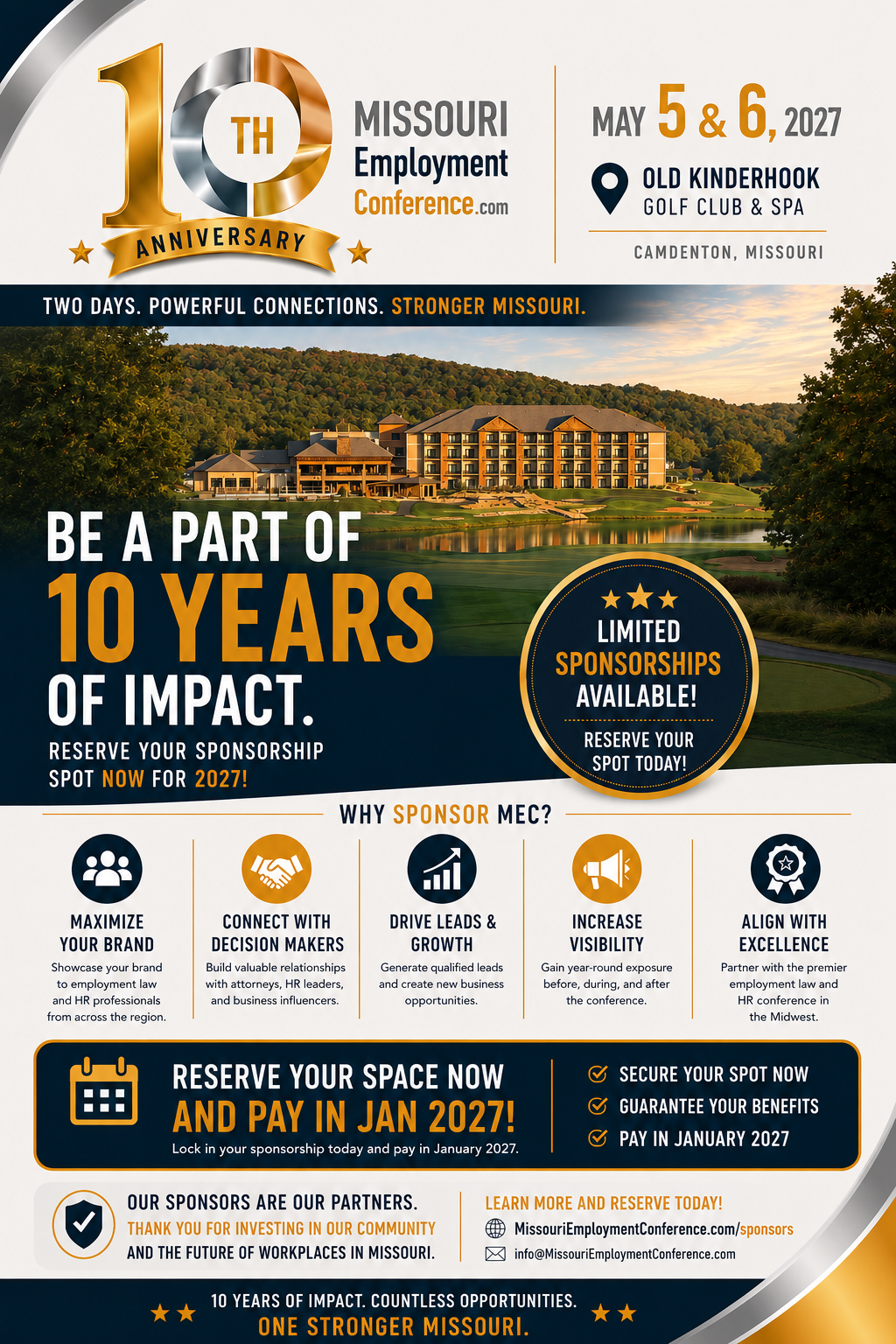
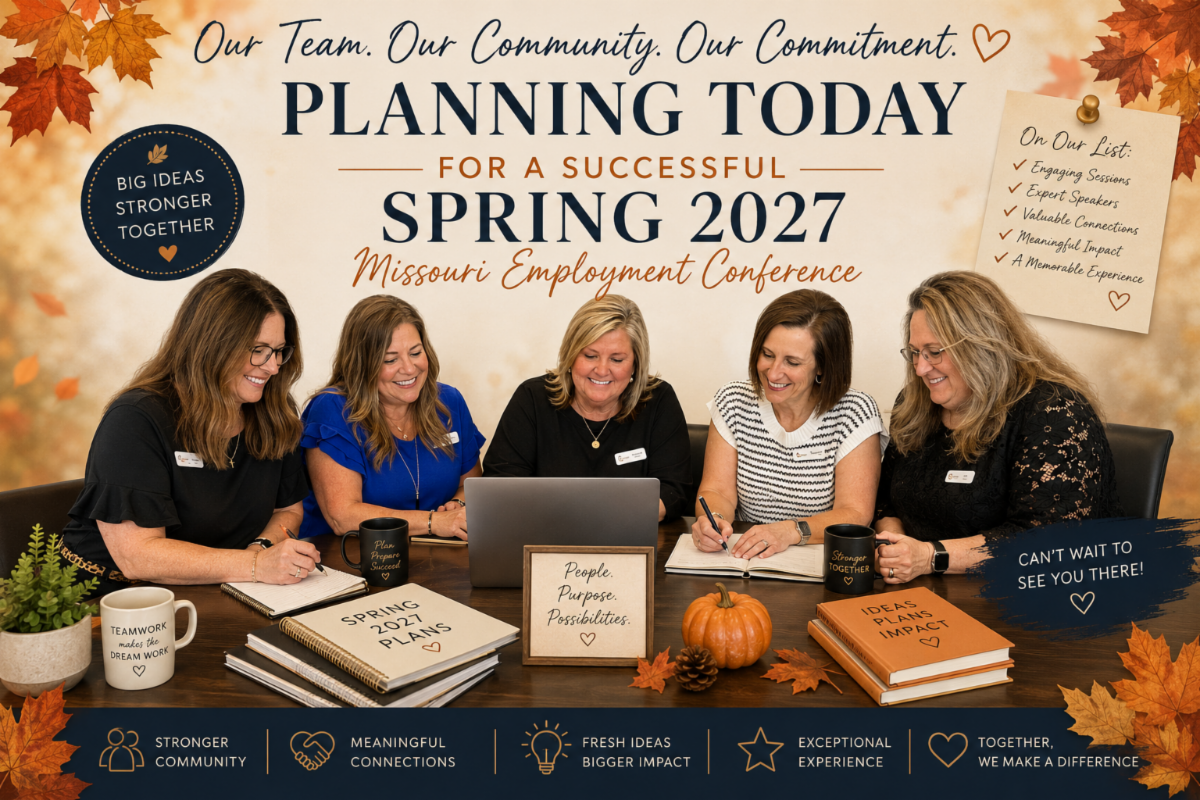
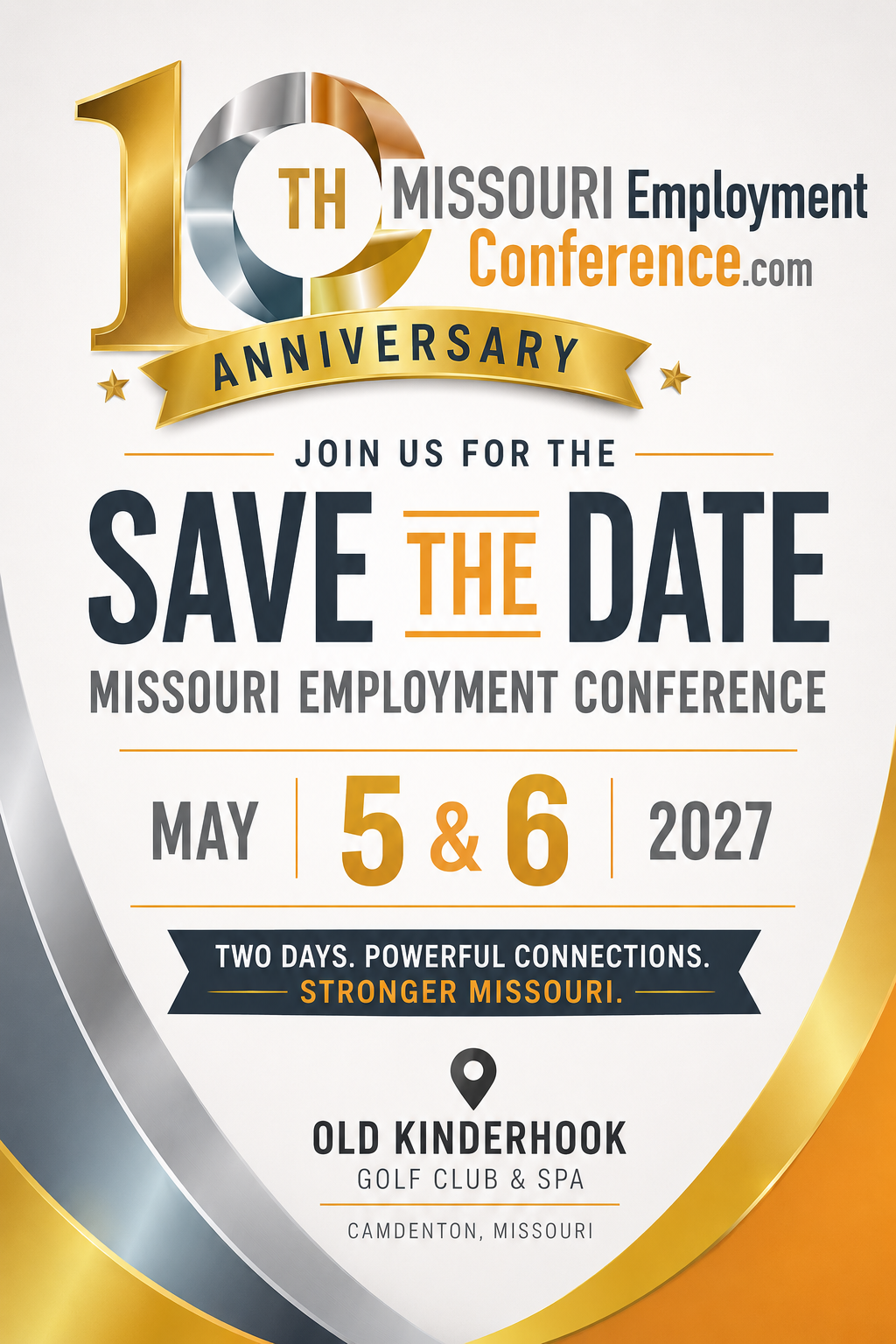
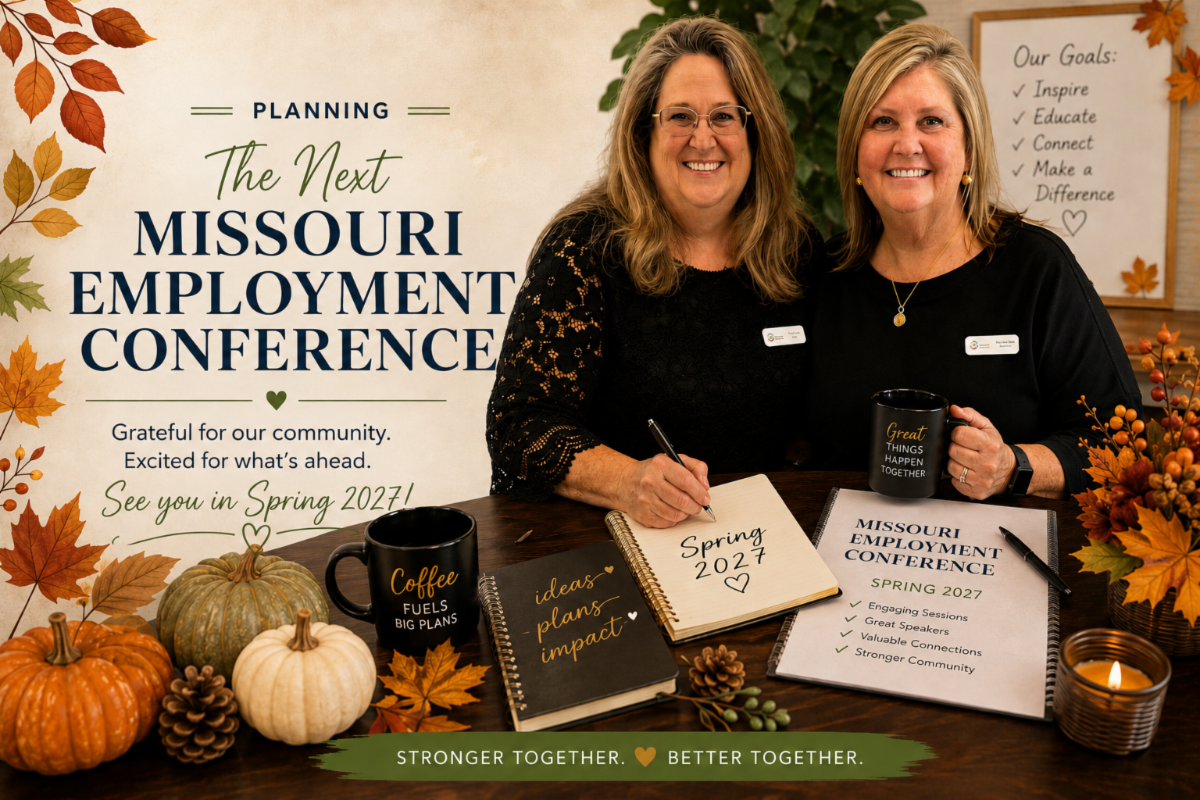
Behind the scenes, we’re already looking ahead and making plans for the Spring 2027 Missouri Employment Conference! There is plenty of work—and plenty of fun—ahead as we begin putting together another great conference. We can’t wait to share more with you in the coming months.
Until then, enjoy the changing season, take care of yourselves and each other, and remember to make a little room in those busy fall calendars for the people who matter most.
Sue & Nan
| | | | |