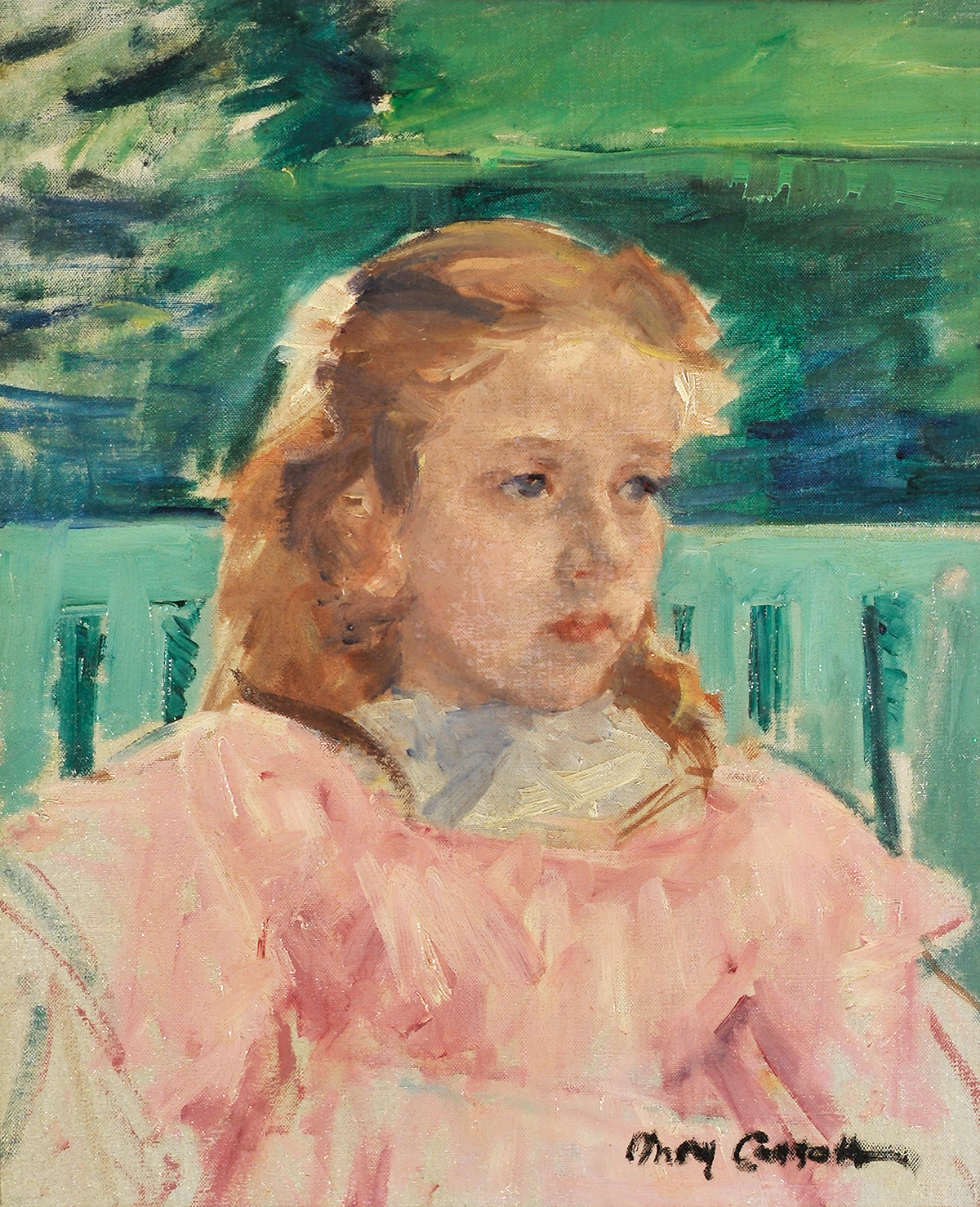
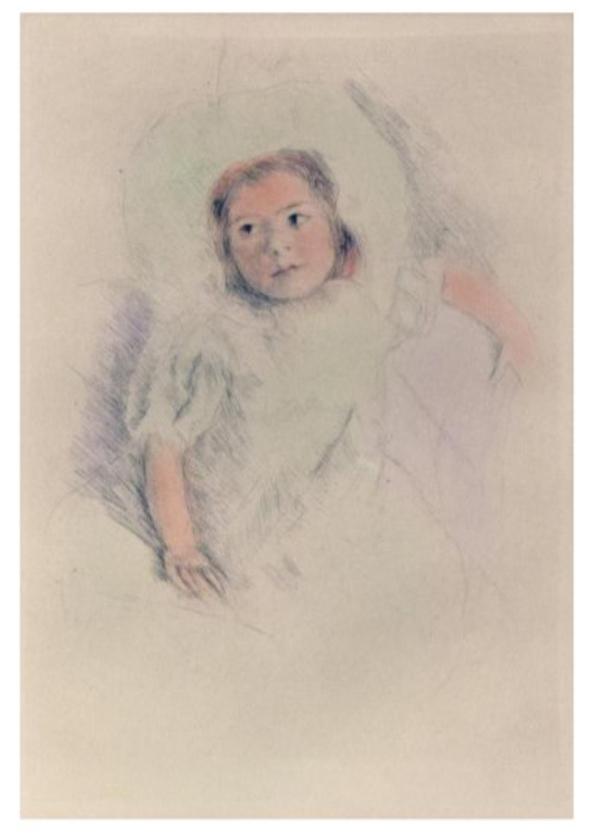
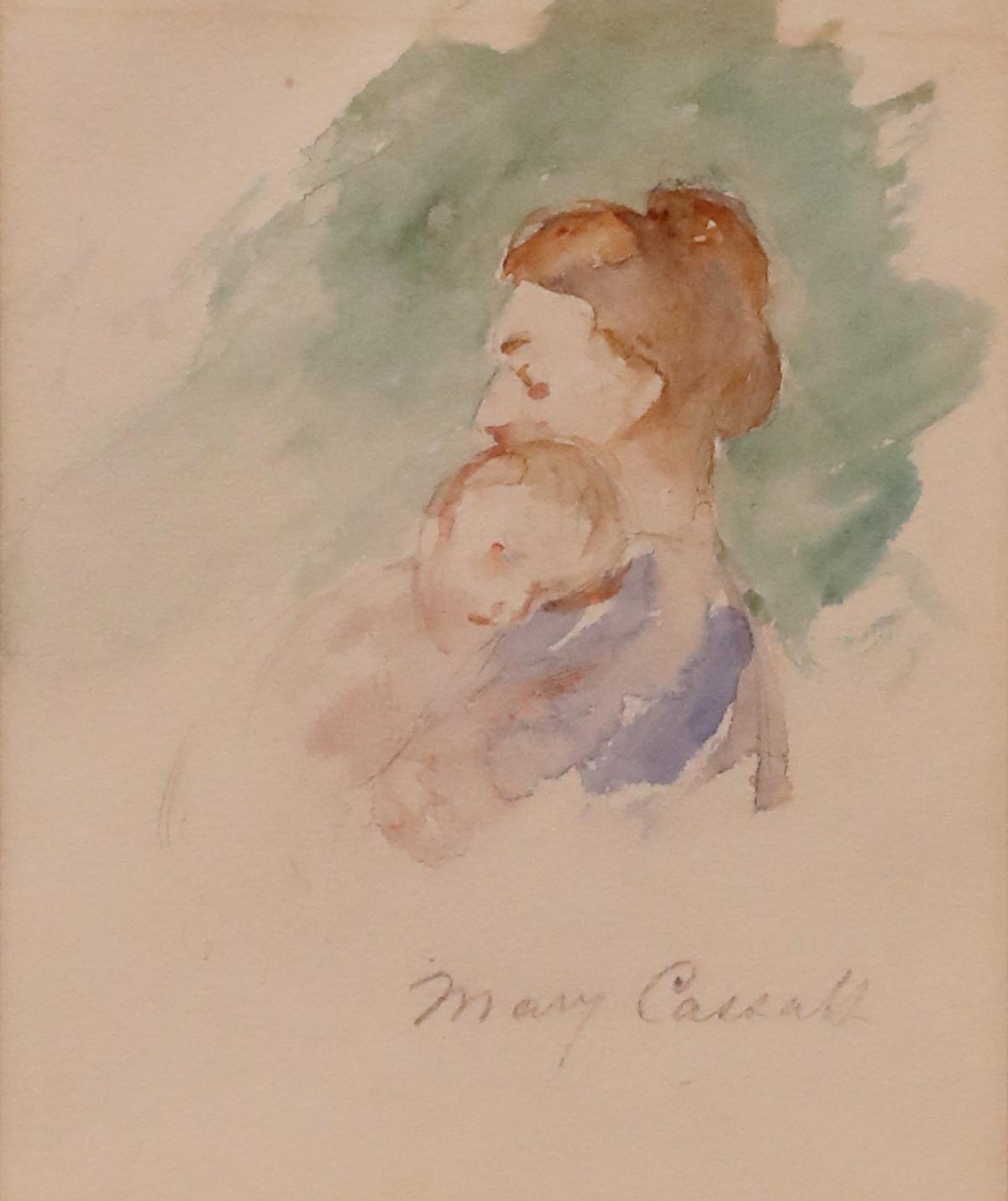
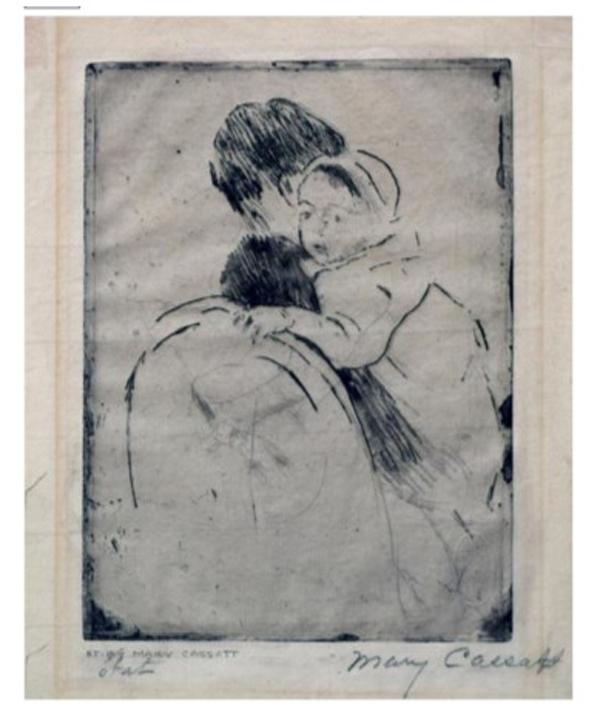
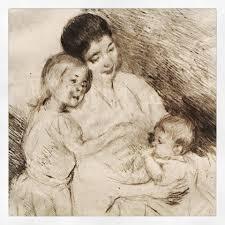
To go from no Mary Cassatt in the building to five separate works by one of my favorite artists has been an exciting time for me. Between the three works in
Across the Atlantic: American Impressionism through the French Lens
and two in
Ooh La La: French Works
from
the Riley Collection
, we have examples of Cassatt in oil, watercolor, etching and drypoint prints.
Mary Cassatt was born into an upper-middle-class family in Allegheny City, Pennsylvania (now part of Pittsburgh’s North Side) in 1844. Her father was a stockbroker and her mother, Katherine Kelso Johnston, was from a banking family. Although Cassatt’s mother didn’t work, which wouldn’t have been an option for a woman of her social status, Katherine was very highly educated and well-read. Friends of the Cassatt family credited Katherine with Cassatt’s artistic sensibility.
Cassatt’s family traveled widely during her childhood and spent five years in Europe. Cassatt learned German and French and had her first drawing lessons while abroad. These lit an artistic fire in her that would never be quenched.
Her family returned to the United States when Cassatt was fifteen and she began to study painting at the Pennsylvania Academy of Fine Arts. However, she was displeased with the slow pace of study and the fact that women students could only study the human body from plaster casts, not live models. In 1866, over her father’s objections, Cassatt moved to Paris to continue her studies there, with her mother and family friends acting as chaperones.
In Paris, Cassatt studied with famed academic painter Jean-Léon Gérôme. His smooth, highly realistic paintings were incredibly popular and he would come to be known as one of the world’s most famous artists by 1880. Cassatt began copying paintings in the Louvre, which required getting a permit.
The fact that Cassatt was a woman greatly shaped her artistic education. Women couldn’t attend the École des Beaux-Arts until 1898 and while other art academies, such as the Academie Colarossi, DID admit women, none of these had the same prestige as the official French school.
Cassatt left Paris to avoid the Franco-Prussian War of 1870-1871 but returned for good in 1874. She was joined by her sister Lydia who was the subject of many of her paintings.
By the 1870s Cassatt had been submitting to the French Salon - the annual or biennial exhibition representing the flower of French art - for years, but she had become critical of what she viewed as the conventional taste that prevailed there. She saw that the selection committee was often prejudiced against works by women unless the artist had a friend or protector on the jury. In 1877 both her Salon entries were rejected and it was at this low point in her career that Edgar Degas invited her to show with the Impressionists, who had held their first exhibition three years earlier in 1874.
Working with the Impressionists opened up new artistic worlds to Cassatt. Previously a studio-bound artist, she began carrying a sketchbook with her while out-of-doors or at the theater to record the scenes she saw.
Cassatt is best-known for her extensive series of tenderly observed paintings, drawings, and prints about mothers and children. Her gender and affluent upbringing prevented her from painting the racetrack and nightclub scenes of other Impressionists so she began to concentrate on the scenes closest to hand: genteel depictions of upper-middle-class motherhood. Her earliest dated work on this theme is from 1888 and after 1900 she concentrated almost exclusively on mother-and-child subjects. The works in both the CRMA’s exhibitions represent her work from this later period, their evocative subject matter highlighted by Cassatt’s delightful proficiency across a wide array of media.
--Associate Curator Kate Kunau