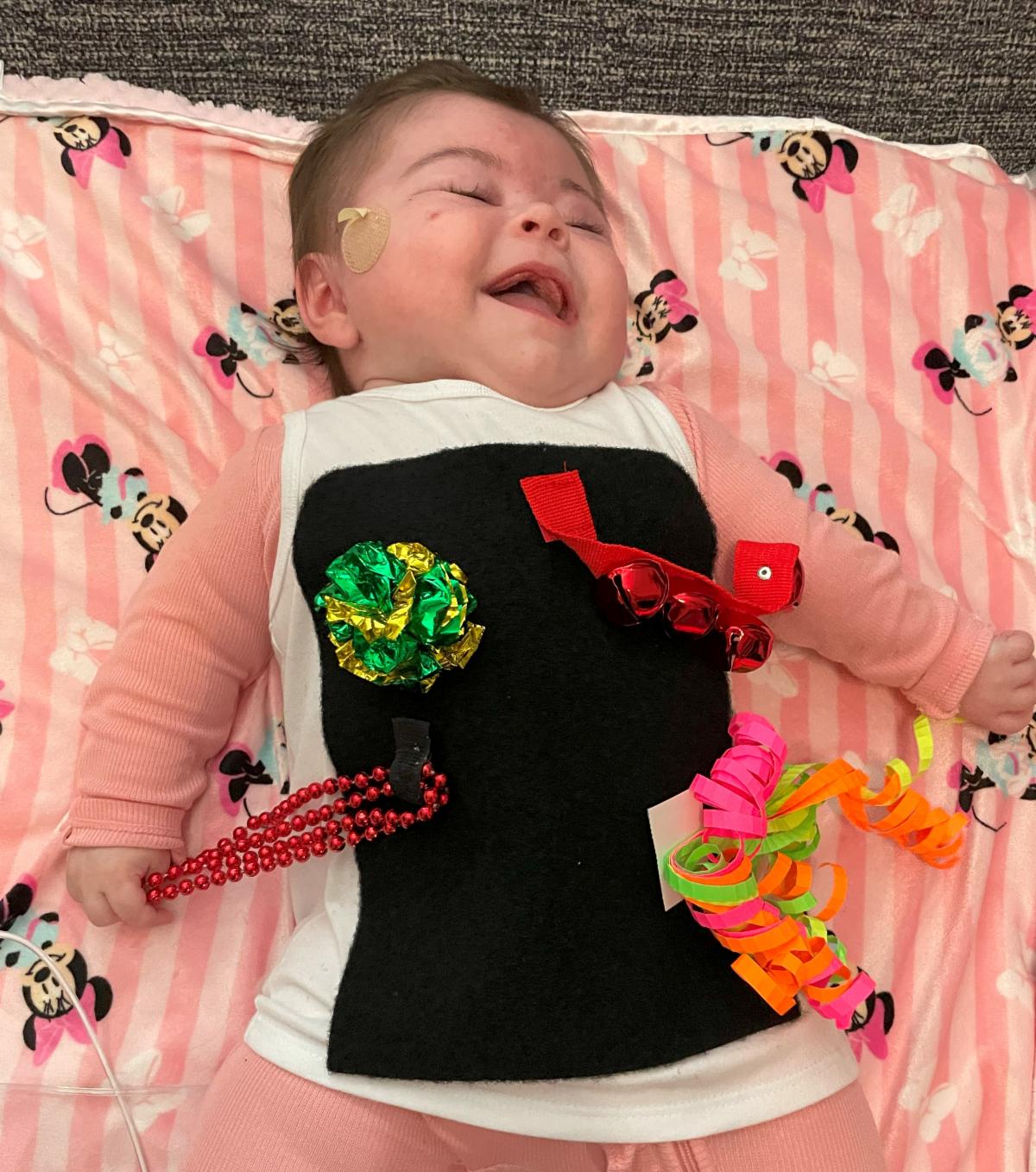
Try a Tactile Tank Top
A very young child with a visual impairment often holds their hands close to their body because they are so sensitive. They’re afraid to reach out and explore their environment. A tactile tank top is a fun way to encourage tactile exploration because they don’t have to reach very far to find something interesting to touch. They’re wearing it on the tank top.

First, glue black VELTEX loop fabric on to the tank top. Then, with VELCRO tape you can attach different items depending on your child’s sensory preferences. When they lose interest in one item, you can move it to a different location on the tank top or try a new texture or noise. If you want your child to reach across their body you can move the item further away from them. Unlike a tactile blanket a tactile tank top can be used when your child is seated or lying on their back so it’s more versatile. Learn how to make a tactile tank top HERE.
Make a Sensory Cube at Our Mystery Party
One of the ways your child learns is through touch. It is how they gain information from the world around them, either through their hands, feet, or even mouth. How do you encourage this sense in your child, even if they are sensitive to tactile stimulation?

Join EI-TVI Maggie Tutt on Wednesday, June 20th, from 10 to 11 am via Zoom as we discuss the importance of tactile play. We’ll make sensory cubes, which are decorated in different colors and textures, and show how playing with them is an easy way to build tolerance for touch because they’re small, lightweight, and portable. Siblings and other family members, as well as former ASV families, are welcome to join us. Sign up HERE.
Supermarkets Are Super Sensory Experiences
Children who are blind or visually impaired may miss opportunities to take in important information through incidental learning, or unplanned learning that happens when using vision to observe the world around them.  An everyday routine – like the weekly trip to the grocery store – can come alive for them through their other senses. Learn how a parent used narration to turn her shopping trip into a sensory experience for her three-year-old daughter who’s blind HERE. 
Turn Grocery Bills into Donations
for A Shared Vision
Thanks to the families who shop at King Soopers and City Market in Colorado, A Shared Vision receives nearly $500 every three months. We are grateful for all who have signed up for the King Soopers/City Market Community Awards program, which donates a percentage of your grocery purchases to A Shared Vision at no cost to you.

Learn how to sign up for this program HERE and support Colorado’s children who are blind or visually impaired.
Why Are Boundaries Important?
Vision gives a child information about many things happening in their environment. Without immediate access to this information, children with visual impairments may not feel safe to move around and explore. Using physical boundaries tell a child where they are in any given space and helps create a feeling of comfort and security. 

You can create a physical boundary to define an area where your child can safely play and explore. Boundaries can be as simple as sitting or lying your child with their back against the couch and putting toys in front of them, or using an empty laundry basket or plastic swimming pool to define a small play space.
Register for In-Person Objective Testing Training

If you are a member of an EI Eligibility Assessment Team and have taken the updated vision screening protocol trainings, the last module on objective testing is now available! You can sign up for in-person trainings in Trinidad on May 18, Colorado Springs on May 22, and Evans on May 30. Denver dates will be available in June. If you missed the other modules, we will offer trainings once a month through September. Register for all the vision screening training dates HERE.
A Shared Vision is a 501(c)(3) nonprofit and the leading provider of in-home and community early intervention vision services in Colorado. We inspire and empower families to nurture the development of their very young children who are blind or visually impaired so that all children may discover their brightest future.
Share this email: