Rail Workers Weekly News Digest
Number 11 - March 17, 2020
|
|
Below is a series of articles compiled over the previous week.
They are of interest to railroad workers.
_____________________________________________
|
|
Article 1 -
CORONAVIRUS NEWS
As the Coronavirus continues to spread across North America, infecting citizens and disrupting economic activity, the railroads - both freight and passenger - and starting to reel from the full effects of the crisis. It is time for all railroad workers to come together and unite in face of this unprecedented situation. RWU will do what we can to contribute to the body of knowledge and disseminate information as it comes available.
If you have yet to read the Special Bulletin #2 that was released Monday, March 16th, 2020, we highly recommend your read over the links.
|
|
A number of unions have approached FRA Administrator Ron Batory to take action last week. He refused, stating that he believed in an "all-government" response to the crisis, stating there was no individual role for FRA to play. On March 14th, however, the FRA did activate the Agency's "emergency relief docket" in response to the outbreak. This action however, does not to address the workers' concerns regarding attendance policies, paid leave time, proper sanitation, etc., but what is has the potential to do is to allow a rail carrier to be exempt from certain Federal regulations for up to 60 days upon the Agency's receipt of a request for "relief." See link below ...
|
|
A number of unions have issued their own demands upon their employers to take the necessary action to make their workplaces safe and secure in the face of the outbreak. Some of these are listed in the Special Bulletin (see above). Railroad Workers United will be releasing an official statement in the coming days. See below for a recent statement from the ATU ...
|
|
Article 2 -
RAIL SAFETY NEWS
How Safe is the Railroad You Work For?
As the old saying goes there are lies, damn lies and statistics. As we all know, numbers can be skewed any way we like to show results that are in our interests. The railroad industry is fond of crowing loudly about just how safe the industry is compared to the past. In some sense, they are correct. Just as mining, milling, factory work, dock work and work in other industrial sectors is safer than is safer than it once was, this is hardly due to the efforts of the corporate bosses. Work has become safer - not because of their efforts - but in many cases in spite of them.
There is no excuse for injuries and fatalities NOT to go down each year. With experience, wisdom, general knowledge, scientific and technological advancement in society as a whole, one should
expect
a decline in workplace accidents, illness, injuries and death.
However, the rail industry actually has a mixed record. For example, the last three years in Canada has witnessed a spike in fatalities, almost all on CP and CN. And the injury rate on Union Pacific has mushroomed this past year as PSR is rolled out. Given that there are at least 10% fewer workers employed by that carrier to actually get injured, one would expect the injury numbers - all things being equal - to drop accordingly, not increase. Sadly, that has not been the case on these railroads that implement PSR. Finally, the rail industry has spun-off and contracted-out thousands of rail jobs to contractors whose employees do not count as "railroaders" because they do not work for a railroad company. These injury/accident statistics are somewhat hidden from view.
The Federal Railroad Administration (FRA) maintains a web page where anyone can look up the injury/accident rate nationally, on a specific property, in a specific year, etc. This information can come in very useful and can be used against the rail carriers when they are exaggerating, distorting and outright lying about their accident/injury rates. Check it out!
|
|
Article 3 -
REGULATORY NEWS
DeFazio: Final Rule on Railroad Risk Reduction Programs Fails to Address Fatigue
Washington — Effective April 20, the Federal Railway Administration is requiring the nation’s largest freight railroads – known as Class I – and smaller freight railroads with “inadequate safety performance” to develop and implement a formal risk reduction program. However, Rep. Peter DeFazio (D-OR), chair of the House Transportation and Infrastructure Committee, says the final rule does not fulfill a congressional mandate to address rail worker fatigue.
A risk reduction program is a comprehensive, system-oriented safety approach that involves employees working together to identify potential hazards and determine plans to reduce or eliminate associated risks.
According to the
final rule
published in the Feb. 18 Federal Register, each railroad will have the flexibility to tailor the program to its own operations and must implement it with a written plan that FRA has reviewed and approved. FRA issued the rule in accordance to sections 103 and 109 of the
Rail Safety Improvement Act of 2008
.
“Railroads’ ongoing evaluation of their asset base and employee performance associated with operations and maintenance, under FRA regulations, can now follow a more uniform path of standardization, toward further reducing risks and enhancing safety,” FRA Administrator Ronald Batory said in a Feb. 18 press release.
|
|
Article 4 -
CREW STAFFING ACTION
Union Solicits First-Hand Reports of the Value of Two-Person Crews
This form is for SMART-TD railroad members to share their experiences on the job to make the public aware of why having two crew members -- a certified conductor and a certified engineer -- in the cab of a locomotive is a matter of public safety.
It is not common public knowledge that in accidents involving trains, a conductor is the first-responder. We want to change that. Whether it be a derailment, a crossing collision, or a hazmat release, the initial inspection, and often action, is performed by the conductor.
The experiences often are traumatic, both to the victim and to the SMART-TD member who must immediately deal with the incident, but on occasion, our actions result in the saving of lives, protection of public property, and/or prevention of derailments/incidents.
We understand that all people have different ways of coping with the effects of these situations and that reliving these instances may not be easy to do.
However, if you are willing to tell your stories about how having two on the crew mattered in keeping the public safe and are comfortable with sharing the details of these instances, we would like to hear from you.
Please fill out the form below with your contact information and share your story, which will be used inside the organization and potentially outside of SMART-TD to get others who may not know to realize the public safety role we fulfill on the United States railroads. (Your personal information will not be released.)
We know the truth… It’s time for us to tell it.
|
|
Article 5 -
OIL BY RAIL NEWS
'Time Will Tell' if Lower Speed Limits Enough to Prevent Fiery Derailments: Expert
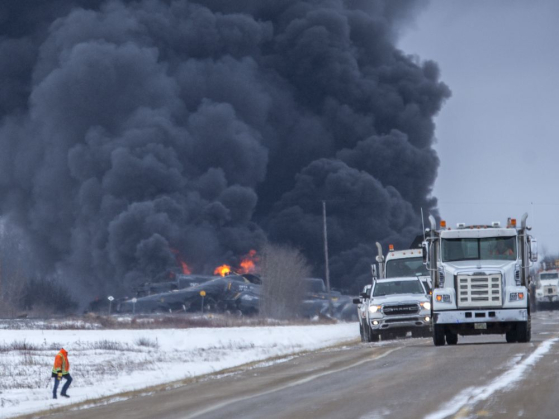
Saskatoon officials say the possibility of a fiery derailment on rail lines running through the city is “highly unlikely” — but at least one expert believes more could be done to reduce the risk of a crude-carrying train going off the rails.
Bruce Campbell said the Canadian railway industry is still skewed toward economics rather than safety, even after the federal government imposed new, lower speed limits following a pair of derailments near Saskatoon, both of which resulted in major fires.
“It is a kind of a question of Russian roulette — not if, but when and where,” said Campbell, an adjunct professor at York University who wrote a book about the 2013 railway disaster in Lac-Mégantic, Que., in which a “runaway” train derailed and exploded, killing 47 people.
“The window is still open for history to repeat itself,” he added.
Federal Transport Minister Marc Garneau imposed new, lower speed limits for long trains carrying dangerous goods last month, after a second oil-laden Canadian Pacific Railway Ltd. train derailed and burst into flames near Guernsey, 100 kilometres east of Saskatoon.
Campbell said Transport Canada, which regulates the railways, could do more to reduce wear on rails by making trains shorter and lighter, increasing inspections, improving safety oversight and tackling fatigue management, a pivotal issue in the recent CN workers’ strike.
Even new, state-of-the-art tank cars have burst into flames after derailments, like the second Guernsey incident on Feb. 6, he pointed out.
Ian Naish, a former director of rail investigations at the Transportation Safety Board of Canada who now runs a private transportation consultancy, took a more circumspect view, saying “time will tell” if the new speed limits are enough to prevent further incidents.
|
|
Article 6 -
TAKE ACTION:
PASSENGER RAIL
In
a letter sent earlier today
to the heads of the House and Senate committees on appropriations, the Rail Passengers Association asked Congress to also provide funding for intercity rail operators, commuter railroads, and public transit agencies to offset their steep revenue losses.
Now,
we need YOUR help
. Please join us in asking Congress to provide financial assistance to keep Amtrak, private rail operators, and transit agencies running in the face of this unprecedented stress facing our transportation system.
We need passengers to speak up to ensure these rail systems are able to restore pre-COVID-19 levels of service on all existing routes once travel restrictions are lifted, and to bring back any employees who have been furloughed as a result of the reduction of service levels.
Thank you for your help!
Sean Jeans-Gail, Vice President of Policy + Gov't Affairs
Rail Passengers Association
It is essential that we defend and fight for a modern, national passenger rail network. The Rail Passengers Association advocates on behalf of America's rail passengers for improved, expanded, and safer train service.
|
|
Article 7 -
TECHNOLOGY NEWS
How Autonomous Freight Trains Powered by Artificial Intelligence Could Come to a Railroad Near You
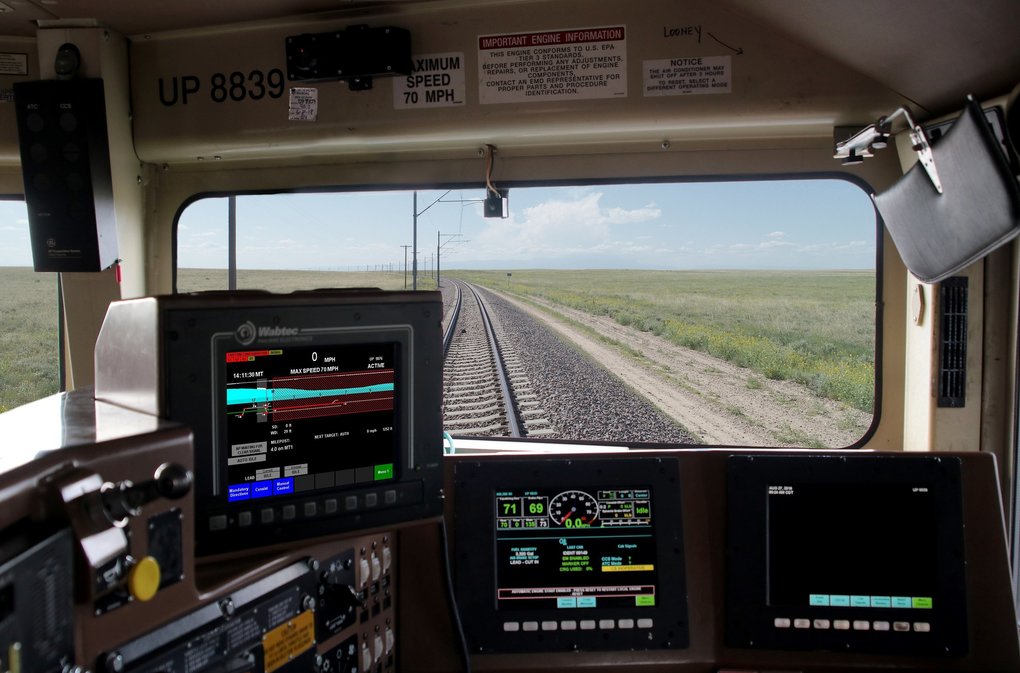
Last summer, a 30-car freight train led by three diesel locomotives rumbled down the tracks for 48 miles through the Colorado desert — with nobody at the controls. But this was no runaway train. In fact, the experiment could be a preview of the rail industry’s future.
The demonstration at the Transportation Technology Center — a research and testing facility owned by the Association of American Railroads — was the debut of driverless train software produced by one of the oldest companies in the industry. Along for the ride were representatives from some of America’s largest freight railroads who in recent years have been intrigued by the many ways artificial intelligence (AI) could be applied to one of the nation’s oldest industries.
As machine learning continues to infiltrate American industry, railroads are looking at it as a tool to improve safety and efficiency, while simultaneously competing for business with a trucking industry positioning to embrace autonomous vehicles.
The A.I. Age | This 12-month series of stories explores the social and economic questions arising from the fast-spreading uses of artificial intelligence. The series is funded with the help of the
Harvard-MIT Ethics and Governance of AI Initiative
. Seattle Times editors and reporters operate independently of our funders and maintain editorial control over the coverage.
Meanwhile, federal regulators are clearing the way and experts say technology like Positive Train Control — the anti-collision technology that investigators say could have prevented the
fatal 2017 Amtrak wreck
in DuPont, Pierce County — have set the groundwork for such operations. But some, including labor leaders, say driverless trains are unsafe and would never be accepted by the public.
“I’m really not sure if people will be comfortable with a 10,000-foot train coming through their town with no one on it,” rail consultant Larry Gross said.
|
|
Article 8 -
HEALTH CARE NEWS
Fundamental Health Reform Like ‘Medicare for All’ Would Help the Labor Market
Job loss claims are misleading, and substantial boosts to job quality are often overlooked
Fundamental health reform like “Medicare for All” would be a hugely ambitious policy undertaking with profound effects on the economy and the economic security of households in America. But despite oft-repeated claims of large-scale job losses, a national program that would guarantee health insurance for every American would not profoundly affect the total number of jobs in the U.S. economy. In fact, such reform could boost wages and jobs and lead to more efficient labor markets that better match jobs and workers. Specifically, it could:
- Boost wages and salaries by allowing employers to redirect money they are spending on health care costs to their workers’ wages.
- Increase job quality by ensuring that every job now comes bundled with a guarantee of health care—with the boost to job quality even greater among women workers, who are less likely to have employer-sponsored health care.
- Lessen the stress and economic shock of losing a job or moving between jobs by eliminating the loss of health care that now accompanies job losses and transitions.
- Support self-employment and small business development—which is currently super low in the U.S. relative to other rich countries—by eliminating the daunting loss of/cost of health care from startup costs.
- Inject new dynamism and adaptability into the overall economy by reducing “job lock”—with workers going where their skills and preferences best fit the job, not just to workplaces (usually large ones) that have affordable health plans.
- Produce a net increase in jobs as public spending boosts aggregate demand, with job losses in health insurance and billing administration being outweighed by job gains in provision of health care, including the expansion of long-term care.
|
|
|
|
|
|
|