Can't see the images? Click "Show Content" or "Trust Sender" at the top of your email. | Behavior Support Newsletter | |
This newsletter is intended for educators and other interested parties who have a role in providing behavior support services. Any information contained is to provide updates to the field on behavior support matters.
This newsletter should not be forwarded.
| |
Many educators may encounter situations in which a student experiences a behavioral or emotional crisis. Whether this involves disrupting the classroom, damaging property or risking harm to themselves or others, these critical moments can interrupt learning and have a lasting impact on everyone in the classroom. Proactive prevention is essential, but it is equally vital to prepare effective strategies for times when a crisis cannot be avoided.
As outlined in the Least Restrictive Behavioral Interventions (LRBI) Technical Assistance Manual (2025 Edition), clear role delineation among responders helps mitigate the impact of a crisis and ensures a coordinated response.
Key team roles to consider including in your response plan include:
-
Leader: coordinates the immediate response and assigns roles as needed
-
Communicator: serves as the primary individual interacting directly with the student
-
Observer: monitors the student for signs of distress and evaluates whether responding adults require additional support
-
Traffic controller: manages the surrounding physical space to maintain safety and privacy
-
Documenter: records key details and timelines throughout the situation
- Notifier: contacts relevant stakeholders such as parents or administrators in accordance with local education agency (LEA) policy
-
Indirect supporter: provides assistance based on the specific situation and any safety protocols defined in the student's behavior intervention plan (BIP)
For additional information, please refer to pages 169–171 of the LRBI Technical Assistance Manual (2025 Edition).
| | |
Emergency Safety Intervention (ESI) Updates
During the 2026 legislative session, Senate Bill (S.B.) 181 updated language in Utah Code Section 53G-8-301. This change to code, in turn, resulted in changes to Board Rule R277-608: ESIs and Prohibition of Corporal Punishment. The updates made to Board Rule R277-608 will become effective in November 2026.
Please watch the ESI changes and updates video (4 minutes) for a summary of changes made in both code and Board rule.
| |
Paraprofessional Behavior Training Course: Enrollment Open
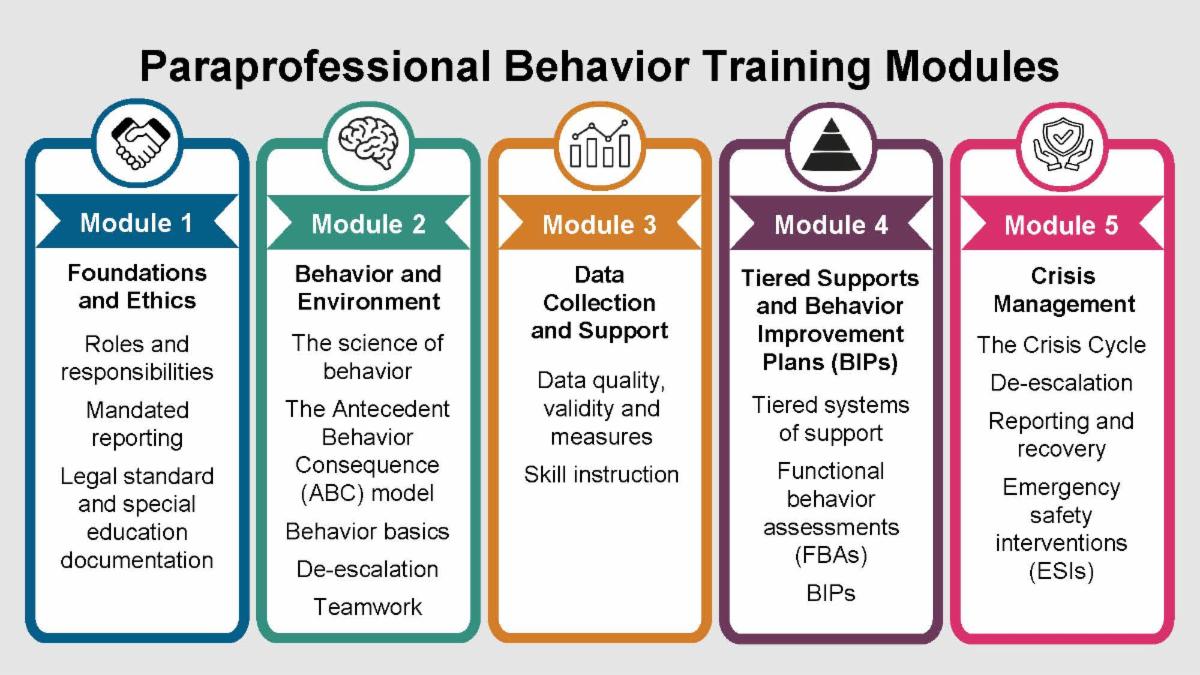
The Utah State Board of Education (USBE) Student Services team is proud to announce open enrollment for the Paraprofessional Behavior Training Course. This 40-hour course offers paraprofessionals a comprehensive exploration of topics and strategies to prepare them to support students across a range of classes and instructional settings.
Topics covered include:
- Module 1: Foundations and Ethics
- Module 2: Behavior and the Environment
- Module 3: Data Collection and Support
- Module 4: Tiered Supports and BIPs
- Module 5: Crisis Management
| | |
Participants will receive a stipend of up to $800 for completing the course outside of contract hours, including attending one required eight-hour in-person training session.
School districts and charter schools have one enrollment spot for each school within their LEA. Enrollment information was shared with LEA superintendents and directors on September 21. School administrators may reach out to their LEA leadership for enrollment information.
Please contact Christina Guevara (christina.guevara@schools.utah.gov) or Stefie Munk (stefie.munk@schools.utah.gov) with any questions.
| | |
Paola is a sixth grade student at Rocky Side Elementary School. Recent assessments show that she is performing above grade level in reading and math and on grade level in other subjects. Her grades are typically Cs and Ds.
Over the past few months, her teacher has become increasingly concerned for Paola as she has been suspended twice for fighting with her peers. Other students regularly complain of Paola’s bullying, reporting that she trips and pinches them when teachers are not looking. Students have also reported that Paola has stolen from them or broken their personal belongings. She has become increasingly disruptive in class and often curses, talks out of turn, and wanders around the classroom when she is expected to sit at her desk. Paola has been sent to the office 15 times in the past two months due to disruptive or disrespectful behavior.
Paola participated in a Tier 2 social skills group, but doing so did not reduce the behavior reports. In fact, several students in the group with Paola refused to attend, saying they were scared of her.
A special education evaluation was completed with Paola. Her full-scale IQ fell above average, and it was noted that she was able to complete her schoolwork “when regulated”. Deficits with emotional regulation, executive functioning skills and social skills were noted.
What is the best next step for Paola’s team?
- Start a second social skills group that consists of her and a different group of students than attended the first group. Because of her above-average intelligence and ability to complete her schoolwork when she is regulated, she does not meet the requirements for an Individualized Education Program (IEP).
- Start suspending Paola every time an inappropriate behavior is reported.
- Meet and determine if an IEP or Section 504 Plan might be needed to support Paola’s social and behavioral skills.
- Require Paola’s parent(s)/guardian(s) to attend school with her until her behavior improves.
| | |
Correct response: 3
While Paola’s cognitive skills appear to be appropriate for her age, she is demonstrating challenges with her social and behavioral skills that are affecting her access to general education curriculum. Paola’s team should meet to determine if she qualifies for special education services through an IEP or 504 Plan. To receive services under the Individuals with Disabilities Education Act (IDEA), Paola must be identified as a student with a disability and must require specialized services in order to access the general education curriculum. Her disability must adversely affect her educational performance, including social relationships and behavioral skills.
1 is incorrect. While additional social skills support may be beneficial, re-enrolling Paola in the same group that was not successful previously is not likely to result in meaningful progress. In addition, teams should not rely on intelligence alone to determine eligibility for special education services. As stated above, teams must consider all factors related to the student’s disability to determine if they affect her educational performance.
2 is incorrect. Exclusionary discipline, including suspension, does not teach new skills and is not likely to improve Paola’s behavior. In addition, Board Rule R277-609 requires schools to consider alternatives to suspension.
4 is incorrect. Schools cannot require parents to attend with their child.
| | |
Follow Up: Thank You for Attending and Supporting the 2026 Behavior Support and Prevention Summit
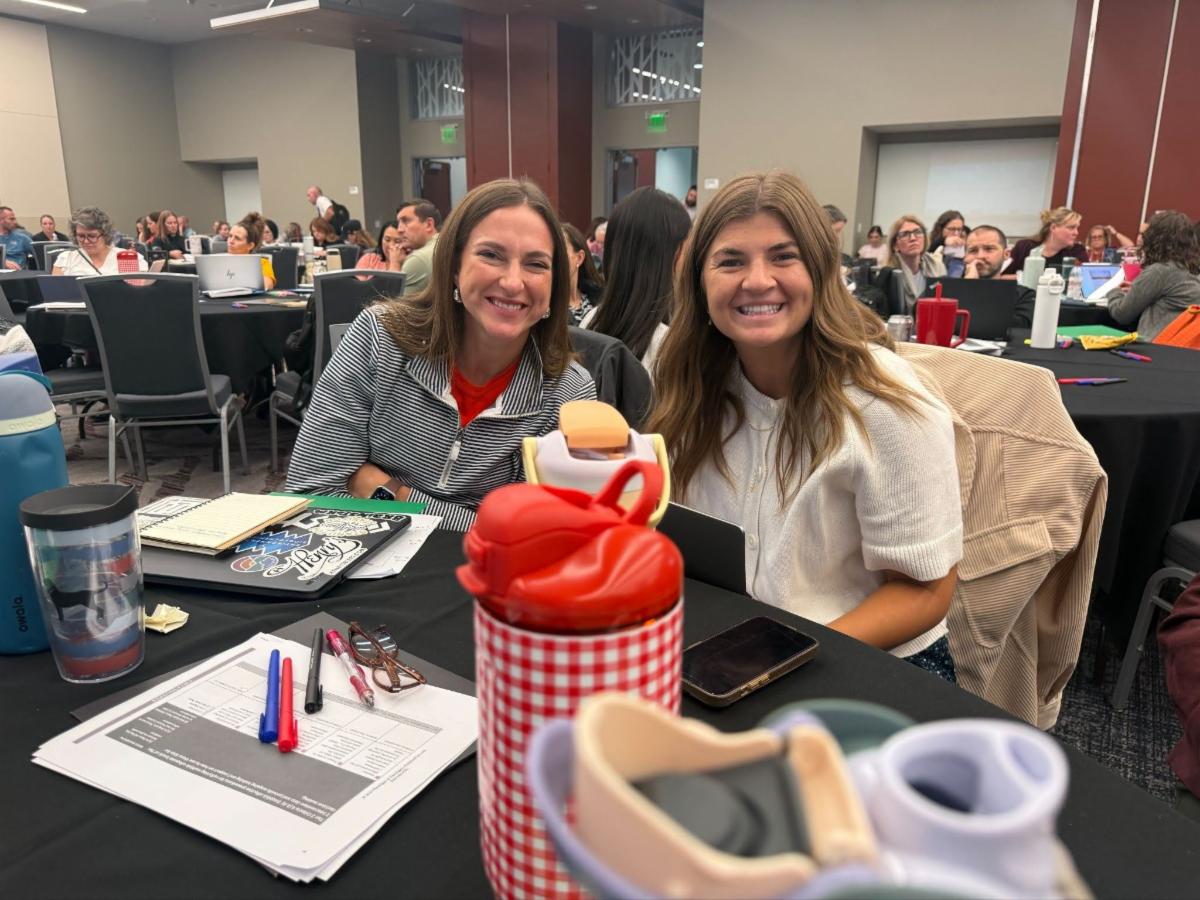
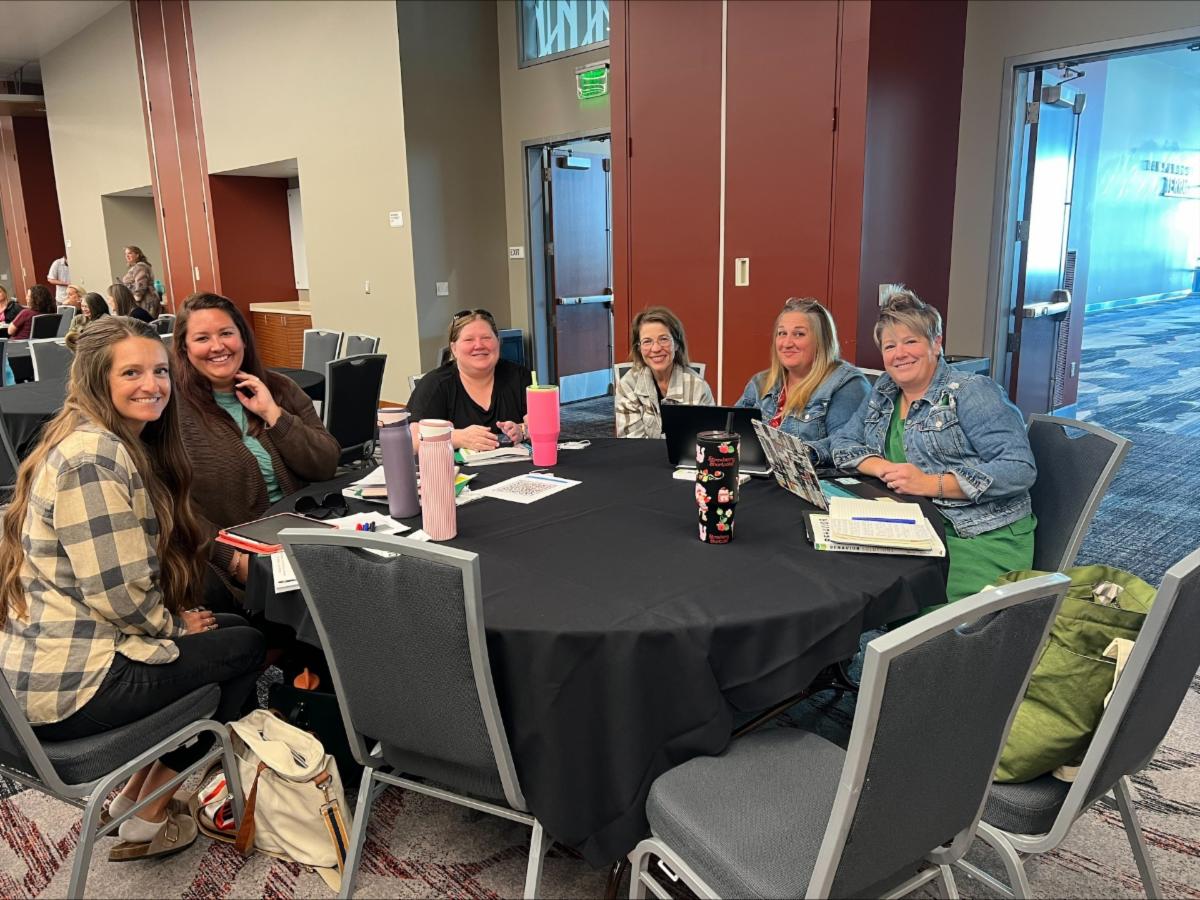
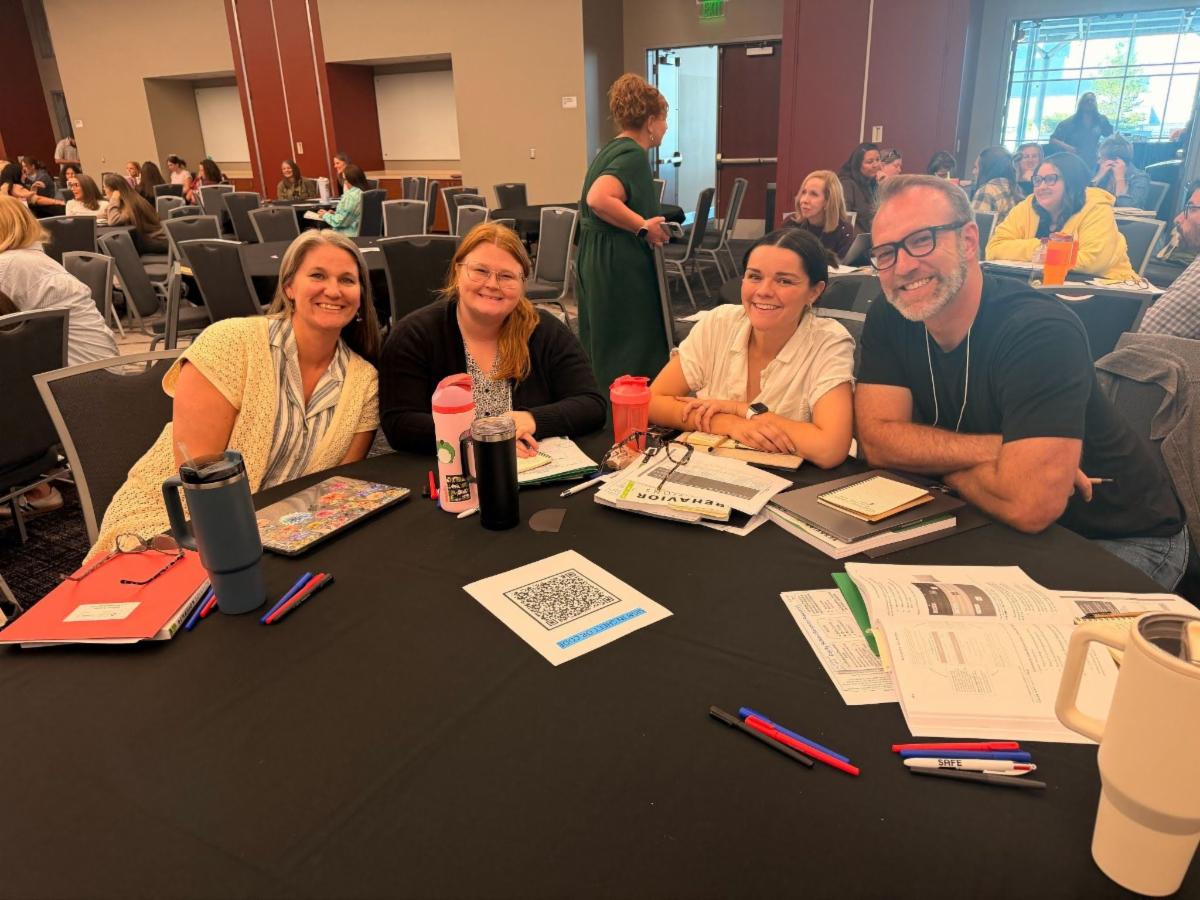
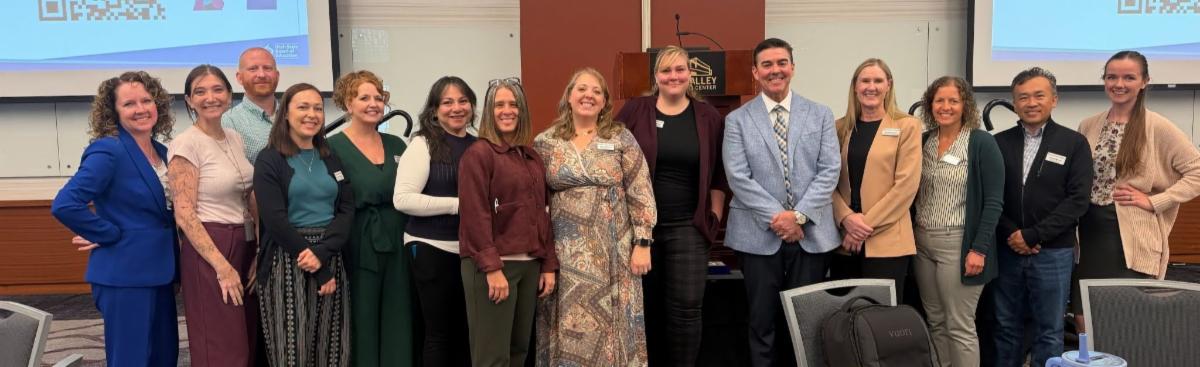
We would like to extend our sincere thanks to everyone who attended the Behavior Support and Prevention Summit on September 24 and 25. We were thrilled by the strong turnout and inspired by the active engagement of participants as they worked to strengthen their Multi-Tiered System of Supports (MTSS). We would also like to express our gratitude to Dr. John Hannigan for sharing his time, expertise, and insights with Utah educators.
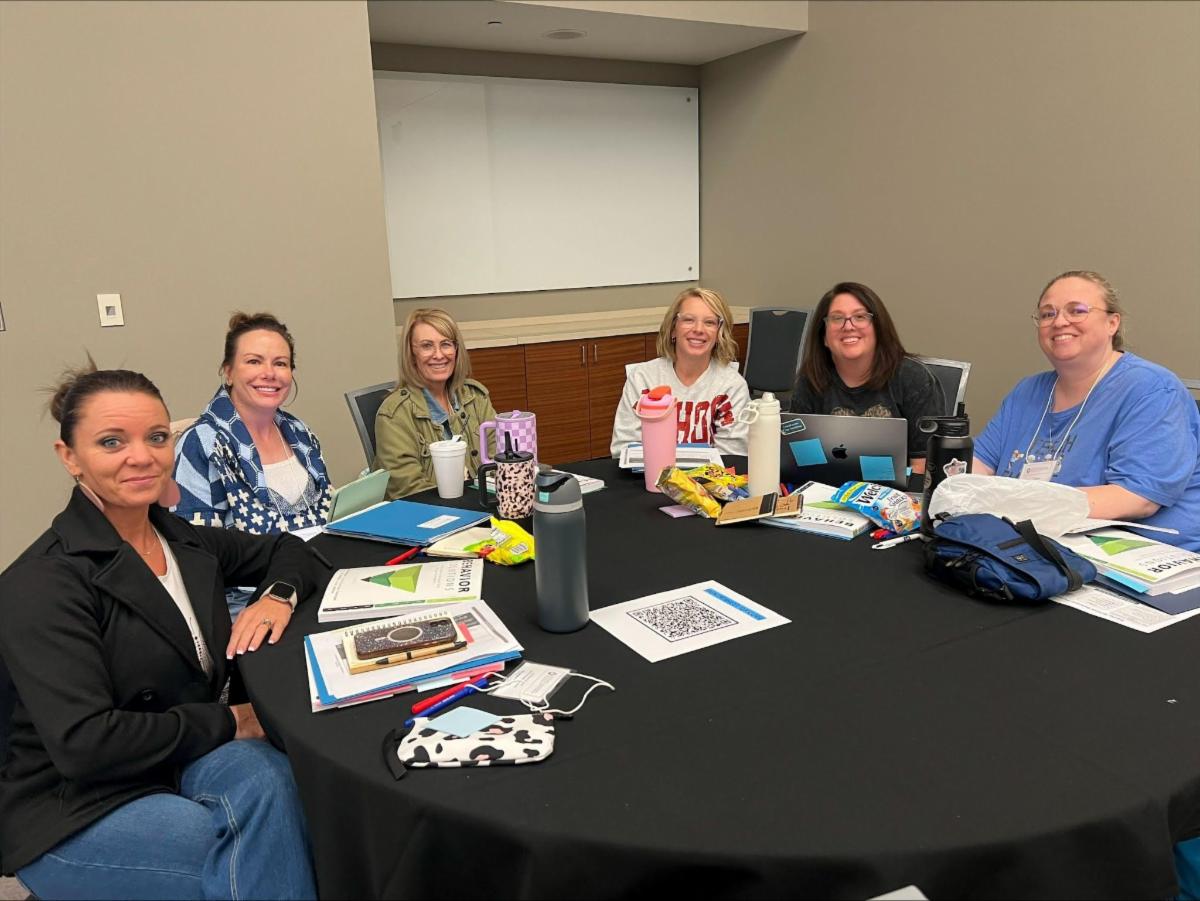
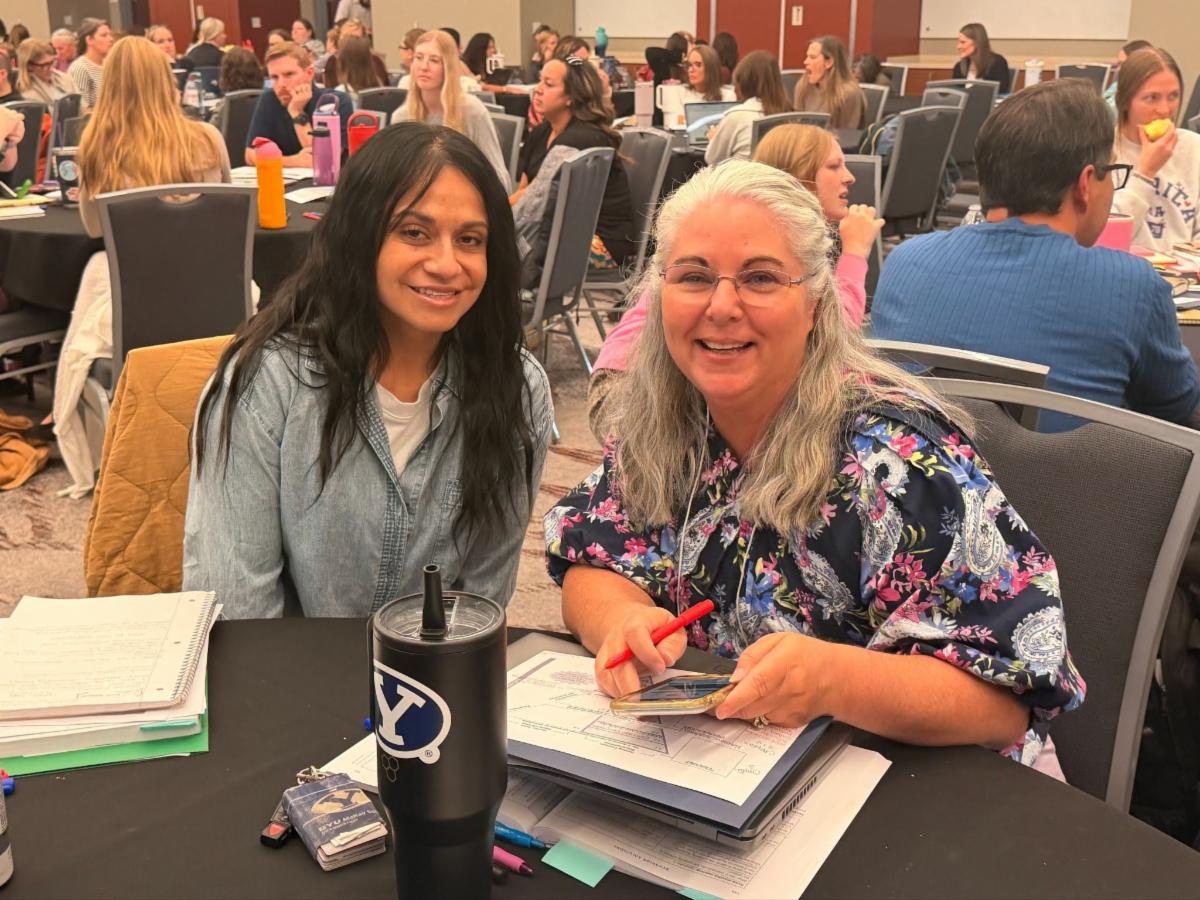
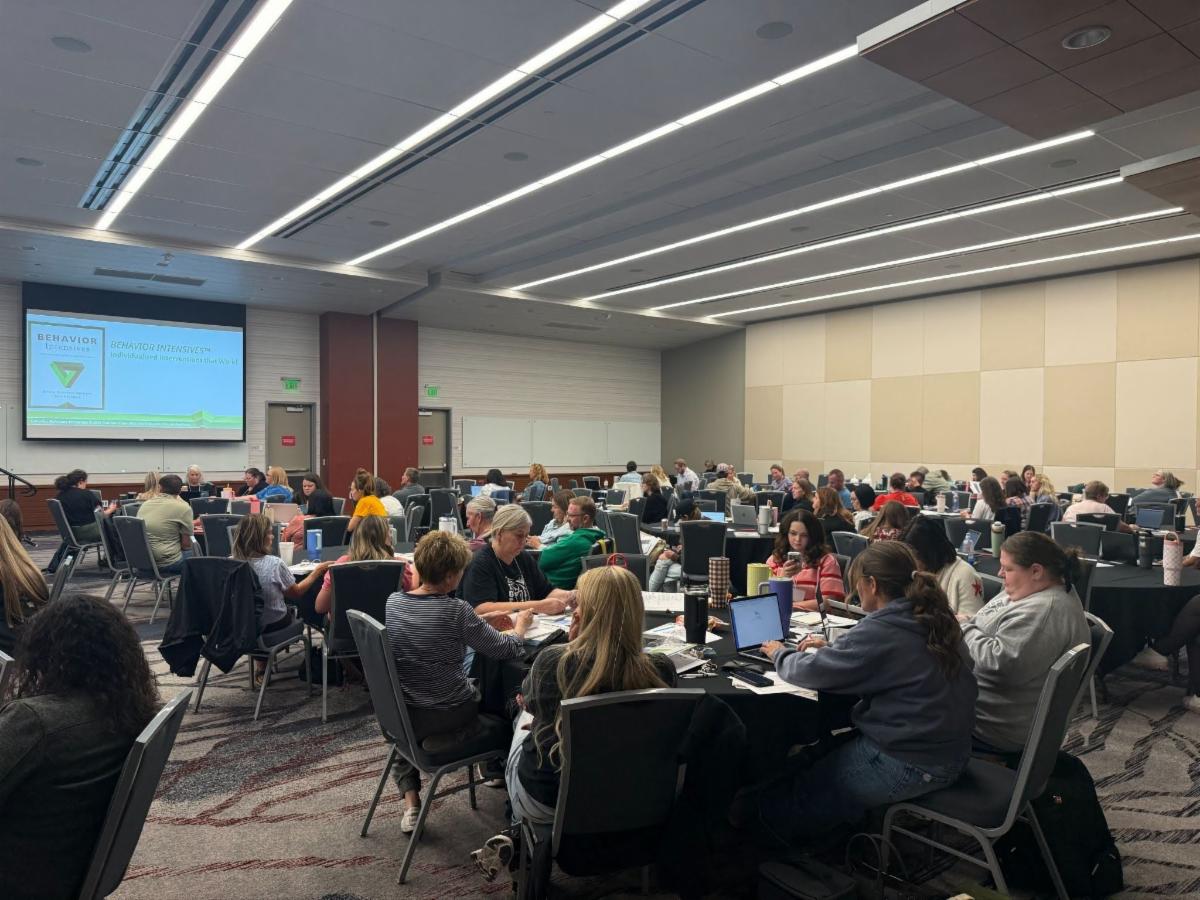
Earlier this summer, USBE staff had the opportunity to preview the Summit content in preparation for this event. During the Summit, staff members joined participants at their tables, listened to stories of both challenges and successes, witnessed your dedication to serving Utah's students and provided support as teams assessed and planned improvements to their behavior support systems. We are grateful for your willingness to share your experiences and perspectives. These conversations helped us better understand the realities, opportunities and needs of schools across Utah. We have included a few photos from the event below.
As a follow-up to the Summit, the USBE Behavior Support and Prevention teams are excited to offer several opportunities for continued learning and collaboration. Please see the “Mark Your Calendar” section below for information about our upcoming Communities of Practice and spring training sessions. These opportunities are designed to strengthen behavior support systems.
Additional Support
The USBE Behavior Support and Prevention teams are exploring the possibility of providing targeted coaching, mentoring and implementation support for schools and districts that are working to strengthen tiered systems of supports and locally apply the concepts shared at the Summit.
Whether you attended the Summit or not, your input is requested and valued. Please take a few moments to complete the Behavior Support Mentoring Interest Survey to help our teams determine if this type of support would be beneficial for Utah schools.
Thank you for your ongoing commitment to creating safe, supportive, and successful learning environments for Utah students.
Please reach out to Krisanne Lewis (krisanne.lewis@schools.utah.gov) with questions or for assistance.
| | |
Behavior Support Team Resource Hub
Our behavior team is here to support you with training and resources related to behavior support. We encourage you to visit our Behavior Support resource page that is housed in Canvas. Please note that this self-enrollment only allows the user to access the resources; user information will not be shared or used for any other purpose. Questions and requests to add additional resources should be addressed to Krisanne Lewis (krisanne.lewis@schools.utah.gov).
| | |
Upcoming Trainings and Workshops
Requests for professional learning can be submitted by LEA administrators via the USBE Learning Portal.
| |
Prevention and Student Services Lunch and Learn Webinar Series for School Year 2026-2027
WHAT: Join the Prevention and Student Services teams at USBE for a monthly Lunch and Learn webinar series, focused on helping educators create the conditions that support student success. For detailed descriptions or to access content from past webinars, please visit the USBE Prevention Professional Learning webpage.
Relicensure points will be provided to all participants who remain on the webinar for at least 45 minutes.
WHO: These webinars are for school administrators, prevention staff, behavior specialists, school counselors, social workers, teachers, school mentors and staff who work directly with students.
WHEN: Sessions are held from 12:00 to 1:00 p.m. on the third Thursday of each month, except in October, when the webinar will occur on the last Thursday of the month.
WHERE: Webinars will be held virtually.
ACTION: You only need to register once for the entire webinar series. Please register for the webinar series via Zoom.
Feel free to share the registration link with anyone who may be interested.
INFORMATION:
September Recap and Upcoming Webinars
- September’s “Connection Saves Lives: A School-based Approach to Suicide Prevention” webinar was amazing! As always, if you missed the webinar, you can access the recording on the USBE Prevention Professional Learning webpage.
Thursday, October 29, 2026 | 12:00 - 1:00 p.m.
- The Verbal De-Escalation Cycle: Another Key to Prevention
How do you prevent behaviors from escalating beyond verbal demonstration? The goal of prevention and behavior support is to help students recognize their actions and learn skills for future success. Adults can support students, even in the most stressful of situations, before behaviors become physical. Join us in exploring how to guide students to de-escalation when they enter the verbal de-escalation cycle.
Presenter: Stefie Munk, Paraprofessional Behavior Training Specialist
Thursday, November 19, 2026 | 12:00 - 1:00 p.m.
- The January Plan: Re-Setting Behavior Expectations
Once the school year nears the halfway point, educators begin to think about the return from winter break and how to best guide students with Tier 1 classroom support. Whether it is re-establishing expectations, adjusting the environment, or exploring higher-level supports, November is the perfect time to draft out your January return to school plan.
For more information, please contact Tanya Albornoz (tanya.albornoz@schools.utah.gov) or Krisanne Lewis (krisanne.lewis@schools.utah.gov).
| | |
Mandt New and Re-certification Trainings
WHAT: USBE is offering free Mandt trainings during the 2026-2027 school year. These trainings offer an option for key identified school employees to receive comprehensive ESI training (see Board Rule R277-608 for more information).
WHO: Key identified school employees (as defined by each LEA’s ESI policy)
WHEN: Dates are listed in Altitude (see links under “Action” below)
WHERE: In-person, specific addresses are listed in Altitude (see links under “Action” below)
ACTION:
| | Join the Tier 1 Student Support Communities of Practice (CoPs) | | |
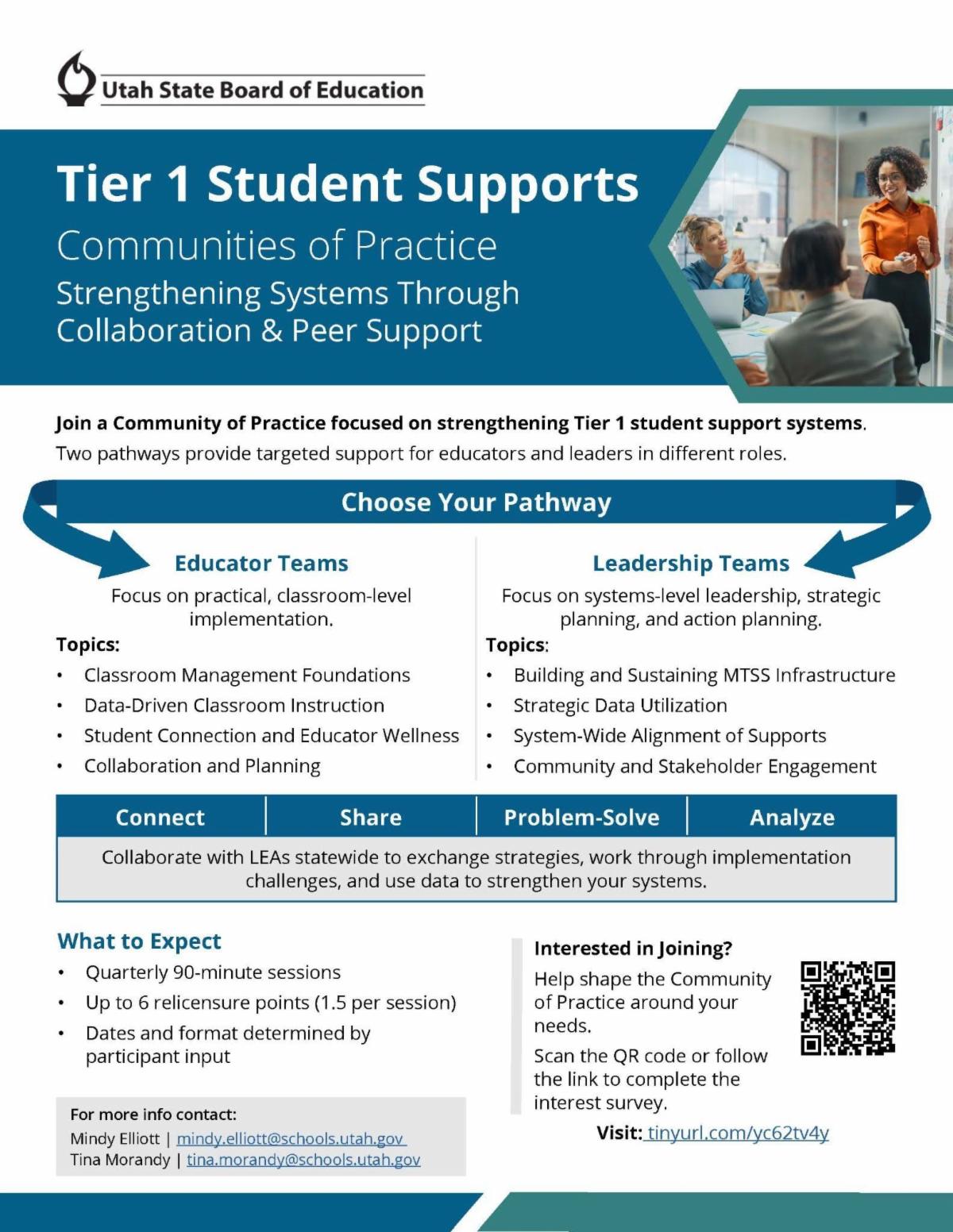
WHAT: USBE’s Prevention and Student Services teams are thrilled to announce a statewide initiative designed to strengthen Tier 1 student support frameworks. This is the field’s opportunity to connect with peers, tackle implementation barriers and earn relicensure points for professional growth.
These are Tier 1 Student Supports CoPs. The two targeted pathways have been designed to address classroom-level implementation or high level systems and strategic leadership, respectively.
WHEN: Quarterly 90-minute sessions (dates TBD)
WHERE: Locations are to be finalized based on participant feedback. Options will include virtual and in-person attendance.
ACTION: If you are interested in attending, please complete the Tier 1 Student Supports interest survey.
INFORMATION: These CoPs provide a space for networking, collaborative problem-solving and analyzing data trends. There will be two distinct pathways tailored to different roles.
For leadership teams and guiding coalitions: focus on high-level systems, strategic leadership and action planning
Topics will include building and sustaining a MTSS infrastructure, strategic data utilization, system-wide alignment of supports, community and stakeholder engagement
For educator and teacher teams: focus on practical, classroom-level implementation
Topics will include classroom management foundations, data-driven classroom instruction, increasing student connectedness and educator wellness with MTSS supports, collaborative communication and planning
Reach out to Mindy Elliott (mindy.elliott@schools.utah.gov) with questions.
| |
|
Youth Mental Health First Aid (YMHFA) Trainings
WHAT: USBE will be hosting multiple YMHFA training sessions throughout the 2026-2027 school year. 7.5 relicensure points are available to those who attend and complete the training, which includes two hours of pre-work that must be completed before the live training session.
YMHFA establishes a foundational understanding of mental health for those without a clinical background. It is important to note that school-based mental health specialists may possess advanced training that extends beyond the scope of this particular program.
WHO: School personnel supporting students from ages 12-18
WHEN:
- Thursday, October 29, 2026 | 8:00 a.m. - 3:00 p.m.
- Thursday, January 15, 2026 | 8:00 a.m. - 3:00 p.m.
- Friday, February 12, 2027 | 8:00 a.m. - 3:00 p.m.
- Thursday, March 18, 2027 | 8:00 a.m. - 3:00 p.m.
- Thursday, April 15, 2027 | 8:00 a.m. - 3:00 p.m.
WHERE: Virtually via Zoom
ACTION: Register via Altitude Course ID #100085
INFORMATION: YMHFA is a curriculum that focuses on how to help adolescents (age 12-18) who are experiencing a mental health or substance use challenge or are in crisis.
YMHFA is primarily designed for adults who regularly interact with young people. The course introduces common mental health challenges for youth, reviews typical adolescent development, and teaches a five-step action plan about how to help young people both in crisis and non-crisis situations. To learn more, download the Mental Health First Aid for Youth flyer.
| | |
Protective Factors Framework Training Opportunities for the 2026-2027 School Year
WHAT: USBE’s Prevention Team is pleased to offer in-person Protective Factors Framework learning opportunities for LEAs during the 2026–2027 school year. This engaging, one-day, six-hour workshop explores the Protective Factors Framework, a research-based, evidence-informed approach to promoting student, family and community well-being.
Participants will gain a deeper understanding of the five protective factors and discover practical strategies for strengthening them within schools and communities. Through interactive activities and real-world examples, attendees will learn how protective factors can enhance student engagement, attendance, behavior, academic achievement and overall well-being. The workshop is designed to support schools in creating safe, supportive environments in which all students can thrive.
Participants will earn 5.5 relicensure points upon completion of the workshop.
WHO: School administrators, prevention staff, counselors, social workers, school-based mental health staff, behavior specialists, teachers and other school staff. Everyone will benefit from the information shared.
WHEN AND WHERE:
- Monday, November 30, 2026 | 9:00 a.m. - 3:30 p.m.
Canyons School District - Peaks Center
9361 South 300 East, Sandy, UT 84070
- Friday, January 29, 2027 | 9:00 a.m. - 3:30 p.m.
Salt Lake County area - location TBD
- Tuesday, February 9, 2027 | 9:00 a.m. - 3:30 p.m.
USU Brigham City - Room D217
989 South Main Street, Brigham City, UT 84302
- Tuesday, March 23, 2027 | 9:00 a.m. - 3:30 p.m.
Cedar City area - location TBD
- Monday, April 12, 2027 | 9:00 a.m. - 3:30 p.m.
Utah County area - location TBD
ACTION: Register for the Protective Factors Framework Workshop via Qualtrics.
| |
|
2026-2027 Early Warning System (EWS) Webinar Series
WHAT: USBE will continue to host a monthly webinar series in partnership with Panorama. This series is designed to help LEAs strengthen their EWS as part of a coordinated MTSS. The webinars will support LEAs in using timely, data-informed practices to identify student needs early, implement evidence-based interventions and monitor progress so teams can respond effectively. Across the full series, participants will build practical skills, shared workflows and sustainable systems that will strengthen student support and improve outcomes.
WHO: Each webinar is designed specifically for LEA leadership, school principals, IT staff and LEA designated points of contact. Other LEA staff are welcome to listen in and learn more.
WHEN:
- Thursday, November 12, 2026 | 12:00 - 1:00 p.m.
Topic: Using Panorama to Track Interventions and Monitor Progress | Register for November 12
- Wednesday, December 9, 2026 | 12:00 - 1:00 p.m.
Topic: Strengthening Attendance Systems - Tackling Chronic Absenteeism | Register for December 9
- Wednesday, January 13, 2027 | 12:00 - 1:00 p.m.
Topic: Supporting Behavior Needs Through an EWS | Register for January 13
- Wednesday, February 17, 2027 | 9:00 a.m. - 3:00 p.m.
In-person | Registration link coming soon
- Tuesday, February 23, 2027 | 9:00 a.m. - 11:00 a.m.
Virtual, for those who cannot attend the in-person meeting on February 17, 2027 | Registration link coming soon
- Wednesday, March 10, 2027 | 12:00 - 1:00 p.m.
Topic: Partnering with Families: Communication That Drives Action |Register for March 10
- Wednesday, April 14, 2027 | 12:00 - 1:00 p.m.
Topic: Leading Effective EWS Teams at the School Level | Register for April 14
WHERE: Webinar sessions are conducted virtually with the exception of the February 17 training. Registration is required for each webinar session. See dates and registration links above.
ACTION: Register for the webinars via the links listed above and in the Utah EWS webinar series flyer.
INFORMATION: For more information, please visit the USBE EWS webpage. Webinar dates and registration links will be shared through LEA designated points of contact, posted on the USBE EWS webpage and distributed through other communication channels.
For questions, please contact Cuong Nguyen (cuong.nguyen@schools.utah.gov).
| |
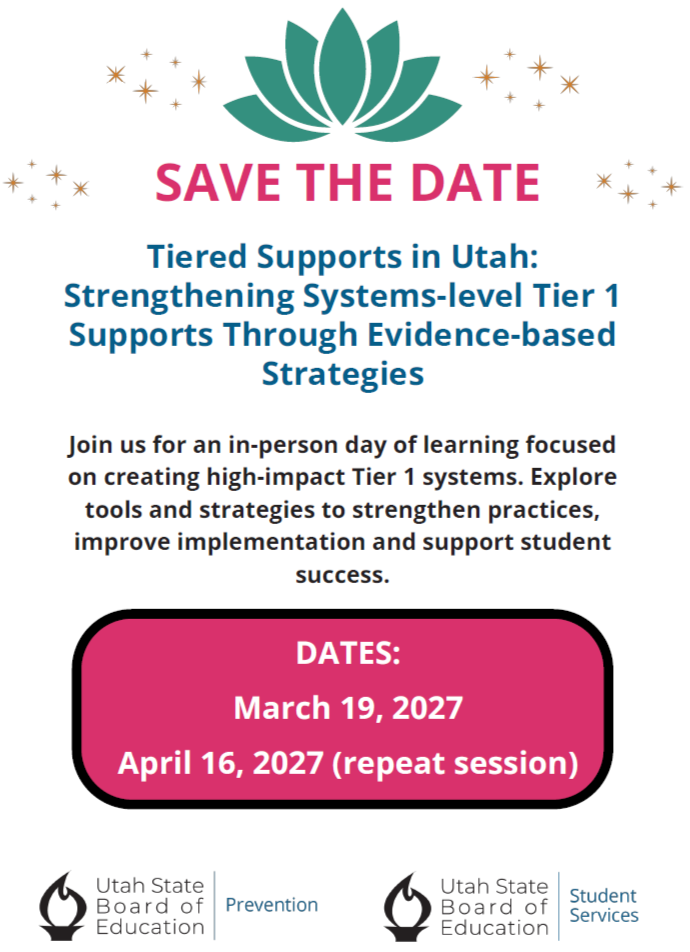
Save the Date
Tiered Supports in Utah: Strengthening Systems-level Tier 1 Supports Through Evidence-based Strategies Workshop
| | | | |