| | |
POLICY & ADVOCACY UPDATE
Issue #74, 25 June 2026
| | | |
- From the AA CEO James Goodwin
- Tax changes closer to passing Parliament
- More political engagement
- Apprenticeship and traineeship numbers continue to fall
- Hotel performance for May
- Overseas arrivals for April 2026
- Growth in the Accommodation Sector
| |
| |
From the AA CEO
As we reach the end of another financial year, it is an opportunity to reflect on the resilience and strength of Australia's accommodation sector. Despite ongoing economic pressures, global instability, workforce challenges and changing market conditions, our industry continues to adapt, innovate and deliver great experiences for guests.
| | | |
|
The hotel sector has once again demonstrated its ability to navigate uncertainty while continuing to invest in people, properties and communities. Regional and remote areas continue to be the hardest hit but hopefully with plenty of fuel and lower prices, the mid-year school holidays will see a much-needed lift in those areas sensitive to the ‘drive’ market.
Political engagement – across all parties – remains a key focus so our key issues are front and centre at a time of competing interests and fragmented community debates
AA continues to prioritise evidence-based policies and to assist with the growing need to be across an ever-increasing amount of policy and regulatory issues, we’ve this week welcomed Amelia Young to the team as Policy & Research Officer. She will work closely with Jenny on our national advocacy agenda as well as supporting our state divisions.
James Goodwin
Chief Executive Officer
| | | | |
Tax Changes closer to passing Parliament
With a deal with the Greens "in the bag" the Government is close to passing its controversial changes to capital gains tax and negative gearing. As discussed in the last Advocacy Update, the business community has been united in expressing its concern particularly about the unexpected changes to capital gains tax which is to be extended beyond residential property assets into capital gains across all investment assets including shares and sale of business.
Adding to these business concerns, we are reminded of a few key events that will take effect on 1 July 2026 which will add to business costs:
- Hospitality Industry General Award rates of pay rise by 4.75%
- Introduction of payday superannuation
- Increase in the Core Skills Income Threshold applicable to temporary skilled migrants to $79,499
| |
More political engagement
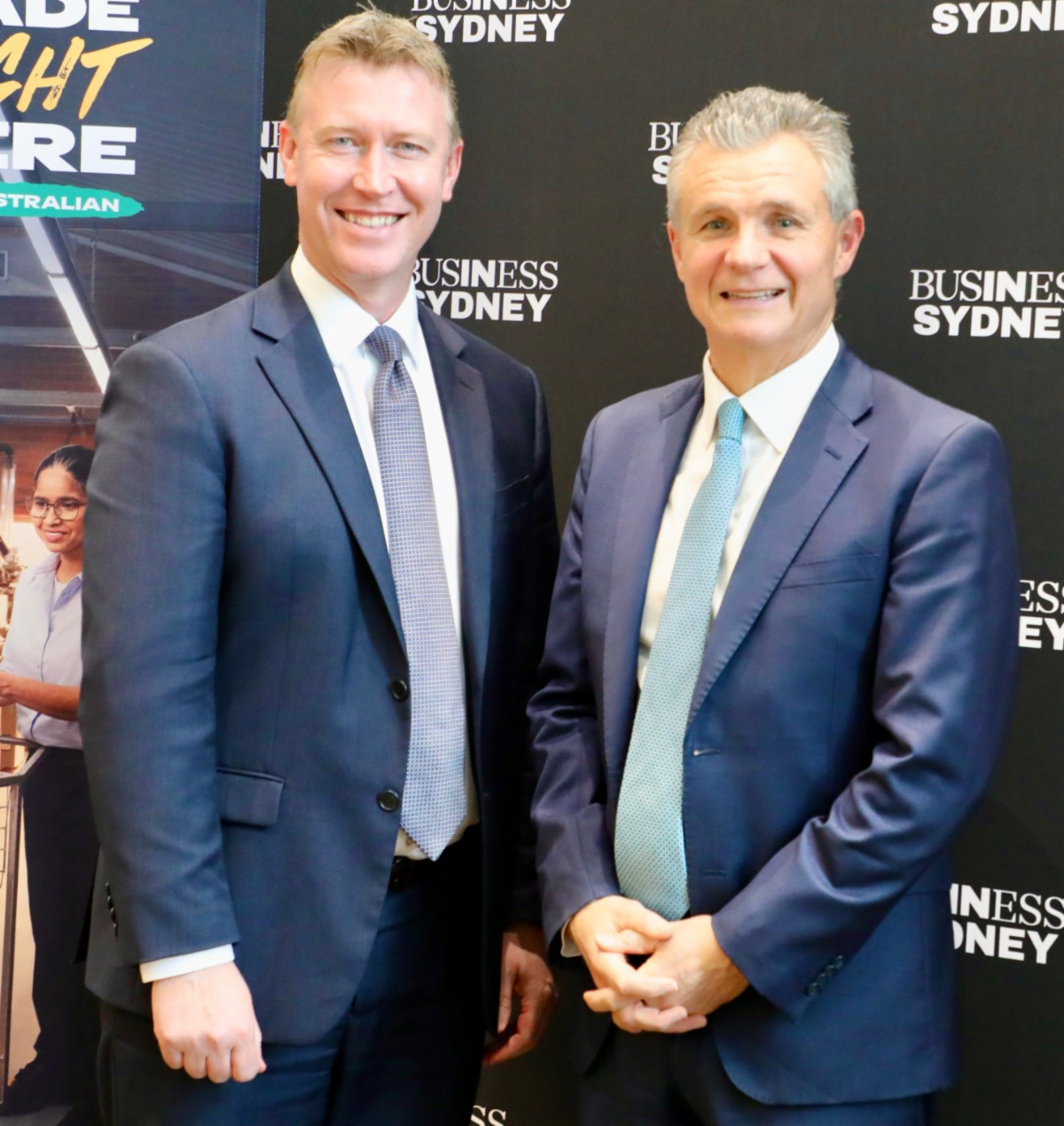
With workforce issues high on the AA priority list, in the past two weeks, AA has met with the Minister for Skills and Training, Minister for Small Business and the Minister for Immigration, Matt Thistlethwaite (pictured right with AA CEO James Goodwin).
Minister Thistlethwaite made valuable comments about the importance of migration to business and the economy. He also noted challenges with visa processing and expressed some frustrations with tactics used by migration agents which further slow down process.
| | | |
As the Minister said, “We are improving skilled visa processing times, and we are tackling the backlogs that have eroded confidence in the migration system. Australia needs a migration system that delivers the skills our economy relies on”.
Next week in Canberra, we will have meetings with Home Affairs, and the offices of Skills & Training and migration.
| | |
Apprenticeship and traineeship numbers continue to fall
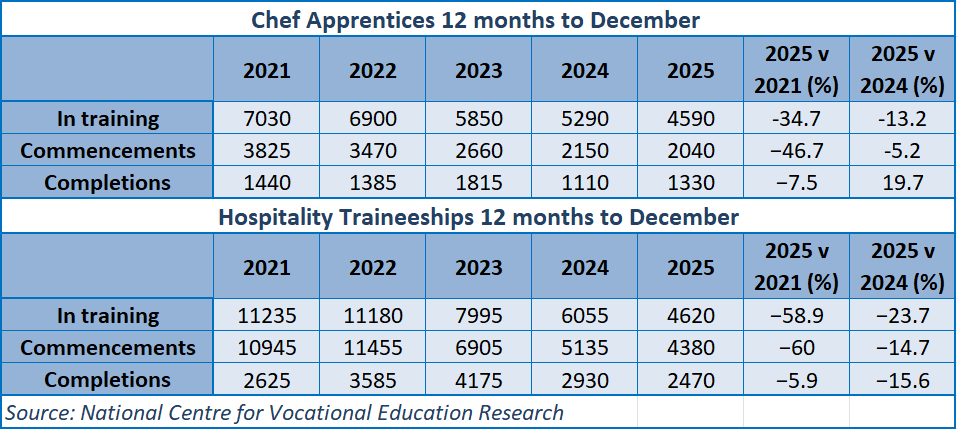
The latest apprenticeship figures released by the NCVER this week for December 2025 confirm that the number of chef apprentices and hospitality trainees continues to fall. In the year to December 2025, across all industries trade commencements fell to 76,585 (down 4.2%), marking the third consecutive annual decline. Across both apprenticeships and traineeships, the most significant falls in numbers in training were seen in Tasmania, the ACT, and Victoria.
As the table below shows, the number of chefs in both commencement and in training have fallen significantly in the year to December 2025, dropping 5.2% and 13.2%, respectively. However, the number of completions for chefs has risen 19.7%, from 1,100 to 1,330 for the year, due largely to the apprenticeship finalisation of those that started during the COVID-19 incentive boost. Concerningly, these falls predate the further reduction of incentives which took effect on 1 January 2026 and also in the May budget, which is sure to see these numbers falling further.
The previous loss of incentives for hospitality traineeships continues to see those numbers fall in all three contract statuses, with commencements down 14.7% on the previous year, and the hospitality traineeships in training falling by 23.7% to 4,620.
| | |
Tourism expenditure and visitor nights growing
The latest international visitor survey (IVS) data released this week by Tourism Research Australia (TRA) shows that in the year to March 2026, international visitors spent $40.9 billion in Australia, up 20% on the previous year. The number of trips increased by 10% to 8.5 million, and nights increased by 9% to 321.9 million. Notably, trips and spend by Chinese holiday travellers increased significantly in the March quarter (48% and 53% respectively on the 2025 March quarter), which can be attributed in part to the longest Lunar New Year holiday on record. Importantly, holiday trips rose 14% to 3.7 million trips in the year to March 2026, and spend by holidaymakers rose 22% to $13.5 billion. The good news for the accommodation sector is that commercial hotels, motels and resorts are continuing to increase their share of international visitor nights, with 27.6 million holiday visitor nights, a 13.6% increase on the 2025 figures. A full break down of international visitor nights will be included in the next advocacy update.
TRA also released the domestic expenditure information, but comparisons remain limited due to the transition from the survey to a more holistic use of data. The year ending March 2026 illustrated mixed results for overnight travel when compared to the same period last year. While overnight spend was up 1% on the year to March 2025 to $107.6 billion, the number of overnight trips was down 2% to 113.1 million. The total number of nights increased 1% on 2025 to 381.6 million, and of those nights, 105.9 million were spent in a hotel, which accounts for 27.7% of all domestic nights. In comparison, 29.9 million (7.8%) nights were spent in a rented unit, and 41.8 million (10.9%) at a commercial camping ground of caravan park. The largest share is with staying in a friend or relative's property at 131.2 million (34.4%). Stronger tourism activity in March 2026 supported total domestic tourism for the March quarter, relative to the weaker March 2025 results impacted by Tropical Cyclone Alfred.
| | |
Hotel Performance for May
CoStar data for May 2026 shows that hotel performance slipped on average across Australia the face of global and fuel uncertainty, with most capital cities holding up, but regions slipping. In terms of average daily rate, South Australia held up the best, with the worst affected being Victoria.
- National average occupancy was up 0.5% to 69.5% for May, ADR slightly up 1.7% to $230.19 resulting in a RevPAR of 2.2%. Across the first five months, occupancy was up 0.8% and ADR up 3.9%.
- NSW experienced an average occupancy of 72%, up 0.7% compared with May last year, with ADR up 2.8% to $244.43. In the first five months, occupancy was up 1.1% and ADR up 5%.
- Victoria's occupancy rose 1.1% to 68%, however ADR fell 0.6% to $197.34. Year to Date (YTD) occupancy was up 0.2% and ADR up 1.5%.
- Queensland occupancy rose by 0.5% to 67.3%, and ADR rose by 0.7% to $253.05. YTD occupancy rose 0.9% and ADR up 3.4%.
- SA occupancy up 0.6% to 69.6% for May, and ADR up 7.3% to $202.23. YTD occupancy was up 2.3% and ADR up 6.7%.
- WA occupancy up 0.2% to 76.3%, and ADR up 3.3% to $242.73. YTD occupancy was up 0.8% and ADR up 5.7%.
- Tasmanian occupancy down 2.2% to 65.8% but ADR stayed consistent with a 0% change at $195.70. YTD occupancy down 0.6% and ADR up 7.1%.
- NT occupancy down 2% to 64.4% but ADR up 1.6% to $222.19. YTD Occupancy down 1.2% but ADR up 2%.
- ACT & Canberra occupancy up 0.8% to 63.1% and ADR also up 3.4% to $181.98. YTD occupancy down 0.5% and ADR down 0.5%.
Preliminary capital city CoStar data for the month to June the 13th shows that hotels in most of the capital cities are on average doing reasonably well:
- Sydney saw a 3.5% rise in occupancy to 77.2%, and ADR was up 4.4% to $255.16.
- Melbourne's occupancy fell 0.6% to 65.8% and ADR fell 0.4% to $198.68.
- Brisbane occupancy fell by 4.1% to 72.2%, while ADR fell 1.7% to $233.95.
- Adelaide occupancy rose by 5.1% to 70% and ADR rose 8.3% to $193.15.
- Perth occupancy fell 4.2% to 72.3% but ADR was up 2% to $227.17.
- Hobart occupancy down 3.4% to 66.1% and ADR down 3.1% to $218.57.
- Darwin occupancy fell 12.4% to 64.3% but ADR rose 0.2% to $239.13.
- ACT and Canberra occupancy was up 4.0% to 70.4% but ADR down 2% to $178.79.
- Gold Coast occupancy up 4.1% to 59.9% and ADR up 7% to $252.15.
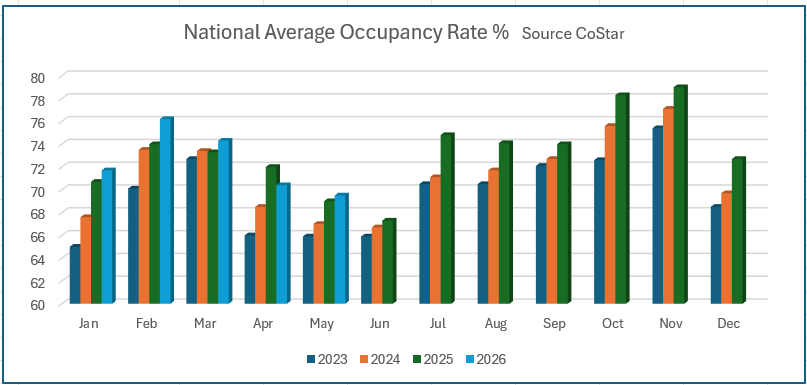
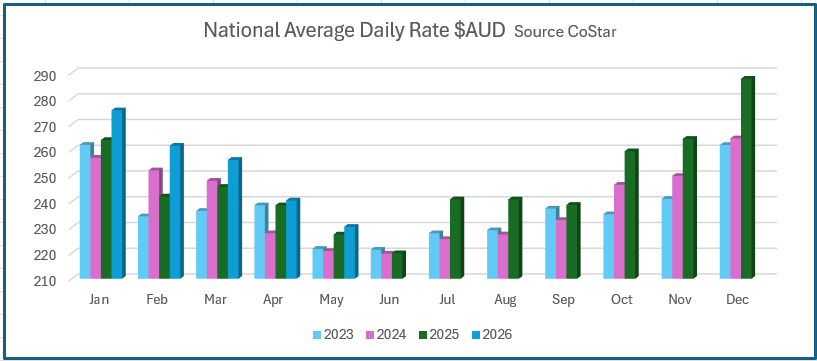
The graphs below derived from the CoStar data show the monthly average performance of occupancy and ADR across Australia since January 2023. The continued upward trend in national occupancy over the past four years is consistent with the results for May 2026.
| |
Overseas arrivals for April 2026
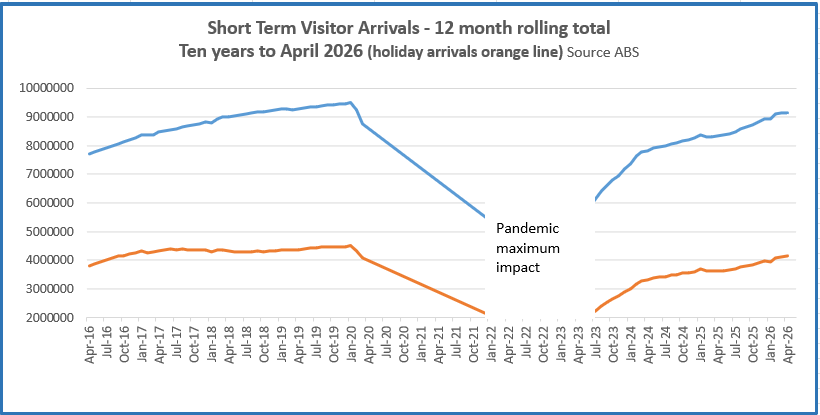
According to ABS data released last week, there was a 0.6% increase in short term arrivals in April to 644,770 compared to April 2025. Holiday arrivals at 289,110 were up by 10.4% compared with April 2025. New Zealand retained the top spot as the largest source country with 124,760 visitors followed by China accounting for 81,580 and the USA third (54,900). Of the top ten origin countries, New Zealand, India, South Korea, and the Philippines all had arrivals greater than April 2019.
The 12-month rolling total arrivals tell a useful story, illustrating the recent improvement as well as the difference with pre-COVID visitors, particularly for holidaymakers. In the 12 months to April 2026 there were 9,160,860 arrivals, up by 9.6% on the year to April 2025, with holiday arrivals at 4,143,310 up a healthy 14.3% on the previous year. Holiday arrivals historically peaked at 4.48 million in the year to December 2019. Overall, this latest data indicates a certain resilience in the arrivals given the current geopolitical issues.
| | |
Growth in the Accommodation Sector
Last week, the ABS released their annual detailed industry data report, which revealed a trending increase in profitability in the accommodation industry. In the 2024-25 financial year, the operating profit before tax of the accommodation sector was $4.1 billion, a 13.5% increase on the $3.6 billion from the previous financial year. By comparison, the other sectors in the hospitality industry reported only a 5.2% increase in profit on the previous financial year (from $8.5 billion in 2023-24 to $8.9 billion in 2024-25, but it is still down from $10.3 billion in 2022-23). Profitability across all industries (excluding mining) increased by 4.4%, while comparable industries such as retail increased by only 1.5% (from $38.3 billion in 23-24 to $38.8 billion in 24-25).
The industry value added (IVA) for the accommodation sector has also continued to rise, with the ABS reporting $13.7 billion, a 12.1% increase from the $12.2 billion in the previous financial year. Total revenue generated by the accommodation sector increased by 6.8% to $27.9 billion in the 2024-25 financial year. Average employment across all of 2024-25 was 137,000 people in their main job, up 3.9% from 132,000 in 2023-24.
Across all of hospitality, the IVA has risen 5.7% on the previous financial year, from $64.7 billion to $68.4 billion in 2024-25. Employment in the hospitality sector as a whole has also seen an increase, from 1.204 million in 2023-24 to 1.237 million in 2024-45.
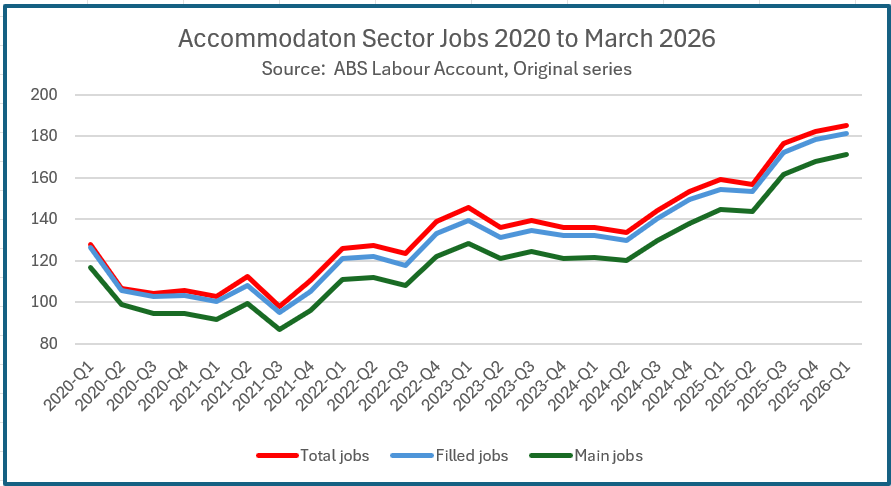
In more recent data on employment, the ABS this week released labour account numbers for March 2026, which revealed a substantial trending increase in jobs in our sector. For those people who consider employment in accommodation as their main job, the sector alone accounts for 171,200 jobs, which is a significant increase of 18.6% from the 144,400 reported in March 2025. The graph below shows the rise in main jobs, as well as total jobs including those people working in our industry not in their main job.
| |
| | |
3 things for you to do today to support the industry's jobs and careers platform eeger.com.au:
- Register on eeger to build your employer profile
-
Follow eeger on LinkedIn to stay in touch
- List your job vacancies on the site that has been developed for industry by industry
| | | | |
Drop me an email at policy@accommodationaustralia.org or give me a call on 0418 277 919 if you have any national policy issue that you think AA should be following up. If you know an AA member who is not receiving this advocacy report but wants to, then encourage them to email me and we can add them to the distribution list. Back issues of the fortnightly advocacy updates can be found here.
Kind Regards
Jenny Lambert OAM
National Policy Director
Accommodation Australia
| | | | |