|
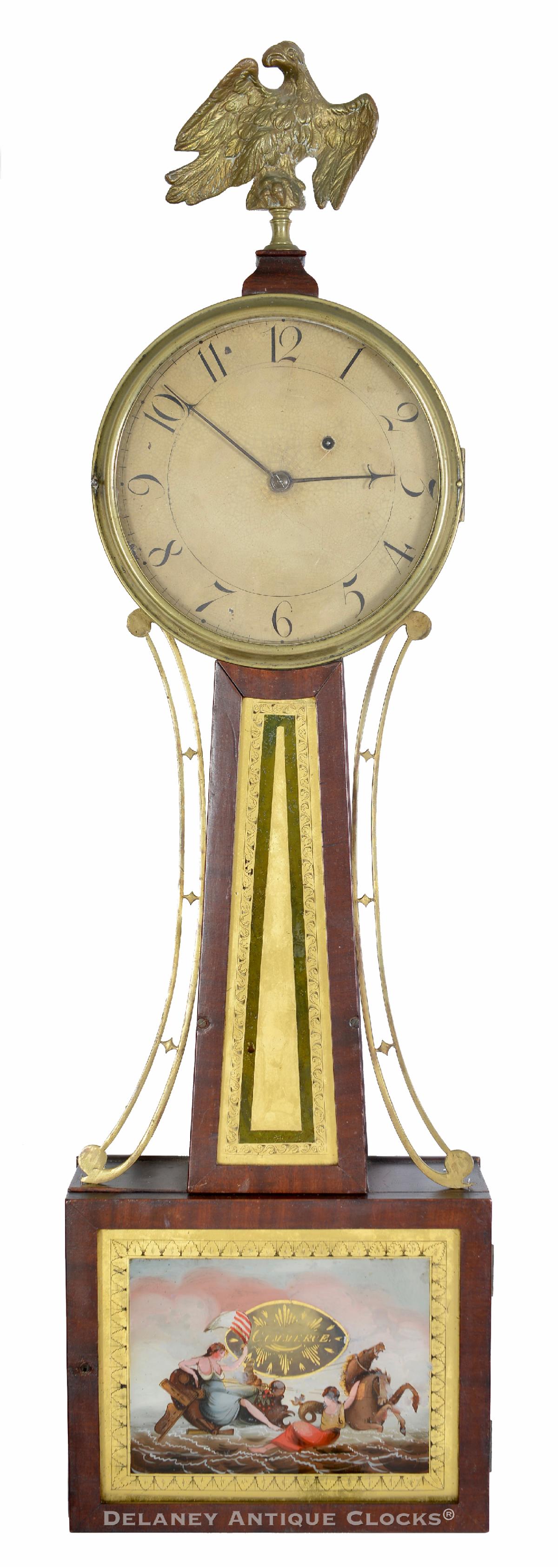
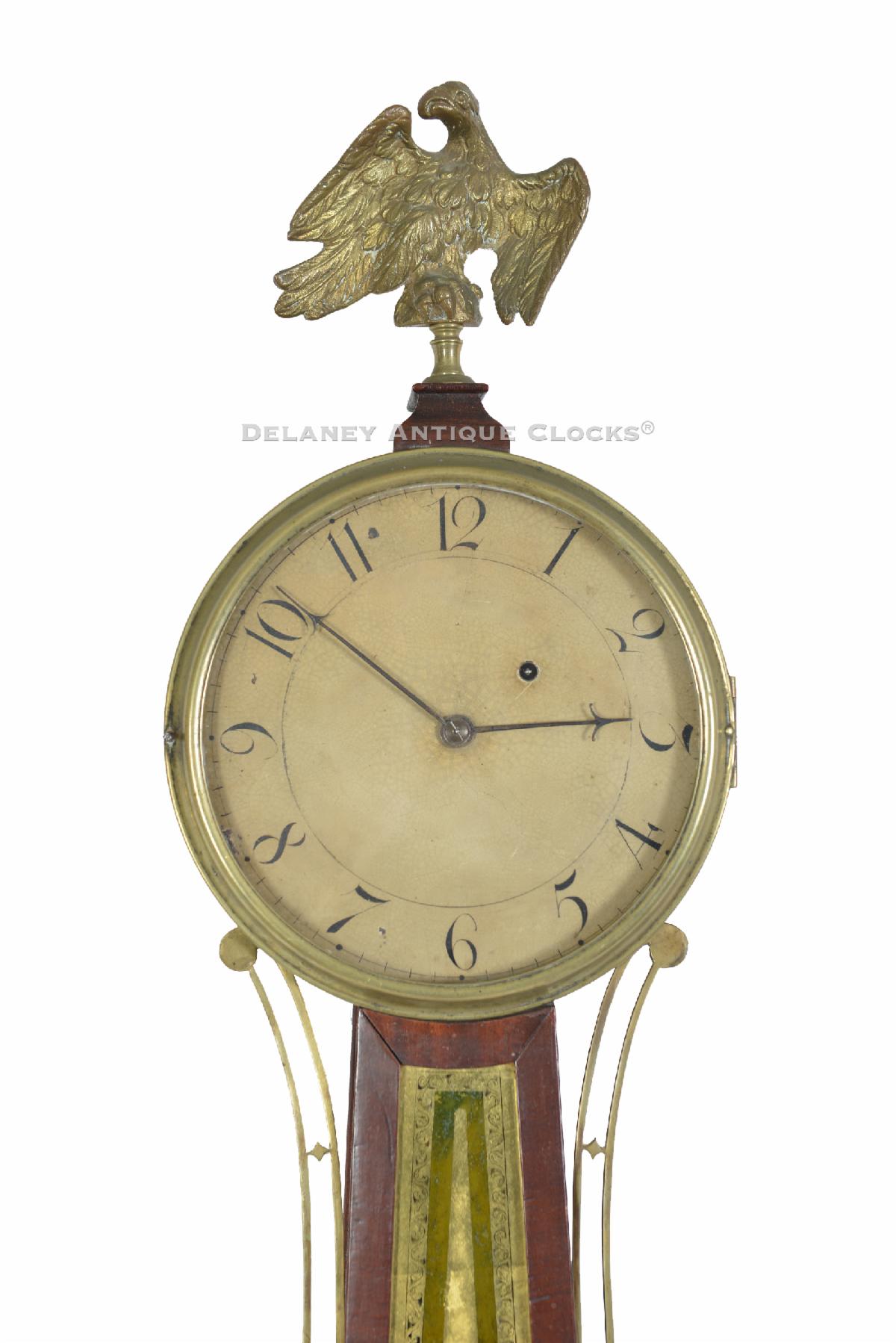
This unsigned Federal Massachusetts timepiece, commonly known as a banjo clock, is attributable to the Willard School of Boston and dates to about 1815.
The form originated with Simon Willard’s 1802 patent for what he called an “Improved Timepiece.” Slender, wall-mounted, and mechanically efficient, the design was distinctly American and became one of the most recognizable forms produced by New England clockmakers during the early 19th century.
The case is constructed of mahogany, with flat mahogany frames, brass side arms, and a cast brass bezel. Behind the bezel is a painted iron dial with Arabic numerals and finely shaped iron hands in the barbed-arrow pattern associated with early examples of the form.
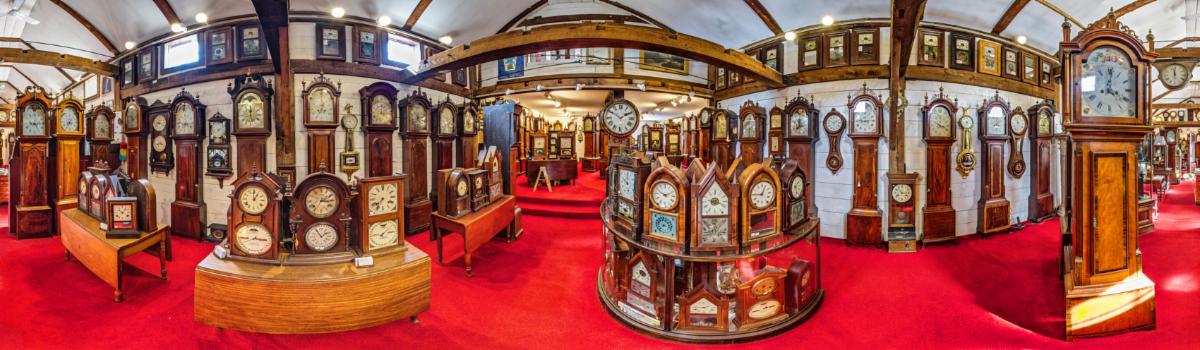
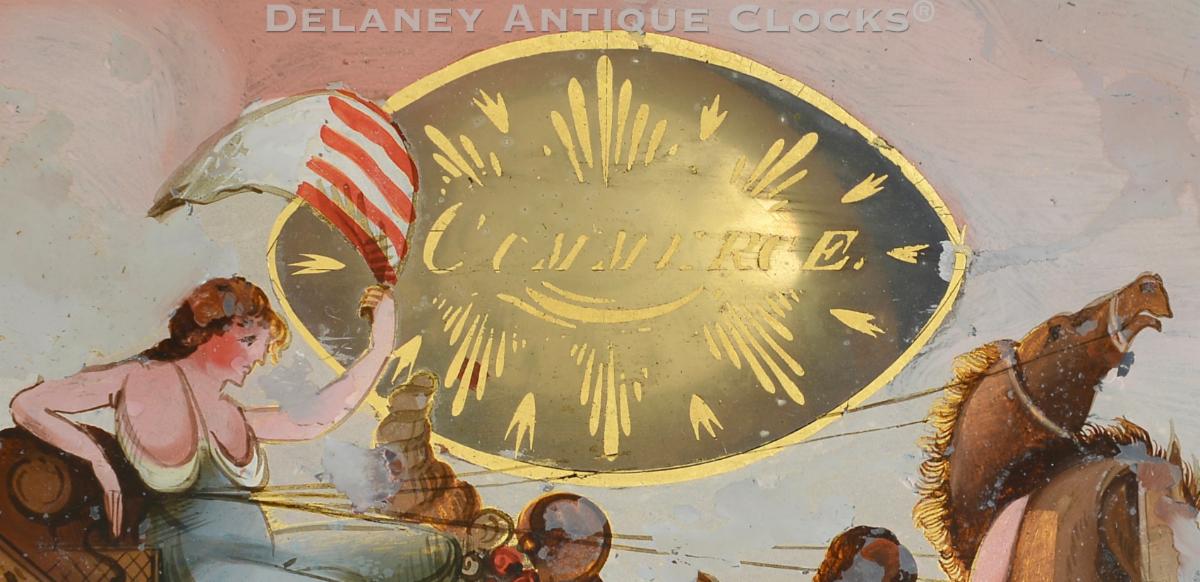
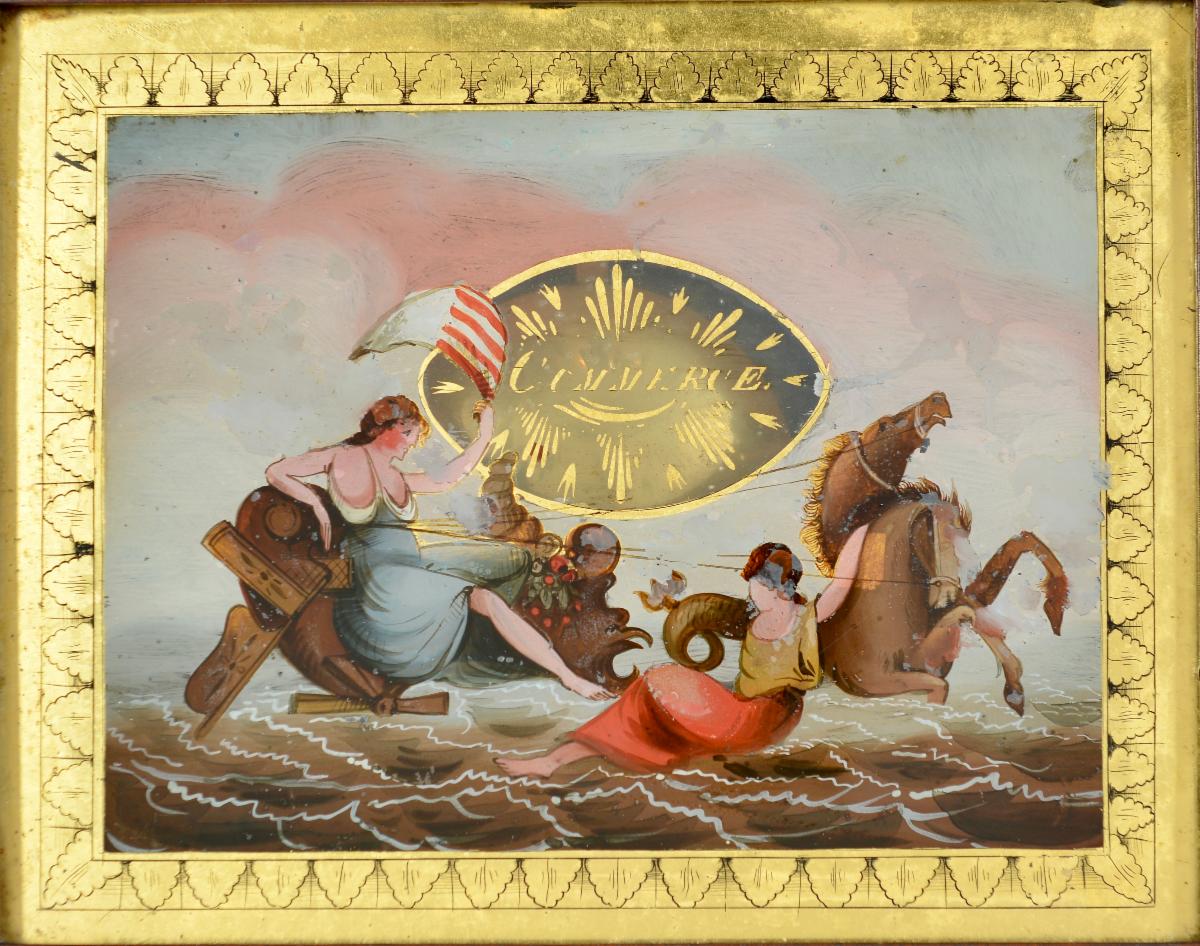
The painted glass tablets are especially well preserved. The lower tablet depicts the “Triumph of Marine Commerce,” an allegorical subject with roots in European painting, sculpture, and civic imagery. At its center, Amphitrite, the Greek goddess of the sea and wife of Poseidon, travels across the water in a chariot drawn by hippocamps, mythological horses with fish tails. Patriotic drapery rises above her like a sail, reinforcing the composition’s associations with navigation, maritime power, and commercial prosperity. The word “Commerce” appears within the pendulum-bob aperture below.
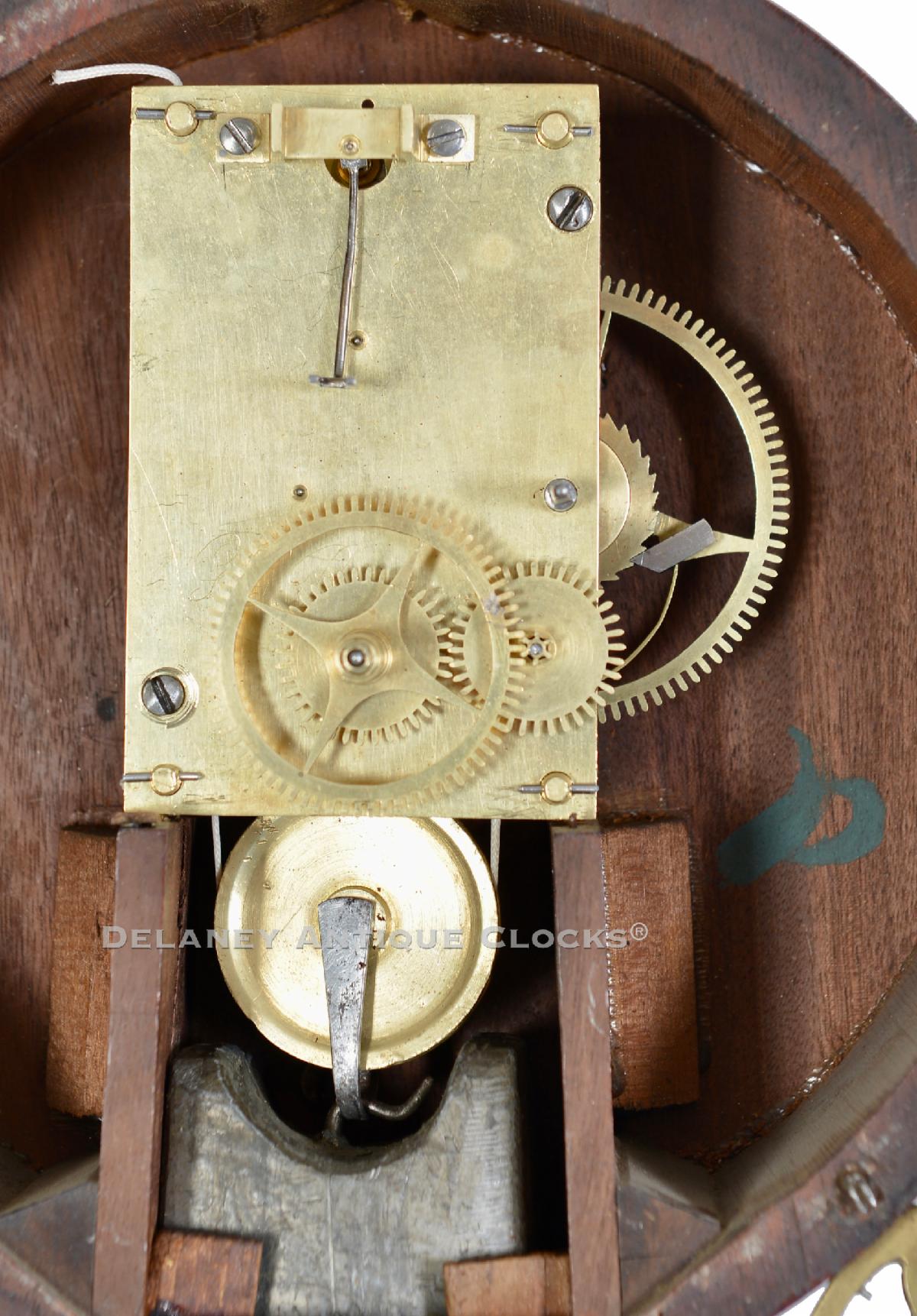
Behind the dial is a time-only, weight-driven brass movement with step-train gearing and a recoil escapement. Its unusually long plates, T-bridge suspension, and through-bolt mounting are notable construction details. The period lead weight retains a Willard-style duckbill hook.
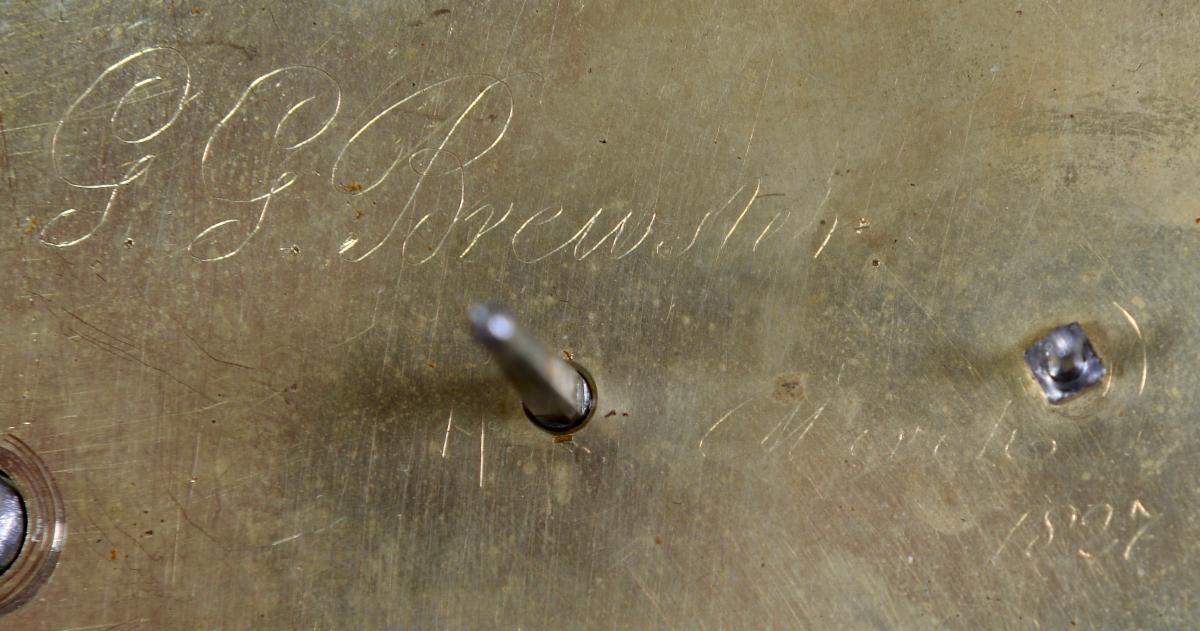
Of particular interest is an inscription engraved on the movement’s front plate: “G. G. Brewster, March 1827.” George G. Brewster is listed in Paul Foley’s Willard’s Patent Timepieces and worked in Portsmouth, New Hampshire, as a watchmaker, clockmaker, and dentist from 1818 to 1836. An advertisement in an 1827 Portsmouth directory noted that he was “constantly supplied with warranted CLOCKS and TIMEPIECES.” Several years later, in 1831–32, Brewster entered into partnership with Josiah Willard Jr. as Brewster and Willard. The inscription provides an intriguing connection between this timepiece and the broader network of craftsmen and merchants associated with the Willard tradition.
A brass eagle finial, mounted on a mahogany chimney plinth, crowns the case.
At approximately 34 inches in length, the clock combines the restrained proportions of the Federal period with imagery that speaks directly to the maritime economy of early 19th-century New England. Its movement details, well-preserved tablets, and documented association with George G. Brewster give the timepiece a particularly compelling place within the larger story of the Willard school.
Dimensions: Height 34", Width 10", Depth 3 1/2"
Inventory 226110
Price $6,500
|