North Plains Water News

April 2026

We are off and Running at the WCC!

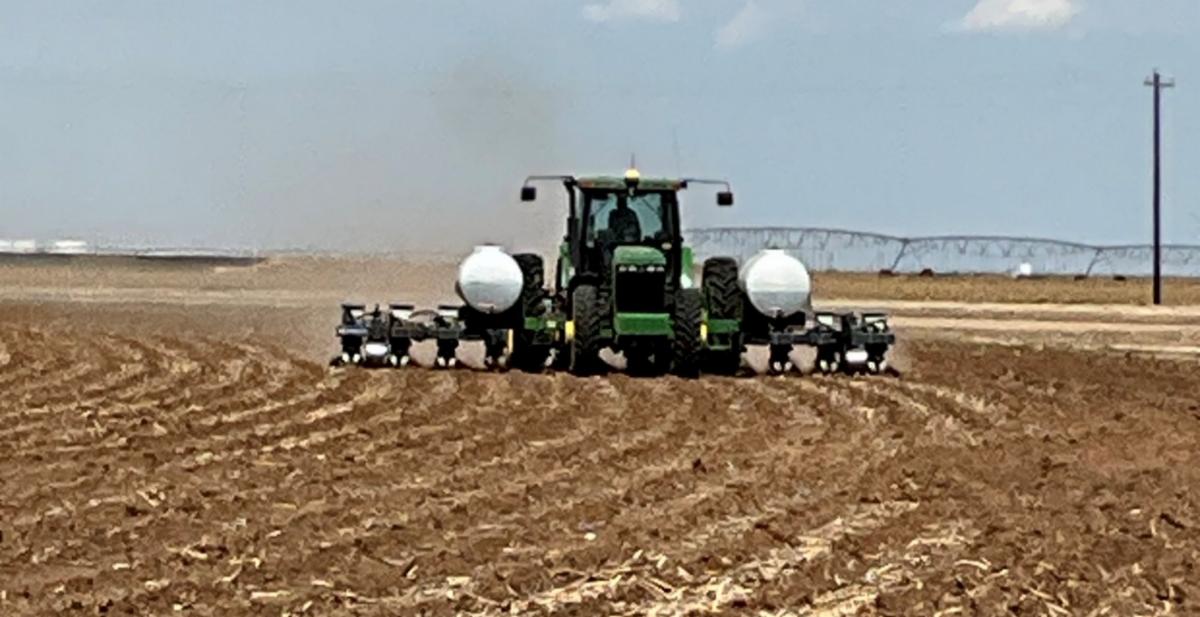
Our first crops were planted this week at the Water Conservation Center, so we are off and running in our demonstration program for the 2026 season! Two half circles of early corn silage were planted on 4/22, after the field had been prepared with strip tillage, residual herbicide and pre-watered with 3” of irrigation. We had been watching the soil moisture and temperature conditions closely and were finally able to press the go button!

The early planted silage corn will share water with a later planted grain corn crop. This should allow us to spread out the peak water demand and ensure adequate moisture during peak crop demand. The early planted silage should also allow us to harvest ahead of many of the silage crops in the area, spreading out the demand on equipment during the tight harvest window. Another advantage we hope to see is that the conditions after harvest should allow us to establish a cover crop whilst the soil is still warm.


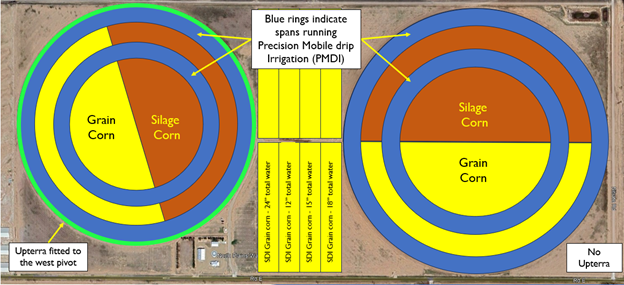
The other halves of each pivot will get planted to grain corn in another 4-5 weeks. Once that crop is established, we will fit mobile drip hose to two of the spans on each pivot. The aim is to demonstrate the differences between irrigation in bubble mode versus mobile drip in a side x side comparison. We will also be able to compare that to the same hybrid of grain corn grown on subsurface drip (SDI) in the neighboring field, setting up a 3-way comparison on irrigation efficiency.


Stay tuned for more updates as we head into season 2026!

Public Comment Period Still Open for Proposed Desired Future Conditions

Groundwater Conservation Districts (GCDs) across Texas are required to adopt Desired Future Conditions (DFCs) for aquifers every five years—a process that has been in place since 2010. These DFCs help guide how groundwater resources are managed for long-term reliablitiy.


In our region, Groundwater Management Area 1 (GMA #1) approved the proposed DFCs during its meeting on February 24, 2026, in Amarillo. As required by Texas law, a public comment period of at least 90 days follows this approval, giving community members an opportunity to review and provide input.


A public hearing was held on April 14, 2026, at the North Plains Water Conservation Center, where stakeholders and residents had the chance to learn more and share feedback.


The public comment period remains open through May 14, 2026. Community members are encouraged to review the proposed DFCs and submit comments in any of the following ways:

  • Email: Submit comments electronically to the District
  • Mail: PO Box 795, Dumas, TX 79029
  • In Person: 603 East 1st Street, Dumas, TX


The proposed DFCs for GMA #1, along with the draft explanatory report and resolution, are available for public review. These documents provide detailed information about the planning process and the long-term groundwater management goals for the area.


Public participation plays an important role in shaping how groundwater resources are managed. Feedback received during this period will be considered as part of the final decision-making process.


For additional information, please contact Janet Guthrie at 806-935-6401 Ext. 207 or visit the GMA #1 website.

Where Does Our Water Come From?

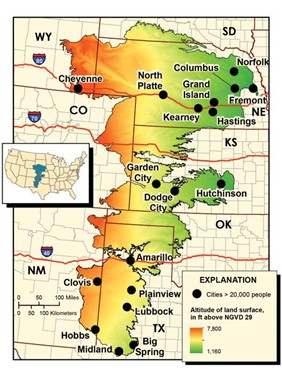
Turn on the tap, and it’s easy to assume water is always there when we need it. But across the Texas Panhandle—and much of the central United States—that water comes from an enormous underground source called the Ogallala Aquifer.


The Ogallala Aquifer can be thought of as a giant natural reservoir beneath our feet. Layers of sand, gravel, and rock—deposited millions of years ago—hold water in the spaces between them, much like a sponge. These layers formed as the Rocky Mountains slowly wore down, with rivers carrying sediment eastward across the High Plains.


Over time, rainfall and melting snow seeped into the ground, filling those spaces with water. However, unlike rivers or lakes that can refill relatively quickly, the Ogallala Aquifer recharges at a very slow rate. In fact, much of the water we use today entered the ground thousands of years ago. Here in the Texas Panhandle, recharge from rainfall is extremely limited—often less than one inch per year.


Despite its slow recharge, this aquifer is vital to life in our region. It supplies water for agriculture, ranching, communities, and local industries. The irrigated fields seen across the Panhandle—those familiar green circles from above—depend on this underground resource.


Because the Ogallala Aquifer replenishes so slowly, careful management is essential. Using water efficiently and reducing waste can help extend its availability for future generations. Understanding where our water comes from is an important first step in protecting it.

WCC Demonstration Program Plan for 2026


The Water Conservation Center (WCC) near Etter TX aims to demonstrate simple techniques and water saving ideas to local farmers that can help them increase their profitability and sustainability in the face of declining water availability. The demonstrations are done on a field scale, using commercial equipment to highlight to producers the economics of water saving ideas and just how accessible real improvements can be on their farm.


This year we have an exciting line up of field demonstrations These include:

  1. The economics of sharing water between early planted silage corn and later planted grain corn. The aim is to spread out peak water demand to ensure a higher yield for each crop.
  2. A comparison between sprinkler, mobile drip and subsurface drip irrigation. Two spans on each pivot have been converted to PMDI to compare with the standard sprinkler package.
  3. The use of drought tolerant corn hybrids under limited water conditions. There will be 6 hybrids tested under 4 irrigation levels, with early and late planting.
  4. The use of Upterra treated water on the west pivot compared to untreated water on the east pivot.


After compelling results from 2025, that highlighted just how far new drought tolerant genetics have progressed, we are keen to repeat the demonstration in 2026. There was one hybrid (P14364PCUE AquaMax) that really stood out, providing a yield advantage between 9% & 14% across a range of high and low irrigation regimes. This is exciting as it provides protection against low yields in low water conditions but also provides the opportunity to increase yields if the conditions allow. This year will be similar to 2025, but featuring a new range of hybrids that include rootworm protection, given the corn after corn rotation. We encourage local farmers to come and see for themselves how modern genetics stack up against each other under a range of water limited conditions.


Anyone who has been irrigating in the panhandle over the last 10-15 years would have seen vast changes in the way we irrigate. Sprinkler pads are being flipped to bubble mode, nozzles are lower and closer together, and the pivots are running slower. This year we have made another investment at the WCC and we will be incorporating precision mobile drip irrigation (PMDI) to compare it against the current irrigation practice. By attaching drip lines instead of spray nozzles, we can get the water to the soil surface with minimal losses and give it a longer time to soak. We will be making a thorough comparison between sprinkler and mobile drip when used to grow grain and silage corn. We will also be able to compare these differences with and without the Upterra water treatment system.


Since we will include the same hybrid used to grow grain corn on the pivots in the subsurface drip fields, this will allow us to compare all 3 types of irrigation in a side-by-side matchup. This should prove very compelling when looking at irrigation options for a future where irrigation efficiency is becoming more critical. This comparison should also allow for some modeling of costs versus the return on investment when considering irrigation upgrades, so local producers can decide what might fit with their own operations.


As always, you are welcome to come out and visit the demonstrations at the WCC and encouraged to ask questions and/or follow the updates. We are planning on holding a field day later in the season and we hope to see your there!

Important Links...


Facebook  Twitter  Instagram