California Asphalt Pavement Association
Vol. 13, Issue 49 || Dec. 14, 2020
|
|
Greetings!
This weekly report contains news and information of interest to the asphalt pavement industry, customers and agency partners in California. Please feel free to distribute this newsletter to others who may be interested in asphalt pavements. To provide feedback or story ideas click HERE. Having difficulty viewing this newsletter? View as Webpage
|
|
EXCLUSIVE: Confidence shaken in our 11th annual 'Better-Worse' survey; COVID-19 and economic uncertainty among top concerns for 2021 |
|
The results are in. The 11th annual CalAPA "Better or Worse" survey shows respondents sharply divided about prospects for 2021, reflecting a state battered by a global pandemic and the resulting economic uncertainty.
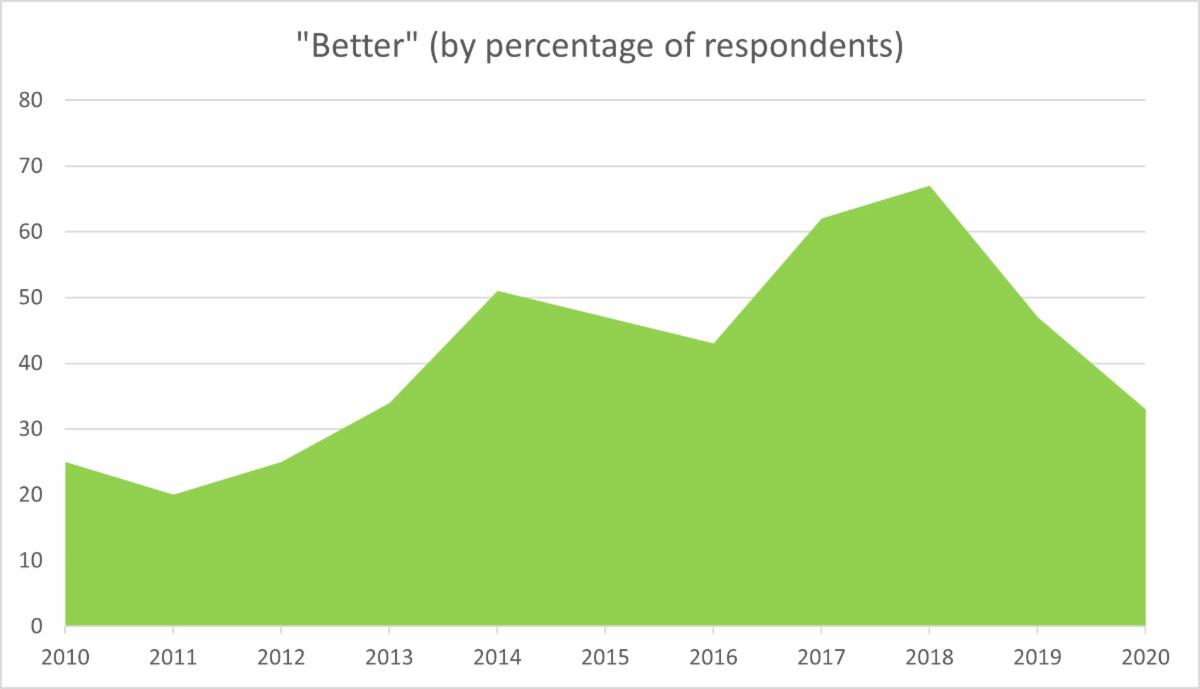
The brief, non-scientific poll of more than 2,500 "Asphalt Insider" newsletter subscribers, conducted over the past month, found optimism sharply down from last year but still higher than was registered during the depths of the last recession in 2011. The number of respondents who said next year would be better than 2020 stood at 33 percent, compared to 47 percent last year. That is in stark contrast to 2011, when the “better” number was just 20 percent. The comments seemed to indicate, however, a belief that it would be hard to top the depressing news of a year dominated by the corornavirus global pandemic.
“COVID sucks!” commented one respondent, a noted figure in academia. Added a state agency representative: “Can it really get worse than 2020? Maybe I better not ask that.”
If there was a glimmer of optimism in the year, it was that road construction was generally designated “essential” by California state and local authorities and allowed to continue. SB1, the Road Repair and Accountability Act of 2017, continued to generate billions of dollars into state and local transportation coffers, which was translated into paving projects that are the bread-and-butter for the industry.
“SB1 money is continuing to trickle in,” one prominent asphalt producer commented. “City and county jobs are paving with more material and bidding at larger dollar amounts.” Added a survey respondent in the pavement preservation space: “Even though there is a pandemic, I see local, state and federal governments still wanting to improve infrastructure and keep jobs alive.”
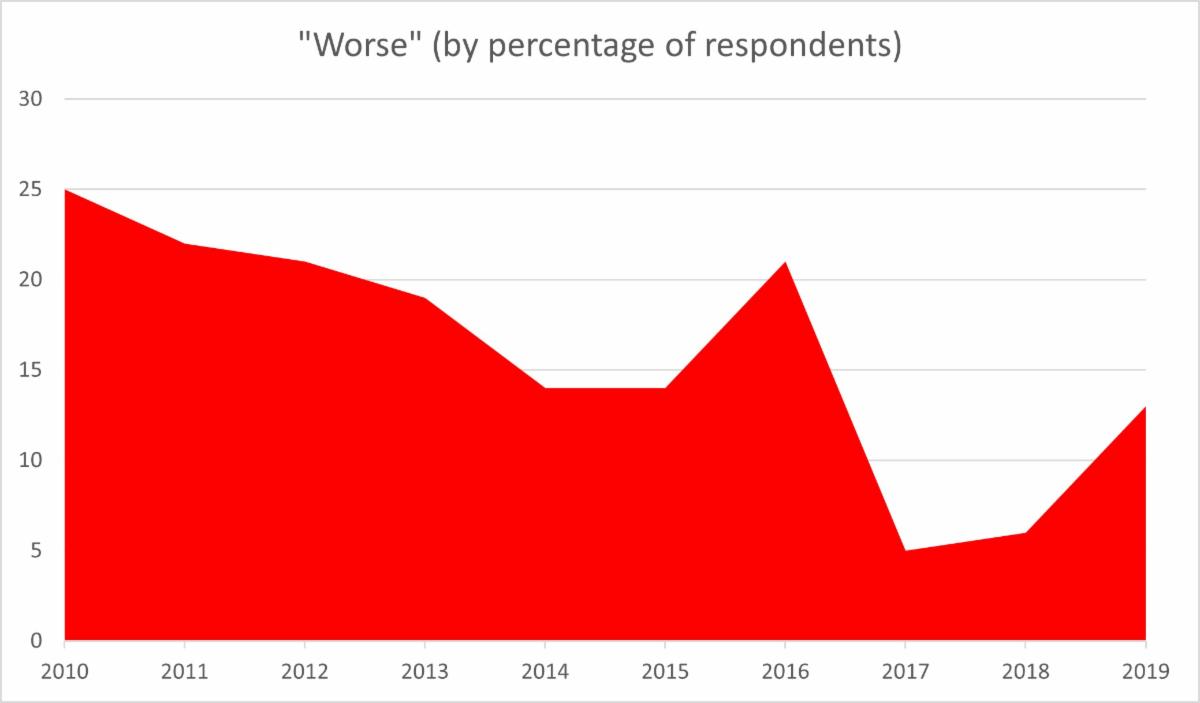
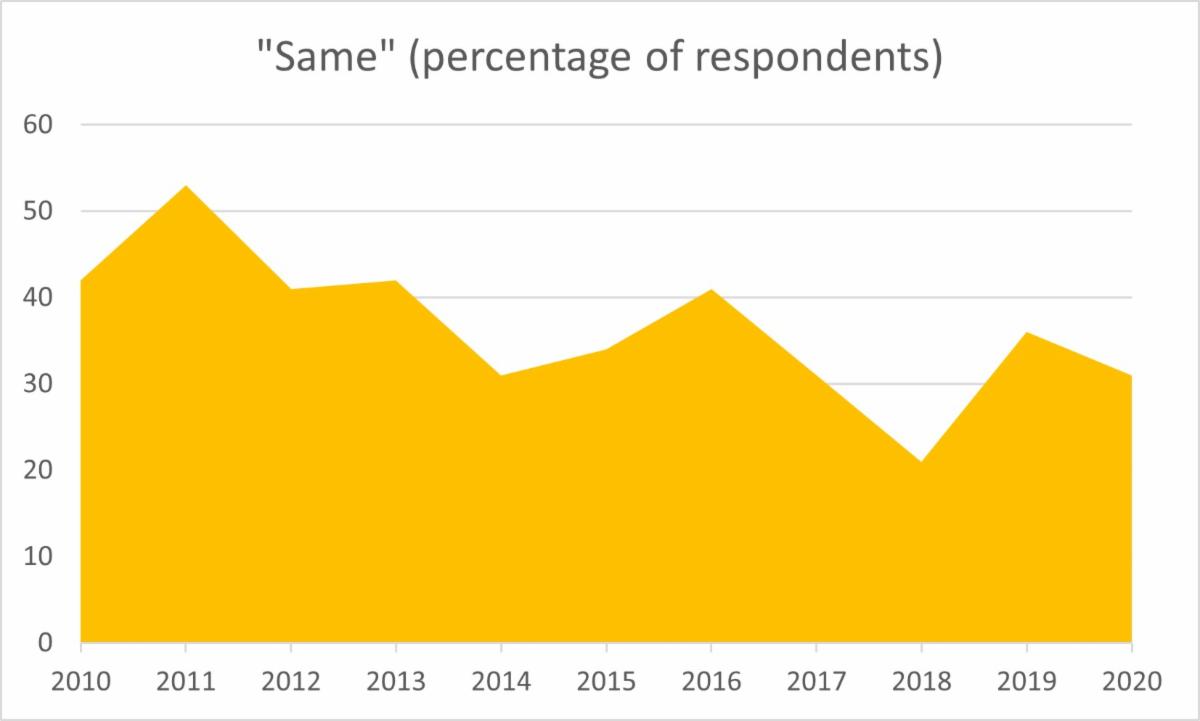
On the negative side, 31 percent of respondents said next year would be worse than 2020, a sharp increase in pessimism from the 13 percent who felt that way last year and a record high for the question. The previous high “worse” percentage in the history of the survey was 25 percent recorded in 2010. About 31 percent of respondents said next year will be about the same as 2020, slightly down from last year. Much of the pessimism was related to lack of work, particularly in rural areas, and a decrease in private work.
“Churned through a lot of backlog in 2020, which has not been replenished at the same rate,” one supplier commented. Added an asphalt and aggregate producer: “Not enough jobs to bid on.”
Of the overall respondents, about a quarter were public agency representatives, with the rest comprising asphalt producers, refiners, paving contractors and other companies that are part of the industry, plus a smattering of others.
For the fifth year in a row, the survey added an optional question, “What is the No. 1 challenge where you work?” That question elicited 127 written responses. Workforce issues continued to dominate the comments, including the difficulty in finding qualified workers, being mentioned in 39 of the 127 comments. “Experienced workers,” “qualified labor” and “finding good people” were the various ways this challenge was articulated by both public- and private-sector survey respondents. Several commented on the inability to find workers to match the challenging and varied work conditions, and high expectations, that face anyone considering a career in construction.
“Recruiting and hiring hard-working people with a positive growth mindset,” one agency representative commented, while another added simply: “Lack of work ethic.”
As the workforce ages and enters retirement or moves to other fields, the survey suggests, the churn in personnel continues to create conflicts between industry and agency personnel. One survey respondent described the top challenge this way: “Dealing with knowledgeable people. Too many transient people in the business now.”
Several other respondents cited the increasingly complex regulatory environment as a top challenge heading into 2021, and a few mentioned the additional public health and worker safety restrictions brought about by the COVID-19 pandemic. The California Department of Public Health reported that, as of Dec. 12, there have been 1.5 million confirmed cases of COVID-19 in California, resulting in 20,847 deaths. A dramatic upswing in cases and hospitalizations in recent weeks prompted state and local officials to issue a number of restrictions on business activity, travel and public gatherings. While the asphalt pavement industry has been designated an “essential” activity and allowed to continue to operate, a flurry of new worker safety regulations have been issued by state and local authorities aimed at slowing the spread of the virus that thrives on close, human-to-human contact.
The main CalAPA survey question is purposefully vague: "For your company or organization, how do you think 2021 will compare to 2020?" However, most of the voluntary comments offered up by survey respondents to justify their opinion centered around how much work is expected in the coming year. The answer varied by company, agency and region, reflecting the size and diversity of California's massive economy and the economic micro-climates that are spread across the state.
As in previous surveys, the weather largely depends upon where you are standing. Some respondents commented that work was brisk, while others were disappointed, particularly in rural areas of California. Several respondents noted a drop-off in private work.
A total of 187 people took part in the voluntary on-line survey, which was conducted from Oct. 29 to Dec. 11. To read the story about last year's survey results, click HERE. More detailed economic forecast information will be featured in the 2021 Forecast Issue of CalAPA's official magazine, California Asphalt, which will hit mailboxes in January.
|
|
'Better' respondents 2010-20 |
|
'Worse' respondents 2010-20 |
|
'Same' respondents 2010-20 |
|
California election results are certified by the Secretary of State; road repairs buck anti-tax trend |
|
The Secretary of State on Friday officially certified the results of last month's general election in California, which saw a record voter turnout and promising results on a number of campaigns closely watched by the asphalt pavement industry.
There were a total of 17.7 million votes cast, which represented an 80.67 percent turnout of registered voters. It was a record number of votes cast in California and the highest percentage turnout of registered voters since 1976. The turnout of eligible voting-age population, 70.88 percent, was the highest since the 1952 General Election, the Secretary of State reported.
The certification of the election results officially commits California's 55 electoral delegates to the presidential ticket of Joe Biden and Kamala Harris. It also confirms the defeat of Proposition 15, a ballot measure that would have raised commercial property taxes in California by an estimated $11 billion. A broad coalition that included CalAPA opposed the measure.
Down ballot, there were several noteworthy results in local races around California. Congressional Republicans, who took a beating at the ballot box in 2018, regained four House seats in 2020. Three candidates won in November: Young Kim, Michelle Steel, David Valadao. They join Rep. Mike Garcia, who won a special election last year. The California congressional delegation is 55 members, but after a poor showing in 2018 only seven were Republican. they have now increased that number to 11.
With the defeat of Proposition 15 and a few other tax measures, a media narrative emerged about the California electorate in 2020 that a pandemic and economic uncertainty made voters less willing to approve tax measures. Street repairs, however proved to be an exception. At least 12 local tax measures were approved in the state that devote at least part of the revenue raised to street repairs. California's Constitution generally requires a two-thirds "super-majority" for tax measures to pass.
Voters in Sonoma County passed Measure DD, which extended a quarter-cent sales tax to fund road and infrastructure projects for 20 years beyond its scheduled 2025 expiration date. In the City of Carson, in Los Angeles County, voters endorsed Measure K, which increased the 9.5 percent sales tax by 0.75 percent to a total of 10.25 percent to raise an estimated $12 million a year for street repairs and other needs.
In the City of Concord, in Contra Costa County, voters passed Measure V, which extended and doubled the local sales tax from 0.50 percent to 1 percent. The sales tax hike is projected to raise $12 million annually for street repairs and other city services. In the City of Lancaster, also in Los Angeles County, voters endorsed Measure LC, with authorizes the city to increase the 9.5 percent sales tax by 0.75 percent to a total of 10.25 percent to raise about $12 million a year for street repair and other work.
Other measures that would dedicate at least part of the money raised for street repairs were passed in Palmdale (Measure AV), Pasadena (Measure P), Petaluma (Measure U), San Francisco (Proposition A), San Jose (Measure H), Santa Rosa (Measure Q), and West Hollywood (Measure E).
In a squeaker, voters in Eureka passed Measure H by a 66.41 percent to 33.59 percent vote. The measure renews the city's voter-approved sales tax at 1.25 cents. In a recent CalAPA survey, a local official from Eureka said Measure H "should quadruple our paving budget."
When it comes to fixing roads, it seems, voters in California are willing to open their wallets.
|
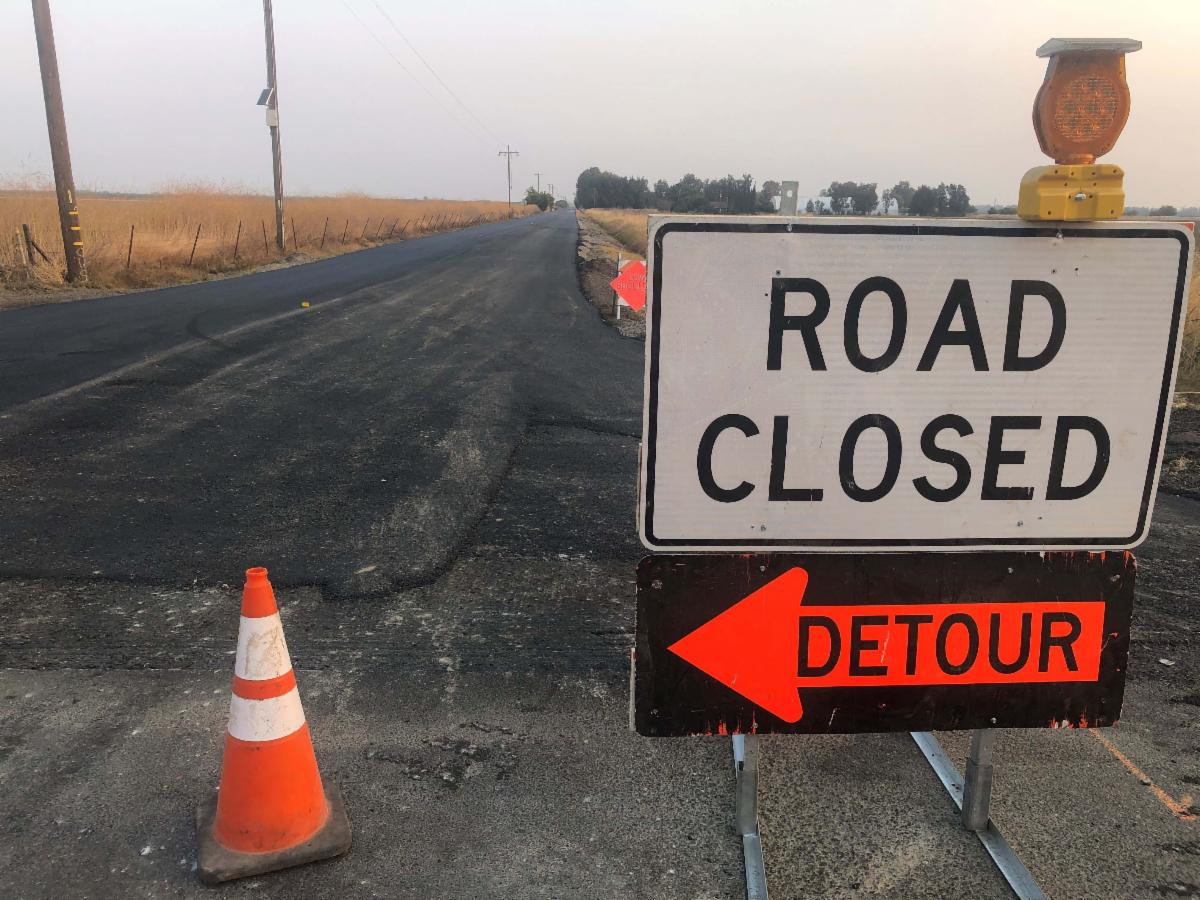
This rural route in Yolo County is one of many road repairs undertaken in 2020. At least 12 local jurisdictions endorsed tax measures at the Nov. 3 election to devote additional funds to pavement repair. |
|
Featured resource: Another asphalt advantage is speed of construction |
|
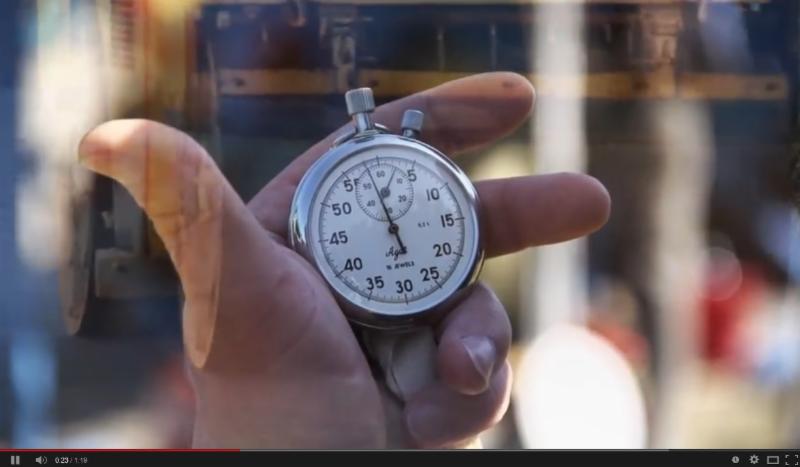
The Asphalt Pavement Alliance, a coalition of the National Asphalt Pavement Association, the Asphalt Institute and State Asphalt Pavement Associations, including CalAPA, has recently highlighted another advantage of asphalt pavements: speed of construction. A brief video that makes the point in a clear and compelling way is HERE.
The stated mission of the Alliance is "to establish asphalt pavement as the preferred choice for quality, performance, and the environment. The APA will accomplish this through research, technology transfer, engineering, education, and innovation."
For other technical and promotional resources, including videos, reports and white papers, visit the Asphalt Pavement Alliance's newly revamped website HERE. Part of CalAPA member dues go toward underwriting the activities of the Asphalt Pavement Alliance. |
|
 |
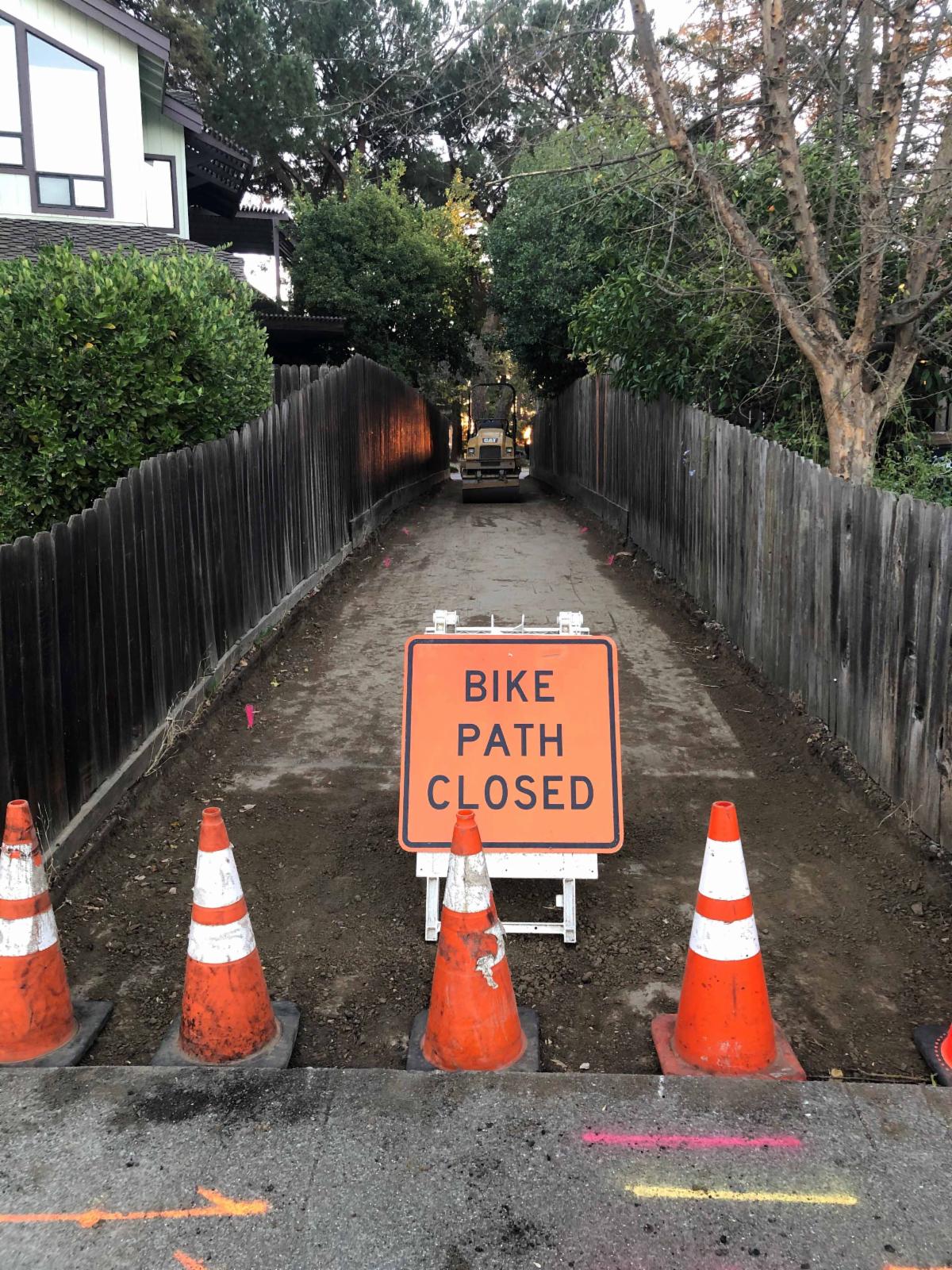
The City of Davis in Northern California is widely considered the "Bicycle Capital of America" for its extensive network of bicycle and walking paths, including this one that underwent rehabilitation this month. |
|
|
|
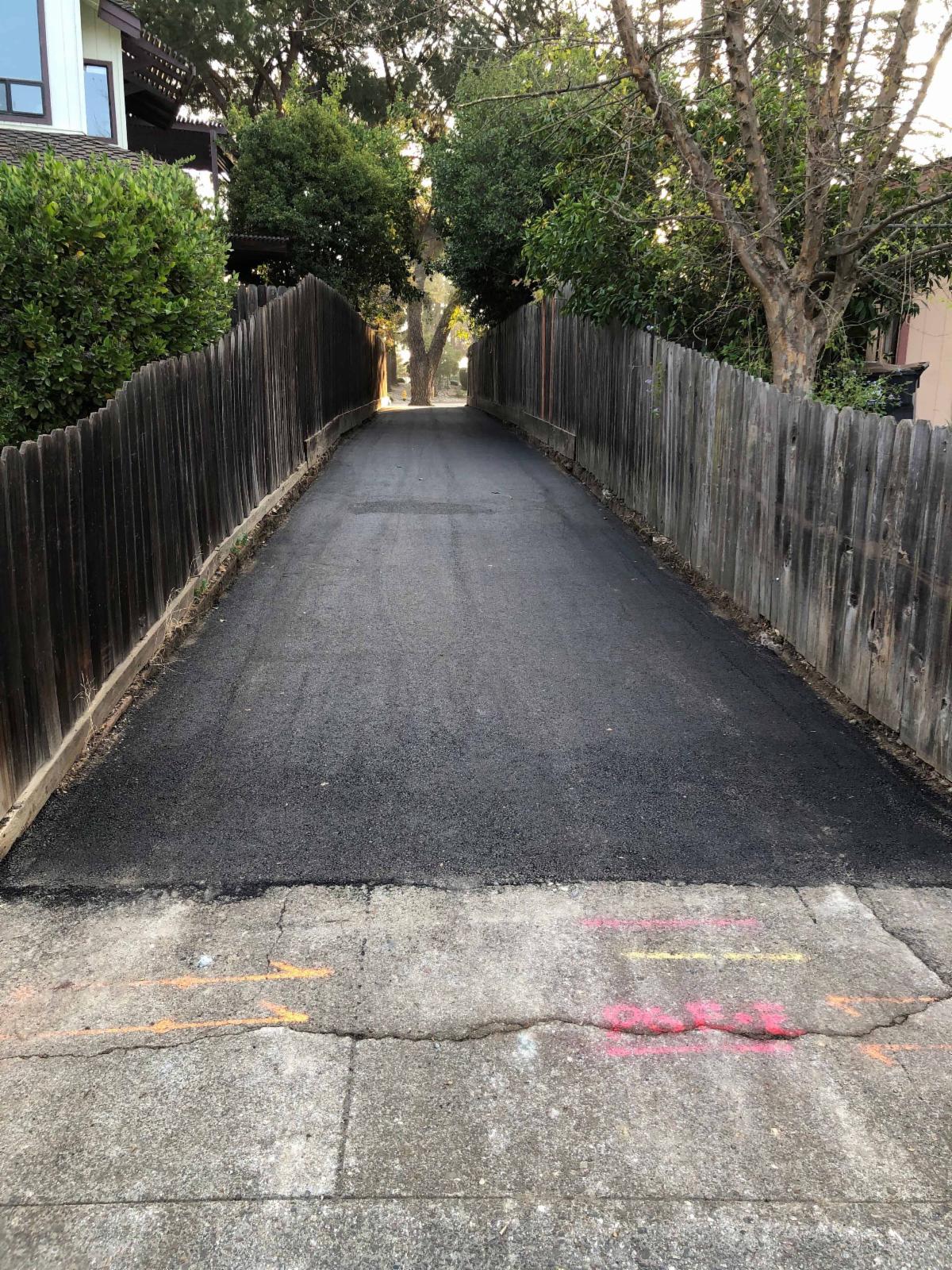
This is the "after" photo of a City of Davis bicycle and walking path completed near Lake Boulevard. The path was paved and open for cyclists and pedestrians within 24 hours, yet another demonstration of asphalt's "speed of construction" attributes. |
|
|
|
Each week we highlight a word, acronym or other term commonly used in the asphalt pavement industry in California.
STANDARD SPECIFICATIONS: Refers to the Standard Specifications published periodically by the California Department of Transportation (Caltrans). The Standard Specifications can be modified by Revised Standard Specifications (RSS).
|
|
Paving Pointer of the Week |
Each week we highlight a key point or best practice of interest to asphalt paving crews, inspectors and others working in the field. We welcome suggestions. More tips can be found in our Asphalt Parking Lot Construction Checklist HERE.
CALL BEFORE YOU DIG: Call 8-1-1 prior to construction when planscall for any type of excavation so that the location of underground utilities can be verified and marked. More information on the 8-1-1 program in California can be found HERE.
|
|
"Experience tells you what to do; confidence allows you to do it.”
-- Stan Smith
|
|
CALAPA CALENDAR:
*
Please watch this space for announcements of future CalAPA events and training opportunities. For more information on what is planned in 2021 and sponsorship opportunities, contact: Sophie You (916) 791-5044.
|
|
PAVEXpress, the popular (and free!) on-line pavement design software now includes a module for calculating Life-Cycle Cost Assessment (LCCA).
|
|
We hope you enjoy CalAPA's Asphalt Insider newsletter. We are committed to providing you with the most up-to-date information on technical issues, regulation, news, analysis, events and trends in California that is of interest to the asphalt pavement industry and our various agency partners. Click HERE to contact us with any comments or suggestions.
Sincerely,
Russell W. Snyder, CAE
Executive Director
California Asphalt Pavement Association (CalAPA)®
|
|
The "Asphalt Insider" is an official publication of the California Asphalt Pavement Association. For more information or to inquire about membership, call (916) 791-5044, or click HERE to send us an e-mail. Copyright © 2020 California Asphalt Pavement Association -- All Rights Reserved. The CalAPA name (No. 5,621,794) and logo (No. 5,621,795) are registered trademarks with the U.S. Patent & Trademark Office.
|
|
P.O. Box 981300, West Sacramento, CA 95798
1550 Harbor Blvd., Suite 211, West Sacramento, CA 95691
|
|
|
|
|
|
|
|