|
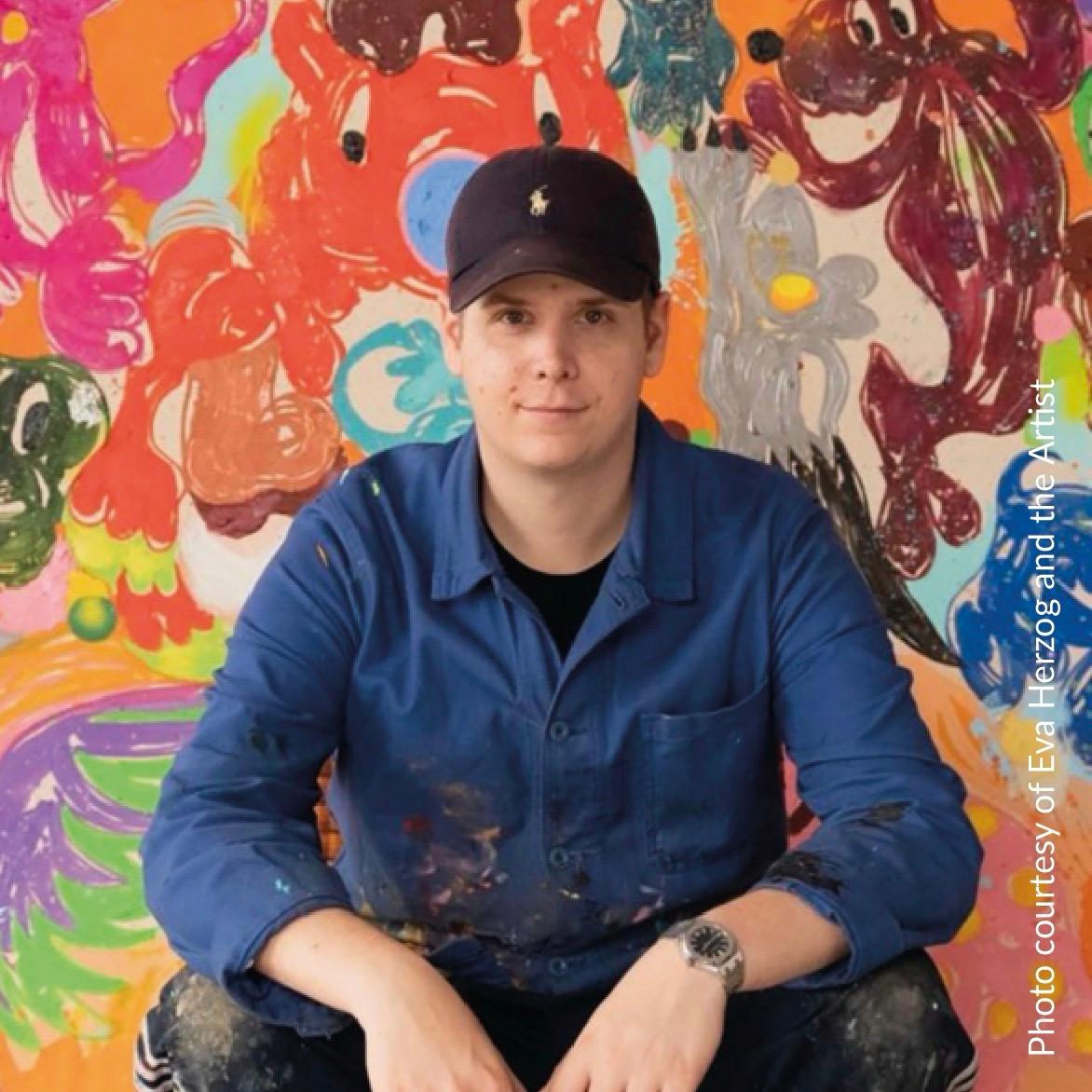
When walking around a gallery filled with Szabolcs Bozó’s work, you might think he’d finished making them in a painting frenzy just before you walked in. But for all the apparent spontaneity and childlike immediacy—"Picasso-on-sugar-candy,” as someone (anonymously) once described his work—every image is the result of meticulous planning, executed via a tried and tested visual language honed over many years.
Born in 1992 in Pécs, a city on the slopes of the Mecsek mountains in southern Hungary, Szabi (his artist name) grew up immersed in a mixture of folklore motifs, local craft traditions, and the extraordinary visual expressions of humour found in niche art movements in Central Europe.
He drew constantly as a child – on schoolbooks, in the margins of newspapers, old letters – anything that had space for an idea. Later, he painted on paper stuck to the floor with tape, encouraging the surfaces to wrinkle and tear from the movement of his energetic strokes.
He studied art in Hungary before relocating to London, hoping the city’s diverse art scene would welcome his exuberant style that was already featuring playful animals and surreal creatures realized in vibrant color. “The characters are the result of a many-decade-long process, in fact, they are my life,’ he said. Later. “I’ve always loved colors and somehow these figures are the perfect way to express myself.”
Szabi’s “cartoonish beasts” with wide-open, expressive eyes, crooked grins, and elongated limbs that seem poised to leap off the canvas at any moment, look as if they were imagined, designed, and created in a single sweep.
In truth, he builds each figure slowly and iteratively – more like an architect than a painter. His aim is to generate a tension in the figure – loose and animated but formulated with precision. The apparent disorder is rehearsed, practiced, and repeated until it merges into his visual language.
Szabi’s technique sits at a “crossroads of immediacy and discipline.” For all his meticulous planning, he embraces and encourages drips, runs, and, smudges, and the unexpected marks of material behaviour. From this incongruous mixture of control and experimentation appear his creatures – often emerging from continuous-line drawing, sketching without lifting his hand, allowing forms to mutate and transform mid-stroke.
|