|
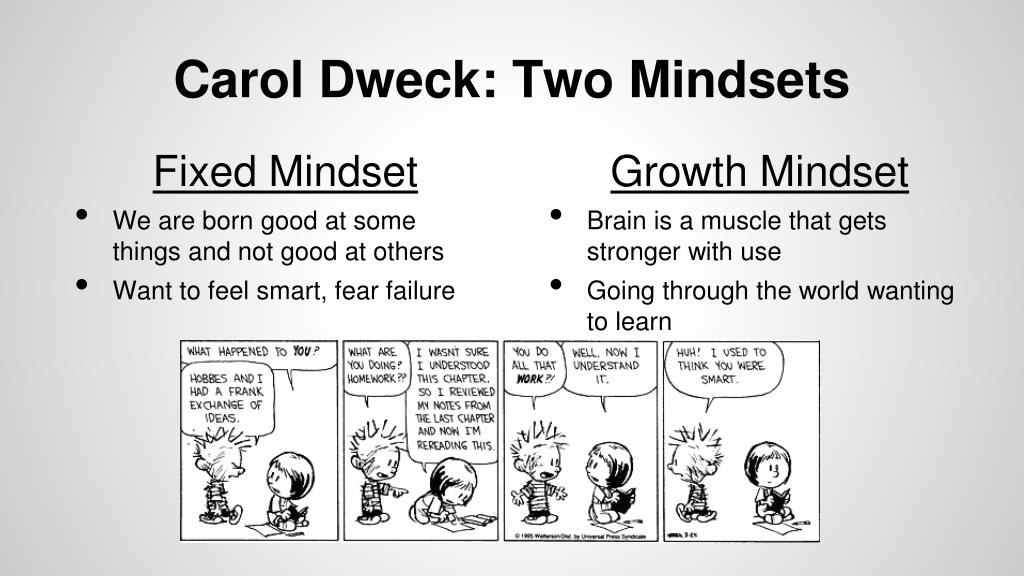
In one world, effort is a bad thing. It, like failure, means you're not smart or talented. If you were, you wouldn't need effort. In the other world, effort is what makes you smart or talented.
Carol S. Dweck
| | |
The FIFA World Cup competition this summer brought me so much joy.
I could not get enough of the stories of people from all over the world coming together in this country to celebrate their love of “the beautiful game”. I wish I could have been in Boston to experience the Tartan Army taking over Fenway Park and bagpipes in the subway station or Team Algeria being welcomed like a long lost family in Lawrence, Kansas, or the Japanese in Texas devouring barbecue and taking selfies at Bass Pro Shops...
I was honored by the sportsmanship displayed on and off the field and deeply felt how much each win and loss meant to the players and their fans.
As I admired the grace and artistry of the players manuvering the ball and as I read the player’s back stories it brought me back into the debate we have as artists and athletes around talent vs. persistance and skill.
| |
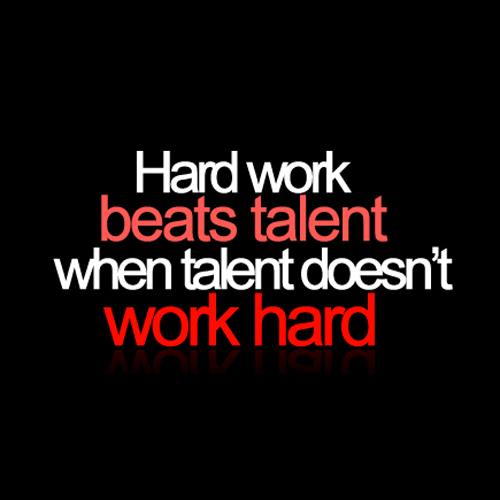
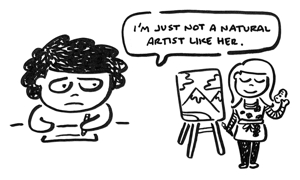
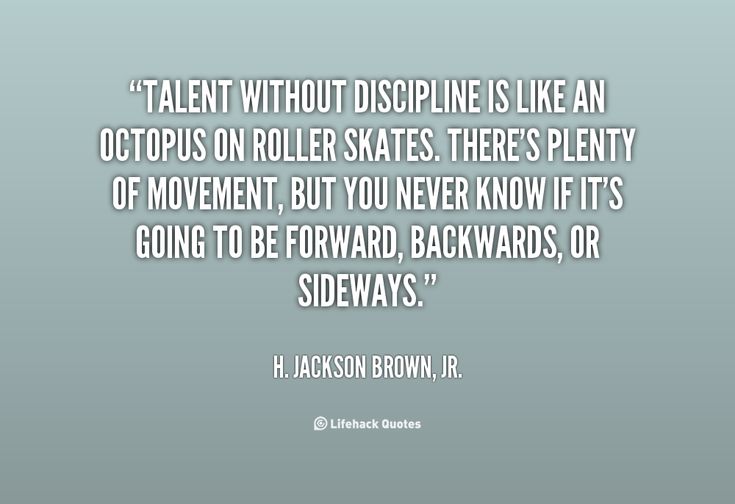
Our society sets us up to believe that success is more talent based than skill based.
We love to read about and celebrate the underdogs, outliers who, despite the odds, achieve at the highest levels in their disciplines. They are made to seem like they’ve been given a gift and often the idea of effort and their time put into practice to get where they are currently is totally dismissed.
It is remarkable how many of the world cup athletes had back stories where their talents were “discovered” as children in unlikely circumstances, whose innate ability enabled them to outperform more celebrated and likely players.
| | |
Talent vs Skill:
The term “talented” is often used to describe people such as actors, musicians, athletes and visual artists.
Talent is the idea that you are born with certain innate and unchangeable aptitudes and physical gifts. In the extreme, it’s the belief that genetics determine what you will be good at later in life and how much effort you will need to expend.
If you’ve been actively told you will or won’t be good at something, how hard will you try? If you think you are already working with all you’ve been given, would you keep expending more effort?
| | |
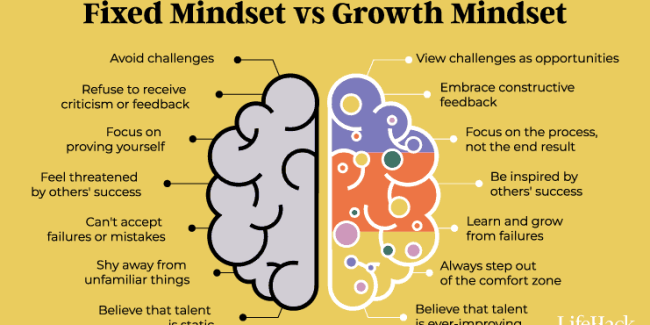
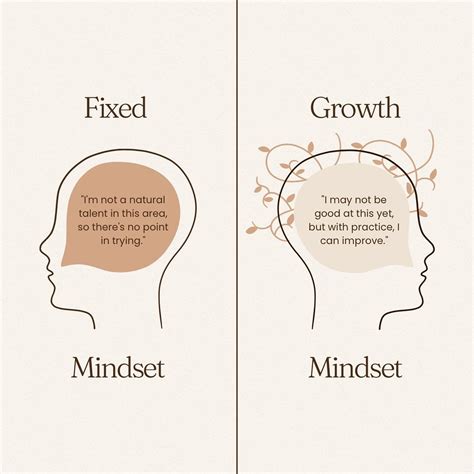
Carol Dweck, the author of the book “Mindset” says this, “believing that your qualities are carved in stone—the fixed mindset—creates an urgency to prove yourself over and over. If you have only a certain amount of intelligence, a certain personality, and a certain moral character—well, then you’d better prove that you have a healthy dose of them. It simply wouldn’t do to look or feel deficient in these most basic characteristics…In the fixed mindset, everything is about the outcome. If you fail — or if you’re not the best — it’s all been wasted."
"Why waste time proving over and over how great you are, when you could be getting better? Why hide deficiencies instead of overcoming them? Why look for friends or partners who will just shore up your self-esteem instead of ones who will also challenge you to grow? And why seek out the tried and true, instead of experiences that will stretch you? The passion for stretching yourself and sticking to it, even (or especially) when it’s not going well, is the hallmark of the growth mindset. This is the mindset that allows people to thrive during some of the most challenging times in their lives."
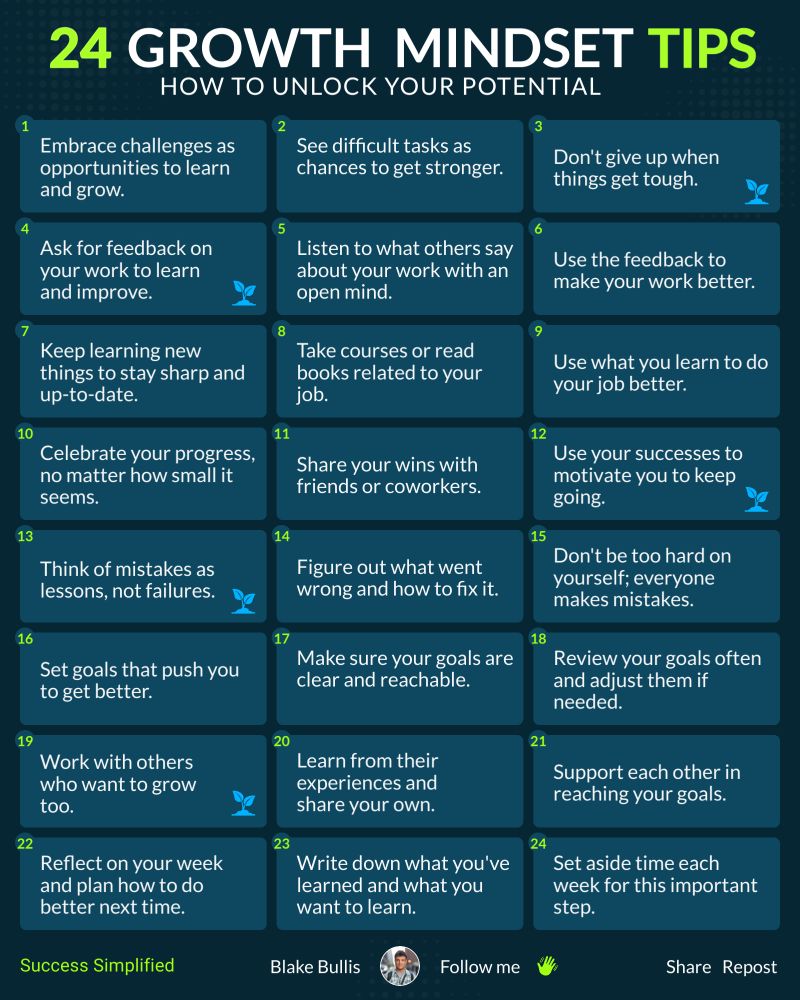
Here’s what Dweck says about the growth mindset: “In this mindset, the hand you’re dealt is just the starting point for development. The growth mindset is based on the belief that your basic qualities are things you can cultivate through your efforts. Although people may differ in every which way—in their initial talents and aptitudes, interests, or temperaments—everyone can change and grow through application and experience.”
| | |
Skill is the amount of technique and knowledge you have around a topic, and your ability to apply that information to the practice of your chosen topic.
So for example, an athlete who is skilled knows many different ways to kick and pass a soccer ball with either foot, how to move on the field, in addition to the complex rules of the game. They study the approaches of other players, employ coaches and are constantly revising and adding new skills to their repertoire.
I’ve had people, even in this community, comment on how talented I am when looking at my recent work. I’m here to tell you, I’ve always had an interest in and a love of art (which maybe is genetic or just because both my parents are artists) but it’s taken decades of hard work and continual art-making to reach my current skill level and I still feel I have lots more room for improvement.
So, what do YOU believe?! For yourself? For your kids?
Which belief gives you more control when it comes to talent or skill? Which mindset do you feel provides you with a sense of agency or ability to change?
| | |
The Myth of Talent:
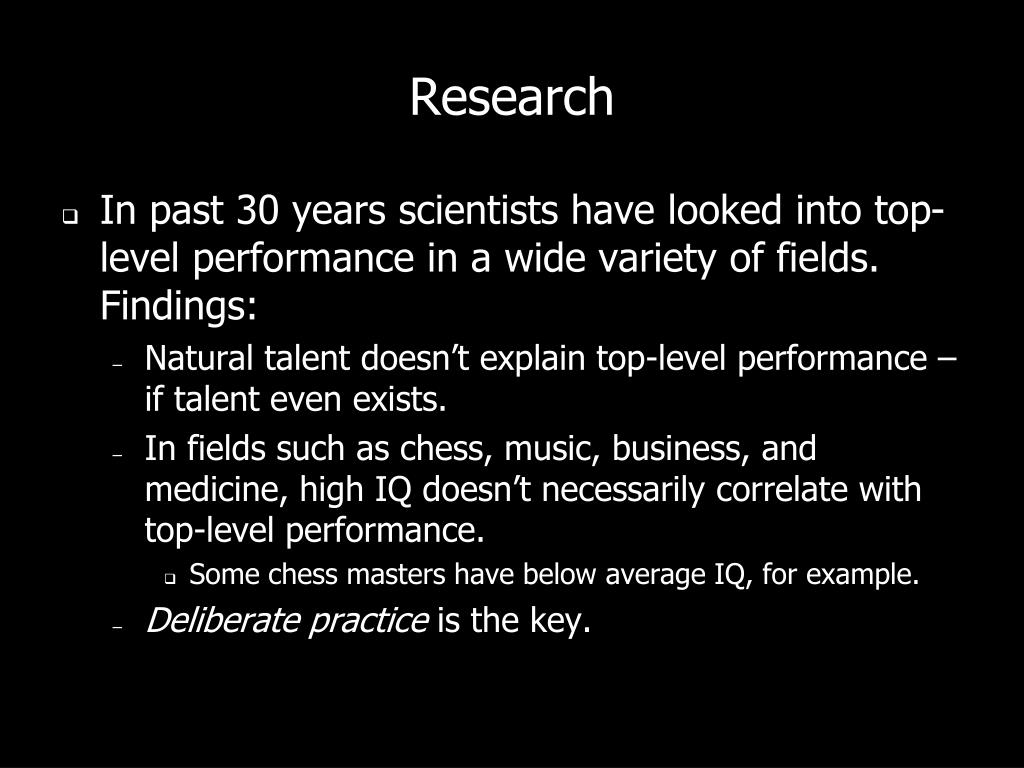
If talent means that success is effortless or rapid, as most people seem to believe, then research shows something is obviously wrong with a talent-based explanation of high achievement.
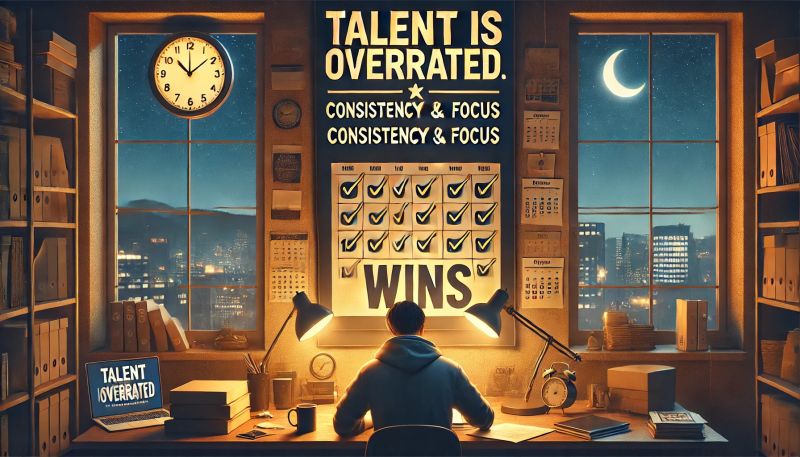
Research data shows talent to be highly overrated. “The phenomenon seems nearly universal. In a famous study of chess players, Nobel Prize winner Herbert Simon and William Chase proposed “the ten year rule,” based on their observation that no one seemed to reach the top ranks of chess players without a decade or so of intensive study, and some required much more time. Even Bobby Fischer was not an exception; when he became a grand master at age sixteen, he had been studying chess intensively for nine years. Subsequent research in a wide range of fields has substantiated the ten-year rule everywhere the researchers have looked. In math, science, musical composition, swimming, X-ray diagnosis, tennis, literature—no one, not even the most “talented” performers, became great without at least ten years of very hard preparation.”
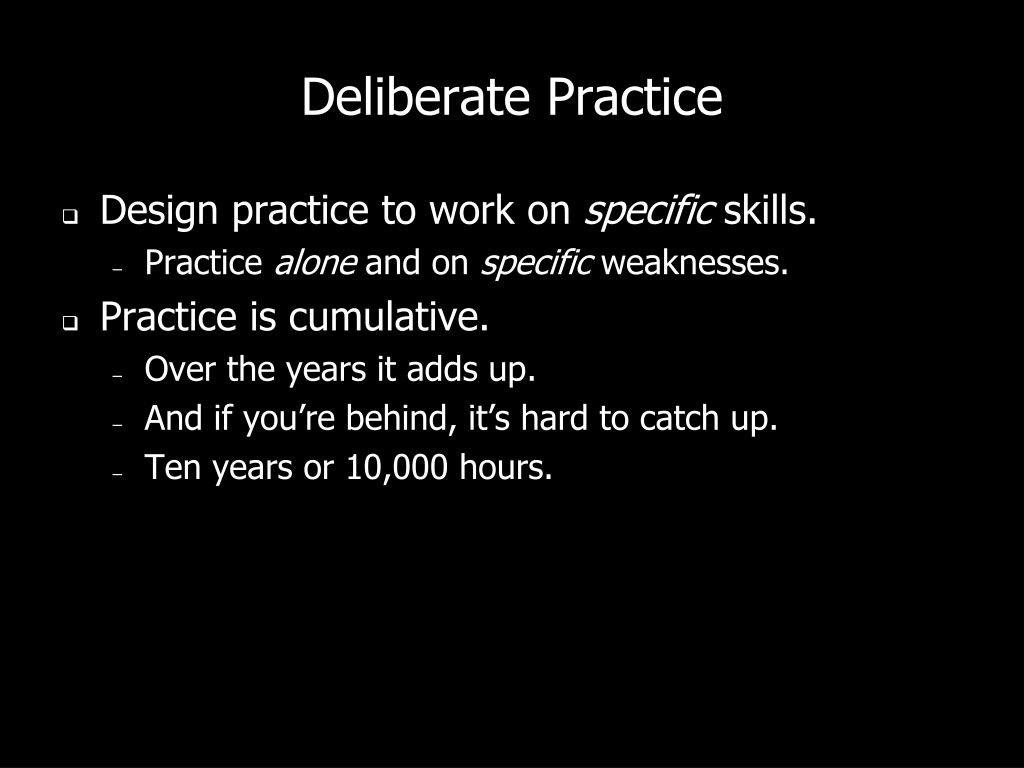
Malcolm Gladwell, in his book Outliers, made famous the idea of the 10,000 hour rule: that if we put in 10,000 hours we will become one of the best in our chosen discipline. (For the record: That’s about 4 hours a day, 5 days a week, 50 weeks a year. For 10 years. :) 10,000 hours may be an oversimplification, but trust that there’s a lot of what’s called “Deliberate Practice”—where we’re at our edge and consciously, intensely developing new skills over thousands of hours for many years.
| | |
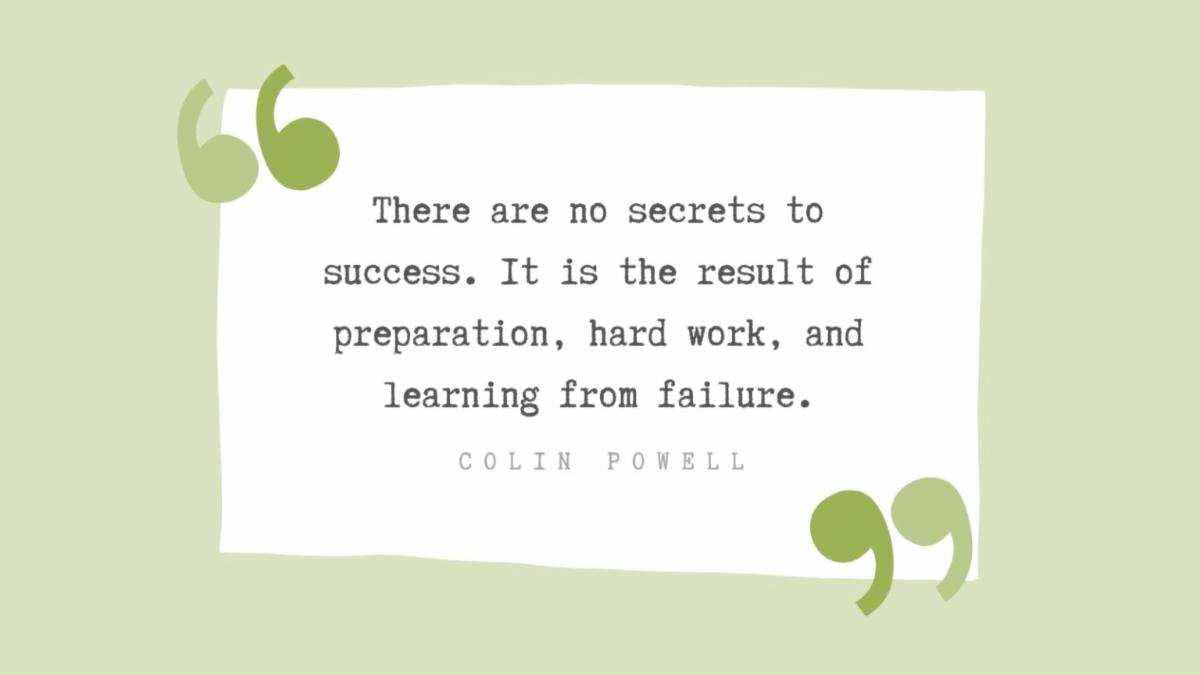
Author of “The War of Art”, Steven Pressfield says this about talent, “My first agent told me he’d seen a million talented people — and 99% of them fizzled out. The ones who made it weren’t the most gifted. They were the most relentless. It doesn’t matter what creative field you’re in. Keep showing up day after day, and the game of numbers will work in your favor.”
Wolfgang Amadeus Mozart was born a genius, right? He just pushed his way out of the womb and started composing amazingly great music, right? You might want to re-think that one… First, consider the fact that Mozart’s dad, Leopold, was a famous composer who LITERALLY wrote the book on how to teach children music. He’d been practicing for years with Wolfgang’s older sister and got to work with little Wolfgang around the time most children start getting potty trained.
Mozart’s first work regarded today as a masterpiece, with its status confirmed by the number of recordings available, is his Piano Concerto No. 9, composed when he was twenty-one. That’s certainly an early age, but we must remember that by then Wolfgang had been through eighteen years of extremely grueling, expert training.”
| | |
Geoff Colvin in his book “Talent is Overrated” outlines research done on violinists at the Music Academy of West Berlin where professors were asked to rate their students into three basic groups: 1) students with a chance to go on to become international soloists; 2) students not quite that good but still pretty awesome; and 3) students who would likely go on to become music teachers.
Researchers got all kinds of data on these students. One of the most significant findings? According to Colvin: “By age eighteen, the violinists in the first group had accumulated 7,410 hours of lifetime practice on average, versus 5,301 hours for violinists in the second group and 3,420 hours for those in the third group. All the differences were scientifically significant.”
Andre Agassi in his book “Open” describes how much he hated tennis and at a young age, he was forced to hit ball after ball: “My father says that if I hit 2,500 balls each day, I’ll hit 17,500 balls each week, and at the end of one year I’ll have hit nearly one million balls. He believes in math. Numbers, he says, don’t lie. A child who hits one million balls each year will be unbeatable.” For a while, Agassi found solace in winning. He won his way to eight grand slams. But what eluded him were feelings of contentment and happiness. “I never chose this life, so I resented it,” Agassi says. “It came with a huge price tag.”
| | |
Resistance:
Colvin points out the fact that all the students knew that practicing by themselves was “THE” most important thing they could do to improve their skills. They also all agreed that it wasn’t particularly fun. As it turns out, only the top two tiers actually practiced on their own… a lot. As Colvin says: “They all knew it, but they didn’t all do it.”
Whether we want to become musical or artistic geniuses or just better human beings, we need to DO the things we KNOW are best for us. Period.
Why is doing what we know is best so hard? American novelist Steven Pressfield defines that force as “Resistance”, a concept that illustrates the universal force that he claims acts against all human creativity. More on resistance in a future newsletter…
| | |
Deliberate Practice -
Geoff Colvin defines “Deliberate practice is characterized by several elements, each worth examining. It is an activity designed specifically to improve performance, often with a teacher’s help; it can be repeated a lot; feedback on results is continuously available; it’s highly demanding mentally, whether the activity is purely intellectual, such as chess or business-related activities, or heavily physical, such as sports; and it isn’t much fun.”
“Practice is so hard that doing a lot of it requires people to arrange their lives in particular ways. The two top groups of violinists did most of their practicing in the late morning or early afternoon, when they were still fairly fresh. By contrast, violinists in the third group practiced mostly in the late afternoon, when they were more likely to be tired. The two top groups differed from the third group in another way: They slept more. They not only slept more at night, they also took far more afternoon naps. All that practicing seems to demand a lot of recovery.”
After presenting that definition, Colvin lays out “What Deliberate Practice Is and Isn’t.” Get the book for more details.
| | |
My hunch is you’ve seen a similar pattern in your creative life.
What about you? How do you start your days? Do you hop online and watch your day dwindle away in mindless, reactive activities? (OMG I’ve done that way too many times! :) Or, do you have clear goals on what you want to achieve and discipline yourself to crush them before you let the day get away?
In the meantime, know that simply showing up and “practicing” isn’t gonna cut it. Think of a recreational golfer who goes to the driving range and “practices” for an hour or so vs. the professional who goes to the course, works with a coach, and deliberately, intensely, and passionately works on improving his or her skills. The outcomes will be very different.
| | |
Comfort, Learning and Panic Zones
“Noel Richy, a professor at the University of Michigan business school and former chief of General Electric’s famous Crotonville management development center, illustrates the point by drawing three concentric circles. He labels the inner circle “comfort zone,” the middle one “learning zone,” and the outer one “panic zone.” Only by choosing activities in the learning zone can one make progress. That’s the location of skills and abilities that are just out of reach.
We can never make progress in the comfort zone because those are the activities we can already do easily, while panic-zone activities are so hard that we don’t even know how to approach them.
Identifying the learning zone, which is not simple, and then forcing yourself to stay continually in it as it changes, which is even harder—these are the first and most important characteristics of deliberate practice. A skilled teacher or coach is instrumental in providing the structure and scaffolding to stay motivated in the learning zone.
Imagine a rubber band held between your pointer fingers on your left and right hands. If you don’t pull at all, there’s no tension. Comfort zone. Not a whole lot of growth. If you pull TOO hard, you’ll snap the rubber band. Snap zone. Ouch.
The ideal? Stretch it so there’s some nice dynamic tension. Not too much. Not too little. The stretch zone. Ahhhhh. :)
THAT’s where we want to play.
Where are YOU playing these days?
| | |
We Can All Become Better
“The evidence offers no easy assurances. It shows that the price of top-level achievement is extraordinarily high. Perhaps it’s inevitable that not many people will choose to pay it. But the evidence also shows that by understanding how a few become great, anyone can become better. Above all, what the evidence shouts most loudly is striking, liberating news: that great performance is not reserved for the pre-ordained few. It is available to you and to everyone.”
Great performance is available to you and me. And to our kids. To our friends and to our families. To everyone. So, let’s embrace this potential within ourselves and everyone we meet today and go out and get a little bit better, shall we? :)
| | |
Self-Taught to Self Confident…Need Support?
If you aren’t as good at art as you want to be, but you also know you don’t want to practice, study, and put in the time to learn, then don’t. That’s totally okay. Lack of skill shouldn’t stop you from making art the way you enjoy it. There’s no rule book that says you have to work on skill, you can be fulfilled making your art your way.
But, think about what it means if you do have a choice. If your commitment to your art determines your level of skill, then, there is a whole lot more personal responsibility and pressure on you. And if you know you want to put in the time, now you know that time WILL pay off...Go for it!
There is power in knowing the truth, knowing you get to decide how much you want to achieve and how you want to do it.
Artists improve by failing, trying again and again, taking feedback, and building skills over time, not by relying on magic. It’s not your genes that make you special. The fact that you are here, you hold these interests and skills, and work hard to use them, that is your super power.
I hope today’s conversation gets you considering your own mindset and beliefs around skill and talent. And if you were one of those people who were told you just “don’t have talent” but love making art, I’m here today to tell you: you do. You have exactly what it takes to improve your skills and make the art your heart calls you to create.
If you’d like individualized coaching and support in building the skills you desire, I’m here to help and I look forward to working with you.
| | |
If someone shared this newsletter with you and you'd like to subscribe, please reach out to me below with your email address. I promise, no spam, no overloading your inbox, just the good stuff.
I welcome the opportunity for connection, conversation, cooperation, collaboration, and commissions.
Live heARTfully
| | P.S. If you didn't get the chance to download your free gift from me: Here are annual collections of my newsletters from September 2022 through December 2025. | | | | |
Studio 18
21st Annual Art Competition
1101 Poinciana Drive
Pembroke Pines, FL 33025
(954) 961-6067
Show dates May 20 - August 6, 2026
www.ppines.com/studio18
| | |
Private Art Retreat with Tina
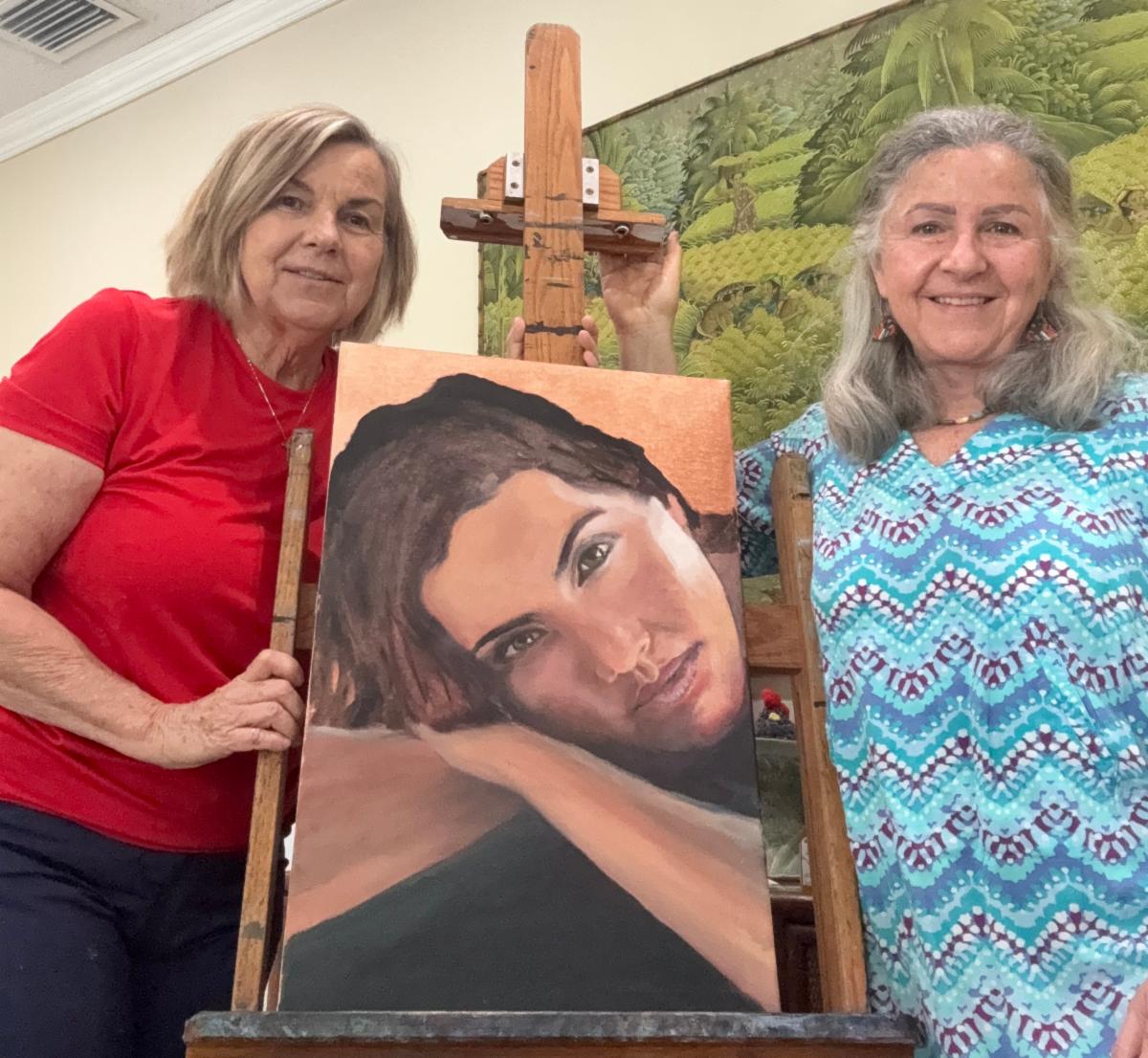
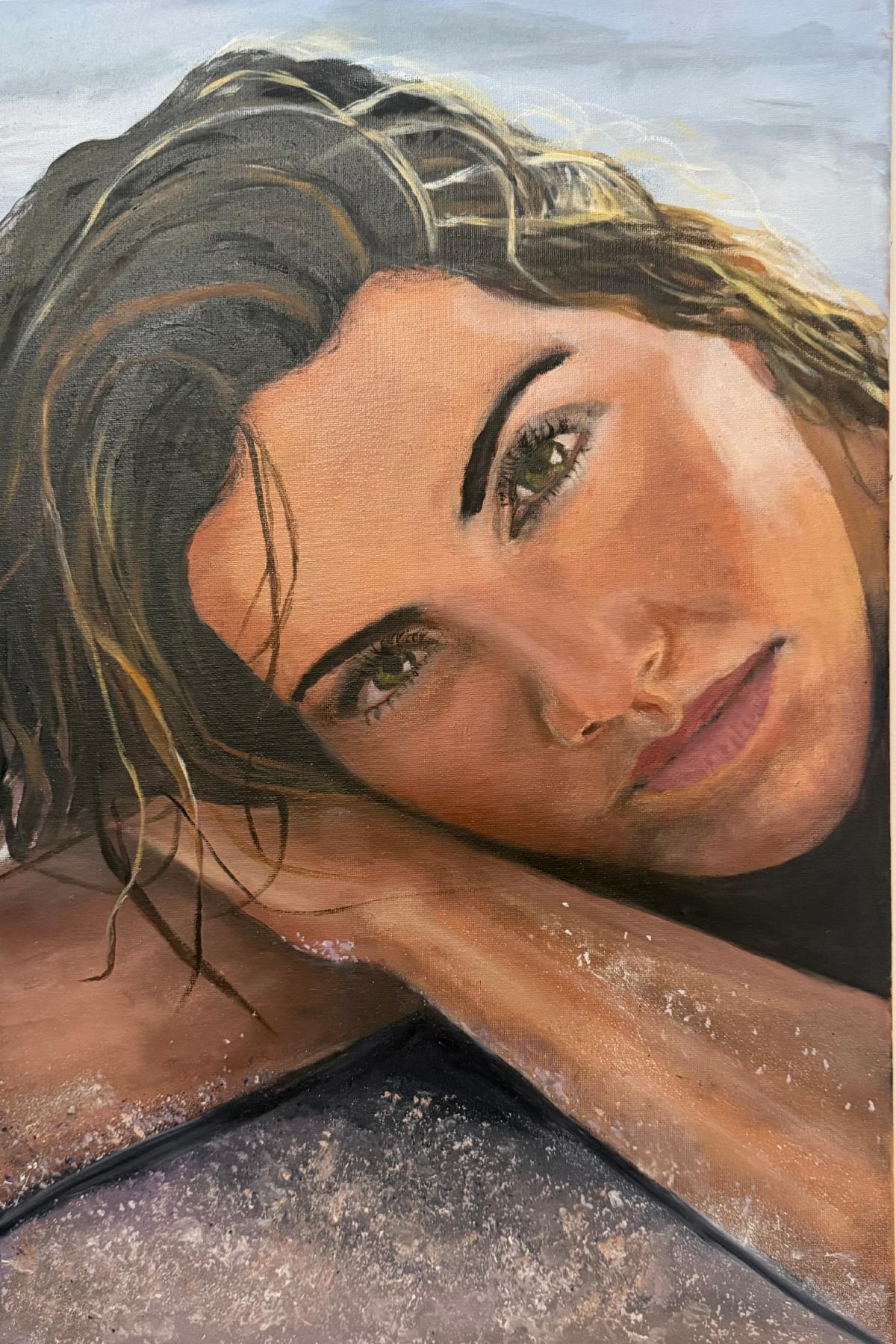
As a birthday gift to herself, Tina came and spent three days working with me on this portrait of her daughter. While we didn’t have time to finish it completely we got the likeness and Tina felt like she made a great leap forward in her understanding of portraiture.
Consider spending a few days in my home studio working on something your wrestling with in your own artwork. I promise it will be fun and time well spent.
| | | |
Private Art Retreats
A personalized experience, full of art and discovery, for those who….
- are traveling alone, or with a couple of friends
- would like a much more flexible, and free experience, and lots of fun, too, tailored exactly to your needs, interests, and experience level
- may want to combine painting with organized discovery trips and tours and really get to know the ‘real’ South Florida
- would like to book in for a shorter or longer time than most workshops
- don’t want to have to bring a mountain of supplies in their luggage
- Prices start at $100 per hour
| |
Painting Joy
Created especially for artistic women in the third stage of life who are dissatisfied with their artwork and want to have more fun connecting with themselves and others. In this three-day watercolor workshop, we experiment with visual cues that inspire joy, discover personal symbols that resonate, and provide ways to bring more effervescence into our lives and art.
Please recommend any venues you know that might be interested in hosting this workshop in 2027.
I am also happy to teach this as a private retreat or for a small group in my studio.
I would very much appreciate your help in getting the next booking.
| | | | | |
Private Portfolio Review
One and a half hour consultation to help you direct your energy into improving your paintings and identifying your “next step"
$250
Text Link
| | | Private Lessons and Events | | | | Master Classes for High School Students | |
Private, highly personalized classes in mastery for artistically-minded US & international students virtually on Zoom or in person at my home.
If you have a student who is a visual thinker, willing to push the boundaries of their own work, and serious about improving their options for college, I want to hear from you! Schedule a time to discuss how I can collaborate with you to build a portfolio that will give your student the greatest chance for success.
Packages start at $130 per hour
Find out more
| | | | Art Workshops, Critiques & Presentations |
Invite me to present or lead a workshop for your school, club, or guild.
I can customize a program for your event or present my skills programs on composition, color theory, drawing faces, coordinating light/shadow or understanding the cues for depth. I am available for judging, confidence-building critiques and recorded tutorials.
| | | | Improve Your Artist Statement | |
If you would like to delve more deeply into your own inner questions and clarify your thoughts as you create an artist statement for your website, a gallery show, a sponsor, or another project, please reach out, and let’s talk. I have helped many students write compelling statements for AP Art, college applications, and competitions.
$250
Find out More:
| | |
Sketchbook Prompt:
Think about a skill that’s just outside your comfort zone. Maybe it’s drawing a face, or a building or a car in perspective. Give yourself permission to be bad at it and stretch yourself by practicing a drawing for a page or two in your sketchbook. Refer to a resource photograph for more accuracy in your perceptions.
| | |
It's time for these artworks to find a forever home. Please contact me if you are interested in adding any of the paintings below to your collection.
I will deliver if you live within a 2-hour drive and if you live further away, I will give you a reasonable price for shipping.
Venmo, CashApp, PayPal and Zelle are welcomed.
| | |
I have seven new watercolor paintings to introduce to you!
In honor of this month’s newsletter I am including a statement for each piece.
| | |
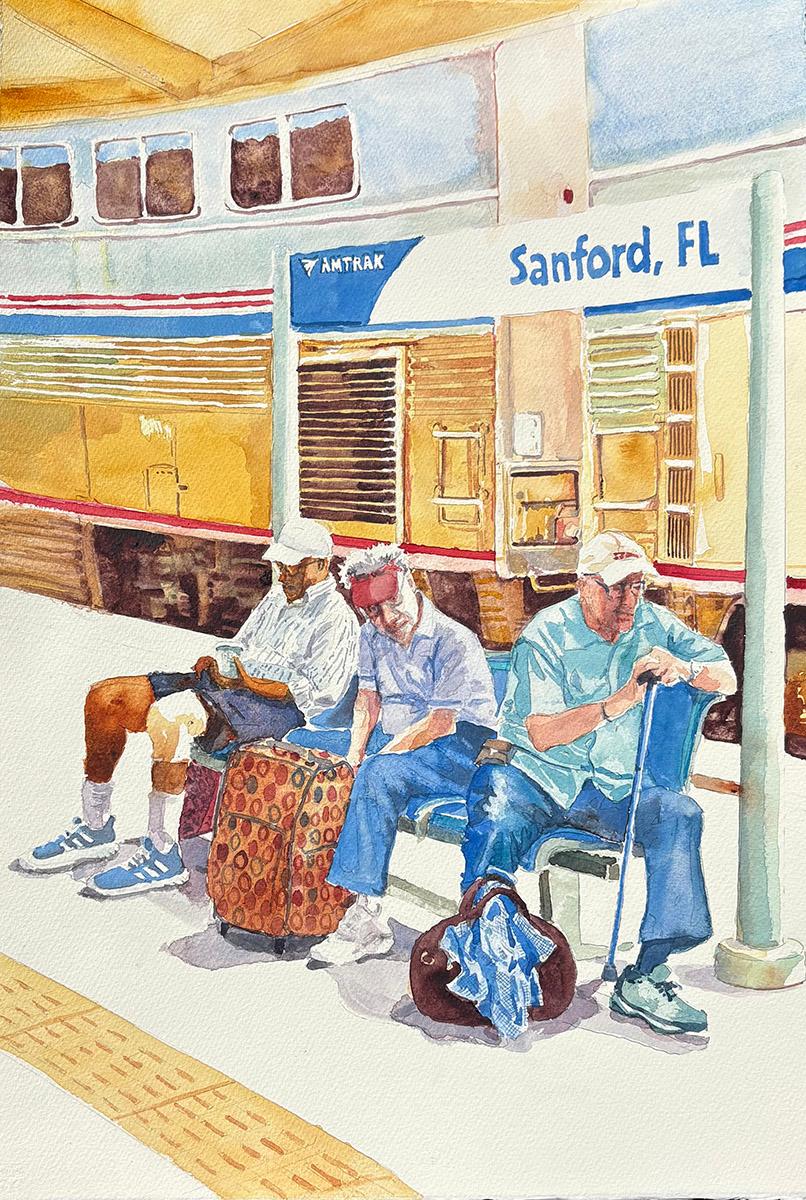
Title: Waiting
Media: Watercolor
Size: 27”x 20"
Price: $777
Frame: Gold
Statement:
While waiting to board the auto train a few years ago I was amused by these three figures. I love the contrast of the speed of the perspective of the train with their solid bored expessions fixed in place by the sign and its poles. They are linked together by color into a really interesting shape and the light falling on them is perfect for watercolor.
| | | |
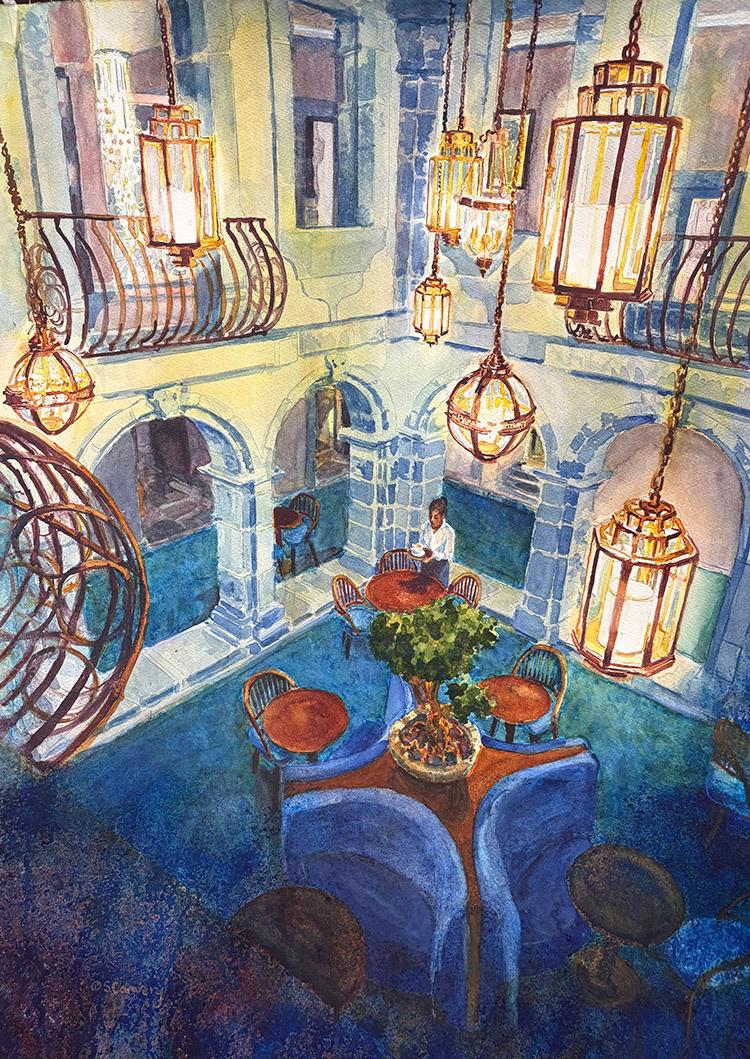
Title: Seixo Convent
Media: Watercolor
Size: 35"x 27"
Frame: Gold
Price:$1212
Statement:
While visiting Portugal last winter I stayed in a lovely convent that’s been converted into a luxury hotel. The cold stone walls of the inner courtyard contrasted beautifully with the warmth of these fabulous hanging lanterns. I love how the circular shape of the tables and banquette bubble up into the lamps and balconies in a joyous way.
.
| | | |
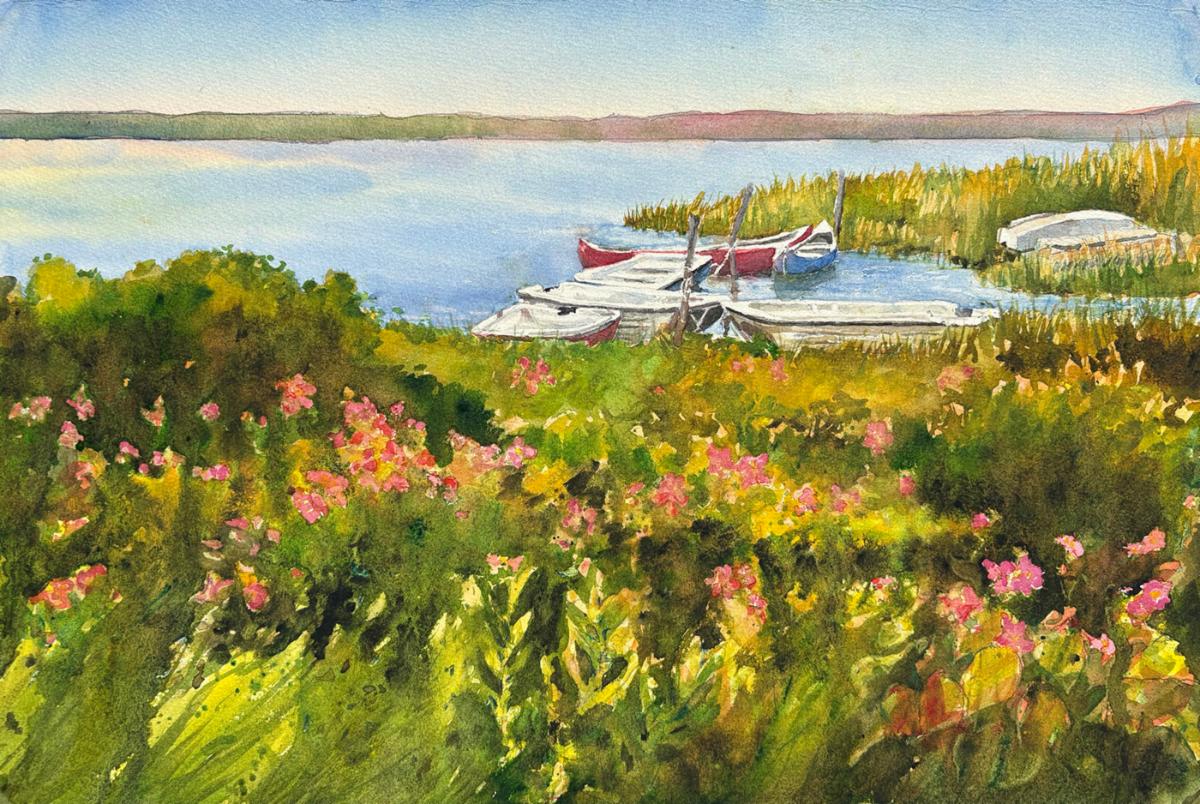
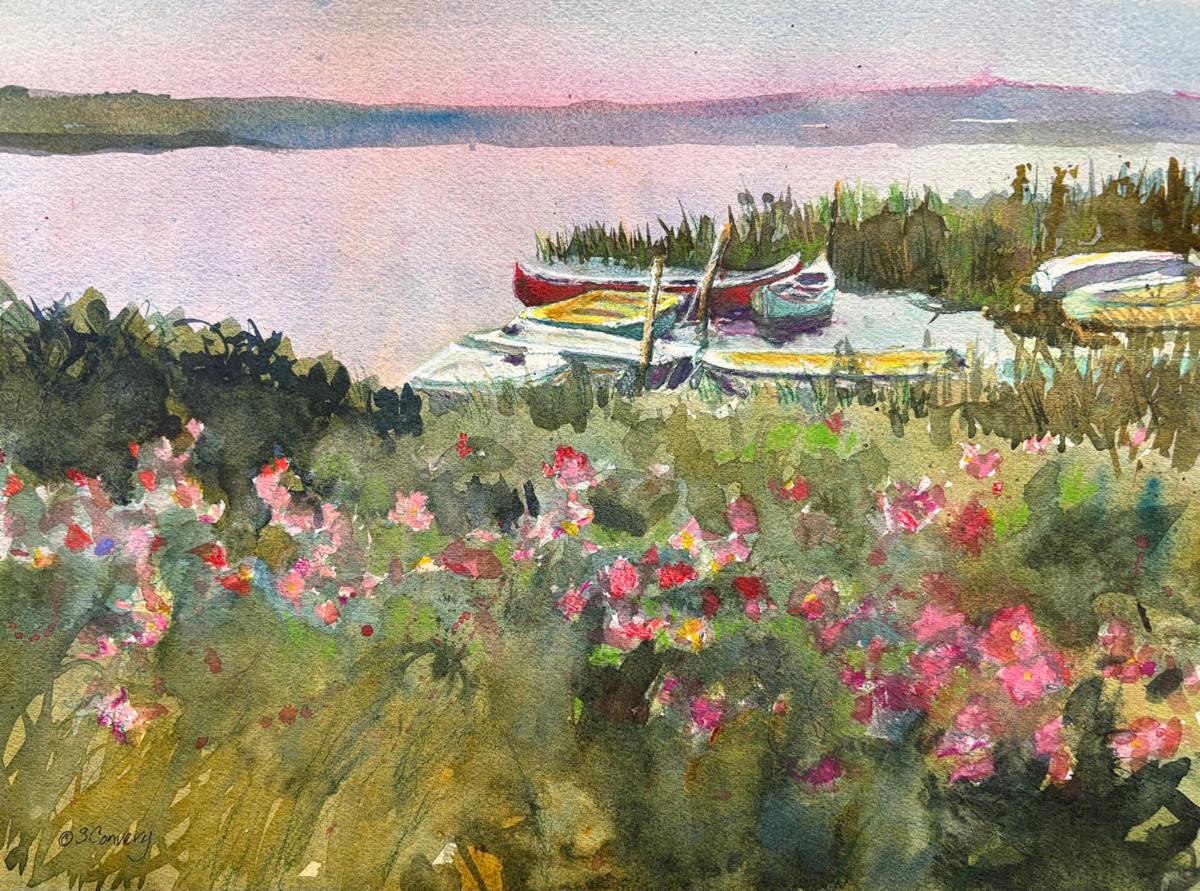
Title: Safe Harbor
Media: Watercolor
Size: 20" x 27"
Price: $777
Frame: Gold
Statement:
This little cove on Martha’s Vineyard in June reminds me of gentle summer days spent messing around in little boats. Beach roses are a signal that the long cold winter is truly ended and summer has arrived.
| | | |
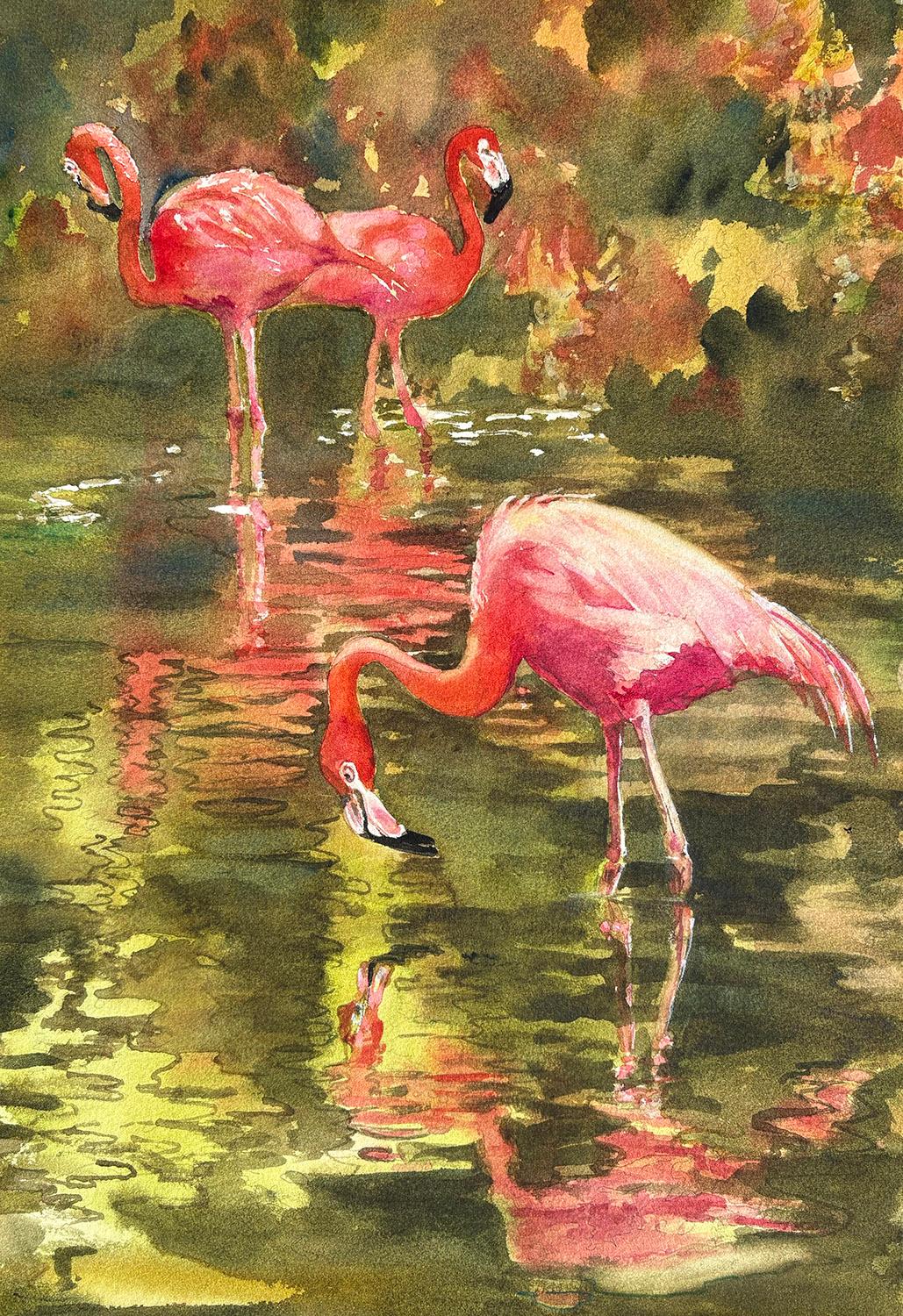
Title: Pink Narcissus
Media: Watercolor
Size: 27" x 20"
Price: $777
Frame: Gold
Statement:
I was intrigued by the contrast of the pink flamingos with the muddy green water and it’s reflections. In this painting I kept the background very abstract to show off the elegant forms of the flamingos.
| | | |
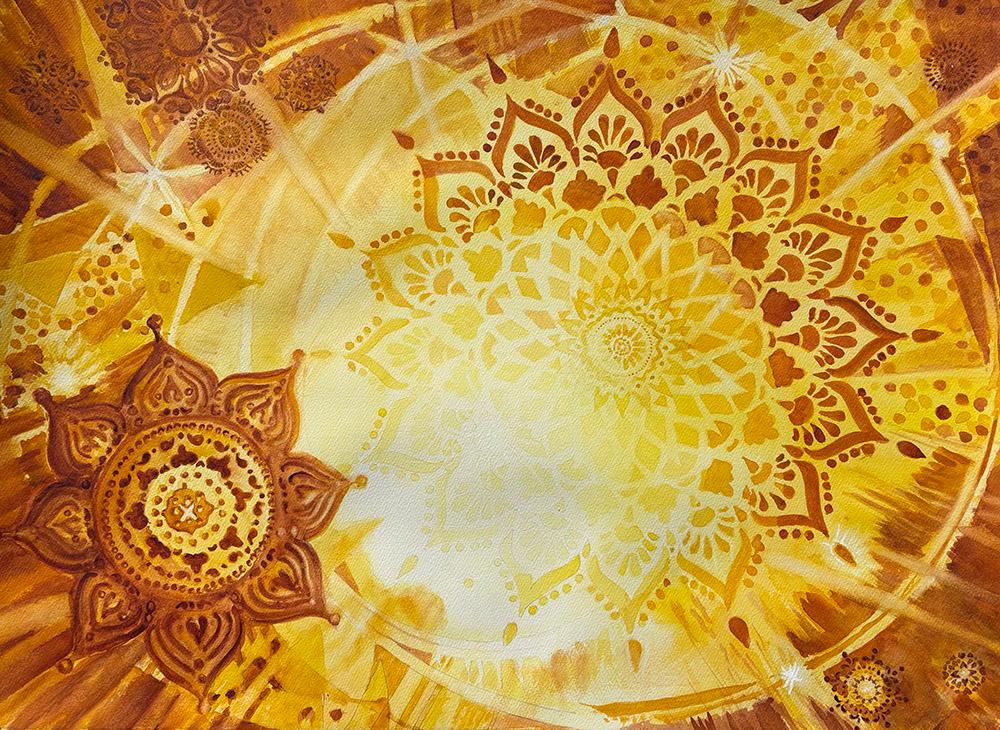
Title: Music of the Spheres
Media: Watercolor
Size: 25" x 33"
Price: $1212
Frame: Gold
Statement:
This painting started as an exercise in what happens to light as it encounters objects. I wanted to play with how bright light makes the edges of objects fade away and lose color. It was fun to work abstractly this way. The swirling mandalas compose a feeling of crescendos and quieter passages as in a symphony..
| | | |
Title: Such is Summer
Media: Watercolor
Size: 15" x 19"
Price: $444
Frame: Gold
Statement:
This painting was my practice sheet for “Safe Harbor”. I generally test out my color and composition before working on a large sheet of paper, but I really like this composition and in some ways I think it is moodier and more successful than the larger final painting.
| | | |
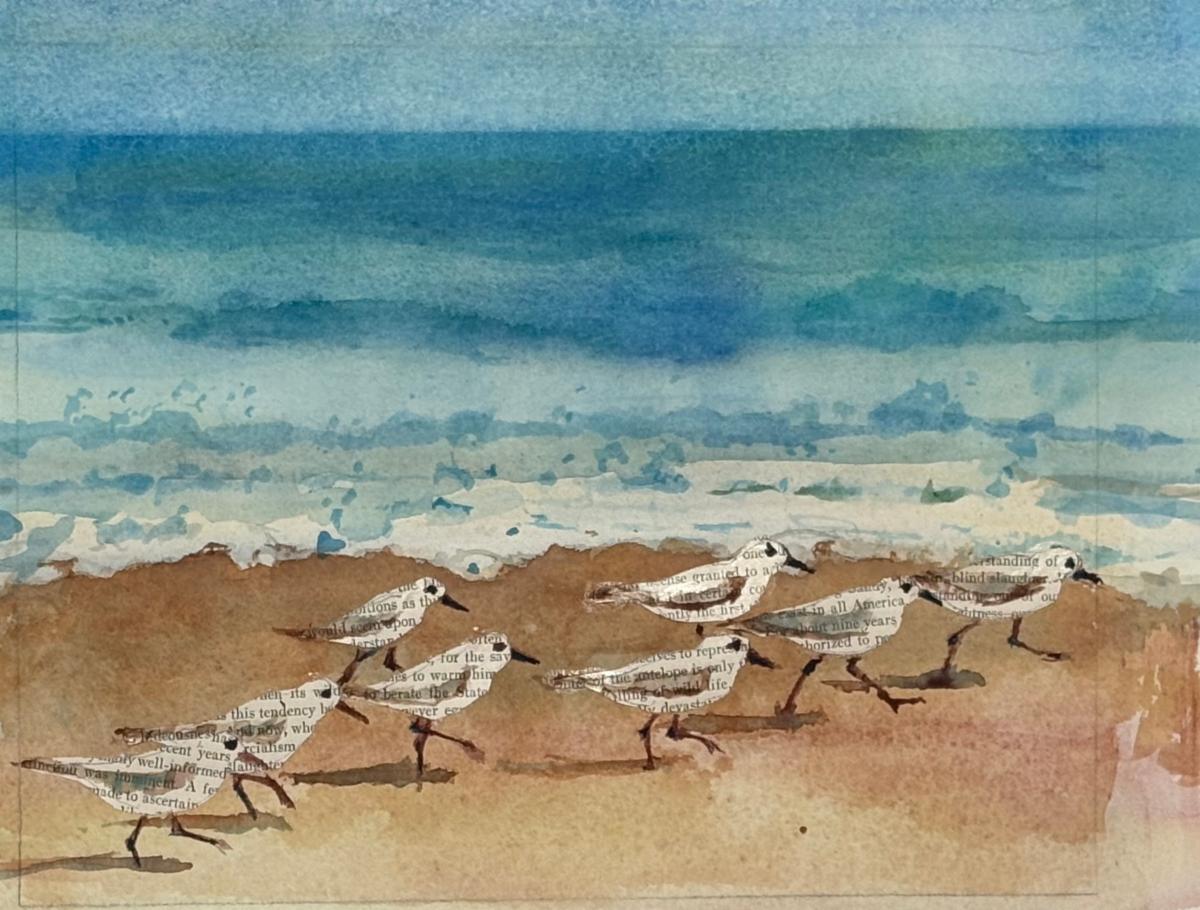
Title:Wordy Birds
Media: Watercolor + Collage
Size: 8" x 10"
Price: $333
Frame: Gold
Statement:
I’ve been creating some loose watercolor landscapes as a warm up before painting. This one looked like it needed some birds in the foreground. I had fun cutting out little bird shapes from a 1930’s magazine and then making them look like sandpipers.
| | | Want to see past issues of my newsletters? Visit this link on my website. | |
Subscription Information: You are receiving this email because you subscribed to my mailing list, downloaded a resource, purchased one of my products/programs, or opt-ed in some other way.
Thank you for being part of the Cr8V Soul Arts Tribe!
NOTE: Unsubscribing means you won't receive any more emails from me including information about your paid products and programs.
| | | | |