|
Written by Kieran Delamont, Associate Editor, London Inc. | |
REMUNERATION
A promotion and a corner office? No problem
If you want to earn the big bucks, prepare to dust off your work clothes and crank up your in-office hours
| |
|
YOU’LL HAVE TO be prepared to give up remote work if you plan to make $200,000, says a new report from Ladders, which crunched the numbers and found that only 3.4 per cent of jobs paying more than $200k were hybrid, while 84.4% were in-person – a 93 per cent increase in the last quarter of 2023.
Remote opportunities to earn the highest salaries have dropped considerably in just the last 18 months; in late 2022, you could expect that a third or more of all high-salary jobs were hybrid or remote. Now, it’s barely one in six.
“The data shows if you want the highest paying jobs available right now, you should hold an advanced degree and expect to work in-person,” said Ladders’ John Mullinix. “It makes sense that many of the highest-paying jobs have these requirements. Obviously, your dentist will have advanced schooling and won’t be able to fill your cavity remotely.”
Some experts, like Mullinix, observe that increasingly it means people are facing a choice in their careers: “[It’s] between going with the biggest paycheque or getting to stay home.”
Part of the story here is just the correlation between normally high-paying jobs (like dentists) that are fundamentally in-person jobs. But we know that companies are also luring people back to the office in part with higher salaries.
Much of that has focused on middle-range salary earners, but it’s interesting to note what’s going on at the upper-end of the pay spectrum. A recent report by Owl Labs found that higher-paid employees have a greater willingness (and often, capacity) to quit over RTO policies. That, in turn, drives up the price of in-office work, while companies have a bit more room to insist upon full in-person weeks for the highest salaries.
The question some will ask is whether this is a longer-term trend or just another data point in a shifting RTO environment. Owl Labs’ Frank Weishaupt, for one, believes remote work is here to stay, even at upper income levels. “I don’t buy it,” he said about the spike in in-office requirements. “It flies in the face of everything we know that people want.”
| |
COMMUNICATIONS
The anxiety of exclamation points
I’m spontaneous! I’m sincere! I’m infantile and hugely annoying! How the exclamation point divided the world
| |
|
AH, THE EXCLAMATION point, the goofy cousin in the punctuation family. Rarely, if ever, to be used in business communications, right? Well, maybe not, say the exclamation enthusiasts!
The exclamation point has legions of resolute supporters. Digiday’s WorkLife quoted lawyer Jane Freedman, who calls them “a way to let my personality come through,” and who, after starting her own firm, allowed herself to exclaim away in her emails.
“I was trying to kind of fit into this corporate mould of what I thought people expected of me,” she explained. “When I started my own law firm it was really freeing to take a step back and be like, oh, maybe I don’t need to do that anymore.”
Writer Anne Helen Petersen is also a fan. “If you’re a woman who works in a traditionally male-dominated industry, chances are high that you’ve heard some version of this advice: when you finish writing your email, go through and replace all the exclamation points.”
To that, she says, Nonsense! “There are very few situations in which I feel the need to be exclamation-free,” she wrote. “We can understand that the way we’ve come to understand professional communication is both arbitrary and unfixed.”
But there are also platoons of haters out there, like Kevin Daum who wrote for Inc.com: “The use of exclamation points has become the new thing to over-analyze and worry about,” to which he advises complete abstinence. It’s inefficient to worry about how you end a sentence, he argues, and if overused the punctuation loses its punch.
The better choice, he believes, is to simply choose to never use it.
“Punctuation at the end of a sentence doesn’t have to be complicated. The vast majority of your work-related sentences end properly with a period. If you would just use it and move on, you could have answered two more emails by now.”
| |
|
|
Terry Talks: Conducting effective job interviews
| The art of conducting interviews is a multifaceted skill that can significantly impact an organization's success. Whether you're an HR professional, a hiring manager, or a business owner, mastering interviewing skills is essential in selecting the right candidates who will contribute to your company's growth and success. | | | |
WORKFORCE
Older, wiser and looking for work
Older workers are an asset, but their value is underestimated by employers, policymakers and workers themselves
| |
|
WITH THE BOOMER cohort aging, a growing part of the workforce is now made up of those over 50, and the segment is expected to expand further in the coming years. And while we hear a lot about workforce changes prompted by younger generations, the adaptations to come for an aging workforce might even be more considerable, and a new report out of the UK says businesses need to be thinking about that now.
“Business must prepare for a workforce containing a growing proportion of over-50s who want and need to work for longer,” reads the Flexible Over Fifty report, put out by the 50 Plus Choices Employer Taskforce.
Flexible work, the organization argues, is the key organizational tool to manage and maintain productivity levels. “Seventy-two per cent of older workers either work flexibly already or want to do so,” the report found.
The report focused on the UK economy for its data, but the same phenomenon is being seen in Canada and across the G7. According to the International Workforce Group (IWG), an estimated 25 per cent of the workforce will be older than 55 by 2031. Toronto-based Wayne Berger, IWG CEO of the Americas, recently told The Globe and Mail the company also foresees growth in the “unretirement” movement.
“Companies can continue to profit from the skills and expertise of older employees, and it helps alleviate the growing issue that is filling the jobs that are open today,” he said. One way to do that is leaning on flexible work as a tool. “Hybrid and remote working models are giving older generations new opportunities to have flexibility around work,” he said.
But despite the opportunities for employers, many conversations around an aging workforce still view it as a problem to be solved ― a premise experts say is fundamentally wrong, and millions of people are proving it wrong every day.
“This practice to say, ‘Well this person is 50, why should we invest in this person, this person will retire.’ This approach is wrong,” said Nicolas Schmit, EU Commissioner for jobs and social rights. “The conversation can’t be about how to avoid a crisis; it needs to be about how to take advantage of the opportunities we have so that we as individuals, organizations and nations can thrive.”
| |
TECHNOLOGY
Does Apple’s Vision Pro have a business case?
Apple’s high-end, high-cost Vision Pro is a technical marvel. But is it right for the workplace?
| | |
|
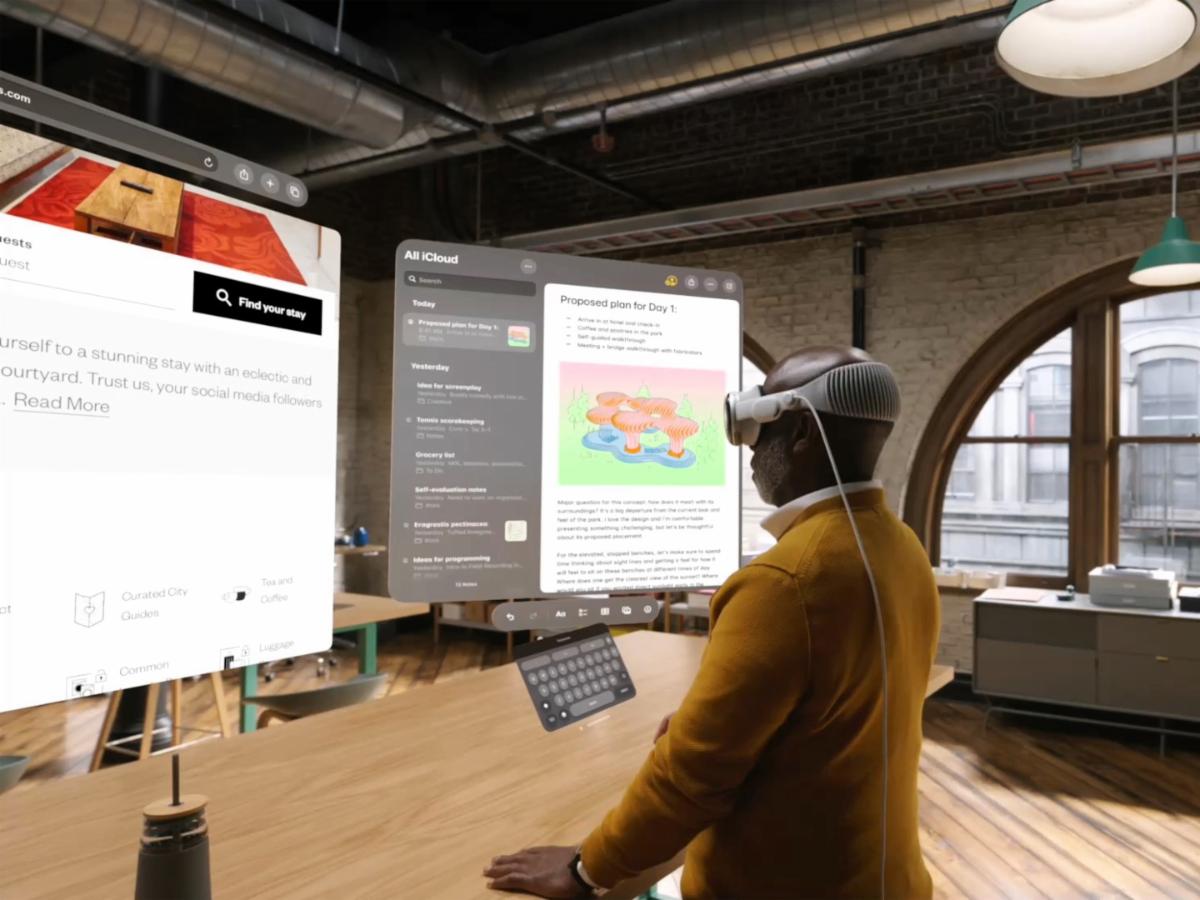
APPLE’S LONG-TEASED VR headset, the Apple Vision Pro, hit the market in the U.S. recently (it will be available in Canada later this year with a starting price tag of $4,685 CAD), and like a lengthy list of Apple products before it, it’s garnering a lot of reactions among users.
Companies have been trying ― mostly unsuccessfully ― to get VR headsets to catch on for a while now, but outside of video games there’s not been much of a use case, especially in the workplace. Could Apple be the one to crack the code?
Some people seem to think so. “I think what Apple has introduced with the Vision Pro will be transformative for people in hybrid work,” said Jeetu Patel of Cisco. Right now, the tool has around 30 workplace apps, from email and word processing to plenty for video conferencing. Aneesh Kulkarni, CTO of the VR platform Strivr, said it clicked for him when he started using it paired with his laptop. “I mirror my Mac to have a much larger area to work,” he says.
Frequent flyers who like to work on the go might find it particularly useful, said Wall Street Journal tech reviewer Joanna Stern, who took it for a spin on a flight recently. “I took a break midflight and went through some emails and a draft of my newsletter,” she explained. “I got so into it, I’d forgotten how odd I must have looked poking the air, wearing my big goggles.” She quotes Dan Newsome, a commuter in financial services, who uses it to work on the commute. “You go into another world,” he noted. “It doesn’t feel like a terrible train ride anymore.”
Fortune’s Dave Smith also gave it a positive review from the perspective of a very busy worker. “I drove four hours over an international border and dropped nearly five grand to buy Apple’s exorbitant first-generation headset. Am I crazy? Yes. But that’s partly because I’m also a working parent,” he wrote, praising its ability to quickly let him jump in and out of deep work with the tool. “I have no plans to return mine. As a working parent, I have limited time, and the time I do spend inside this device feels novel ― and worth it.”
|
| | | | |