The American Society of Le Souvenir Français Inc.
Monthly Bulletin - Vol. IV. No 5 - May 2024
|
|
French Pioneers of the American West
(Part 2 of a series - The Frontier - 1750-1850)
|
|
Cover illustration:
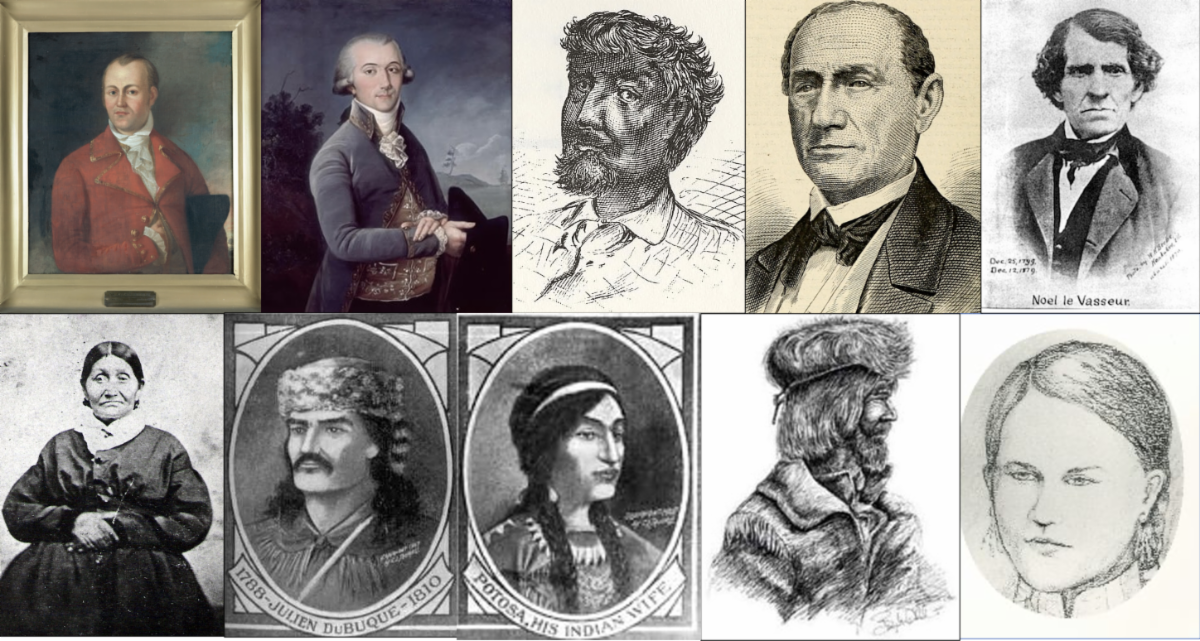
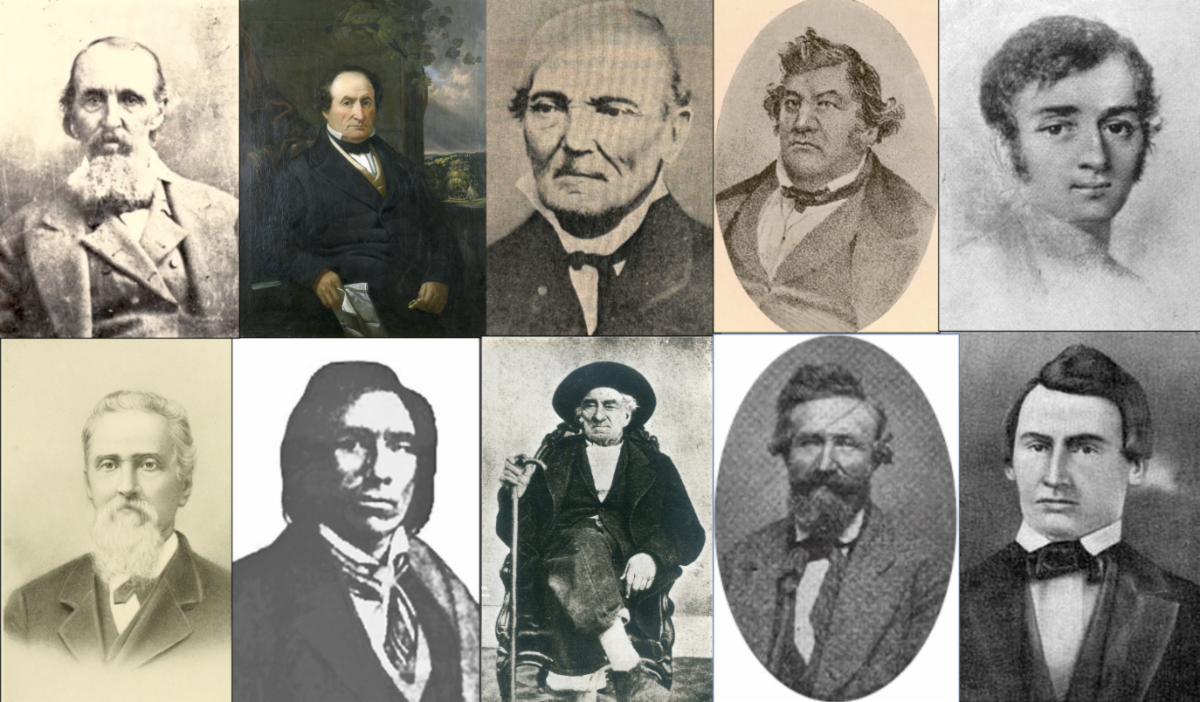
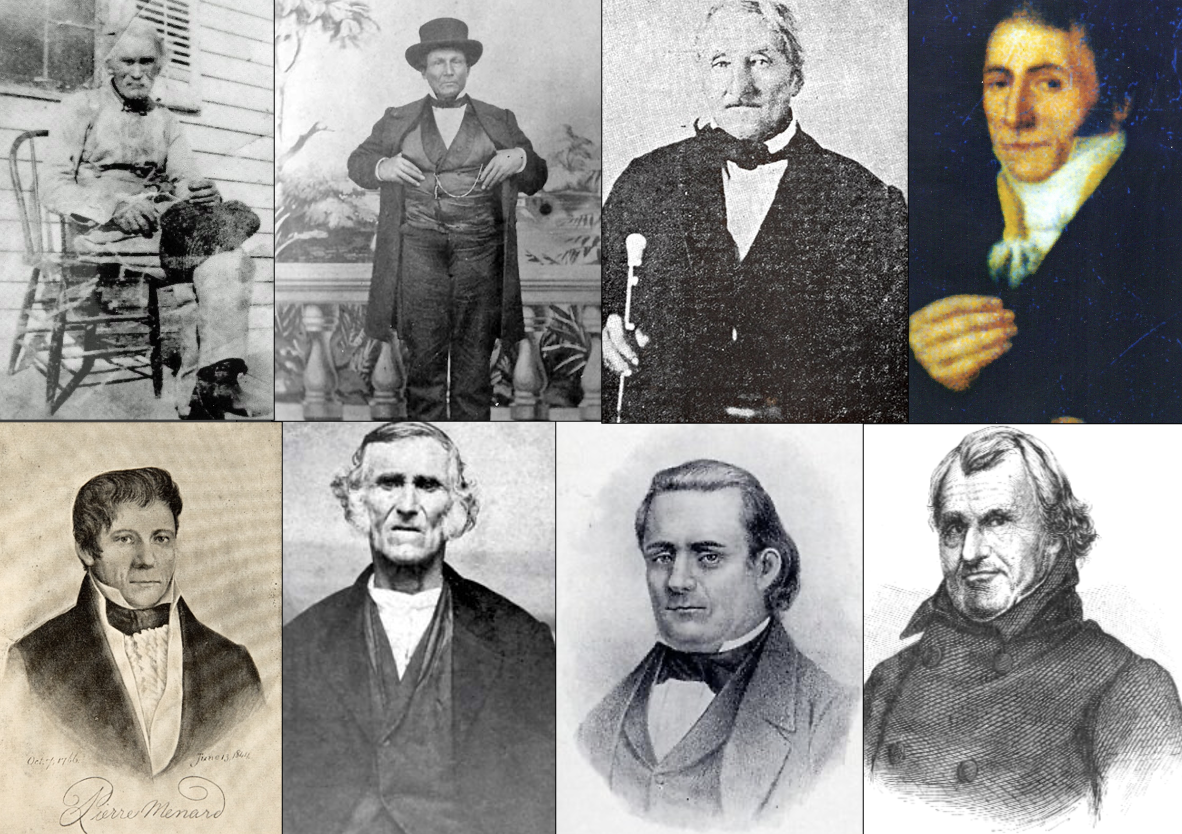
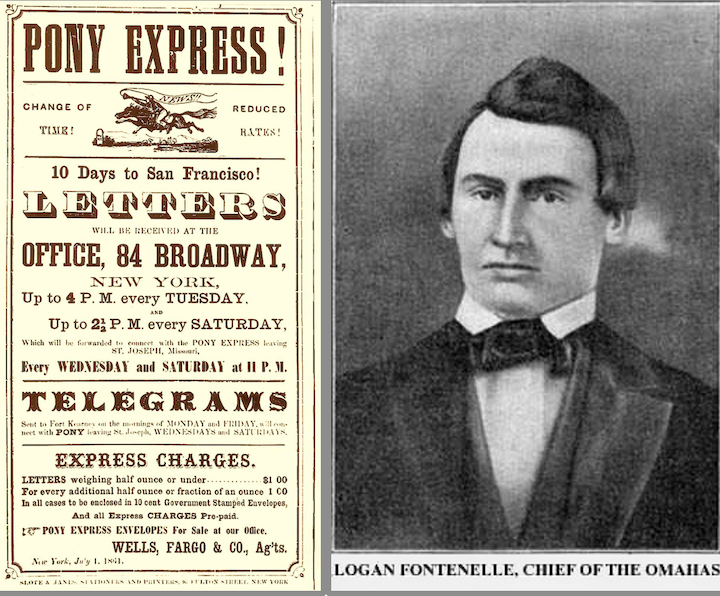
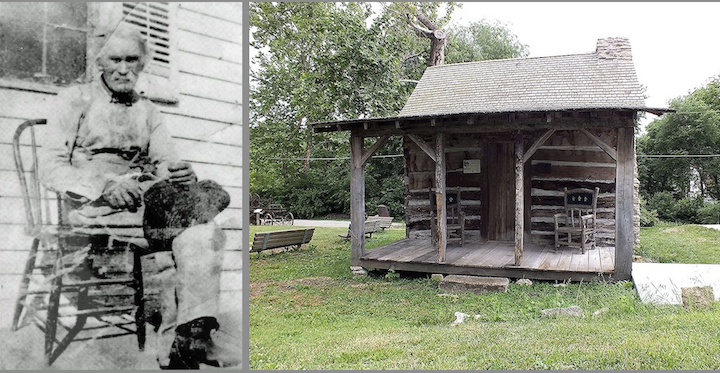
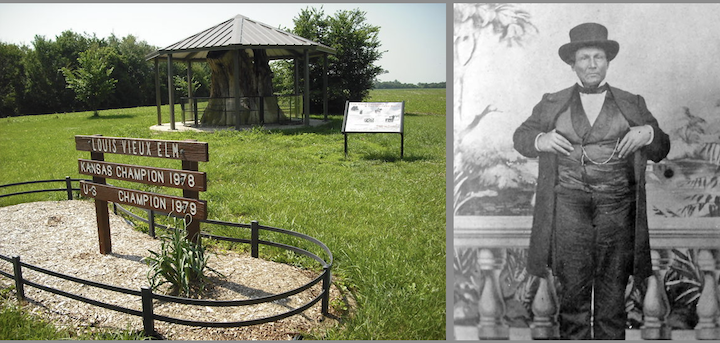
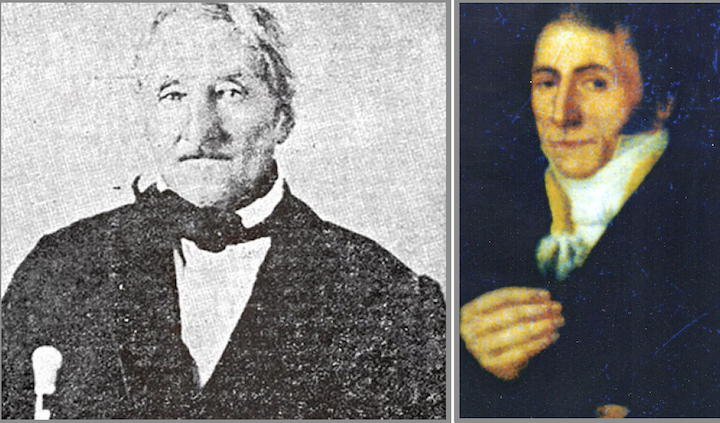
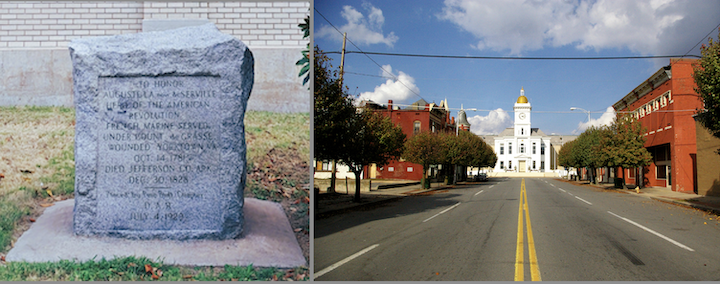
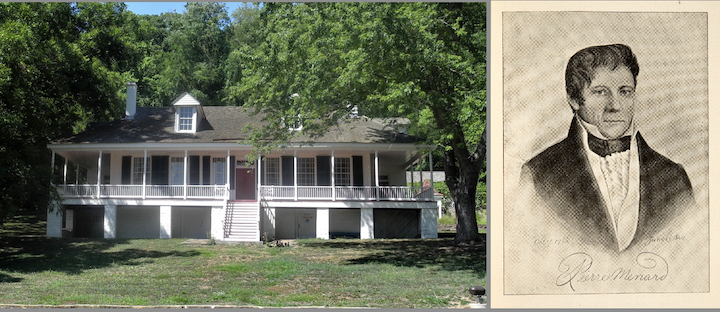
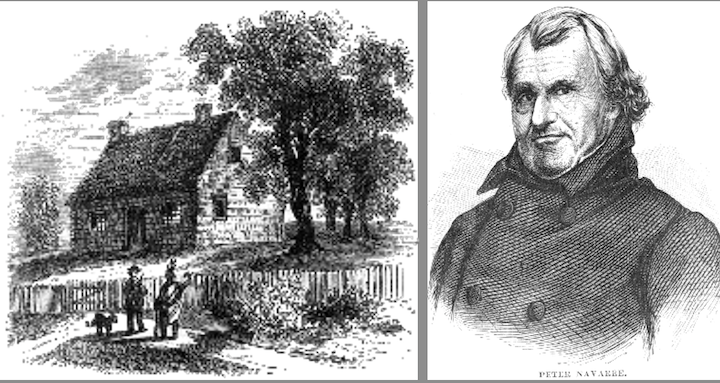
From top to bottom, left to right: Auguste Chouteau, Pierre Laclède, Jean-Baptiste Pointe du Sable, Jean-Baptiste Beaubien, Noël Le Vasseur, his wife Watseka (Josette) Bergeron, Julien Dubuque and his wife Potesa, Joseph LaFramboise Sr., his wife Magdelaine LaFramboise, Daniel Marsac, Solomon Juneau, Jean Brunet, Antoine LeClaire, Joseph Nicollet, Alexandre Faribault, Joseph Renville, Joseph Robidoux IV, Laurent Bernard, Logan Fontenelle, Jean-Baptiste Didier, Louis Vieux, Antoine Barraque, Jean-Pierre Emmanuel Prudhomme, Pierre Menard, François Navarre, Alexis Coquillard, Pierre Navarre.
(Photos credits in Chapters further below)
|
|
EDITORIAL
Last month we sailed in the Pacific Ocean, from Alaska to California, and from Hawai'i to present-day American Samoa. We are thankful for all the warm messages received. If this great navigator is a national celebrity of sorts in France, there are quite a few other French land explorers, pioneers and settlers, who are mostly forgotten on both sides of the Atlantic. Yet, in many ways, they contributed to building this great nation of ours and left their mark that can still be felt today.
In our March Bulletin "French Explorers of the West (Part 1, 1634-1804)" we narrated the 1634 expedition of Jean Nicolet and the 1659 expedition of Radisson and Groseillers to Wisconsin, the travels of Sieur Du Luth to Minnesota in 1678, the 1719 exploration of Kansas by Claude du Tisne, the 1722 exploration of Arkansas by Bernard de la Harpe, the 1742 Verendrye brothers expedition to South Dakota, as well as the stories of several French members of the Lewis & Clarke expedition of 1804.
We continue with this second of a series, this time paying tribute to "French pioneers and settlers of the American Frontier". Before the Far West, the West started in Saint Louis in Missouri. It is hard to imagine today that there was also an "Illinois Frontier", and that settlers were far and few between beyond this frontier, throughout the vast plains of the Midwest.
Are you familiar with any of the names on the cover illustration? Most likely not, and yet these men ventured to these lands and became early settlers, many years before the US Cavalry opened up forts further West, before the Native Indians populations were forced to relocate in new reservations, and waves of Europeans immigrants crossed these regions in covered wagons.
They all had French surnames, coming from France or Canada, and several were Metis, commercing and intermarrying with the Natives Indians for generations. All left a profound legacy. Their descendants all over these States are rightly proud of their great deeds and heritage.
We will continue our series in future months with other very colorful characters in the French Explorers of the Far West (1840-1890) and finally the French in Early California (1850-1920), which will surprise you.
At Le Souvenir Français, we travel across the oceans, the fruited plains, the mountains, and centuries as well. We pay tribute to all those whose deeds profoundly contributed to the joint history of France and the United States.
Our series honoring members of the Lafayette Flying Corps continues.
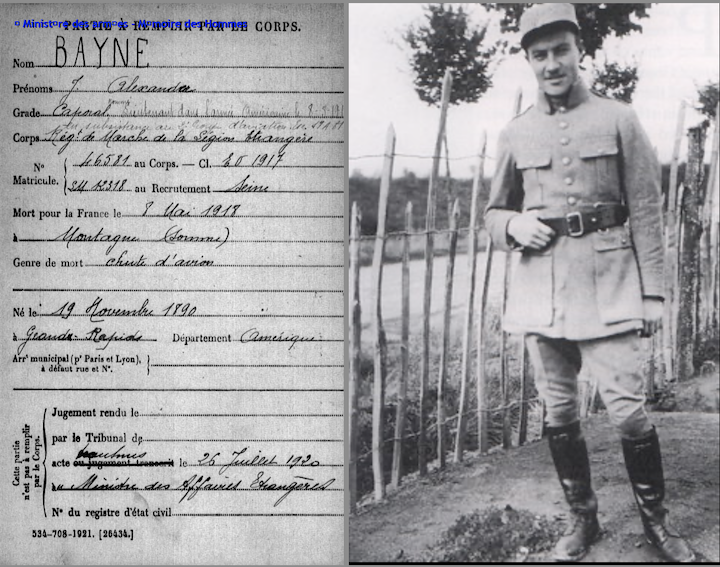
This month, we are paying tribute to Lt. James Alexander Bayne, who “Died for France” and whose remains rest at the Lafayette Escadrille Memorial in Marnes-la-Coquette just outside Paris.
We are about to embark on a period filled with numerous significant celebrations. Make sure to mark your calendar! The 80th Anniversary of D-Day holds a special place in our hearts, as we express our heartfelt gratitude to the brave survivors of that historic battle for freedom and democracy. In addition to this milestone, there are several other noteworthy events that deserve your attention and support, all of which are detailed in the latter part of this Bulletin. The Lafayette Bicentennial is currently in its final stages of preparation! We encourage you to stay updated on all the exciting events taking place across 24 States by visiting www.Lafayette200.org. The festivities will kick off on August 16th in New York, so be sure to join us in celebrating this momentous occasion.
We appreciate your valuable feedback and suggestions. We kindly ask you to share this Bulletin with your friends, colleagues, and particularly within the education community. It is essential to pass on the legacy of knowledge to the younger generations.
On behalf of the Board of Directors,
Thierry Chaunu
President, American Society of Le Souvenir Français, Inc.
|
|
Historical Context:
A vast continent to settle
|
|
Above:
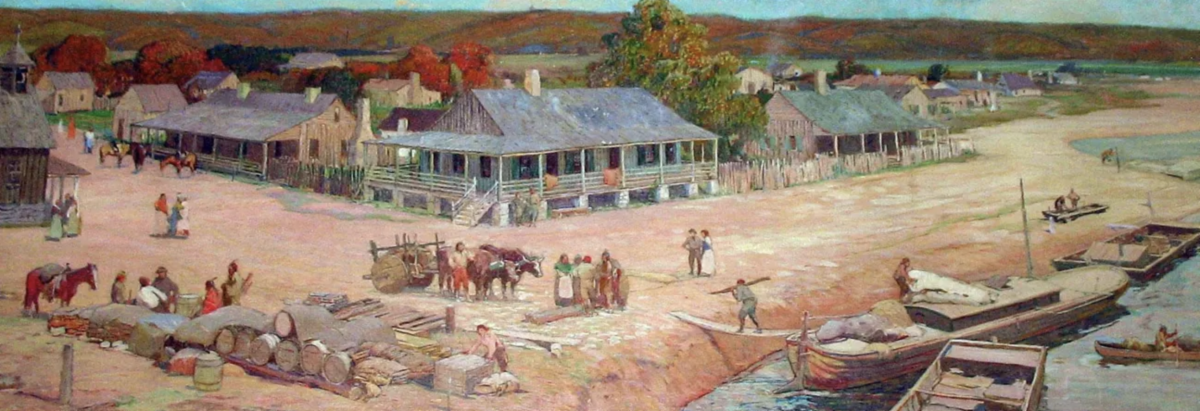
Top: Illustration of early scene of the French settlement of Ste. Genevieve in its original location on the banks of the Mississippi River. Cropped from a mural painted in 1924 that is located in the Missouri State Capitol building in Jefferson City, MO. Artist: Oscar E. Berninghaus (1874–1952).
Missouri State Capitol, Photo National Park Service, Public Domain
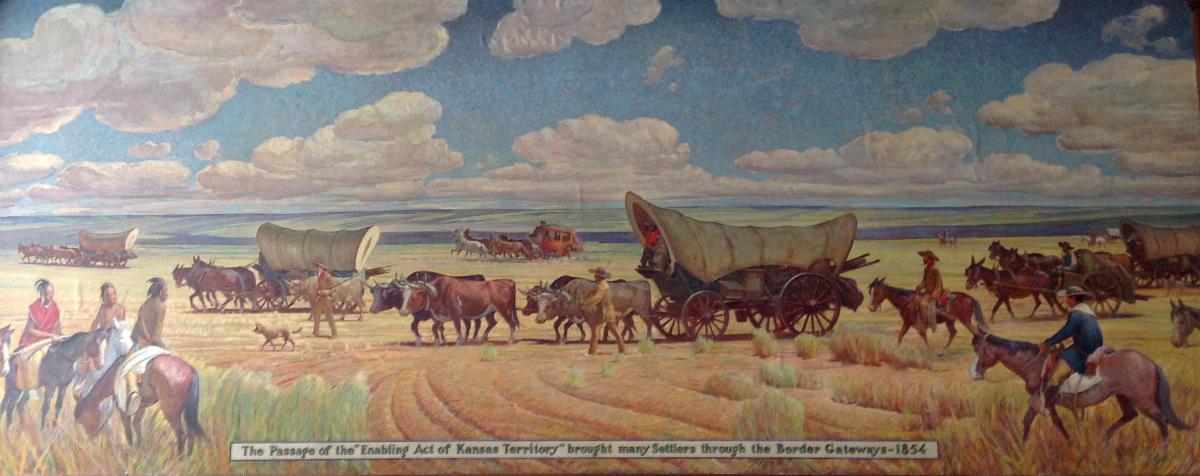
Bottom: Border Gateways, by Oscar E. Berninghaus (1937) depicting immigrants arriving in Kansas territory following the Kansas-Nebraska Act of 1854. Mural is located on the second floor of the Fort Scott, Kansas Federal Courthouse, By Oscar E. Berninghaus (1874-1952) - original painting is a work of the United States Department of the Treasury., Public Domain, https://commons.wikimedia.org/w/index.php?curid=27766773
|
|
• Trying to narrate what happened in the years following the American Independence is difficult. History is not linear. Attempting to stick to a geographical combined with a chronological coherence is challenging. So much happened in a couple of generations! Many who were born French were subjected to Spanish governors after the French Bourbon monarchy temporarily gave Louisiana to the Spanish branch (The Sun King's Louis XIV second grandson Philippe became King Philip V of Spain, which explains this "family pact"). Many rebelled against the new authority and some even were executed. Then the French Republic took back Louisiana, only to sell it three years later to the United States in 1803 (Napoléon Bonaparte was First Consul of the French Republic, not yet crowned Emperor Napoléon I).
• Many French speaking towns and villages throughout the Mississippi readily accepted the new reality that was the United States of America and pledged loyalty. The gradual westward expansion led many French settlers to form new settlements.
• The use of French language declined greatly after the turn of the 20th Century. By 1960, only a few hundred would still speak the "Missouri French" or "Illinois Country French" patois that is nearly extinct today.
In this Bulletin, we will select just a few of these French settlers of the West.
But first, we will pay tribute to two important families, or dynasties. Remember their names! You will find them again all over the Far West, in our future bulletins: the Chouteau and the LaFramboise families.
|
|
Auguste Chouteau and Pierre Laclède
Co-Founders of Saint Louis, Missouri
|
|
Above:
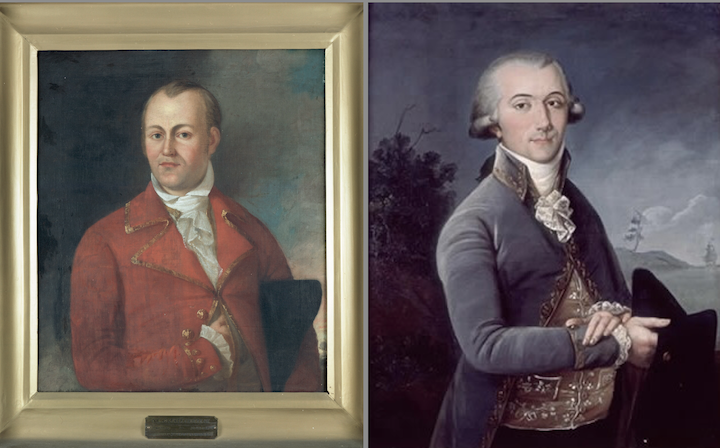
Left: Portrait of Auguste Chouteau, one of the founders of St. Louis. The portrait is a copy taken from a miniature in a private collection that was painted in the late 1700s by an unidentified artist. Missouri History Museum, Public Domain, https://commons.wikimedia.org/w/index.php?curid=61630770
|
|
Auguste Chouteau
• René-Auguste Chouteau Jr. (September 7, 1749, or September 26, 1750 – February 24, 1829), also known as Auguste Chouteau, established the city of St. Louis, Missouri, excelled as a fur trader, and engaged in politics. Together with his business associate Pierre Laclede, he held a dominant position in the fur trade with the prominent Osage tribe along the Missouri River for an extended period. His commercial ventures in St. Louis were diverse, and he maintained strong relationships with the ruling authorities of French, Spanish, and American descent.
• His extensive family became a powerful actor in settling the entire American West throughout the 19th Century.
• Marker, « Auguste Chouteau, Father of St Louis"
6358 Delmar Boulevard, Saint Louis MO 63130
• Inscription:
“Born René Auguste Chouteau in New Orleans, he was raised by his stepfather, Pierre Laclède, and his mother, Marie Therèse Chouteau. As Laclede's clerk and Lieutenant, the 14-year-old Chouteau led the workers who began building St. Louis on February 15, 1764. He prospered as the village grew into a commercial hub, adapting to Spanish rule in 1770 and U.S. control in 1804. Diversifying into banking and real estate as the fur trade declined, Chouteau, the town's business and social leader, was the first board of trustees chairman upon its incorporation in 1809. As an early historian of the city wrote, "Laclede founded, and Auguste Chouteau built, St. Louis.”
Erected 1993 by St. Louis Walk of Fame.
Pierre Laclède
• Pierre Laclède Liguest or Pierre Laclède (1729 – 1778) was a French fur trader who, with his young assistant and stepson Auguste Chouteau, founded St. Louis in 1764, in what was then Spanish Upper Louisiana, in present-day Missouri.
• He was born in the village of Bedous, the southwest French province of Béarn, and decided to seek fame and fortune in New Orleans at the age of 26. He quickly got into a relationship with a married woman, Marie-Thérèse Chouteau.
• He became quickly adept at trading with Indians and was sent with his young stepson Auguste Chouteau, aged 14, and a few companions by Gilbert Antoine de Saint-Maxent in 1763 to construct a trading post near the confluence of the Mississippi and Missouri rivers. Since it was too marshy, he founded a trading post 18 miles south, and legend has it that St. Louis was founded on Saint Valentine's Day of 1764.
• The St. Louis downtown riverfront area is named Laclede's Landing in his honor. He is also the namesake of Laclede County, Missouri. There is also a town, Laclede, Missouri, the Pierre Laclede Honors College at the University of Missouri–St. Louis, to name a few sites and institutions honoring this great French settler.
• Marker, « Pierre Laclede », Founder of St Louis
Forest Park, Fine Arts Dr, St. Louis, MO 63110
• Inscription of marker:
“This monument is erected to commemorate
the landing of the founders of the City of Saint Louis
Pierre Laclede and companions in the year 1764”
Erected 1923 by Saint Louis General Assembly
Fourth Degree Knights of Columbus."
• Sidewalk marker, Pierre Laclède
6315 Delmar Blvd, University City, Saint Louis, MO 63130
• Inscription:
“ French-born Pierre Laclède Liguest arrived in New Orleans in 1755. He ventured up the Mississippi in 1763 to build a trading post after his firm won trading right in the Upper Louisiana Territory. Choosing a site near the mouth of the Missouri, he sent his stepson, Auguste Chouteau, to start the settlement in February 1764. Naming it St. Louis, Laclede laid out streets, made property assignments and governed until territorial officials arrived in October 1765. Laclede, who brought his library to the wild, owned the town's first industry, a water-powered mill. St. Louis' first citizen, Pierre Laclede envisioned his village becoming "one of the finest cities in America."
Erected 1993 by St. Louis Walk of Fame."
|
|
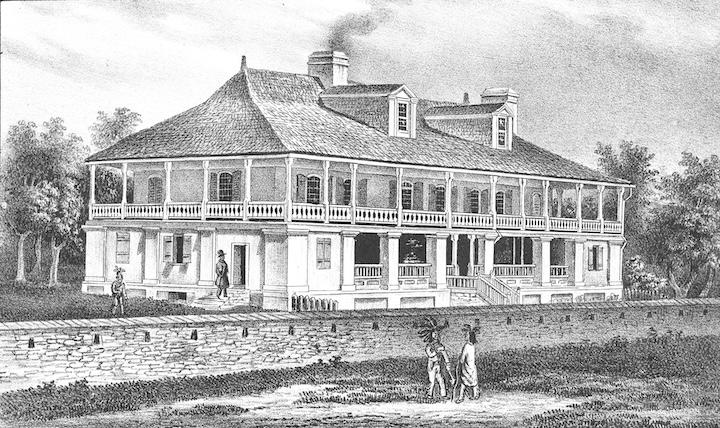
Above: Plate V: Old Chouteau Mansion, St. Louis. Mo approx. 21 x 28 cm. published by the artist and printed by Chambers and Knapp By John Caspar Wild - The Valley of the Mississippi Illustrated in a Series of Views, Public Domain, https://commons.wikimedia.org/w/index.php?curid=113451481
|
|
Jacques-Timothée Boucher, Sieur de Montbrun
First Citizen of Nashville, Tennessee
|
|
Above:
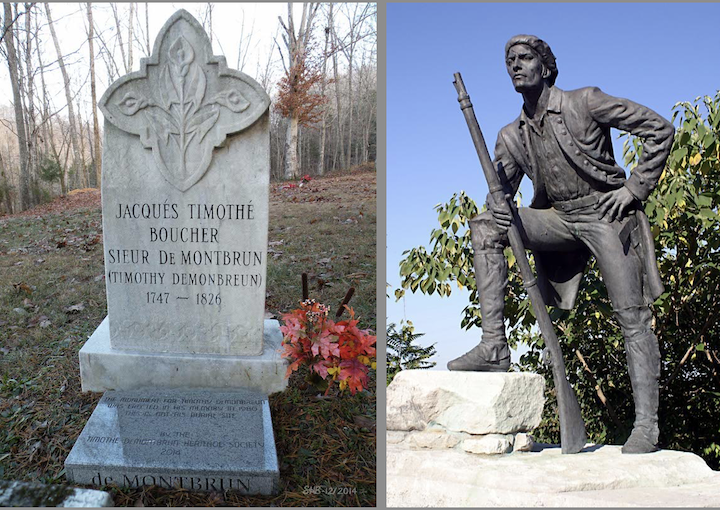
Left: Cenotaph, Photo by OBXr Memorial ID 234084427
Right: Statue of Timothy Demonbreun, WPLN News . “Sculptor Alain Lequire. Plaque donated in memory of Dr. Truman Weldon Demonbrun, president of the Timothy Demonbreun Heritage Society 1977-1996”
|
|
Jacques-Timothée Boucher, Sieur de Montbrun
• Jacques-Timothée Boucher, Sieur de Montbrun (1747 – 1826), anglicized as Timothy Demonbreun, was a French-Canadian fur trader, a Lieutenant in the American Revolution, and Lieutenant-Governor of the Illinois Territory.
• He is known as the "first citizen" of Nashville, Tennessee.
• Born in Québec, Demonbreun traveled extensively, became a successful trader with many employees, and managed two careers and two families. He fulfilled his duties as lieutenant governor of the Illinois Territory and maintained a family in Kaskaskia, Illinois. Demonbreun had five children by his wife, Therese Archange Gibault, in Illinois. During his time in Nashville, he took a mistress named Elizabeth Bennett and had three children by her.
• Marquis de Lafayette visited Nashville on May 4, 1825, during his farewell tour of the United States. Andrew Jackson presided over a banquet in his honor at the Nashville Inn. Jacques-Timothée, by then very elderly, conversed with the Marquis in their native French. When he died in 1826, Demonbreun divided his substantial fortune among his children.
• Nashville's monument to Jacques Timothe Boucher, Sieur de Montbrun (Timothy Demonbreun) was sculpted by Alan Lequire.
• Statue “Timothy Demonbreun“
Bicentennial Park, 101 Union St & Gay Street Connector, Nashville, TN 37201
• Inscription:
Jacques Timothe Boucher de Montbrun
(Timothy Demonbreun)
1747-1826
French Canadian Fur trader and Explorer
Officer of the American Revolution
Lieutenant Governor of the Illinois Territory
Honored as Nashville’s First Citizen”
• Marker, “Timothy Demonbreun“
101 3rd Ave N. at Broadway, Nashville, TN 37219
• Inscription
“Jacques-Timothé De Montbrun, born on Mar. 23, 1741, in Boucherville, Quebec, was the first white man to live in the Nashville area. Beginning in 1769, he spent several winters here trading for furs. He served as Lieut. Gov. of Illinois Country, 1783-86. He became permanent resident of Nashville in 1790, operating store & tavern. Died at home on this site, Oct. 30, 1826.”
“Erected 1971 by The Historical Commission of Metropolitan Nashville and Davidson County”
• Plaque, “Jacques-Timothée Demonbreun”
North Capitol, 7th Avenue N, near amphiteater, Nashville, TN 37208
• Inscription:
“French-Canadian fur trader
Jacques-Timothé Demonbreun
visited the Nashville area as early as 1769
and settled here in 1790.”
• Marker, “Demonbreun’s cave“
Cumberland River next to Music City Star Train Depot and pedestrian bridge,
Nashville, TN 37201
• Inscription:
“Jacques-Timothe De Montbrun, French Canadian fur trader and later lieutenant governor of the Illinois Country, visited in this area as early as 1769. On at least one occasion he took refuge in the cave 0.9 mile N. when attacked by Indians. He settled in Nashville in 1790, living there until his death in 1826.
Erected by Tennessee Historical Commission”
• Cenotaph, “Timothy Demonbreun“
Carney Cemetery, Marrowbone, Ashland City, TN 37015
• Inscription:
(Front):
Jacques Timothy Boucher Sieur de Montbrun
(Timothy Demonbreun)
1747-1826
(Back):
"French Canadian Fur trader of French Lick
Officer of the America Revolution
Governor in Command of the Illinois Country
Early resident and merchant of Nashville
Et Quoy Plus"
• Plaque:
"The monument for Timothy DeMonbreun
was erected in his memory in 1980
This is not his burial site
By the Timothe DeMontbrun Heritage Society 2014"
• It is impossible to refrain from including this portrayal of Timothée de Montbrun, similar to all the remarkable individuals who settled in the American Frontier during that era:
“Timothy Demonbreun lived many lives, held many offices, and accumulated much wealth in the standards of that era. He had dealings with important men like Colonel George Rogers Clark, James Robertson, and Andrew Jackson. He slept in comfortable beds in his house as a governor and also made the earth his bed during uncountable nights during the hunting seasons. He dealt with Spanish governors, frontier governors, and Indian leaders. He had a noble Catholic wife and a frontier mistress that some thought was half-Indian. He brushed death many times, but the nobleman of New France died without fanfare in a place that he had helped raise from an Indian hunting ground to a growing city in a new state. His name is synonymous with courage, honor, and self-sacrifice that is the hallmark of the pioneers that settled the Cumberland.”
|
|
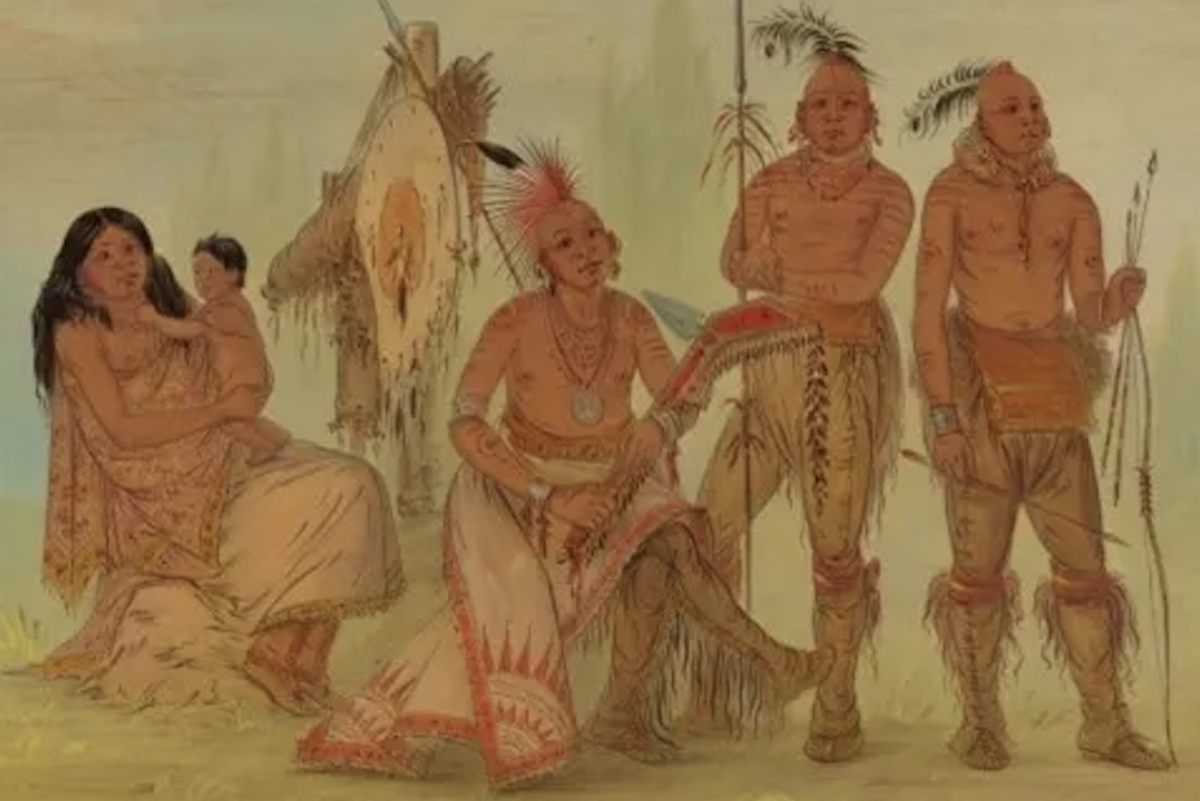
Above: A group of Osage, illustration National Park Service, Public Domain
|
|
• The Osage people refer to themselves in their indigenous language as 𐓏𐓘𐓻𐓘𐓻𐓟 (Wazhazhe), or "Mid-waters" and are deeply connected to their spiritual beliefs.
• The French called them "nation des eaux sages", pronounced "o- sāj" which can be roughly translated as "calm water".
• Their religious practices revolve around the concept of Wah-kon-tah, the great mystery spirit or power. According to Osage oral traditions, the People of the Sky (Tzi-sho) and the People of the Earth (Hun-Kah) came together to form a unified tribe known as the Children of the Middle Waters (Nee Oh-kah-shkahn).
• The ancestral Osage were renowned for their hunting skills and were a formidable nation. Initially, they resided in villages along the Osage River. However, they also traversed the vast land between three significant rivers: the Missouri to the north, the Mississippi to the east, and the Arkansas to the south. Expanding their territory, they ventured into the windswept plains where they skillfully hunted buffalo.
• The French developed strong links of trade and friendship with the Osage.
Marker « The French and the Osage”
Loose Park off Wornall , 416 W 12th St, Kansas City, MO 64105
• Inscription (side in English):
”A Frenchman, Pierre Esprit Radisson, wrote in 1659 of a nation "of extraordinary height and bigness” (the Osage) living up the Missouri River. Marquette and Joliet’s 1674 maps show the village of the Osage, and some of La Salle’s entourage wrote of the Osage in 1687. In 1724, Louis XV’s emissary, Sieur de Bourgmont, left Fort Orleans (at present Brunswick, Missouri) for the west with many Osage, and negotiated a Comanche treaty to open the trail to Santa Fe. In 1755, the Little Osage went east with the French to help defeat British General Braddock (and George Washington and Daniel Boone). Later, Osage Chief Pawhuska showed Lt. Zebulon Pike a scarlet coat and blond scalp taken in that battle. The French said the Osage had much “amour propre” (i.e. pride). The Osage grew more and more obstreperous, culminating in the “Osage War” of 1793 which stifled trade on the Missouri. In 1794, Spanish Governor Carondelet ordered the St. Louis Chouteaus to build a fort among the Osage, in southwest Missouri, cut off their trade, and eradicate them. But the Osage were their best customers – and in-laws! So the Chouteaus secretly diverted trade goods to them and the Osage boasted that Fort Carondelet was built at their request and that they owned it. It soon closed, however, and the U.S. took little to Louisiana in 1803. After Fort Osage was built on the Missouri near Kansas City in 1808, the Little Osage moved there en masse for two years, and the Big Osage visited periodically, inhibiting the Osage business of the French until it closed in 1822. Ferry owner Peter Roi improved what became Wornall Road to the south. Eventually it reached to the French-speaking entrepots of Pappinville and Trading Post on the Marais des Cygnes (march of the Swans) River in Osage county far to the South. The French traders said the Osage liked “pantoufles sauvage” (i.e. savage slippers – moccasins). The Osage called the future Kansas City “Sho-To-To-Wan” – Chouteau’s Town. “Big Oil” was found on the Osages’ later Oklahoma tribal land, and they drove the most expensive Cadillacs and Pierce Arrows – amour proper still!” - Erected by the Chouteau Society"
• Relationships with the French are still strong today. There is an interesting story related in Osage News of August 2, 2013:
"William Least Heat-Moon, author of the book, “An Osage Journey to Europe, 1827-1830: Three French Accounts,” gave a history of the relationship to the crowd at the dedication. He said in 1826, the Osage and French were becoming intertwined as they traded and intermarried in Missouri. A voyage to France was to take place in 1827 and 12 Osages were invited to go. These 12 Osages, along with three Americans and a French guide, traveled to the East Coast to set sail. Along the way six Osages turned back after one of their rafts overturned in the Neosho River. In 1827 six Osages set sail for France, four men and two women. After three months at sea, they arrived in Le Havre, France on July 27, 1827.
“In France the Osages found themselves lionized as ‘noble savages.’ They went to the theater, rode in a hot-air balloon, and even had an audience with the king of France,” according to an excerpt from Least Heat-Moon’s book. “Many Europeans ogled them as if they were exhibits in a freak show. As the entourage moved through Belgium, Holland, Germany, Switzerland, and Italy, interest in the Osages declined. Soon they were reduced to begging in the suburbs of Paris, without the means to return home. It was during this time that one of the Osage women gave birth to twin girls. A Belgian, according to Least Heat-Moon, adopted one of the girls. The group made their way to southern France and ended up in Montauban. Starving and begging, they were taken in by Bishop Dubourg. Dubourg and the people of the town restored the Osages to health and arranged safe passage back to the Americas. On the journey, two Osage men died of smallpox." https://osagenews.org/osages-honor-historical-french-connection-with-monument/
• Marker, “Friendship Between the Osage and the Occitan of Montauban”
819 Grandview Ave, Pawhuska, OK 74056
• Inscription:
“In November 1829, three Osages arrived in Montauban, the Occitan Region of France. Little Chief, Big Soldier and Hawk Woman crossed the Old Bridge, received help from Bishop Dubourg, and with the generosity of the people of Montauban they were able to return to the Osage.
In 1989, the friendship between the Occitan of Montauban and the Osage was revived. The cities of Montauban and Pawhuska signed a twinning agreement in 1999 so that today we often see Osages in Montauban and Occitans in Pawhuska.
With this monument we celebrate that people across borders, mountains and oceans can unite, respecting their differences in ties of sincere friendship.
Today, July 24, 2013, we hereby dedicate this monument to the many enhanced exchanges that encourages us to retain and maintain our distinct cultures, languages and value systems.
"The Earth does not belong to Man, Man belongs to the Earth"
Erected 2013.
|
|
François Chouteau
Founder of Kansas City, Missouri
|
|
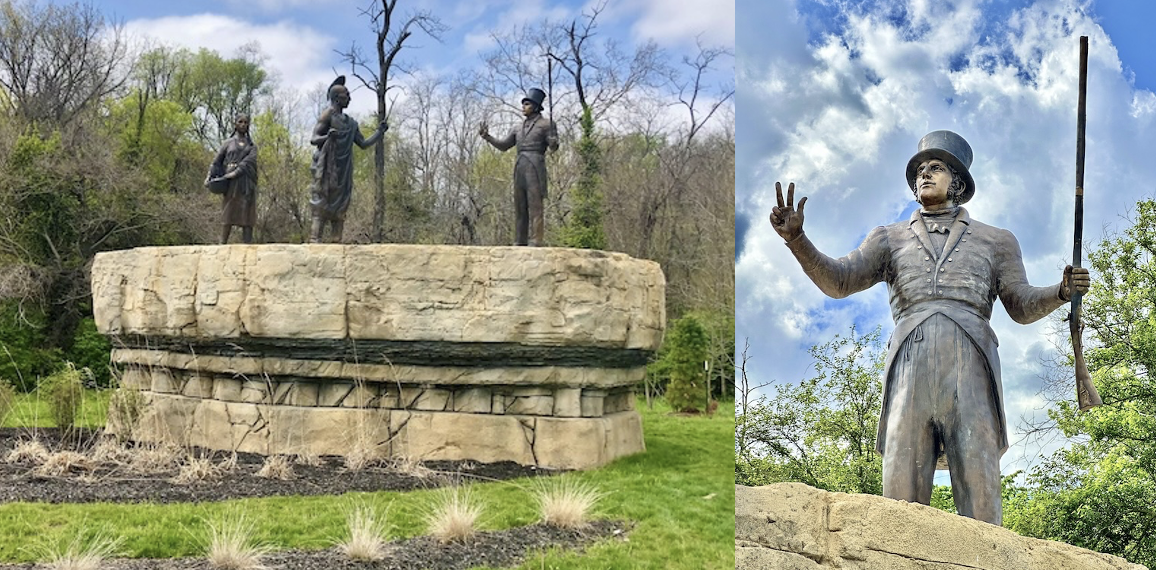
Above: François Chouteau & Native American Heritage Monument
Francois Chouteau bronze sculpture at the Chouteau Heritage Fountain in Kansas City, Missouri
3904 NE Chouteau Trafficway, Kansas City, MO 64117
|
|
François Gesseau Chouteau
• François Gesseau Chouteau, nephew of Auguste Chouteau, (born in Saint Louis on February 7, 1797 - died in West Port - Kansas City on April 18, 1838) was a prominent figure in American history as a pioneer fur trader, entrepreneur, and influential community leader recognized as the "Father of Kansas City". He established the initial fur trading post in the untamed wilderness of western Missouri. His first spouse belonged to the Osage Nation and gave birth to a son, while his second wife, Bérénice, was the mother of nine children.
• There are numerous bilingual French & English markers in Kansas City that narrate the birth and development of this "gateway" to the American West.
The François Chouteau & Native American Heritage Monument can be found on the west side of Chouteau Parkway, south of I-35, north of Parvin Road near the Chouteau Rain Gardens. The monument is designed to resemble the river bluffs where Rock Creek and the Missouri River meet, using materials like limestone, river stones, lighting, and landscaping. In 2019, the renowned sculptor Kwan Wu was commissioned to create four impressive sculptures for the monument. Three of these sculptures depict a trade encounter, while another shows a Native American trapper hunting.
• Marker «The Old Chouteau Trading Post /
Le Vieil Etablissement Commercial Chouteau”
400 Grand Boulevard, Kansas City MO 64106
• Inscription:
“In 1821, Francois and Berenice Chouteau arrived from St. Louis to establish Kansas City's first commercial emporium, the "Chouteau Trading Post", and in effect to found Kansas City. Francois was the grandson of Pierre Laclede, founder of St. Louis, and his wife Berenice was the daughter of Pierre Menard, a prominent man of French descent. French traders and soldiers had gone upriver as far as the Platte, starting as early as 1680. In its earliest years, the location of the Post was called "Chez les Canses" -- meaning "at the village of the Kansa" -- and later it was referred to simply as "Chouteau's." The first Chouteau personnel, including Francois' assistant, Louis (GrandLouis) Bertholet, who arrived in 1820, located on the North bank of the Missouri River. Some remained there after the Post was erected on the South bank.
Chouteau descendants say the first religious services here were held at the Post, and the first burials were made nearby. The first Chouteau Post was located near the South end of the Chouteau Bridge considerably down river. It was soon swept away by a flood, and after each ruinous flood the Post was relocated further up the river bank, and to the West. Berenice Chouteau, the "mother and Grand Dame of Kansas City," was a woman of great courage and compassion. When young Francois was killed by a stampeding horse in 1838, Berenice continued on at the Post. An 1841 map drawn by Fr. Point, priest of the French-speaking Church of St. Francis Regis, founded by Berenice, shows the home of "Madame Chouteau" at the eastern tip of the settlement (nearby, at Third and Grand). During a severe cholera epidemic, she nursed the severely ill and dying children - black, white, and Indian, and made shrouds for those who died, including two of her own children, from her linens and her silk wedding gown! She outlived her nine children, and died in 1888 at the age of eighty seven, having gained the love and respect of all Kansas Citians.”
Erected by The Chouteau Society and The City of Kansas City
• Marker «The French Bottoms - Early Day Kansas City”
1800 Genessee Street, Kansas City MO 64102
• Inscription (excerpts):
“One of America’s oldest and most prestigious livestock expositions, the American Royal, is situated in the very spot where Kansas City, the gateway to the agricultural West, had its beginnings. This little French-speaking enclave below the imposing bluffs, still today sometimes called the French Bottoms, was settled in the very early 1800’s by French-Indians who came down from the Northern Missouri River with their Blackfoot wives. They were part of the genesis of the vast cornucopia of riches of food and fiber which was to become the American West”...
...”The French Commandant of the Missouri, referring to the general area from present Kansas City on Westward said, circa 1717: “This is the finest country and the most beautiful in the world; the prairies are like the seas, and filled with wild animals, especially oxen (buffalo), cattle, hind and stag, in such quantities as to surpass the imagination...”
...” These country French had week “bals” where the tasty pot de boullion and friendly cup of wine went around and the chansons and fiddles and laughter rang out. But after the great flood of 1844, all was washed away, and the village priest said that all one could hear wafting up from the little French clearings were the songs of the birds and the chattering of the squirrels”... Erected by Chouteau Society & the Mildred Lane Kemper Fund
• Marker « Kansas City's Old Square / Le Vieux Carré de Kansas City”
400 Grand Boulevard, Kansas City MO 64106
• Inscription:
Kansas City's Old Square:
“Like New Orleans' "Vieux Carre," Kansas City's old market square and its surrounding Old Town streets in River Quay are oriented on the bias to the river in the Old World fashion, rather than on the strict east-west Yankee survey. That is because when Francois Chouteau, the French-speaking founder of what is now Kansas City, first laid out his trading post and adjoining trails in 1821, the Missouri river was his superhighway to St. Louis and to the Northwest hinterland. The scattered French settlers who first permanently occupied Kansas City, around 1799, together with those who came with the Chouteaus in the early 1800s, maintained fields extending from the west (on Quality Hill) and up the hill from their cabins located eastward down along the Missouri. These tracts backed up to this open area, which formed a sort of "common fields." Unlike St. Louis, it was not fenced, and was not formally maintained.
All this open area and adjacent land (114 acres) was claimed by an enterprising French grocer, farmer and tavern owner, Gabriel Prudhomme (from whom a number of Kansas Citians are descended) and he was given a patent to the land. Prudhomme, who showed much promise, was not destined to develop Kansas City, however. In 1831 he was "shot in a free fight by some fellow Canadians. It was a fierce brawl. When the fight was over there were many wounds and much blood spilt, and Prudhomme lay on the ground, still and dead." Thus it was that on the widow Prudhomme's land the "Town of Kansas" was platted in 1846 and, since the old residents, both French and American, probably had some informal community claim to the general area where the Market Square now stands, it is not surprising that it was dedicated as the square or village green of the new town.”
Erected by The Chouteau Society and The Francis Families Foundation."
• Marker « Old French Kansas City”
Downtown Kansas City, 259 West 13th Street, Kansas City, MO 64105
• Inscription:
“A short distance northwest of this marker was the center of the village which in the early 1800's the St. Louis Chouteau called "Chez Lez Canses"" meaning "at the home of the Kansas." Others called it "Chouteau's." The Chouteaus founded Kansas City in 1821 to trade for beaver furs with the French-speaking Kansa. French traders started coming up the Missouri as early as 1680 and traded on the River thereafter; some located here temporarily in 1799, and a few Canadian French farmers arrived here about 1803 to 1813. To the west was the Church of St. Francis Regis, built of logs by the French-speaking parishioners in 1835, with its cemetery behind. Down over the West Bluffs were little arpent strip farms of the French, and their songs and the music of their fiddles could be heard in the area which is now Quality Hill. To the North along the Missouri river were their open fields which became Kansas City's old square. North of Ft. Leavenworth was the abandoned site of Fort Cavagnal (1744-1764) at the second old Kansas Grand Village. East past Prudhumme’s farm which downtown Kansas City was platted, was Francois and Berenice Chouteau's trading post near the present Chouteau Bridge. Further east near Brunswick, Mo., was the former home of Ft. Orleans established at the Missouri Village in 1723, for trade with Taos and Santa Fe, by Etienne Veniard, Sieur de Bourgmont, protege of Louis XIV and the Regent. French mountain men-turned trail guides visited Westport to the South, probably including Sacajawea's son, Jean Baptiste Charbonneau, former "Chouteau's" resident. Out WornallRoad, the Old French trail led to Pappinville, abandoned Ft. Carondelet and Chouteau's Trading Post, South among the Osage.”
Erected by Chouteau Society Francis Families Foundation.
|
|
Jean-Baptiste & Catherine Point du Sable
Founders of Chicago, IL
|
|
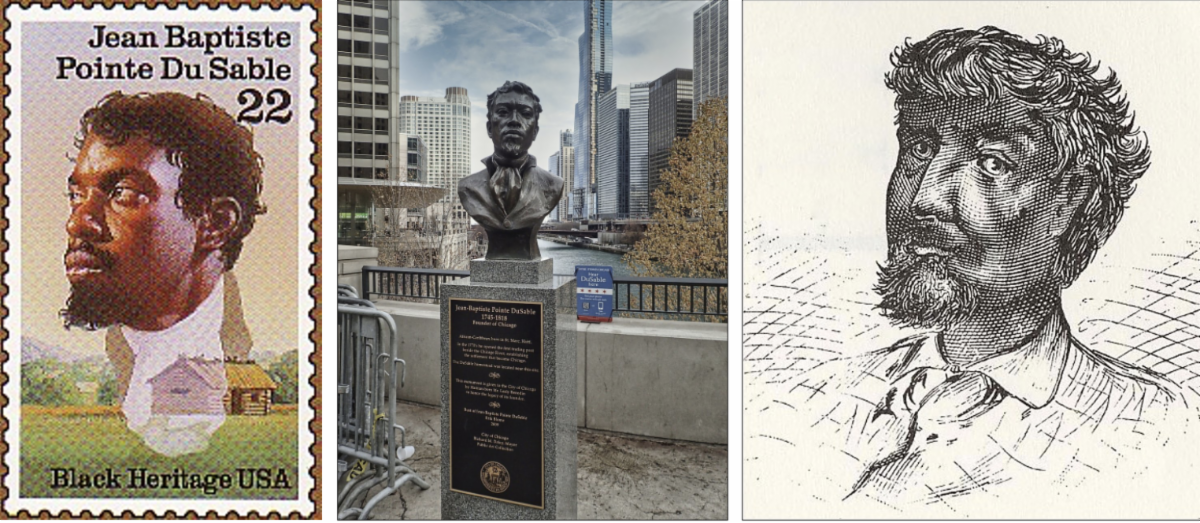
Above:
Left: United States Post Office Stamp, Public Domain
Middle: Photo, Twitter, Rep. Kam Buckner
Right: sketch of Jean Baptiste Point du Sable. There are no known portraits of Point du Sable made during his lifetime. This depiction is taken from A.T. Andreas 1884 book History of Chicago. By Copyrighted to Moses Engineering Company, New York - Public Domain
|
|
Jean Baptiste Point du Sable
• The name Chicago is derived from a French rendering of the indigenous Miami-Illinois word shikaakwa for a wild relative of the onion. The first known reference to the site of the current city of Chicago as "Checagou" was by Robert de la Salle around 1679 in a memoir. The first known non-indigenous permanent settler in Chicago was trader Jean Baptiste Point du Sable. Du Sable was of African descent, most likely born in the French colony of Saint-Domingue (Haiti), and established the settlement in the 1780s. He is commonly known as the "Founder of Chicago”.
• In October 2010, the Michigan Avenue bridge in the heart of Chicago was renamed DuSable Bridge.
• Point du Sable married a Potawatomi woman named Kitihawa (Christianized to Catherine) on 27 October 1788, in a Catholic ceremony in Cahokia in the Illinois Country, a longtime French colonial settlement on the east side of the Mississippi River. They had a son named Jean and a daughter named Susanne.
• Bust & Plaque
« Jean-Baptiste Point Du Sable
(1745-1818)
Founder of Chicago”
Pioneer Court near the Chicago River, Chicago IL 60611
• Inscription:
“African-Caribbean, born in St.Marc, Haiti. In the 1770's he opened the first trading post, beside the Chicago River, establishing the settlement that became Chicago.
The DuSable homestead was located near this site. This monument was given to the City of Chicago by Haitian-born Mr. Lesley Benodin to honor the legacy of its founder.
Bust of Jean Baptiste Pointe DuSable/ Erik Blome 2009
City of Chicago/ Richard M Daley, Mayor /Public Art Collection
Erected 2009 by The City of Chicago.”
• Marker «The DuSable House”
701 N 2nd St, St Charles, MO 63301
• Inscription (excerpts):
“Upon this property resided Jean Baptiste Point DuSable (1740's-1818) Monsieur DuSable, an African American, is considered to be the "founding father" of Chicago. In 1800 he moved to St. Charles and worked as a fur trader until his death"[...]
This property was acquired by the Academy of the Sacred Heart in December of 2010."
Erected 2017 by Rollin Jackson, Jr. (Eagle Scout Project - Troop 72).”
• Marker, « Catherine and Jean-Baptiste Point du Sable”
"Fur traders and farmers"
Pioneer Court near the Chicago River, Chicago IL 60611
• Inscription:
“Considered the founders of Chicago, Catherine (1756 - 1809) and Jean Baptiste (1745 - 1818) Point du Sable established a fur trading post on this site in the 1770s or early 1780s, approximately a half century before Chicago was incorporated. This commercial enterprise helped shape the American government's vision of the potential of this area and therefore its decision to build the first Fort Dearborn in 1803 across the river, at what is now the intersection of Michigan Avenue and Wacker Drive.”
“Much about the du Sables' lives is unknown. Scholars say Jean Baptiste probably was born in Saint Dominique (now Haiti) in the West Indies. At least one of his parents was a slave; he is best described as Afro-French. Catherine was Potawatomi; her Native American name is unknown. Native women who married fur traders and converted to Catholicism, as she did, constructed female kin networks that linked fur settlements throughout the Great Lakes and Mississippi River valley, and Catherine's connections were essential to her husband's commercial success. By the time the du Sable family left Chicago in 1800, their prosperous farm included a large house, a bake house, smokehouse, poultry house, stable, barn, 2 mules, 30 cattle, 38 hogs, and 44 hens. Du Sable's post, with its diverse clientele of Indian, French and American traders, established a tradition of commerce that would provide the foundation of Chicago's economy for decades to come.”
|
|
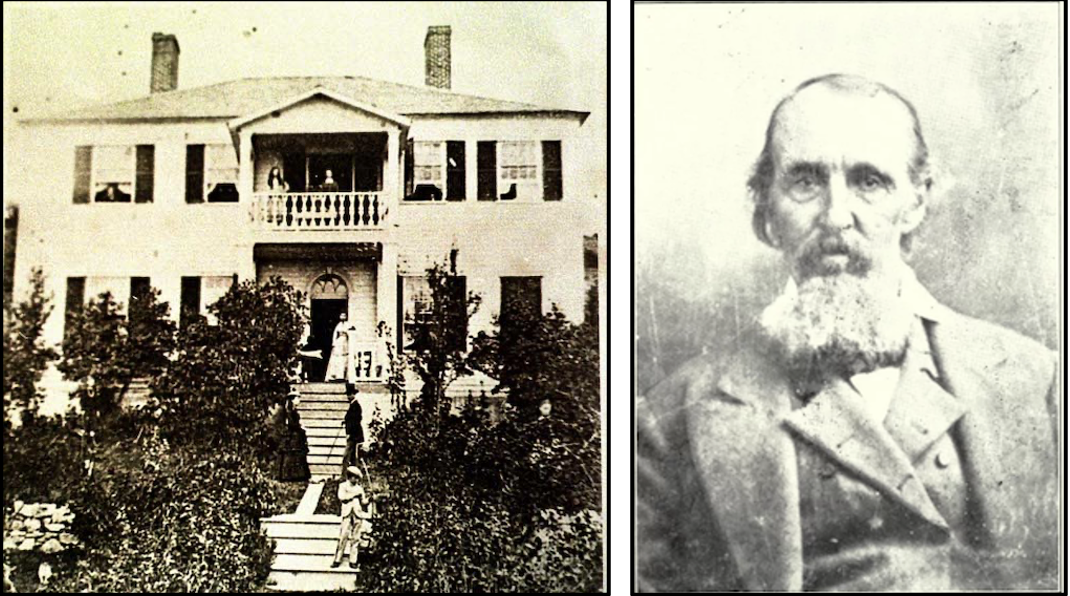
Jean-Baptiste Beaubien
The wealthiest man in Chicago
Noël LeVasseur
First resident of Bourbonnais, Illinois
|
|
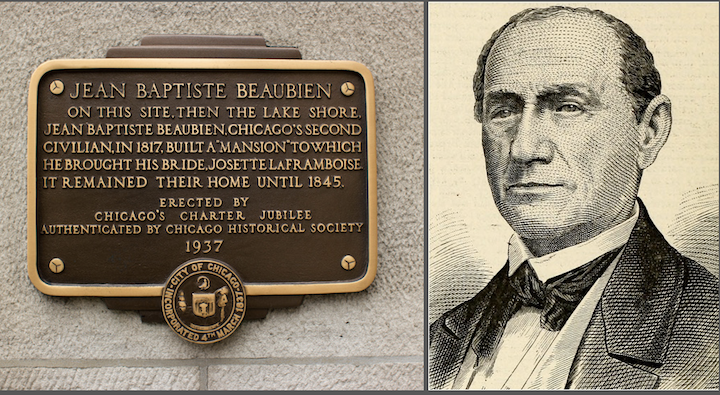
Above:
Top Left: Plaque, former home site of Jean Baptiste Beaubien.
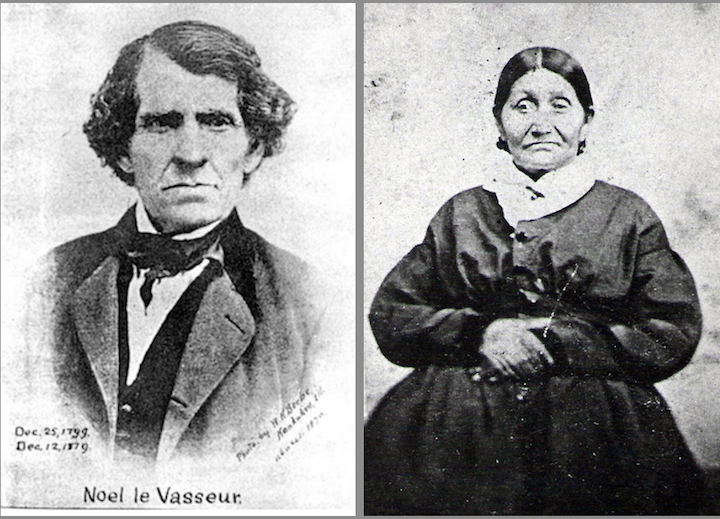
Bottom Left: Noël Le Vasseur
|
|
Jean-Baptiste Beaubien
• Jean-Baptiste Beaubien (born in Detroit, Michigan on September 5, 1787, and died in Naperville, Illinois, on January 5, 1864) became an early resident of what is now Chicago, Illinois and is also often referred to as the Founder of Chicago. Jean Baptiste Beaubien came from a prominent local French-Canadian family. His parents were Joseph Cuillerier Beaubien and Marie-Josephette Douaire De Bondy.
• Throughout his life, Beaubien was married four times, starting in 1804. He outlived three of his wives and may have had as many as 20 children.
• By 1825, Beaubien had established himself as the wealthiest man in Chicago, with property valued at $1000 according to the first Chicago tax roll.
• He played a significant role in the early development of the town. Beaubien hosted both the first town election in 1825 and the first general election in 1826. Moreover, he, along with his brothers and sons, was among the 500 citizens who incorporated the City of Chicago in 1833, proudly bearing the name "Chicagoans.”
• Plaque, “Jean Baptiste Beaubien”
78 E Washington St, Chicago, IL 60602
• Inscription:
"On this site, then the lake shore, Jean Baptiste Beaubien, Chicago's second civilian, in 1817, built a “mansion” to which he brought his bride, Josette LaFramboise. It remained their home until 1845.
Erected 1937 by Chicago's Charter Jubilee."
Noël Le Vasseur & Watseka ("Josette") Bergeron
• Noël Le Vasseur (December 25, 1798 – December 12, 1879) was a French Canadian fur trader who became the first permanent non-Native American settler of the area and is known as “The Father of Kankakee County”. He married a Potawatomi Indian, named Watch-e-kee, who exerted great influence in the region. The last sentence of his obituary in the Watseka Republican, December 25, 1879, page six reads in French: "Aveclui disparait l'un des plus courageux pionniers de l'Ouest" (With him will disappear one of the most courageous pioneers of the West).”
• Marker, « Noël Le Vasseur (1799-1879)»
147 S Main St, Bourbonnais, IL 60914
• Inscription:
“Father of Bourbonnais, Voyageur, Fur Trader and First Permanent Settler
of Bourbonnais Grove. Noël Le Vasseur and his wife Watch-e-kee arrived here in 1832. He bought large tracts of land from the Potawatomi Indians and encouraged hundreds of French-Canadian families to emigrate from Quebec Province to Bourbonnais Grove, thus forming the nucleus of the village’s population. The LeVasseur home, the first brick building in the county, stood 75 yards northeast of this marker. These bricks were salvaged from the house which was demolished in 1885.”
Erected 1979 by Bourbonnais Grove Historical Society; and residents and friends of the Village of Bourbonnais.”
• Watseka or Watchekee Bergeron (c. 1810–1878) was an indigenous Potawatomi woman who was born in Illinois and named after the protagonist of a Potawatomi legend. Her uncle, Tamin, served as the chief of the Kankakee Potawatomi Indians. Additionally, she was also known by the names Josette or Zozette Bergeron.
• At the age of 10 or 11, Watseka became engaged to Gurdon Saltonstall Hubbard, and they married when she was fourteen or fifteen. However, their marriage was dissolved in the same year. Later, at the age of eighteen, Watseka married Noel Le Vasseur. Described as "beautiful, intelligent, and petite," she had three children with Le Vasseur, who learned to speak the Potawatomi language.
• In 1836, Watseka relocated to Council Bluffs, Iowa, along with her tribe, as they had been removed from their ancestral lands in 1832 following the Treaty of Camp Tippecanoe. In 1840, she married Francis Xavier Bergeron, a French-Canadian.
• Her biography per the Citizen Potawatomi Nation Cultural Heritage Center states: "French-Canadian Francis Xavier Bergeron arrived in the Great Lakes region as a young man where he met Watseka on one of her trips back to the region. In 1840, she received the Christian name Josette or Zozetta upon her baptism. She had four children: Jean Batiste, Catherine (Kate), Matilda and Charlie. She died in Council Bluffs, Iowa.
• Watseka, a city in East Central Illinois, was named after her. The Iroquois County Chapter of the Daughters of the American Revolution was also named in her honor. Catherine (Kate), the daughter of Watseka and Bergeron, married Joseph L. Melott, a Frenchman. Together, they played a significant role in founding the community of Mission Hill, which is now called Wanette, Oklahoma.
|
|
Julien & Potosa Dubuque
Founders of Dubuque, Iowa
|
|
Above:
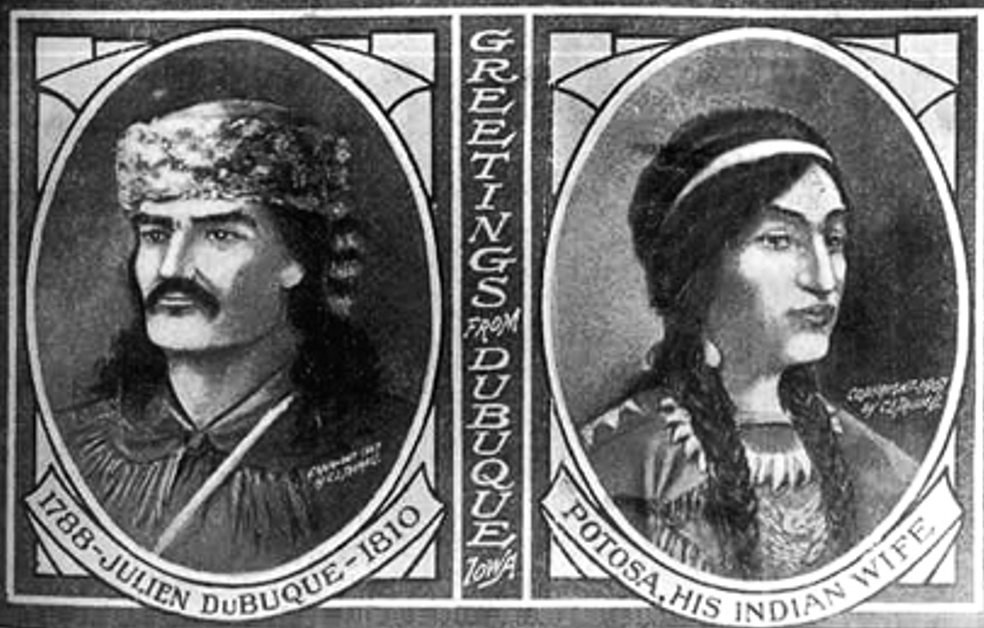
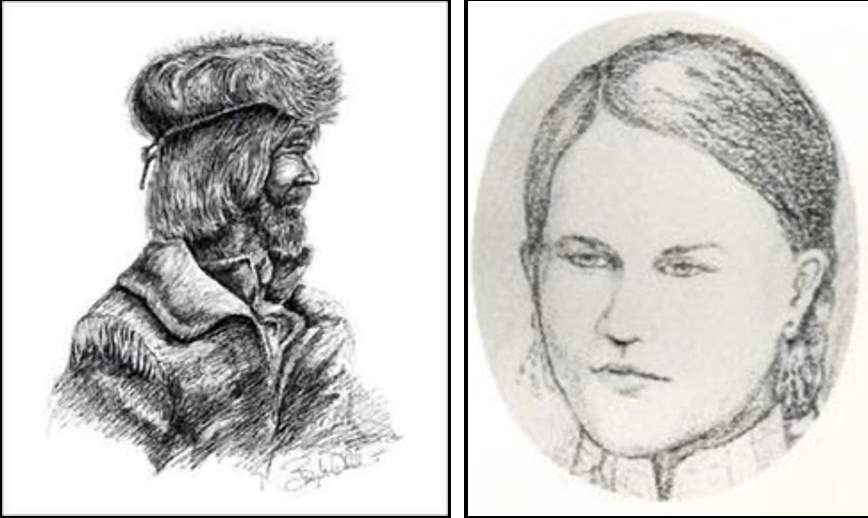
Top: Photo: An artist's 1907 conception of Julien Dubuque and his wife Potosa
Public Domain, https://en.wikipedia.org/w/index.php?curid=36391180
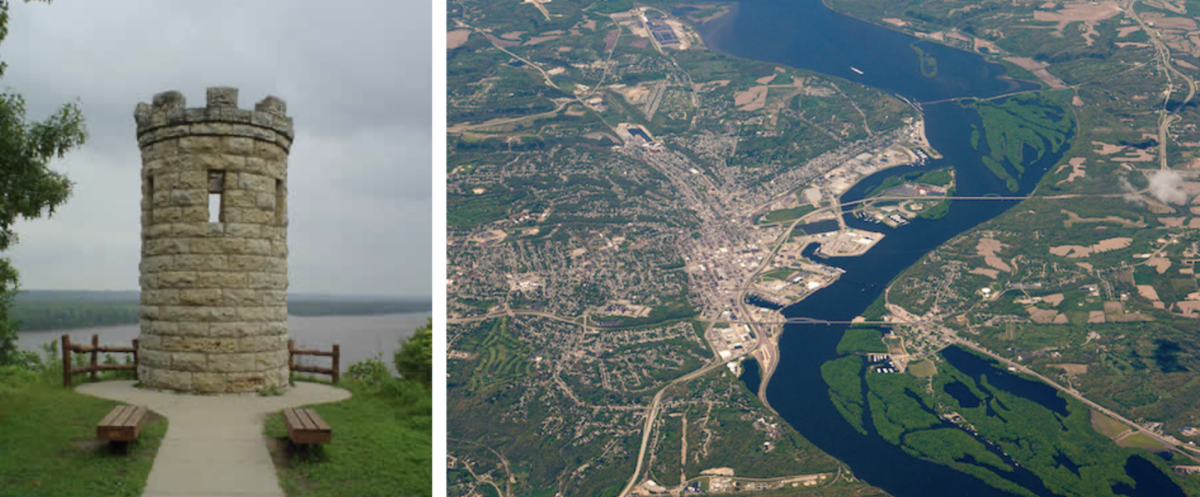
Bottom left: Julien Dubuque Monument, National Park Service, Public Domain
Bottom Right: Aerial view of Dubuque and surrounding area
|
|
Julien & Potosa Dubuque
• Julien Dubuque (January 1762 – 24 March 1810) was a French Canadian of Norman descent. He obtained permission from the Meskwaki people to mine lead and was granted land by the Spanish in 1796. Dubuque remained in the area for the rest of his life and formed a friendship with the local Meskwaki chief Peosta. There is speculation that Dubuque married Peosta's daughter, Potosa, although this is debated. Following his death, the Meskwaki constructed a log crypt for Dubuque, which was later replaced by a stone monument. The name "Potosa" is often associated with the origin of Potosi, Wisconsin, a town founded as a lead-mining settlement.
• This area is important historically in the Indian-French fur trading culture and the first record of lead mining by a French trader, Nicolas Perrot, in 1690. In 1788 Julien Dubuque was granted rights by the Mesquakie Indians to mine their land for lead. Dubuque settled close to the village of Kettle Chief just south of where the Julien Dubuque Monument now stands. It was here that Dubuque founded the first Euro-American settlement in what is now Iowa.
• Julien Dubuque’s Mine, Mines of Spain, is a National Historic Landmark located along the southern edge of Dubuque, IA, with access via Highway 52 South, at the intersection of Route 61. In 1796, the Spanish Governor of New Spain, Francisco Luis Hector, barónde Carondelet, officially granted a 189 square-mile area to Julien Dubuque for his mining operation. In recognition of the grant, Dubuque named his mines in Spain’s honor.
• When Julien Dubuque died in 18010, the Mesquakie people buried him with tribal honors beneath a log mausoleum at the site of the current monument. The Julien Dubuque monument was built in 1897 and sits high above the Mississippi River. It overlooks the Mines of Spain property in the town that would eventually bear his name.
• Marker, “Julien Dubuque & The Mines of Spain”
1810 Monument Dr, Dubuque, IA 52003
• Inscription (excerpts):
“Julien Dubuque was born on January 10, 1762 at Trois Rivières near Quebec, Canada. In 1788, he established a trading post and lead mining smelter at the mouth of Catfish Creek. He was active in fur trading and lead mining with the Mesquakie (Sac & Fox) tribe who lived nearby. According to the legend, Dubuque married Potosa, daughter of Chief Peosta. Julien Dubuque died on March 24, 1810 and was buried by the Mesquakie (or Meskwaki) with tribal honors overlooking Catfish Creek and the Mines of Spain. In 1897, the Old Settlers Association erected the 25 foot tall limestone monument that exists today known as the Julien Dubuque Monument.”...[...]
...“Dubuque's right to the land was originally obtained from the Mesquakie in an agreement dated September 22, 1788 and signed at Prairie du Chien, Wisconsin. On November 10, 1796, Julien Dubuque obtained an official land grant from the Spanish Governor, Baron de Carondelet in St. Louis. The Spanish grant included 73,324 acres of land. It stretched for eleven miles north and south of Catfish Creek and nine miles west. This area shown on early 18th Century maps as "Lead Mines" (mine de plomb) became known as “Mines of Spain”...[...]
• Marker, “Dubuque’s Mines of Spain – Historic Dubuque”
8991 Bellevue Heights Rd, Dubuque, IA 52003
• Inscription (excerpts):
“The city of Dubuque was named for Julien Dubuque, a swarthy French Canadian who came to this area around 1785. Dubuque wooed Potosa, the daughter of Peosta, a Fox Indian chief whose village stood at the mouth of Catfish Creek, just below present-day Dubuque. In 1788 the Fox Indians gave Dubuque the right to work the lead mines in what is now Dubuque County” [...]
Historic Dubuque -- the Key City of Iowa -- formed a part of what became French Louisiana when Joliet and Marquette paddled by in 1673. Perrot taught the Miami Indians how to mine lead here in 1690. France ceded Louisiana west of the Mississippi to Spain in 1762, placing this area under Spain. Frenchmen mined lead here during the American Revolution. The Fox Indians granted Julien Dubuque the right to work the lead mines in 1788 and this right was confirmed by a Spanish Land Grant in 1796. Dubuque, the first permanent settler in Iowa, died in 1810. His tomb is on a bluff overlooking the Mississippi below Dubuque. Sturdy lead miners drew up the Miner’s Compact (the first code of laws in Iowa) on this site in 1830. Permanent white settlement began here in 1833 following the withdrawal of the Fox Indians. The first survey of the city limits was made that fall. Dubuque is a city of many firsts -- the first church and the first murder and public hanging (1834), the first newspaper and the first bank (1836). The town was incorporated in 1836. Dubuque, city and county, had 31,164 inhabitants in 1860.”Erected 1967 by State Historical Society of Iowa and the Iowa State Highway Commision.”
• The Julien Dubuque Monument is located on the edge of the bluff above Catfish Creek in the Mines of Spain Recreation Area.
• Monument and grave site, Julien Dubuque
1810 Monument Dr, Dubuque, IA 52003
• Inscription:
“Julien Dubuque
Miner of Mines of Spain
Founder of our City
Died March 24, 1810”
• There is also a Plaque on the sidewalk in Shenandoah, Iowa:
501-599 W Sheridan Ave, Shenandoah, IA 51601
• Inscription:
(Marker is part of Shenandoah's Iowa Walk of Fame)
“Julien Dubuque
First white Iowa settler”
|
|
Michigan
Joseph & Magdelaine LaFramboise
Daniel de Marsac, Founders of Lowell, Michigan
|
|
Above:
Top Left: Joseph LaFramboise (1765-1806)
Top Right: his wife Magdelaine Laframboise
Bottom Left: House of Magdelaine La Framboise, Mackinac Island
Bottom Right: Daguerreotype of Daniel de Marsac
|
|
Joseph & Magdelaine La Framboise
• In 1795, Joseph La Framboise and his French-Indian wife, Magdelaine, established a trading post on the Grand River, marking the inception of the first enduring commercial structure in western Michigan. Impressively, at the age of 15, Magdelaine possessed fluency in Odawa, French, English, and Ojibwe. Both Joseph and Magdelaine were devoted Catholics. Tragically, Joseph was assassinated in 1806. However, Madame La Framboise persevered and diligently managed the trading post. Her impeccable reputation among the local tribes allowed her to maintain a consistent trading route to and from Mackinac Island.
• Marker “Joseph and Magdelaine LaFramboise”
11000 Bowes Rd, Lowell, MI 49331
• Inscription (excerpts):
“Joseph LaFramboise Sr. (1765-1806)”
“The first trading post in the Lowell area was built by Joseph LaFramboise who traded along the Grand River as early as 1793. […] As a trader, LaFramboise brought goods from Mackinac Island in exchange for beaver, otter, mink, ermine, muskrat, and fox pelts they had trapped and tanned. Joseph LaFramboise was one of six brothers from Trois Riviere, Quebec, trading in the northwest. They were well connected in the trade. Joseph was a known business partner of Charles Langlade, an influential Metis from Michilimackinac who had been trading at Grand Haven since 1795. Joseph traded in West Michigan and Wisconsin as early as the 1780s. He built about 20 posts from the Kalamazoo River to Grand Traverse Bay as his "fur chain." The headquarters of his fur chain was the log trading post he built near Lowell because the Flat River was the richest furring river in Michigan at that time. Each spring, he returned to Mackinac Island with the furs acquired over the winter months when fur was prime. Joseph married Magdelaine Marcotte in 1794. His marriage to Magdelaine gave him connections to the Odawa bands along the Grand River, and gave her status in the world of traders on Mackinac Island.”
In 1806, while the family and the voyageurs were returning by bateaux from Mackinac Island, Joseph was killed.”
• Marker “Joseph and Magdelaine LaFramboise”
11000 Bowes Rd, Lowell, MI 49331
• Inscription (excerpts):
“Magdelaine LaFramboise (1780-1846)”
“Magdelaine (Magdelene, Madelene) was born in 1780 to Jean Baptiste Marcot(te) and Marie Neskesh, daughter of Odawa Chief Returning Cloud (Kewinaquot) […] Magdelaine married French fur trader Joseph LaFramboise in 1794. The couple had two children, daughter Josette (1795) and son Joseph Jr. (1804). Madame LaFramboise was Michigan's first record businesswoman. After Joseph was killed in 1806, Madame obtained a trader's license and took over as the fur trader. She visited outposts and supported heart works and engages. It was said "there was at that time no better fur trader than she." […]
Madame was deeply religious and energetic. She taught catechism to local children, ran a boarding house for Odawa children so they could go to school, helped the poor, paid the salaries of the Mackinac priests, and finally gave a tract of land for St. Anne's Church. Her only request was that she and her daughter be buried under the high altar of that church. Madame LaFramboise died in 1846, at the age of sixty-six.”
Erected by Lowell Area Historical Museum.”
Daniel Marsac
• Daniel Marsac came to the area in 1828 and had a camp on the
river south of Grand Rapids. Later he was in Lowell and then at the mouth of the Flat River.
• Lowell was first settled in the 1840's by Daniel Marsac who built a trading post there and called it Dansville. In 1851 it was renamed Lowell, after the township, when the railroad went through.
• Throughout the initial years of his trading post, Marsac resided alongside Wabiwindego, the popular leader of the Odawa community residing along the Grand River.
• Daniel Marsac's proposed to marry Jenute, an Odawa woman, who eventually accepted after initially refusing. Together, they welcomed a daughter named Marie.
• Daniel Marsac went back to Detroit, and married another woman named Colette. He believed that his previous union with Jenute held no significance as it was not officially recorded.
• As a result of the government's land agreement in 1836, Daniel pursued a career as a farmer in the vicinity, as individuals with indigenous offspring were eligible for land allocation. After the 1855 Treaty of Washington, indigenous people were provided with the chance to select a piece of land on a reservation. Although many moved, they faced difficulties due to the lack of natural resources and employment opportunities, which eventually led to them selling their land back to the government.
• Marker “Fur Traders - Where The Rivers Meet”
11000 Bowes Rd, Lowell, MI 49331
• Inscription:
[...] “The LaFramboise Post was the earliest known post near the Flat River. Joseph LaFramboisetraded on the Grand River as early as 1783. He established a post here in 1796, the same year that he married Magdelaine Marcotte, a French-Indian woman. After Joseph was killed in 1806, his wife (known as Madame LaFramboise) continued his business, becoming Michigan's first businesswoman. She worked as an independent trader until 1818, when she became an agent for the powerful Mackinac based American Fur Company owned by John Jacob Astor. The Company records show her to have earned as much as $10,000 a year. The precise location of this post is unknown. In 1821, Madame LaFramboise retired to her house on Mackinac Island.”[...]
“ Madame Magdelaine LaFramboise ran the first fur trading post in Lowell following her husband's death. She was just 26 years old when she became the first woman trader in Michigan. She knew Odawa, Ojibwa, French and English. She had boatmen, bookkeepers and even a personal servant in her employ. She spent winters here trading for furs and summers at her Mackinac Island home, pictured above. She had two children, Josette and Joseph. Both children studied in Montreal. Josette married Captain Benjamin Pierce, brother of President Franklin Pierce”.[...]
“Daniel de Marsac, the founder of Lowell, 1831
Daniel de Marsac built a log cabin trading post at the junction of the Flat and Grand Rivers in 1831 and settled here. First he married the Indian maiden, Jenute. They had a child, Marie, who he took to Detroit to be educated (age 4) She soon took sick and died. Marsac then married a French lady and had 10 children. He gave up trading, platted 80 acres as “Dansville”, and opened a log tavern before leaving town to become a farmer.
[…] The Fur Trade in Lowell:
“By the mid-1700's, French traders from Michilimackinac had established themselves on the Grand River at Grand Haven. During the next eighty years many other posts would be dotted along the Grand, representing French, British and American traders, supplied from both Detroit and Michilimackinac. The large Odawa population at Flat River led this area to be an economically important site to secure. Fur bearing animals and especially white ermine were abundant in this area.
Fur traders like Charles Langlade traveled through this area during the mid-1700's but the first permanent trading post was built here by Joseph LaFramboise about 1796 and used by Madame LaFramboise until 1821. Louis Campau built a post here in 1826, using it until 1831. Daniel Marsac began trading in 1829 and built a cabin in 1831. 1831 is the date we say Lowell began because Marsac lived here all year long. Lewis Robinson and Philander Tracy built a fur warehouse in 1836. John Hooker used the Marsac post until 1854 when the Odawa left Lowell for the reservation in Oceana County”.[…]
Erected by Lowell Area Historical Museum.”
|
|
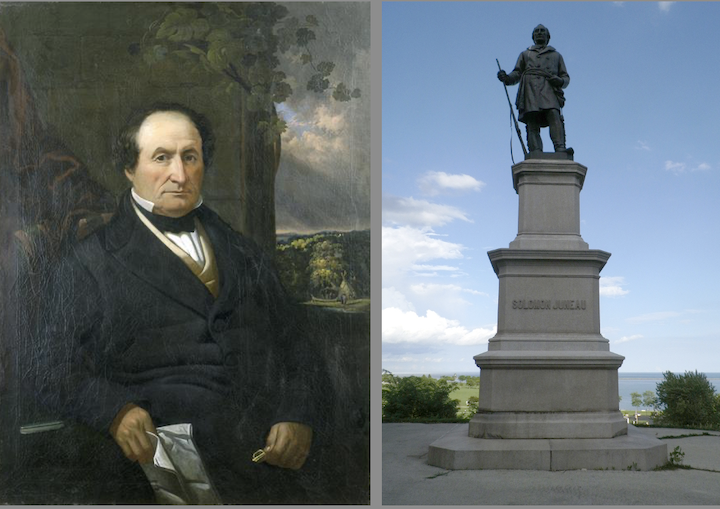
Solomon Laurent Juneau
Founder of Milwaukee, Wisconsin
|
|
Above:
Left: Painted portrait of Wisconsin politician Solomon Juneau (1793–1856) by Samuel Marsden Brookes (1816–1892) Public Domain,
Right: “Juneau Monument”, Juneau Park, 900 N Prospect Ave, Milwaukee, WI 53202
Statue by Richard Henry Park, 1887.
Photo: By Lonibug - Own work, Public Domain
|
|
Solomon Laurent Juneau
• Solomon Laurent Juneau, also known as Laurent-Salomon Juneau, (Born Repentigny, Québec August 9, 1793 – died Keshena, WI on November 14, 1856) was a French Canadian fur trader and politician who founded Milwaukee, Wisconsin.
• In 1816, Juneau arrived at Fort Michilimackinac and began working as a clerk in the fur trade. He eventually became an agent for the American Fur Company. In 1820, Juneau married Josette Vieau, who was of Métis and French-Menominee Indian descent.
• In 1831, Juneau learnt English and got naturalized. By 1835, he constructed the first store and inn in Milwaukee.
• In 1837, he established the Milwaukee Sentinel newspaper.
• From 1846 to 1847, he became Milwaukee's first mayor and first Postmaster.
• With Josette, Juneau also founded the village of Theresa. She passed away in 1855, and Juneau followed a year later. At his funeral, six Menominee chiefs served as pallbearers.
• Juneau's cousin, Joseph Juneau, was the founder of Juneau, Alaska.
(We will tell his story in Part IV of our series).
• The Juneau Monument is a public artwork by American artist Richard Henry Park located on the grounds of Juneau Park, which is in Milwaukee, Wisconsin. The base of the statue is made of limestone. On top of the base is a bronze statue of Solomon Juneau. On each side of the base are bronze reliefs. The statue is 5 feet (1.5 m) wide by 15 feet (4.6 m) high.
• Juneau Monument
Juneau Park, 900 N Prospect Ave, Milwaukee, WI 53202
• Inscription:
“Solomon Juneau, First White Settler of Milwaukee, MDCCCXVIII
Solomon Juneau, First Mayor of Milwaukee, MDCCCXXXXVI”
• Marker, “Historic Milwaukee”
200 E Wisconsin Ave, Milwaukee WI 53202
• Inscription (excerpts):
“In the early 1800s, a young French Canadian named Solomon Juneau came to work in Milwaukee and met and married his boss’s daughter, Josette Vieau, who was of French and Menominee ancestry. The couple built a cabin for their family on the northwest corner of Water Street and Wisconsin Avenue. At least 13 of their children survived infancy.
Juneau purchased 133 acres in the heart of Milwaukee’s downtown for $165.81 in 1835, dirt cheap even then. The earliest structures, a random jumble of dwellings, stores, taverns, sawmills, and shops, clustered along Water Street near Michigan Street and Wisconsin Avenue. [...]
On January 31, 1846, more than two years before Wisconsin became a state, Milwaukee was incorporated as a city. Solomon Juneau was elected as its first mayor.” [...]
• Marker, “Solomon Juneau House”
201 S Milwaukee St, Theresa, WI 53091
• Inscription:
«Born in 1793, Solomon Juneau, a French Canadian agent for the American Fur Company and founder of the City of Milwaukee, established one of his outlying trading posts in this vicinity along the east branch of the Rock River in the early 1830s. He named it “Theresa” in honor of his mother. In 1847, after helping to develop Milwaukee and serving as mayor, Juneau turned his attention to the pretty spot near the Rock River where he had a trading post and constructed this Greek Revival house, which he and his wife Josette called their “summer retreat.” In 1848, Juneau platted the Village of Theresa, opened a general store and soon constructed a dam for his grist and sawmill. In 1852, the Juneau family moved permanently to Theresa. Josette died in 1855 and Solomon Juneau died a year later. The Juneau House is the last remaining home of Solomon Juneau. It was moved 200 feet from its original location and is maintained by the Theresa Historical Society as a house museum.”
Erected 1997 by Wisconsin State Historical Society. (Marker Number 345.)”
|
|
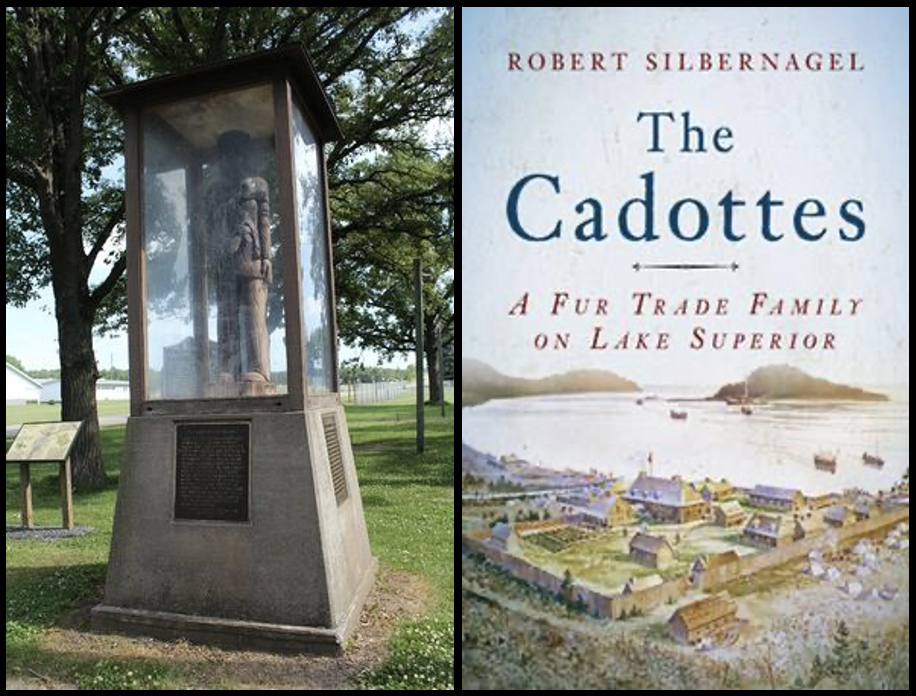
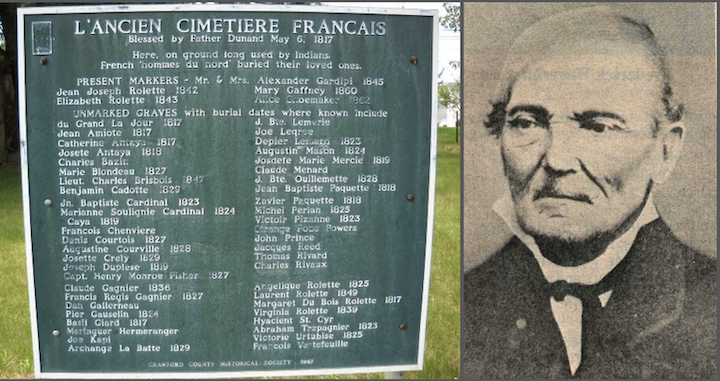
Wisconsin
Michel Cadotte, Jean Brunet, Alexis LaFramboise
Early settlers in Wisconsin
|
|
Above:
Top Right: Book Cover "A Fur Trade Family on Lake Superior", Wisconsin Historical Society Press; 1st edition (May 29, 2020)
Top Right: Daguerreotype of Jean Brunet
|
|
Michel Cadotte
• La Pointe was originally the site of a fortified French trading post from 1693 to 1698 and from 1718 to 1759. The current city began to develop in the late 18th century under the leadership of Michel Cadotte.
• Michel Cadotte was born July 22, 1764, as the second son to a French father and an Anishinaabe mother in present-day Sault Ste. Marie, Michigan.
His father Jean Baptiste Cadotte, Sr. was a fur trader. Michel's paternal grandfather was a Frenchman named Cadeau, and he had come to Lake Superior in the late 17th century on a French exploratory mission. Michel's mother was a member of the powerful Owaazsii (Bullhead) clan of the Anishinaabeg. She is frequently described in historic records as having high status in the region and as being an exceptionally kind person. She was a Roman Catholic convert whose French name was likely Marianne or Anastasia. His parents sent Michel and his brother Jean Baptiste Jr. to Montreal for their education in French Catholic schools.
• The town of Cadott, Wisconsin, in Chippewa County, Wisconsin, was named for him.
• Marker “Michel Cadotte”
N136 Old Fort Road, La Pointe WI 54850
• Inscription:
“A French-Canadian trader built a post on this site about 1792. From his wife Madeline daughter of the Chippewa chief White Crane the island takes its present name. The official French fort La Pointe was built in 1718 about 500 feet west. Its commandants were St. Pierre, Linctot, La Ronde, Marin, and Beaubassin, the last of whom retired in 1759.”
“Erected 1926 by Rachael Brock Woods.”
• Statue of Michel Cadotte
Plaque, “The Cadotte Trading Post Site”
Riverview Park, west side of SR27 between Mills and Oak St Cadott, WI 54727
• Inscription:
“In 1787, Michel Cadotte, famous Madeline Island fur trader, had a trading post nearby on the Yellow River. Here Michel Jr. was born, and another son, Jean Baptiste, is said to be buried on the river's bank. Robert Marriner built a dam at "Cadotte Falls" in 1865 and later named the village Cadott to honor the French-Indian fur traders. Erected 1975. (Marker Number 121.)”
Jean Brunet
• Jean Brunet was born in Gascony, France in 1791, allegedly of nobility, and came to America in 1818 and first settled in St. Louis. Called a man of “considerable note,” he served as an officer in the U.S. Army and participated in the building of Fort Crawford.
• Later he moved to Prairie Du Chien and then, in 1828, to present-day Chippewa Falls. Jean Brunet's pioneering spirit was reignited as time went on, prompting him to venture even further north along the Chippewa River. This area had previously been untouched and largely unexplored.
Brunet eventually halted his journey at a falls located 30 miles upstream on the river. It was here that he constructed a log building, which not only served as his residence but also functioned as a trading post, supply depot, and a favored gathering spot for travelers in the region.
• In 1837 and 1838 Jean Brunet served on the Wisconsin Territory legislature. Shortly thereafter Brunet moved 25 miles (40 km) upriver where he settled permanently. He engaged in trade with native people and ran a popular inn He also served as the first judge in the Chippewa Falls area. The town of Cornell was originally named Brunet Falls and a State Park, Brunet Island State Park is named in his honor.
• Marker, “Jean Brunet”
51 Park Rd, Cornell, WI 54732
• Inscription:
“Jean Brunet is one of the most noteworthy pioneers of the Chippewa Valley. Born in France in 1791, Brunet immigrated to this country in 1818 and moved to Chippewa Falls in 1828. He built the first dams on the Chippewa River at Chippewa Falls and Brunet Falls which is now the City of Cornell. He was our first Judge and member of the legislature for Chippewa County when it met at what is called Burlington, Iowa. Brunet piloted the first raft of lumber from the Falls to Prairie du Chien and piloted the first steamboat up the river. He operated the first stopping place and portage at Cornell where he operated his business as a dealer in boats, oxen and logging supplies. Along the banks of the Chippewa River, he traded with the Indians and taught them to work iron and wood, and to worship God. As the great peace maker between the Indians and whites, he was loved and respected by the Indians as no other man before or since. Brunet's trading post was located on the west bank of the river just below the existing dam where he was often visited by Ezra Cornell who is credited as the founder of Cornell. Some of the remnants of the foundation may still be found. Brunet Falls, although not visible is located just north of the bridge. Brunet died in 1877 and is buried at Chippewa Falls. His wife is buried in the Estella cemetery southeast of Cornell.
Erected by the Chippewa County Historical Society. (Marker Number 41.)”
Among the many other early French settlers of Wisconsin, may we add:
• Alexis Laframboise, in 1785, coming from Michilimackinac (now in Michigan) settled a trading post; and is considered the first resident of European descent in the Milwaukee region.
|
|
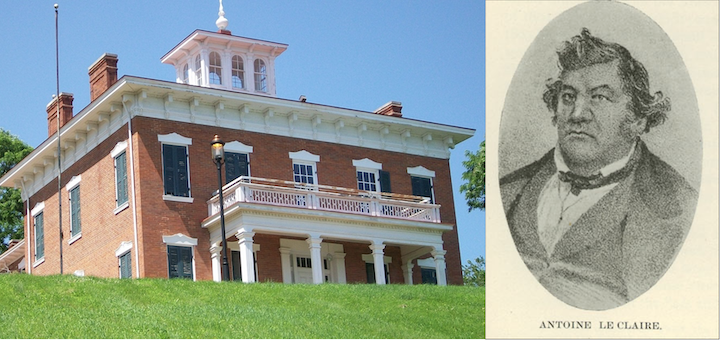
Antoine LeClaire, Founder of Davenport, Iowa
and early settler of Wisconsin
|
|
Antoine Le Claire
• Antoine Le Claire (also "LeClaire"; December 15, 1797 – September 25, 1861) was a US Army interpreter, landowner, businessman, philanthropist and principal founder of Davenport, Iowa. His father, François Le Claire, came to the Americas with Lafayette. His mother was a Native American from the Pottawatomie tribe.
• Le Claire spoke English, French, Spanish and a dozen Native American dialects!
• He worked on the Black Hawk Treaty by which the US government purchased land from the Natives, and for this Chief Keokuk gave a generous portion of land to Antoine Le Claire's wife, Marguerite, the granddaughter of a Sauk chief.
• Le Claire built their home on the exact spot where the agreement was signed, as stipulated by Keokuk, or he would have forfeited the land.
• Le Claire founded Davenport on May 14, 1836, naming it for his friend Colonel George Davenport, who was stationed at Fort Armstrong during the war.
• The nearby city of LeClaire is also named for him.
• Marker “Historic Davenport”
Rest Area 14, Westbound, Interstate 80, Bettendorf IA 52722
• Inscription (excerpts):
“...In 1836, George Davenport and Antoine LeClaire, together with six associates [...] acquire and lay out a 36-block townsite along the Mississippi...The purchase price for much of the heart of present-day Davenport was $2,000. The town was incorporated by the Legislative Assembly in 1839”...” William F. (Buffalo Bill) Cody was born on a farm not far from this overlook in 1846, the same year Iowa was admitted as a State.” Erected 1966 by State Historical Society of Iowa and the Iowa State Highway Commission
• Plaque, “The First House on the East Side of Milwaukee”
“LeClaire's Trading Post”
100 East Wisconsin, 100 E Wisconsin Ave, Milwaukee, WI 53202
• Inscription:
«The first house on the east side of Milwaukee was built on this site in the year 1800 by Antoine LeClaire as a trading post, the log house shown on the left of this view:
The log cabin, stockade and store on the right were erected by Solomon Juneau in 1825
In 1835 Juneau built a large warehouse which in 1851 was replaced by Ludington's brick block and the latter by the present building in 1891
This tablet was erected under the supervision of the Old Settlers Club of Milwaukee County by Capt. Frederick Pabst in 1903”
|
|
Joseph Nicollet
Cartographer extraordinaire of the West
|
|
Above:
Top Left: Portrait of Joseph Nicolas Nicollet
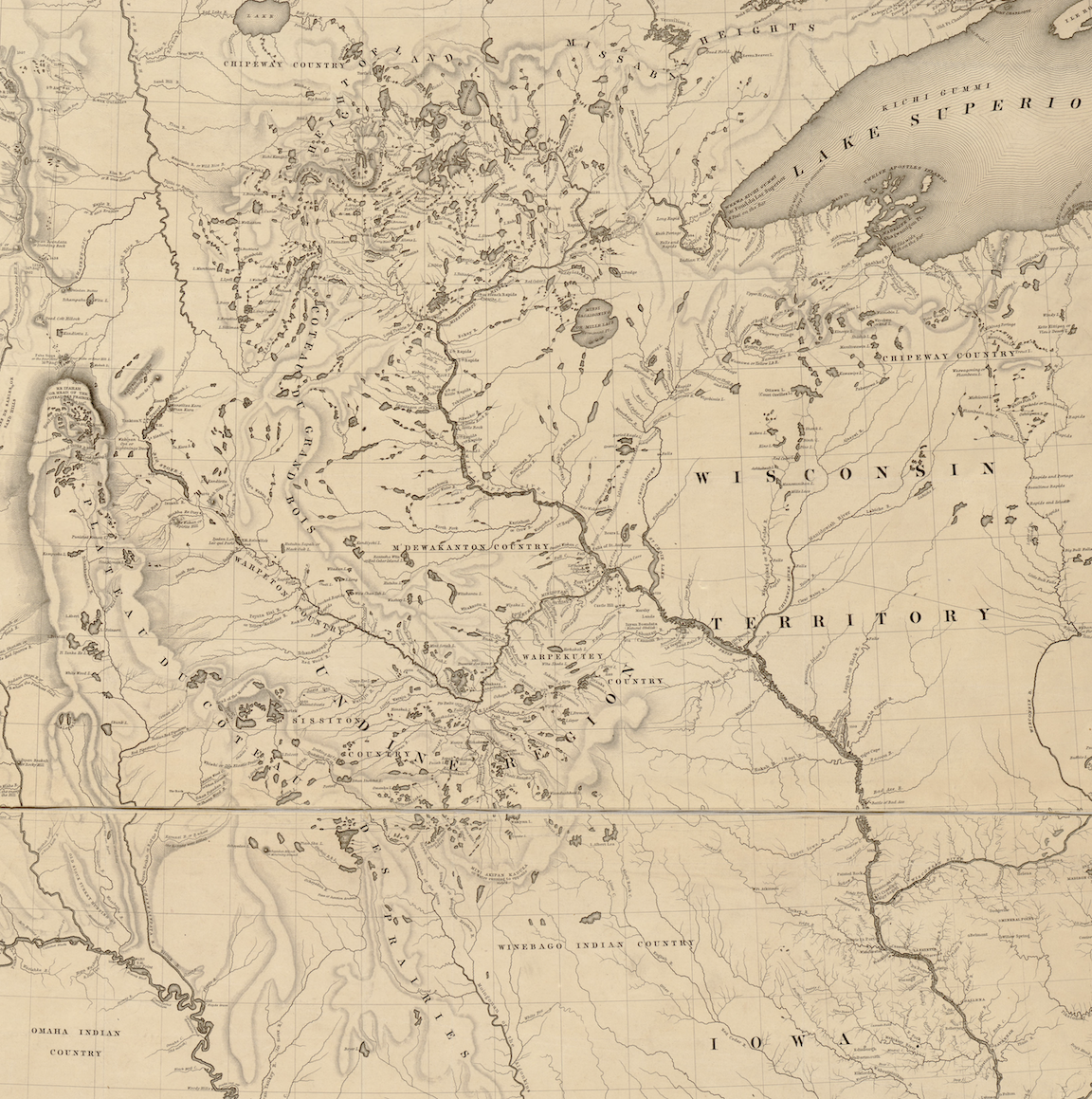
Bottom: detail of a Nicollet map, "Hydrographical basin of the upper Mississippi River from astronomical and barometrical observations, surveys, and information. By J. N. Nicollet, in the years 1836, 37, 38, 39, and 40; assisted in 1838, 39 & 40, by Lieut. J. C. Fremont, of the Corps of Topographical Engineers under the superintendence of the Bureau of the Corps of Topographical Engineers and authorized by the War Department - U. S. Congress, Public Domain, https://commons.wikimedia.org/w/index.php?curid=9463226
|
|
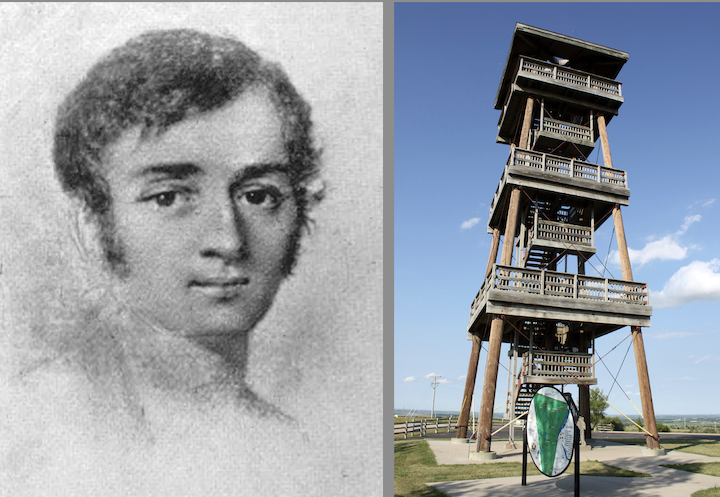
Joseph Nicolas Nicollet
• Joseph Nicolas Nicollet (July 24, 1786 – September 11, 1843) was a French geographer, astronomer, and mathematician, Nicollet was known for mapping the Upper Mississippi River basin in the 1830s. He led three expeditions in the region between the Mississippi and Missouri Rivers, primarily in Minnesota and the Dakotas.
• Before emigrating to the United States, Nicollet was a mathematics professor at Collège Louis-le-Grand, and a professor/astronomer at the Paris Observatory. Political/academic changes in France inspired Nicollet to come to the United States.
• His seminal work, Map of the Hydrographical Basin of the Upper Mississippi, was published in 1843 and covered a region half the size of Europe. Nicollet's maps were considered some of the most accurate of the time, correcting the errors made by Zebulon Pike, and they provided the basis for all subsequent maps of the American interior. They were also the only maps to use regional Native American placenames and among the first ones in the world to show elevation with a technique called “hachuring” . Nicollet Tower, constructed in 1991 and located in Sisseton, South Dakota, is a monument to Nicollet and his work.
• Nicollet's own name is applied to several places in the region he explored, including Nicollet Island, Nicollet Avenue in Minneapolis, Nicollet County and the city of Nicollet, all located in Minnesota.
• He is buried at the Congressional Cemetery in Washington D.C.
• Marker, “The Nicollet Expedition”
Circle Trail, 36 W Reservation Avenue, Pipestone, MN 56164
• Inscription:
“In 1838, the U.S. Government commissioned Joseph N. Nicollet and five others — including Lieutenant John C. Fremont — to map the tringle of land between the Missouri and Mississippi Rivers.
While at Pipestone Nicollet wrote, "Toward 10:00 Fremont, Flandin and I go on horseback into the valley to study its physical and geological character. In order to grasp the relation between the valley and surrounding prairies, we travel far and wide."
“After exploring this rock ledge, he recorded, "This admirable hill awaits the poet and the painter, who should visit it when the last rays of the setting sun are falling upon it.”
Erected by Pipestone National Monument Minnesota and National Park Service.
• Marker, “Joseph N. Nicollet”
Saint Anthony Falls Heritage Trail
13 Merriam St, Minneapolis, MN 55401
• Inscription:
“Nicollet Island bears the name of a French scholar and scientist who explored the headwaters of the Mississippi for the US government in 1836. Accompanied by some Ojibway friends and two hired voyageurs, Joseph Nicollet camped by the falls for several days, then canoed up the river with his barometer, sextant, chronometer, charts, and notebooks. From his measurements he created the first reliable map of the region.”
Erected by the St. Anthony Falls Heritage Board.
• Marker, “Exploring the River Valley”
1851 North Minnesota Avenue, Saint Peter MN 56082
• Inscription:
"Although European traders reached this area in 1695, it was not systematically mapped until the late 1830s. The mapmaker was Joseph Nicollet, a French astronomer and cartographer who led two government-sponsored expeditions into what is now Minnesota and North and South Dakota in 1838 and 1839. His guide was Joseph Laframboise, a Métis (mixed-blood) fur trader. Laframboise was married to a daughter of Ish-Tak-Ha-Ba (Sleepy Eye), leader of the Swan Lake band of the Sisseton Dakota. Nicollet spent considerable time in the Swan Lake area and wrote about the Dakota in his journal.
Learning from the Dakota
Nicollet depended on the Dakota for much geographical information. In his 1887 memoir, Nicollet's assistant John C. Frémont recalled seeing him "surrounded by" Dakota people and, "with the aid of the interpreter, getting them to lay out the form of the lake and the course of the streams entering the river nearby, and after repeating pronunciations, entering their names in his notebook."
Erected by the Minnesota Historical Society.”
• “The Nicollet Tower"
Joseph N. Nicollet Tower and Interpretive Center
45352 SD Highway 10, Sisseton, SD 57262
• In 1991, the Joseph N. Nicollet Tower and Interpretive Center was erected in Sisseton, South Dakota, along the route that Nicollet had taken during his final expedition from Devil's Lake to Fort Snelling. A local banker and resident of Sisseton developed a keen interest in Nicollet's story and accomplishments after reading Joseph N. Nicollet on the Plains and Prairies, a translated version of Nicollet's journals. The banker successfully raised $335,000 from seven local donors to construct the monument. The tower, standing at 80 feet tall and comprising 96 steps, was primarily constructed using Douglas-fir sourced from Idaho, reinforced with concrete pillars and steel bolts. The tower offers a panoramic view of six counties spanning three states, including the Laurentian Divide, the Coteau des Prairies, and the ancient glacial valley that Nicollet had mapped. The Interpretive Center, which encompasses 2,400 square feet of classroom space and exhibits, features Nicollet's map and a mural depicting his encounter with Wanata, the chief of the Yankton Dakota.
|
|
Minnesota
Louis Provencalle (also known as Leblanc),
Alexandre Faribault, Founder of Faribault, MN
Joseph Renville
Early settlers of Minnesota
|
|
Above:
Middle Right: Faribault House historic home, photo by McGhiever
|
|
Louis Provencalle aka Leblanc
• Louis Provencalle aka Leblanc was born about 1773 in Québec, the son of Pierre Carbonneau dit Provencalle Sr. and a woman of a Chippewa Indian tribe. Louis was a voyager and trader in the Northwest Territory. He worked for many of the early trading companies including the American Fur Company at Traverse des Sioux on the St. Peter's (now the Minnesota) river. He died in 1851 in Saint Peter, Nicollet County, Minnesota.
We mention this settler in this Bulletin, not only because a historical marker honors his memory, but also because we found the anecdote about his mathematics quite amusing:
• Marker, “Fur Trader Louis Provencalle”
1851 North Minnesota Avenue St Peter, MN 56082
• Inscription:
Because of its importance as a river crossing, Traverse des Sioux was a major distribution point for the fur trade.
“As early as the 1770s, the Dakota were trading here for guns, blankets, and kettles. One prominent local trader was the French-Canadian Louis Provencalle, who worked here from 1826 until about 1848. Provencalle, his Dakota wife, and their four children lived in a cabin near this site. Their cabin (sketched here after the family had abandoned it) was used as a dining room, kitchen, and warehouse during the July 1851 treaty negotiations.”
Pictograms
“Provencalle was good at arithmetic but could not read or write. He kept track of his credits and debits with a system of pictograms. Each person or type of trade good had a specific mark or figure. According to the missionary Samuel Pond, "This mode of keeping accounts had one advantage over the others, in that the Indians could easily learn to read this picture writing and see for themselves how their accounts stood." For example, the curved-horn figure on the bottom of this page from one of Provencalle's credit books stands for a decorated powder horn.”
Erected by the Minnesota Historical Society”
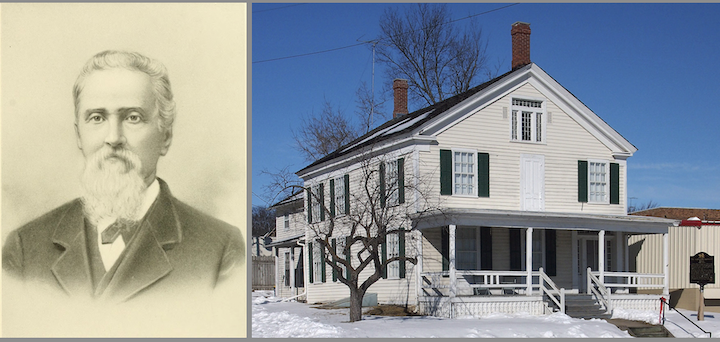
Alexandre "Alex" Faribault
• Alexander "Alex" Faribault (born June 22, 1806 in Prairie du Chien, Michigan Territory – died November 28, 1882 in Faribault, MN) was a territorial legislator who founded the town of Faribault. His father Jean-Baptiste Faribault was a fur trader and his mother was a Dakota Indian. His wife Mary was also from a prominent French-Dakota family.
• The Alexander Faribault House is considered the oldest framed structure in the area, and still stands in its original location.
• Marker, & House “Alexander Faribault“
12 Central Ave N, Faribault, MN 55021
• Inscription:
“Alexander Faribault, namesake of this community, epitomized cultural coexistence. As the child of a French-Canadian father and a half-Dakota mother, Alex saw the value of multiculturalism and respect across religious lines. At a time when this ideal was rare, Alex dreamed of a community where all nationalities and religions could live side by side.
The community Alexander built further exemplified these values: indigenous Dakota, American settlers, Nordic refugees, and the German, Irish, and French-Canadian immigrants all called this city home. Diversity, understanding, and tolerance often come with conflict. Alex lost his home, his wealth, his family, his reputation, his life, all in the pursuit of this dream: a thriving community built on coexistence, located where the Straight and Cannon Rivers meet..”
Joseph Renville
• Joseph Renville (1779–1846) was an interpreter and expedition guide. He contributed to the translation of Christian religious texts into the Dakota language. Joseph Renville's father, Joseph Rainville (also known as De Rainville) (1753–1806), was a French Canadian fur trader, and his mother, Miniyuhe (Miniyuhewiŋ), was a kinswoman of the Mdewakanton Dakota chief Little Crow family. Renville's bicultural formative years probably included instruction by a Roman Catholic priest in Eastern Canada.
• Marker, “Fort Renville”, “Lac qui Parle Mission“
Kragero Township, Watson MN 56295
• Inscription:
“Fort Renville, the headquarters of the fur trade in this area during the 1820s and 1830s, was located at the bottom of this hill. Joseph Renville, son of a French trader and a Dakota woman, began trading for furs at Lac qui Parle in 1826. One of the founders of the American Fur Company, which dominated trade in the upper Midwest, Renville wielded great influence in the Lac qui Parle area and played an essential role in establishing the mission here.”
History in the Ground
“In 1940 archaeologists located the foundations of buildings at Lac qui Parle Mission and the site of Fort Renville. A later study of the fur post identified the location of the trader's house, a cabin used by the missionary Thomas Williamson, and a storehouse. The archaeologists also found evidence of a wooden stockade that must have given Renville's fur post the look of a small fort.”
Erected by Minnesota Historical Society.”
|
|
Joseph Robidoux IV
Founder of St Joseph, Missouri
|
|
Above:
Top Left: Halftone Copy Photograph of Joseph Robidoux IV
By Unknown author - Missouri History Museum
Top Right: Cover illustration, “Robidoux Chronicles: Ethnohistory of the French-American Fur Trade”
by Hugh M. Lewis, Barnes & Noble
Middle: St. Joseph, Missouri, at about the time of Robidoux’s death in 1868. Library of Congress, Geography and Map Division, 73693489. Originally published by Merchants Lithographing Co., Chicago, 1868.] Public Domain, https://en.wikipedia.org/wiki/St._Joseph,_Missouri
|
|
Joseph Robidoux IV
• Joseph Robidoux IV (1783–1868), was a fur trader credited as the founder of St. Joseph, Missouri. Robidoux was the oldest of the six sons (his brother Antoine became famous later in Colorado). In 1799, at the age of 16, Joseph began accompanying fur traders to the upper Missouri River, where they traded with a variety of Native American tribes. In 1803, Robidoux was sent by his father to organize a trading post at Fort Dearborn, the site of present-day Chicago.
•In 1826, he established a trading post at the Blacksnake Hills. In 1843, Robidoux hired architects to design a town for him on his land around his trading post, which he named Saint Joseph. His early trading offices are known as Robidoux Row (listed in the National Register of Historic Places). He died at the age of 85, in 1868. Present-day Saint Joseph retains the downtown streets which he named for his children and his second wife Angélique.
• Marker, “Joseph Robidoux, City Founder 1783-1868”
Missouri riverfront park, accessed via Francis Street, St Joseph, MO 64501
• Inscription:
“Near this site the French fur trader Joseph Robidoux established a trading post in 1826 while it was still Indian territory. Robidoux and his family oversaw a far-ranging fur trading empire.
The Platte Purchase of 1837 added the six county northwest corner to the state of Missouri. With the opening of the area to settlers, Robidoux incorporated the town of St. Joseph in 1843, naming it for his patron saint.”
• Marker, “Saint Joseph”
961-901 Penn St, St Joseph, MO 64503
• Inscription (excerpts):
“Renowned city of the Pony Express, St. Joseph was first settled as a trading post for the American Fur Company by Joseph Robidoux, 1826. Later he acquired the site and laid out a town in 1843. St. Joseph became an outfitting point for settlers in northwest Missouri and travelers on the Oregon-California trail. It was also a supply base for army posts and western gold mining camps. Here was the terminus of the first railroad to cross Missouri, the Hannibal and St. Joseph in 1859. The railway postal car, developed by W. A. Davis of St. Joseph, was first used on this line in 1862. April 3, 1860 the Pony Express was put into operation between here and Sacramento, California, by the freighting firm of Russell, Majors and Waddell. Operated as a relay it met the need for speedy mail service to the West and popularized the central overland route. About 1982 miles were covered regularly in 10 days and 190 relay stations, 420 horses, and 80 riders were used. The record run was 7 days, 17 hours. The Pony Express discontinued in October 1861. The telegraph then reached the coast...”
[...] Early impressed with the beauty of the site were geographer Maximilian, Prince of Wied, 1833; missionary priest Father De Smet, 1838; and ornithologist Audubon, 1843.
Erected 1953 by State Historical Society of Missouri and State Highway Commission.”
• Marker, “Joseph Robidoux at Roy's Branch”
961-901 Penn St, St Joseph, MO 64503
• Inscription (excerpts):
“Joseph Robidoux, founder of St. Joseph, was the leader of a French-Canadian fur trading family which sent men out to trade with the Indians along the Missouri River and as far west as today's Wyoming, Colorado, and New Mexico. From his first trip up the Missouri River in 1799 at age 16 to his death in 1868, Robidoux witnessed many changes in this area. He was the first permanent settler in Blacksnake Hills and later encouraged other settlers to come to his newly established town of St. Joseph. Before he died he saw his town grow to a population of about 19,000 citizens. The small creek which cuts through the bluffs and empties into the Missouri River near here is known as Roy's Branch. It was named for fur trader and trapper Jean Baptist Roy. Members of the French-Canadian Roy family had settled along the Mississippi River near St. Louis in the mid-1700s and were involved in the fur trade business along the Missouri River. Jean Baptist Roy was still trading in this area in the 1830s. [...]
In the fall of 1826, fur trader Joseph Robidoux was granted permission by the U.S. Government to set up a small trading post at the mouth of Roy's Branch. Since the northwest corner of today's Missouri was the Platte Indian Territory, no settlers were allowed. However, Robidoux obtained a special permit to live and work in the Territory..” [...]
The river bottoms at this point are called French Bottoms since a number of French families, some in the employ of Joseph Robidoux, settled. here. [...] The French-Canadians also contributed to the success of the Lewis and Clark Expedition. These men were used to travel on the Missouri River and helped pull, pole, row and sail the keel boat and two pirogues up the river. They were also familiar with landmarks, many of which had been named by Frenchmen, and the locations and customs of the various Indian tribes."
Erected byNational Park Service, Missouri Lewis & Clark Bicentennial Commission, City of St. Joseph, and St. Joseph CVB.”
• Robidoux Pass, also known as Roubadeau Pass, Roubedeau Pass, Roubideau Pass, Roubidoux Pass and Roubadeau Pass Gap, is a gap passing through the Wildcat Hills near Scottsbluff, Nebraska about 9 miles (14 km) west of Gering, Nebraska. Used by thousands of emigrants to the west from 1843-1851, the pass is a National Historic Landmark since 1961.
• The area was named for members of the Robidoux family, who in the 1840s maintained a trading post east of the gap and later one at Scottsbluff. It contained blacksmith and grog shops, as well as other goods.
There is a mistake in the marker, it is Joseph Robidoux IV, and not his father Joseph Robidoux III, who died in 1809.
• Marker, “Robidoux Pass”
Roubadeau Pass Road, Robidoux Road, NE
• Inscription (excerpts):
“Robidoux Pass was named for Joseph Robidoux III of St. Joseph, Missouri, who established a trading post and blacksmith shop here in 1849, just in time to witness the beginning of the great California gold rush... [...] ... Several factors make Robidoux Pass historically unique. The eastern approach, surrounded by picturesque bluffs, seemed to the struggling emigrants like an “enchanted valley’” In the pass itself there were copious springs, described as among the best along the entire route to California, and nearby trees for firewood and wagon repairs. From the pass looking east is a spectacular view of the North Platte Valley and distant fairy-like Chimney Rock. From the summit of the pass the emigrants, looking west toward the sanctuary of Fort Laramie, got a magnificent panoramic view climaxed by Laramie Peak, mistakenly thought by some to be their first view of the Rocky Mountains.
Erected 1994 by Oregon-California Trails Association”
• Marker, “Robidoux Trading Post”
Robidoux Road, Gering, NE 69341
• Inscription (excerpts):
“In 1849 Joseph Robidoux III of St. Joseph, Missouri, licensed in the Indian trade, ordered removal of his outfit from the vicinity of Fort Laramie to this strategic pass over Scotts Bluff, where there was ample wood and water. Evidence from several emigrant diaries, together with artifacts found at the site, confirm the location of his new post at a point about 300 yard north-northeast of here at the intersection of the big spring-fed ravine to your right, flowing north, and the smaller drainage descending eastward from the crest of the pass.”..[...]
...Since the original intention of the Robidoux family was to trade with the Indians for buffalo robes, they were probably at first dismayed by the sudden invasion of their domain by a large army of covered-wagon emigrants bound for the California goldfields. However, they seem to have adjusted rapidly to this development. The traders did a land-office business with the emigrants, principally in providing blacksmith services, though there was also a brisk trade in staples and whiskey. Another bonanza for the traders was the frequent abandonment of wagons and surplus gear and supplies by overloaded emigrants, which added to the Robidoux inventory. Despite this unexpected property, for whatever reason in later 1850 the Robidoux family abandoned their trading post here and built a new one about one mile to the southeast, over the bluffs in a place now called Carter Canyon, which was rarely visited by emigrants and probably was soon abandoned. A famous visitor to the Carter Canyon site was Father Pierre Jean DeSmet in the autumn of 1851, following the great gathering of Indian tribes at Horse Creek during the negotiations for the first Fort Laramie peace treaty. During the early 1851 Emigration season the Robidoux Pass post was reopened to trade with the emigrants. However, later that season the Robidoux family finally abandoned the pass altogether and established posts on the trail at points both east and west of Scotts Bluff, the former at the fork in the trail near present Melbeta, the latter where the two trail branches rejoin at Horse Creek, near present Lyman, Nebraska.”
Erected 1994 by Oregon-California Trails Association.”
• Marker, “Robidoux Trading Post”
Nine (9) miles west of hiways 71/21, Carter Canyon Rd, Gering, NE 69341
• Inscription (excerpts):
“... Engaged in trade with the Plains Indians, the Robidoux family established a post on this site in 1851.
Sometimes referred to as the “winter quarters”, this venture followed an earlier post and blacksmith shop owned and operated by the free trader Robidouxs just north of here on the Oregon Trail.
Robidoux brothers Joseph, Antoine, Louis and Isadore visited here and farther west trapping and trading with the many tribes as early as 1822.
Research indicates that Antoine, son of Joseph III, resided here with his Indian wife and children until 1853, serving as post clerk...”
Erected 1993 by Gering Tourism Committee, the City of Gering and the Oregon Trail Community Foundation.”
|
|
Kansas and Nebraska
Georges Guittard, Jean-Pierre Cabanne,
Louis-Baptiste Chartran, Laurent Bernard,
Logan Fontenelle, Jean-Baptiste Didier
Louis Vieux
|
|
Above:
Top Left: Poster from the Pony Express, advertising fast mail delivery to San Francisco. Actual author unknown (Pony Express) - Smithsonian National Postal Museum,Public Domain,
Bottom Left: The Louis Vieux Elm Tree Park near the Vermillon Creek Crossing of the Oregon Trail. Nearby are soldier burials, the Louis Vieux Family Cemetery and Cholera Cemetery.
Bottom Right: Louis Vieux, studio photo circa 1869
His gravesite is the tallest monument in the cemetery, and his epitaph reads: “To the memory of Louis Vieux. Died May 3, 1872. Aged 62yrs. 5 mos. 3 Ds. His worthy deeds within our hearts Shall live beyond the tomb. Requiescat in pace, Amen.”
|
|
• Several French and French Canadien settlers also opened as relay posts to start servicing the waves of European immigrants on their way to the Far West.
We are presenting seven of them below:
George Guittard
• "Guittard Station"
Marker, «Saddle Up at Guittard Pony Express Trail»
716 21st Rd, Beattie, KS 66406
• Inscription (excerpts):
"George Guittard: George Guittard, a former French magistrate, came to America in 1833. He journeyed west in 1857 with his family of five, traveling by rail to St. Louis, by river steamer to St. Joseph, and by ox team to Kansas. Their ranch on Vermillion Creek (Robidoux) became the first permanent settlement in northeast Marshall County. Son Xavier served as postmaster for 42 years. He distributed mail through pigeon holes inside the west entrance of Guittard Station. In 1859 George Guittard built a 12-room, two story lodge to accommodate the needs of more and more people passing through by wagon, coach, and horseback. Guittard Station served as an inn to refresh travelers, sell supplies and water, graze and shelter animals, and aid in repairing wagons and coaches.[...] A fresh horse, water, and food made Guittard Station a welcome stop after a fast ride across the rolling green prairie.
Pony Express In 1845 it took six months to get a message from the East Coast to California. [...] Something had to be done to deliver mail faster! Enter the Pony Express - formed on January 27, 1860. Pony Express riders galloped from one relay station to another, carrying mail and telegrams between Missouri and California in only 10 days. [...] No remnants of the station exist."
• Pony Express Trail
“1860 - 61
Guittard Station
East 80 rods
Oregon Trail”
Erected by National Park Service and National
Jean Pierre Cabanne
• Jean Pierre Cabanne, born in Pau, Bearn, France on October 18, 1773 – died in St. Louis, MO on June 27, 1841, was a French merchant and trader. After acquiring a solid education and training in the merchandise industry, he emigrated to America. Initially involved in the sugar trade in Charleston, SC, he later moved to New Orleans, then St. Louis, MO, where he ventured into the fur trade business. By 1801, he was actively engaged in trading with the Kanza Indians, and by 1805, he had acquired licenses to conduct official trade with tribes as far north as Sioux country along the Missouri River. He dedicated part of each year to exploring the wilderness. Jean Pierre Cabannecollaborated with renowned fur traders such as Pierre Chouteau, Jr., and in 1822, he established Cabanne’s Trading Post on the Missouri River between Omaha and Fort Atkinson, which later transformed into Fort Robidoux in North Omaha, NE. He was a partner in the Pratt, Chouteau & Co. for several years before merging into the American Fur Company in 1826, during which time he accumulated a substantial fortune. In 1830, he briefly participated in the Santa Fe trade, and in 1840, he co-founded an opposition company named Pratte and Cabanne with Bernard Pratte. Additionally, Jean Pierre Cabanne played a pivotal role in establishing the Bank of Missouri, and among the first incorporators of the city of St. Louis. His legacy continues through many of his descendants who still reside in the city.
• Marker, “John Pierre Cabanne”
2800 Hummel Rd, Omaha, NE 68112
• Inscription:
“John Pierre Cabanne's pioneer fur-trading post was 385 feet southeast of this spot.
Erected 1927 by Mary Katharine Goddard Chapter Daughters of the American Revolution (DAR).”
Louis-Baptiste Chartran
• Louis-Baptiste Chartran (b. 1795,- 1854) was a Metis fur trader and is the namesake for the town of Chadron, Nebraska. He was the eldest son of Jean Baptiste Chartran and Marguerite Desrosiers dit Dutremble. Louis married Therese Compagnot at Cahokia (Western Illinois) and had a son, also Louis, born in Cahokia. The Chartran family had left Montreal in the mid-1800s to move to the Cahokia area. He was killed near Fort Laramie in 1854, his body was laid in state in BullTail’s teepee. He was an accomplished trader, and interpreter. All who knew him described him as “a very good man.”
Louis-Baptiste Chartran, Founder of Chadron, Nebraska
• Marker, “Chadron Creek Trading Post”
US-385, 16129 Gold Rush Highway, Chadron NE 69337
• Inscription:
“Employees of Lancaster P. Lupton built a trading post on the creek near here in 1841 to trade with the Sioux Indians. From 1842 until at least 1845 this post was managed by Louis B. Chartran, first for Sibille and Adams and later for Pratte & Cabanne. These companies were successively headquartered at Fort Platte about eighty-five miles southwest of here and competed aggressively with Pierre Chouteau Jr. & Co., which owned Fort Laramie. As a result of this competition, fur traders were very active in this region during the 1840's, bringing liquor, blankets, guns, ammunition and other trade goods to exchange for fine Indian-tanned buffalo robes. This creek is shown on the earlier maps of the area as "Chartran's Creek" in tribute to the trader Louis Chartran. The French settlers of Missouri Pronounced it "Shattron," and from this the modern name of "Chadron" evolved. Today this creek is Chadron Creek, and from the creek the city of Chadron received its name.”
“Erected by The Museum of the Fur and Trade Nebraska State Historical Society”
Laurent Bernard
• Marker, “French Settlement of Julian”
111 West Street, Julian, NE 68379
• Inscription:
“The first French people in this area were trappers and traders along the Missouri River. Permanent French settlers began to arrive during the 1850s. Among the early settlers were Julien Bahuaud and the Laurent Bernard, Jean Bize, and Jean Lavigne families. Eventually about 40 French families settled in this area, along with settlers of other ethnicities.
A post office was established in 1880 at the Thomas Tobin house, about a mile south of what is now downtown Julian.
In 1887 the Nebraska Southern Railway (later the Missouri Pacific) built a line connecting Auburn to Nebraska City. A new town was platted along this route on November 7, 1887, and took the name Julian after its most prominent settler. It was later said that railroad officials named the town "Julian" because they couldn’t pronounce "Bahuaud". Julien Bahuaud was murdered in 1899; the crime went unsolved until the killer confessed 14 years later.
The post office was relocated, and Julian was incorporated on June 15, 1896. It became the largest primarily French immigrant community in southeast Nebraska, reaching a population of 206 in 1900.”
Erected 2019 by Julian Preservation Committee; and Nebraska State Historical Society”
Logan Fontenelle
• Logan Fontenelle (May 6, 1825 – July 16, 1855), also known as Shon-ga-ska (White Horse), was a trader who served for years as an interpreter during the United States negotiations with Omaha leaders in 1853–1854 about ceding land to the United States prior to settlement on a reservation. His mother was a daughter of Big Elk, the principal chief, and his father Lucien Fontenelle from New Orleans was a respected French-American fur trader. In 1855 a band of Sioux killed and scalped Fontenelle and five of his party, who were part of the Omaha summer buffalo hunt, along Beaver Creek.
• Americans believed that Fontenelle held the position of a chief, but due to his French white father, he was not recognized as a member of the tribe. The Omaha people followed a patrilineal system, which meant that Fontenelle could only become a chief if he had been officially adopted by a tribal member, and considered him a "white man".
• The town of Fontanelle, Nebraska is named after him, (originally misspelled) as are several avenues, parks, and schools in Nebraska.
• Marker, “Logan Fontenelle - July 1855”
Logan Fontenelle Historical Marker, Petersburg, NE 68652
• Inscription:
”Near this location in July 1855
Logan Fontenelle
noted French-Indian leader
of the Omaha tribe, was slain in battle with the Sioux.”
Petersburg Com’l Club, July 1955”
Erected 1955 by Petersburg Commercial Club.”
Jean-Baptiste Didier
• When one reads the following, one can only imagine how eventful his life (as well as all his fellow immigrants to the United States) must have been... And to think that he lived until 1918, one cannot refrain from wondering, if only extensive interviews had been collected then, as we do now with Veterans!...
"John B. Didier, one of the oldest pioneers of the state, died Thursday morning [September 26, 1918, at the home of his daughter, Mrs. August Last, in Barada township, aged 91 years and 6 months..." So reports the Falls City News edition of Oct 1, 1918, p.2, c,3...
• Marker, “1854 Didier Log Cabin”
Brownville City Park, Brownville, NE 68321
• Inscription (excerpts):
"John B. Didier, Frenchman/Fur Trader (sic)
• December 25, 1827 — Birth of John B. Didier, II to John and Anna B. Didier in France
• 1827 — Arrived in America, settling in Cincinnati, Ohio
• 1849 — Moved to St. Louis, MO, worked for Pierre Chateau, Jr. (sic)
• 1852 — Oversaw fur trading post five miles below Fort Laramie, Wyoming
• August 19, 1854 — Experienced and endured the Grattan Massacre — all of the soldiers were killed. Their remains are at the National Cemetery at Ft. McPherson in Nebraska. John survived and reported the battle and loss to Mr. Chateau.
• 1854 — Came to Nebraska, erected the 1854 cabin, living there 63 years.
• 1855 — Married Mary Peneaux Beauvais Red Nose Didier Desera in Brownville, NE by Judge Whitney.
• 1918 — John died September 27 and is buried at Barada, NE
[...]
Log Cabin History: The original cabin was erected by John B. Didier in 1854 in what is now Richardson County, Nebraska, ten and one-half miles south of Brownville. The cabin was located in Section 3, Township 3, north of range 16. Records indicate he was the second white settler in this area.
Erected by Brownville Historical Society."
Louis Vieux
• Louis Vieux (11/30/1809- 5/3/1872) was born in Milwaukee, Wisconsin, Louis Vieux was the son of noted trader Jacques Vieau and his Potawatomi wife, Angelique Roy. He held a reputation as a keen businessman and Potawatomi leader in the 1800s. He ran a successful ferry along the Vermillion River on the Potawatomi reservation in Kansas where he charged Oregon Trail travelers $1 per outfit to cross, sometimes making upward of $300 per day.
• Marker, « Vieux Cemetery »
Oregon Trail Road, Louisville, KS 66547
• Inscription:
“Of Pottawatomie Indian and French ancestry, Louis Vieux was an early resident of this area. Probably born near Lake Michigan, Vieux, with a portion of the Pottawatomies, moved to Iowa and later Indianola, Kan., near Topeka. In 1847 or 1848, Vieux moved to this area of what became Pottawatomie county, located on the Oregon Trail near the Vermillion river crossing. This Vieux family, with its seven children, lived in a log cabin and Vieux built and operated a toll bridge over the river. He charged Oregon Trail travelers one dollar per outfit and it was estimated that he earned as much as $300 per day during the peak season of wagon travel. In 1861, Vieux was one of the signers of a treaty allowing the Pottawatomie to hold lands in common or establish individual claims of 80 acres per person or more, depending on their position in the tribe. Vieux served as a business agent and interpreter and occasionally represented the tribe in Washington, D.C. Near here is the Vieux cemetery where members of the Vieux family and other early settlers were buried.”Erected by Pottawatomie County Highway Department. (Marker Number 107.)
• Marker, «The Vieux Crossing »
Intersection of Camp Creek Road and U.S. 24, Belvue KS 66407
• Inscription (excerpts):
“A few miles to the northwest, the Oregon-California trail crossed the Vermillion Creek heading toward the Pacific from the "jumping off" towns on the Missouri River.
The crossing was named for Louis Vieux, a Potawatomi leader of French and Native American lineage who established a toll bridge there in the 1850s. Charging a dollar per outfit, he is said to have made as much as $300 per day during busy times. In addition, he supplied emigrants with hay and grain.
[...]
On a nearby hill the graves of Louis Vieux, some of his family, and other early settlers can be seen in the Vieux Cemetery.”
Erected by Kansas State Historical Society and Kansas Department of Transportation. (Marker Number 19.)
Visit Louis Vieux Historical Site!
Hwy 24 N on Oregon Trail Rd St. Marys, KS 66536
|
|
Arkansas
Antoine Barraque, Founder of New Gascony, AR
Jean-Pierre Emmanuel Prudhomme
First white settler, Hot Springs, AR
Joseph Bonne, Founder of Pine Bluff, AR
Auguste Le Noir de Serville, French-American Patriot
Early settler of Pine Bluff, AR
|
|
Above:
Top Right: Portrait of Emmanuel Prudhomme, Coll. Sandra Prud’homme Haynie. In 1822, during a trip to Paris to buy furniture for their new home, Jean Pierre Emmanuel Prud'homme and his wife Catherine Lambre had their portrait painted. A plantation owner in Louisiana, he is shown holding cotton in his hand to symbolize his success in growing this plant.
Bottom Left: Marker honoring Auguste Le Noir de Serville
|
|
Antoine Barraque
• Antoine Barraque was born on April 15, 1773, in southwestern France. Educated in Paris, he served in the French army under Napoleon Bonaparte, fighting at the battles of Marengo, Austerlitz, Jena, Lodi, and Moscow.
• Following the end of Napoleon's empire, Antoine Barraque relocated to Arkansas, arriving in 1816 at the age of 43. The following year, Barraque married Maria Therese Dardenne, the daughter of his friend, Joseph Dardenne, another French immigrant, and a Quapaw woman.
• Antoine Barraque then established the settlement he called New Gascony on November 29, 1832, and named for the Gascony region of France. It is an unincorporated community in Bogy township in Jefferson county in Arkansas, 13 miles (21 km) west of Pine Bluff, the county seat.
• He died on December 30, 1828 in Richland Township, Jefferson County, Arkansas.
• Marker, « Barraque Street»
201 W Barraque St, Pine Bluff, AR 71601
• Inscription:
“This street was named for Antoine Barraque (1773-1858), native of France, soldier of Napoleon, and one of this area's earliest settlers. Founder of New Gascony in this county, he was a man of property and Indian sub-agent. Trusted and liked by the Quapaw nation, he led that tribe to their new home pursuant to the Treaty of 1824. A distinguished citizen of early Jefferson County, Antoine Barraque has descendants still living in Pine Bluff.”
“Erected by Jefferson County History Commission.”
Jean-Pierre Emmanuel Prudhomme
• Jean-Pierre Emmanuel Prudhomme (1762-1845) born & died in Natchitoches, LA, was a plantation owner Revolutionary War Patriot, who served in the Galvez expedition. His grand-father Jean-Philippe Pierre Prudhomme, as soldier in the French Army, was stationed in Louisiana, stayed there and is the founder of a large dynasty.
• “...Emmanuel had a long and interesting life. He was born January 2, 1762 in Natchitoches, LA to Dr. Jean Baptiste and Marie Josephine Prudhomme. He was one of 8 children and father to 8 children...[...] Emmanuel was a planter. His first crops were tobacco and indigo and sold the indigo to France to use as dye for French soldiersuniforms [...] In the early 1800’s many inhabitants had developed close relationships with the native Indians. Emmanuel had an undiagnosed ailment that caused him considerable pain. It was perhaps arthritis. The Natchitoches Indians, who were friendly with Emmanuel told him of a place of “healing waters” and offered to take him there. In 1807, Emmanuel accepted their offer and with a servant and necessary provisions, headed for the springs now known as Hot Springs, Arkansas. He was one of the first white men ever to visit these ‘healing waters’. He built a modest home there and visited frequently for a few years.”
Excerpt from an Oct. 23, 2010 address to the Association for the Preservation of Historic Natchitoches by Kathy Prudhomme Guin, a great, great, great, great granddaughter of Jean Pierre Emmanuel Prudhomme (1762-1845)
• Marker, “Hot Springs' First White Settler”
128a Central Ave, Hot Springs, AR 71901
• Inscription:
"The first White man to settle near the hot springs was Emmanuel Prudhomme of Louisiana, who came in 1807 for reasons of his health. He bathed in the springs and lived in the temporary primitive cabins that had been built prior to his arrival.”
Erected by City of Hot Springs.”
Joseph Bonne
• Joseph Bonne who was born in 1793 and was baptized by a visiting priest at Arkansas Post. Records dating back to 1801 show that “fifty miles up the Arkansas River on the Bonne Reserve lived Joseph Bonne, Michael Bonne and other taxpayers named Bonne.”
• Joseph Bonne was interpreter for the United States government at the signing of the Quapaw Cession at St. Louis, Missouri, August 21, 1818. Due to a great flood in 1819, Bonne and his wife, Mary Imbeau, moved five miles upstream to the place later named Pine Bluff. Bonne built a log cabin with a lean-to which served as his home…as well as a tavern with lodging accommodations for travelers.
• The settlement was officially named “The Town of Pine Bluff” by the county court on October 16, 1832. At the time the town had 50 residents. Today’s population is 55,000.
• Marker, « Joseph Bonne Cabin»
225 W Barraque St, Pine Bluff, AR 71601
• Inscription:
“In 1818 a French trapper, Joseph Bonne landed on the south bank of the Arkansas River with his dog and gun near the location of the original Jefferson County Courthouse. Driven to this high bluff after flood waters had threatened his homesite at Arkansas Post, Bonne and his family erected a cabin and became one of the first white settlers in the region which has become Pine Bluff. The Bonne hand-constructed log cabin became the first seat of government, and history reports that Joseph Bonne operated the first tavern in the area.”
Erected 1976 by Jefferson County History Commission.”
Auguste le Noir de Serville
• To the area now known as Redfield came Auguste le Noir de Serville, who was a soldier in the French Army, served under the count of Rochambeau in the American Revolutionary War and was wounded at Yorktown on October 14, 1781. Killed by a falling tree in 1828, De Serville was buried with full military honors, and his funeral was attended by political and military notables. Unfortunately the exact location of his grave is unknown.
• Marker, « Auguste La noir de Serville» (sic)
Jefferson County courthouse, 101 W Barraque St, Pine Bluff, AR 71601
• Inscription:
“To honor
Auguste La noir de Serville
Hero of the American Revolution
French Marine served under Count de Grasse
Wounded Yorktown, VA Oct. 14, 1781
Died Jefferson Co. Ark. Dec. 30, 1828
Erected 1929 by Pine Bluff Chapter, D.A.R”
|
|
Other notable settlers:
Pierre Menard, Oklahoma
Pierre Navarre, Ohio
François Navarre, Michigan
Alexis Coquillard, Founder of South Bend, Indiana
|
|
Above:
Top Right: Pierre Menard by Mason, Edward G. (Edward Gay), 1839-1898 - "Early Chicago and Illinois" Newberry Digital Exhibitions 2019-05-10, Public Domain
Middle Right : François Navarre portrait by Lossing
Bottom Left: Pierre Navarre, circa 1850
|
|
Pierre Menard
• Pierre Menard (7 October 1766 – 13 June 1844) was a fur trader and U.S. political figure. Pierre Menard was born at St. Antoine-sur-Richelieu, near Montreal. His father was Jean Baptiste Ménard, a French soldier in the regiment of Guyenne.
• Marker, “Manard Settlement”
On route US 62, Fort Gibson OK 74434
• Inscriptions (excerpts):
“Site of Manard Settlement on Bayou Menard. Named for Pierre Menard (1766-1844). Menard, an early day fur trader, merchant and member of the Chouteau family. Served as the first territorial governor of Illinois. Springs at Manard identified as a Cherokee council ground prior to 1828. Trading post est. by Bartholet & Heald in 1832. Cherokee agency est. by Montfort Stokes in 1837. Burial place of HT Martin (1822-1868), first postmaster of Cherokee Nation West. Site of Civil War skirmish on July 27, 1862, involving US Maj. WM A Phillips and Indian Home Guards who encountered and routed Watie's Confederates under Lt Col Thos Fox Taylor. Stage stop and site of holdup of US Mail by Cook Gang on July 14, 1894, and shooting of Joseph Glad by outlaw Jim French in 1894.
Erected 2000 by Oklahoma Historical Society.”
Pierre Fréchette Navarre
• Pierre Fréchettte Navarre (1787-1874) is credited as the first white settler in present-day St. Joseph County. A grandson of a French officer who was stationed in the area in 1745, Pierre married a Potawatomi woman named Keshewaquay and had ten children. He built a log home, the first in the county. • Pierre was well respected by and fiercely loyal to the Potawatomi tribe. In fact, when they were forcibly removed from the Michiana area he traveled west with the tribe but afterwards returned home. Navarre’s original cabin has been preserved and can be visited at the Botanical Gardens of Toledo.
• Navarre Park, Navarre Elementary School, and Navarre Avenue are all named in his honor.
• Marker, « Peter Navarre”
1001 White St., Toledo, OH 43605
• Inscription (excerpts):
“Peter Navarre, 1790-1874. Considered the first citizen of the East Side, Peter Navarre, along with his brother Robert, first settled the land east of the Maumee River in 1807. A fur trader by profession, Navarre was experienced in wilderness survival and had a deep understanding of Native American life. He died on March 20, 1874, and was buried at Mt. Carmel Cemetery across the river from his beloved East Toledo.
In 1922, the City of Toledo declared September 9th Peter Navarre Day, an official city holiday. This marker commemorates the 200th anniversary of the founding of East Toledo.
Peter Navarre, War of 1812. During the War of 1812, Peter Navarre acted as a scout for the American army and provided intelligence about enemy strength and locations. [...] His skill and resourcefulness to pass through enemy territory aided the United States in retaining this area during the war.”
Erected 2007 by East Toledo Historical Society, The Ohio Historical Society.
(Marker Number 50–48.)”
• Stele, « Peter Navarre 1787-1874”
Mt. Carmel Cemetery, 2-98 W Manhattan Blvd, Toledo, OH 43608
• Inscription :
“Famous Scout
Whose loyalty, courage, and resourcefulness
aided the United States in retaining this
territory during the War of 1812 – 1815.
His grave is 400 feet south of this spot.
This memorial erected October 6, 1923.
by The Peter Navarre Chapter
N.S.U.S. Daughters of 1812"
François (Francis) Navarre
• François (Francis) Navarre, born in Assumption Parish in Sandwich, Ontario, across the river from Detroit, Michigan, was a significant figure in the early history of the region. His parents were Robert Navarre and Marie Louise Marsac. On 9 Nov 1790, in Detroit, Michigan, Francois married Mary Suzor, the daughter of Louis Francis Suzor and Mary Joseph LeBeau.
• He played a pivotal role as the first permanent white settler in the River Raisin area. He arrived in the region around 1780 and established the town of Frenchtown. His attracted nearly 100 settlers who followed suit, constructing log cabins and coexisting harmoniously with the local Native American tribes for an extended period.
• He implemented a civil government and court system in the area, earning him the title of the "Father of Monroe". He also served as a Captain and later a Colonel in the militia of the River Raisin. During the War of 1812, he faced capture by the British on two occasions but managed to escape both times.
• Marker, “Colonel Francis Navarre”
320 E Front St, Monroe, MI 48161
• Inscription:
“First Indian
Grant of land to the
First White Settler In Monroe
Col. Francis Navarre
1785
First White Child Born In Monroe
Gen. Winchester's
Headquarters 1813."
Visit River Raisin National Battlefield Park!
333 N Dixie Hwy, Monroe, MI 48162
“Early River Raisin settlers were often called “The French”. They were descendants of the original colonists who left France for Canada in the mid-1600s. Over the generations, many French-Canadians moved to Detroit. Finally, many Detroiters with French-Canadian heritage moved to River Raisin. They were French-speakers, faithfully maintaining French cultural traditions, especially their devout Catholicism. So – in the centuries of living in North America, these people were called “The French”. River Raisin settlers were also called habitants, which is French for ‘inhabitants’, and Canadiens, French-speaking settlers of French-Canadian heritage. The Settlement itself was often called “Frenchtown” by non-French speaking outsiders.”
• “The first Non-Native settler was a French settler, twenty-one-year-old François (Francis) Navarre. His family had lived in Detroit for many years and were highly regarded in government and business. Navarre took up residence at River Raisin in 1785 and persuaded a number of friends and relatives to join him. Navarre was an undisputed community, business and church leader when first the British, and then the Americans, controlled the River Raisin Settlement. He served as a ranking officer in River Raisin’s militia, opposing the British in the Battles of the River Raisin. Sometimes called “the Father of Monroe”, François Navarre died in 1826 and is buried in Monroe’s Old Burial Ground. ”
Alexis Coquillard
• Alexis Coquillard, a French Canadian fur trader, explorer, and the founder of South Bend, Indiana, was born in Detroit on September 28, 1795, and passed away on January 8, 1855. His parents, Alexis Cerat (Serat) dit Coquillard and Cecile Tremblay, as well as his paternal grandparents, Jean-Baptiste Cerat dit Coquillard (1716–1771) and Marie-Madeleine Jourdain (1719–1791), were all natives of Montreal.
• After serving in the War of 1812 against the British, Coquillard relocated to the St. Joseph River valley in 1823. He played a significant role in the treaties with the Tippecanoe and Chicago following the peace agreement in 1814.
• Coquillard was a close associate of Father Edward Sorin and played a key role in the establishment of the University of Notre Dame in 1842. His nephew, Alexis T. Coquillard, was among the initial students of the university.
• In 1839, Coquillard constructed the first mill in South Bend. He later built a second flour mill known as the Merchant's Mill and established the Kankakee Race.
• Coquillard married Frances C. Comparet of Detroit, with whom he had a son named Alexis T.
• Coquillard died of a head injury sustained from a falling beam during a fire at his mill on January 6, 1855. He breathed his last on January 8, 1855, at the age of 59 and was laid to rest at Cedar Grove Cemetery on the Notre Dame campus.
• Marker, "On This Site South Bend Was Founded "
306 N. Michigan Street & La Salle Street, South Bend IN 46601
• Inscription:
"On this site
South Bend
was founded
as a fur trading post in 1823
by
Alexis Coquillard,
who came here from Detroit, Michigan,
representing the American Fur Company."
Michel Brouillette
• Michel Brouillette (born in Québec c. 1745 – died 1797) served as a Virginia soldier with General George Rogers Clark of Revolutionary War fame.
• Marker, “Brouillette Trading Post”
11233 N Shirley St, West Terre Haute IN 47885,
• Inscription:
Front:
“Brouillette Creek (pronounced “Brew-yet”) that flows through southern Vermillion County and joins the Wabash River in northern Vigo County is named for Michel Brouillette, French fur trader from Vincennes. Michel Brouillette, the father, came to Vincennes from Quebec in 1761, and established a trading post near the confluence of Brouillette Creek and the Wabash to conduct fur trade with the local natives."
Back:
"Brouillette, a member of the Vincennes militia, was involved in events surrounding Fort Sackville, Henry Hamilton, and George Rogers Clark in 1778. Michel Brouillette, the son, born in Vincennes in 1774, continued the fur trade with the Miami and Kickapoo in the area. Michel Brouillette was a translator and scout for William Henry Harrison during land treaty negotiations and the Indian uprisings that led to the Battle of Tippecanoe."
Erected 2016 by Vincennes Historical and Antiquarian Society.”
Michel Brouillet
• Michel Brouillet (also spelled Brouillette), Jr. was born in Vincennes on August 14, 1774. Brouillette's father, Michel Brouillet, Sr. had served in the Vincennes militia as an officer. Brouillet, Jr. served as a scout for William Henry Harrison during the Tippecanoe campaign. He had a Native American wife and a son who became a Pottawatomie chief.
• He had a home built in Vincennes in 1809, today known as the Old French House, that is the best surviving example of French Creole architecture in all of Indiana. The French utilized vertical log construction instead of horizontal. This home is the last remaining French Creole post-on-sill home left in Indiana.
• Marker, “Old French House”
509 North 1st Street, Vincennes IN 47591
• Inscription:
“Home of French fur trader Michel Brouillet (1774-1838). French Creole cottage (built circa 1806) is typical of "posts-on-sill" construction technique used by French settlers in Mississippi Valley during eighteenth and early nineteenth centuries. Restoration 1974-1976. Located within Vincennes Historic District.
Erected 1995 by Indiana Historical Bureau and Old Northwest Corporation. (Marker Number 42.1995.1.)”
|
|
Above:
Top Left: Photos: Nicollet Historical Society
https://nchsmn.org/wp-content/uploads/2020/05/Crossing-8-18-WEB.pdf
Right: Church of the Holy Family log church built in 1799 inCahokia, Illinois, in French "Église de la Sainte-Famille" de Cahokia (note the French Fleur-de-Lys royal Flag hanging above the main entrance) -
Photo By Kbh3rd https://commons.wikimedia.org/w/index.php?curid=16366732
|
|
Le Souvenir Français was originally founded in France to maintain the tombs of all French soldiers who died in combat. Our Society's prime mission here in America is to honor the memory of French soldiers, sailors or aviators who are buried in the United States. Our second mission is to honor Frenchmen who did great deeds in the United States. We include French Canadians as well as French-Indian or French-African (creole) metis individuals who left a mark. It is therefore fitting that we conclude this Bulletin with a few selected sites of eternal rest. Much can be learnt from these sites, and we hope to be able in the future to encourage further academic historical research on these families.
• Stele, « Founders of Saint Louis, Missouri”
Cavalry Cemetery 5239 West Florissant Avenue, Saint Louis MO 63115
• Inscription :
“Buried here are the remains of many men and women who were founders, on 14 February 1764, of the city of St. Louis, including:
Nicolas Beaugeneau • Jean-Baptiste Bequette (blacksmith) • Jean-Baptiest Bequette(miller) • Margaret Bequette • Joseph Chancellier • Louis Chancellier • Auguste Chouteau • Jean Cote • Alexis Cotte • Francois Delin • Gabriel Dodier • Jean-Baptiste Gamache • Jean-Baptiste Herieux • Paul Kiercereau • Joseph Labrosse • Theodore Labrosse • Pierre LaClede • Julian Leroy • Joseph Mainville • Mrs. Joseph Mainville • Jean Baptiste Martigny • Alexis Picard • Antoine Villiere Pichet • Antoine Pothier • Louis Ride, Sr. • Antoine Riviere • Jean Salle • Roger Taillon • Joseph Michael Tayon
The Gamache Family and the Archdiocese of St. Louis have donated this monument to honor the founding men and women of the City of St. Louis. We wish to thank M. Neil Moersch, Jenne Kostial and Sharon Kamprad for their unwavering and dedicated research and Monsignor Dennis Delaney, director of the Catholic Cemeteries of the Archdiocese of St. Louis, for his assistance and guidance.”
Erected 2009 by Gamache Family and the Archdiocese of St. Louis.”
• Marker, “L'ancien Cimetière Francais”
— Old Frenchtown Cemetery —”
French Town Cemetery, Frenchtown Road, Prairie du Chien, WI 53821
• Inscription:
“L'ancien Cimetiere Francais"
Blessed by Father Dunand May 6, 1817”
“Here, on grounds long used by Indians,
French 'hommes du nord' buried their loved ones.”
“Present Markers - Mr. & Mrs. Alexander Gardipi 1845 • Jean Joseph Rolette 1842 • Elizabeth Rolette 1843 • Mary Gaffney 1860 • Alice Shoemaker 1862
“Unmarked Graves with burial dates where known include: du Grand La Jour 1817 • Jean Amiote1817 • Catherine Antaya 1817 • Josete Antaya 1818 • Charles Bazin • Marie Blondeau 1827 • Lieut. Charles Brisbois 1847 • Benjamin Cadotte 1829 • Jn. Baptiste Cardinal 1823 • Marianne SoulignieCardinal 1824 • Caya 1819 • Francois Chenviere • Denis Courtois 1827 • Augustine Courville 1828 • Josette Crely 1829 • Joseph Duplese 1819 • Capt. Henry Monroe Fisher 1827 • Claude Gagnier 1836 • Francis Regis Gagnier 1827 • Dan Gallerneau • Pier Gauselin 1824 • Basil Giard 1817 • MeringuerHermeranger • Joe Kapi • Archange La Batte 1829 • J. Bte. Lemerie • Joe Leqree • Depier Lessard 1823 • Augustin Mason 1824 • Josdefe Marie Mercie 1819 • Claude Menard • J. Bte. Ouillemette 1828 • Jean Baptiste Paquette 1818 • Zavier Paquette 1818 • Michel Perian 1825 • Victoir Pizanne 1823 • Strange Poze Powers • John Prince • Jacques Reed • Thomas Rivard • Charles Rivaux • • Angelique Rolette 1825 • Laurent Rolette 1849 • Margaret Du Bois Rolette 1817 • Virginia Rolette 1839 • HyacientSt. Cyr • Abraham Trepagnier 1823 • Victorie Urtubise 1825 • Francois Vertefeuille”
Erected 1967 by the Crawford County Historical Society. (Marker Number 1.)”
Marker, “St. Raphael's Frenchtown Cemetery”
Frenchtown Cemetery, 6595 Frenchtown Rd, Belleville, WI 53508
• Inscription:
« Final resting place of early French emigrants and their descendants.
Coming directly to the Montrose-Belleville community from St. Germain in eastern France, 32 families arrived beginning in the early 1850's. Unique and isolated, the group prospered and grew, numbering nearly 500 in 1900.
Typical pioneers, these people were persistent, industrious, and true to the teachings of their church.
"Jesus pardonnez a vos serviteurs pour lequels Marie la divine patronne implore la clemence."
[Translation: "Jesus pardons those servants for whom Mary the Divine Patron asks clemency."]
Erected 1967 by the Dane County Historical Society. (Marker Number 9.)”
At the same site, there is another marker that provides several interesting historical facts:
• Inscription (excerpts):
« As tradition has it, the Belleville French group originated with John Roy, a native of St. Germain, France. Roy, who was married to Cecelia Tourdot, fought in the Mexican War of 1848, and most probably received a land grant from the United States government upon discharge and then came to Wisconsin to settle. The families of August Tourdot, a brother-in-law of John Roy, and Francis Larouquearrived in the Belleville area in the early 1850s [...] The inter-relationship of families prompted future groups to emigrate. The fact that Mrs. Gus Tourdot was a sister to Eugene Fleury and John Roy a brother to Mrs. Francis Tisserand, was most likely the reason for the Fleury and Tisserand families to leave France for America in 1853 [...] As the French groups arrived, some were able to purchase 40 or 80 acre tracts from the "Yankee" land owners who had brought the land from the government 10 or 15 years before. Most, however, rented land and purchased their holdings in later years as they became more solvent. In the early years the group remained very close knit. Speaking only a "patois" French limited social contacts with their English speaking neighbors. Records show that they borrowed money and material goods from each other on a regular basis. Four of the Frenchmen: Xavier Garvoille, August Francois, and brothers Olympe and August Genin, answered their country's call to arms and served in the army during the Civil War. As the years passed, the French community grew, numbering nearly 500 at the turn of the century. Marrying outside their own group eventually became commonplace, the Irish, Swiss and German settlements in the area often providing the other partner of the union. Other than their complex interfamily relationships, their Catholic faith was a prominent uniting force -- and most assuredly sustained them through many hardships. The building of St. James Church in Dayton, in 1869, was the accomplishment of this French group in Montrose Township [...] In the mid 1870s supposedly at the wake of a fellow Frenchman, the group decided it was time to have their own cemetery. Eugene Pernot offered an acre of land the French Cemetery became a reality...[...]”
• Marker, “The Old French Cemetery”
Traverse Township, St Peter, MN 56082
• Inscription:
"The Old French Cemetery
was located south of this ravine.
The earliest settlers and a few Indians
were buried there until about 1850.
Erected by
Traverse des Sioux Chapter, D.A.R., 1939"
• Marker, « In Memory of our Soldiers and Patriots»
116 Church St, Cahokia, IL 62206
• The parish was founded in 1699, when two priests from Québec came here to establish a mission. This continued until 1768. The present church was built in 1786, just after the arrival of Father Paul Saint-Pierre, and consecrated in 1799. This list of mostly French-born Patriots who fought for American Independence deserves additional research into their life story.
• Inscription :
"Dedicated to the memory of our soldiers and patriots who served with fidelity the cause of the American Revolution and all others who aided the quest for freedom.
Clement Alarie,-- Jean Bte Auarie,-- Gabriel Baron,-- Jean Ste, Baron, -- Angelique Beaulieu,-- Michel Beaulieu,-- Joseph Bissonet,-- George Buin,-- Nicholas Boismenu Sr.,-- Antoine Boyer,-- Marie Larcheveque Brady,-- Alexis Brissons,-- Charles But Bau,-- Joseph Buteau,-- Pierre Buteau,-- Jean Ste. Gabassier,-- Charles Cadron,-- Antoine Gesire,-- Joseph Cesire,-- Louis Chatel,-- Claude Chevalier,-- Prancois Chevalier,-- John Conn,-- Francis Danis Cup,-- Jean Bte. Deshayes,-- Jean Ste. Dusuque,-- Francois Trotter,-- Charles Duchar Me,-- Raphael Oagne,-- Charles Germain,-- Louis Gervais,-- Phillipe Gervais,-- Antoine Girardin,-- Pierre Oodin,-- Antoine Marmand,-- Joseph Labuxiere,-- Jean Bte. H. Lacroix,-- Joseph Lambert,-- Clement Landlois,-- Joseph Lapance,-- Pierre Laperche,-- Louis Lebrun,-- Louis Lecompt,-- Francois Lefevre,-- Joseph Leface,-- Pierre Martin,-- Francois Pancrasse,-- Joseph Felletier,-- Charles Pilet,-- Louis Filet,-- Michel Pilet,-- Paul Poupard,-- Pierre Roy,--Jean Bte. Saucier--
They are interred here in the the original Holly Family Cemetery surrounding the Mission Cross."
Erected by Cahokia Mound Chapter National Society of the Daughters of the American Revolution (DAR)."
• Marker, « In Memoriam”
Pine Street Cemetery, 200 Pine Street, Gallipolis, OH 45631
• The Pine Street Cemetery was established around 1790. The most interesting monuments are those of the original French 500 settlers. The cemetery currently houses a collection of gravestones that date back to 1815. Some of these older headstones carry cautionary epitaphs, delivering powerful and lasting messages. These understated symbols of communication required less space than written words
• Inscription:
“Here sleep many of the French Five Hundred
who founded Gallipolis in 1790 and hundreds
of their descendants and others who won
honors in the service of their city and country.
Their names are recorded in stone
and their deeds in the hearts of their appreciative townsmen.”
|
|
To be continued!
End of Part Two of our series
Long before the celebrated Lewis & Clark expedition, several French explorers had ventured far into the West, trying to find this direct route to China, claiming land for the King of France. Although they are duly recognized at many sites (some of them rediscovered at the beginning of the 20th Century) with markers, statues and monuments, they are mostly forgotten or barely mentioned in school textbooks, in the United States and in France as well.
They had lived for generations with the local Indian tribes, trading with them, mixing blood lines. That was before the "Conquest of the West " and the forced relocation of so many native tribes. These French pioneers of the American Frontier founded many cities.
In Part Three of our series we will pay tribute to these French-Americans of the Far West, The Rockies and Texas, who were before or among the very first cohorts of immigrants, and in Part Four we will reach the Pacific along these early French immigrants to California, Oregon, Washington, Alaska, and Hawai'i.
|
|
Tribute to Lt. James Alexander Bayne
Lafayette Flying Corps
"Died for France"
on May 8, 1918, at Montagne-Fayel, (Somme)
We continue our series started this past October with tributes to members of the Escadrille Lafayette, later part of the Lafayette Flying Corps. For access to our Bulletin dedicated to the Escadrille Lafayette, please click on:
This month, we pay hommage to Lt. James Alexander Bayne, who "Died for France" while serving in World War One.
|
|
Photos above, from Left to Right:
"Caporal Jean Alexandre Bayne" in French Air Force uniform. The "Livret Militaire" shows a penciled entry that reads: "promoted to Lieutenant in the American Army on May 5, 1918" (date of his death).
Buried at Escadrille Lafayette Monument, Marnes-la-Coquette, France.
https://www.findagrave.com/memorial/171834714/james-alexander-bayne
|
|
James Alexander Bayne was one of 269 Americans who served in the LaFayette Flying Corps in France during World War 1. He was born on November 19, 1890, in Grand Rapids, Michigan.
After high school, James had pursued a career as an artist in Chicago. He painted the first Kellogg's Corn Flakes baby that appeared on the cereal box.
He was killed on May 8, 1918 when the SPAD fighter aircraft in which he was flight-testing entered a steep dive after which all four wings separated and the aircraft crashed into the ground. For more information about James, see page 51 of the book, "The LaFayette Flying Corps: The American Volunteers in the French Air Service in World War One," by Dennis Gordon. Schiffer Military History; Atglen, PA: 2000.
Lt. James Alexander Bayne is buried at the Escadrille Lafayette Monument, at Marnes-la-Coquette on the outskirts of Paris.
|
|
ANNOUNCEMENTS AND SAVE THE DATES |
|
Our Hermione Fund raising appeal continues!
|
|
• This past November, our Society helped launch the US Fund raising campaign to help Save the Hermione and have it sail back in time for the United States Semiquicentennial. This is an ongoing campaign and all donations are tax-deductible.
• Save the Date! On Saturday August 17, throughout the morning, an ongoing presentation on the history of the frigate Hermione followed by Q&A's from the general public will take place on board of the three-mast Wavertree at South Street Seaport in downtown Manhattan, as part of the kickoff celebrations of the Lafayette Farewell Tour Bicentennial.
|
|
"Merci Train" 75th Anniversary Celebrations |
|
• Our November 2022 Bulletin narrated the incredible story and ongoing legacy of the "Train de la Reconnaissance Française", affectionately called "The Merci Train" (November 2022: "The Merci Train, 49 boxcars of French gifts"
• 2024 is the 75th anniversary of the "Merci Train", a gesture of friendship and gratitude from the French people to Americans who gave 49 boxcars full of gifts for each State in 1949.
• The Merci Train, the 40&8 National Box Car Association and many other local organizations, custodians of the various "Merci train" boxcars in several States are planning celebrations throughout the year. We are honored to help get the word out.
• The Historic Museum of Holly Hill is planning with our Society, represented by Brigitte van den Hove-Smith, Déléguée Générale Adjointe, South East USA a special commemoration in Holly Hill, Daytona Beach, FL at the Florida boxcar on November 11 at 11:00AM, with the French General Consulate in Miami. Stay tuned for more details!
• Another "Save the Date": February 2, 2025 for the re-dedication of the Hawai'i boxcar, currently being restored thanks to Mr. Jeff Livingston, Historian, 40 & 8 Project Manager, Hawaiian Railway Society, and volunteers, as well as the enthusiastic support of the Aloha Chapter, NSDAR, of the Daughters of the American Revolution, Laura Ingenluyff, State Vice-Regent, Hawai'i NSDAR. See the photos below that we just received, showing the incredible efforts that are being deployed to save this historical artifact.
|
|
Highlights of the month:
Preservation work done by volunteers in Utah
Restoration underway in Hawai'i
|
|
Above: Photo by Michael Pannellof Utah's Merci train Boxcar loaded on a truck
Below: Photo by Laura Ingenluyff, State Vice Regent D.A.R., of Hawai'i Merci Boxcar in the middle of restoration.
The Utah Merci Boxcar (40 and 8 boxcar) was loaded on a truck on May 1st at 8:00 AM to be restored in Cheyenne, Wyoming. It has been entrusted into the very knowledgeable and capable hands of Mr. Mike Pannell who will begin a total restoration.
"Special thanks to all of the efforts by Christy McBride, Hope Eggett, and all of the staff at Union Station. Also a heartfelt thank you to Mayor Nadolski, the Ogden City Council, the Union Station Foundation, and the American Legion Baker-Merrill Post 9 for stepping up with needed funding to preserve this incredible piece of History."
A short ad: The American Legion is still selling commemorative challenge coins to raise additional funds. Only $20! Also, the 75th Anniversary Patch are available. A limited number available at $10 each or three for $25. Payment can be made by check, VENMO, Cash App or Credit Card. at djk3002@yahoo.com. Please contact David J. Knutson via email for more details at: djk3002@yahoo.com
Photo below:
With the active involvement of the D.A.R. State of Hawai'i and the work of many volunteers, the Hawai'i Merci train boxcar is undergoing complete restoration. Stay tuned for updates! (Photo courtesy Jeff Livingston)
Our Society applauds the dedication and efforts of the American Legion and all the patriotic associations all over the United States who are the custodians of these boxcars. Their preservation work and dedication are admirable.
http://mercitrain.org/
|
|
A Proclamation from the
Commonwealth of Massachusetts
May 1, 2024
|
|
Annual Celebration of
French Alliance Day
Washington Memorial Chapel, Valley Forge, Pennsylvania
Sunday May 5, 2024
|
|
Above:
"A Service of Evensong Commemorating the French & American Alliance of 1778"
Valley Forge Memorial & Washington Memorial Chapel
2000 Valley Forge Park Rd, Valley Forge, PA 19481
Photos courtesy of Gardiner Pearson, past President, Washington Memorial Heritage
|
|
• We are honored to attend every first Sunday of May a most special celebration service at the George Washington Memorial Chapel.
As we do every year, we placed alongside the tricolor standard a wreath with the ribbon of our association The American Society of Le Souvenir Français.
Another wreath was placed by the Washington Memorial Heritage, organizer of the annual celebration.
• According tho the instructions of General George Washington, every year, on the first Sunday in May, Washington Memorial Chapel at Valley Forge commemorates the Treaty and its celebration at the Valley Forge encampment on May 6, 1778 with a mass to thank France and King Louis XVI. The Treaty of Alliance, Friendship and Commerce between France and the United States, signed in Paris in February 1778, turned the tide of America's struggle for independence during the American Revolution.
• This year the address was made by Lt. Commander Serge Djeangoury, French Navy, assigned to the Naval Sea Systems Command (NAVSEA) in Washington, D.C.
• We thank Rev Father Tommy Thompson, Rector, president David Lauhoff, past president Gardiner Pearson, new executive Director Mark Thompsson, and salute all the other dignitaries present, as well as all the re-enactors for their most gracious welcome and friendship.
• The Chapel is both a place of worship and a memorial to George Washington, the Founders and Patriots, and the Continental Army. It seeks to ensure that the ideals and principles of the American Revolution are understood and kept alive by contemporary and future Americans. The mission of Washington Memorial Heritage, a 501 (c ) 3, is to preserve the Chapel and support its secular mission. For more information, contact: Board@wrmheritage.org
|
|
Annual ceremony
In Flanders' Field Memorial Day
Clinton Park, New York City
Tuesday, May 14, 2024
|
|
Above:
Top right: COL. Arnault Rouger, French Army, Military Advisor, French Mission To The United Nations, Thierry Chaunu, Paul Garabedian, Alain Dupuis, Mr. Damien Laban, acting Consul General of France in NY, Premier maître Franck Le Bris, French Navy, Assistant du représentant militaire et de défense auprès des Nations Unies
Bottom left:
Mr. Yves Wantens, General Representative of the Government of Flanders, welcoming participants.
Photos: Daniel Falgerho, Federation of French War Veterans
|
|
At the invitation of the Consulate of Belgium and Mr. Yves Wantens, General Representative of the Government of Flanders, the Federation of French War Veterans and the American Society of Le Souvenir Français, Inc. participated on May 14 in the moving annual commemoration held at Clinton Park, Manhattan, of the Battle of Flanders, where hundreds of thousands French, British, US and Allied soldiers died in the famous "poppy fields".
Mr. Damien Laban, acting Consul General of France in NY, laid a wreath, escorted by COL Arnault Rouger, Military Advisor, French Mission To The United Nations and Alain Dupuis, president of the Federation of French War Veterans, and 2nd Vice-President, Deputy General Delegate of our Society.
FROM 'FLANDERS FIELDS' / IF YE BREAK FAITH / WITH THOSE WHO DIED /
WE SHALL NOT SLEEP / THOUGH POPPIES GROW / ON FLANDERS FIELDS /
|
|
It's all about Rochambeau!
From the Battle of Rhode Island Association
|
|
The Battle of Rhode Island Association Lecture Series sponsored by the Rhode Island Senate Legislature and the General Society of Colonial Wars continue as we partner with the Portsmouth Historical Society and the Varnum House Museum to bring a series of lectures from historian Dr. Robert A. Selig in Portsmouth and East Greenwich.
Battle of RI Lecture Series: Dr. Robert A. Selig
“Rochambeau’s Engineers at Butts Hill Fort".
On April 29th, 2024 took place a talk about the role of French engineers in the updating of Butts Hill Fort in Portsmouth, RI. It is based on entries concerning Butts Hill Fort in Rochambeau's Orderly Book (livre d'ordre) with additional info from the papers of engineers such as Desandrouins, Oyre, Palys and others. This research was funded by the Massachusetts Society of the Cincinnati.
Dr. Selig is a historical consultant who received his Ph.D. in history from the Universität Würzburg in Germany in 1988. He has published several books on the American War of Independence and is a specialist on the role of French forces under the Comte de Rochambeau during the War. In 2022 the French government recognized his contributions by awarding him the National Order of Merit. He serves as a project historian to the National Park Service for the Washington-Rochambeau Revolutionary Route National Historic Trail Project (WARO). For this project he researched and wrote surveys and resource inventories for the nine states (and the District of Columbia) through which American and French forces marched in 1781 and 1782.
Click on the Youtube link below to watch the lecture!
|
|
This past weekend May 18-20 at Yorktown Heights (NY)
a wonderful weekend
celebrating Rochambeau
and the encampment of the French Army
|
|
Thanks to the indefatigable leadership of Lynn Briggs, Chairman, Yorktown Heritage Preservation Commission / Yorktown 250 Chair, New York State Washington Rochambeau Revolutionary Route Organization, the second edition of this remarkable celebration has been a resounding success. More photos and details will be shared in our next Bulletin.
|
|
An announcement from the
Williamsburg-Yorktown American Revolution Round Table
June 5, 2024
|
|
80th anniversary of D-Day - events in preparation |
|
There will be countless official ceremonies celebrating the 80th Anniversary of D-Day on June 6, 2024, at the beaches of Normandy, in Paris, and at commemorations with the participation of French Consulates throughout America.
• You may remember that 3 years ago we also supported premiere in New York
the incredibly moving documentary "The Girl Who Wore Freedom", by filmmaker Christian Taylor.
This is the perfect time to view it again, or for the first time! It is now widely available on several platforms such as AppleTV or Amazon Prime Video. For a complete list, visit: https://thegirlwhoworefreedom.com/
|
|
"Operation Mirror 2024"
"La Flamme de la Nation" from the Arc of Triumph, Paris
to the Tomb of Unknown Soldier, Arlington National Cemetery
Saturday May 24th at 2:00PM
• As part of the 80th anniversary of the Normandy landings, the "Flamme de la Nation " which has been burning since November 11, 1923, on the tomb of the Unknown Soldier under the Arc de Triomphe, was collected on May 8, 2024, following the daily rekindling of the flame. It will then be physically transported to the United States.
• 12 young French students will accompany the flame. They reached Cherbourg in a convoy of vintage 1944 military vehicles along the "Voie de la Liberté" from the village of Saint Symphorien-le-Château. They crossed the Channel for a stopover at Southwick House, near Portsmouth, England, which served as the departure point for the Allied armada. At the time of this writing they are crossing the Atlantic on board the Queen Mary 2, and will disembark at the pier in Brooklyn on November 23, and will board a chartered bus to reach Arlington, VA. where the flamme will be presented at the Tomb of the Unknown Soldier on May 24th at 2:00PM.
• This gesture is a testimony of France's gratitude to its allies, as their commitment was crucial in regaining its freedom.
• This project is placed under the High Patronage of Mr. Emmanuel Macron, president of the French Republic.
• Le Souvenir Français in Paris, which is an association placed since its inception in 1887 under the High Patronage of the President of the Republic, is an Official partner of "Operation Mirror".
https://laflammedelaliberte.com/
|
|
An announcement from the
United War Veterans Council
June 10, Château-Thierry, France
|
|
3rd Infantry Division
Advance preparations for the 80th anniversary of
Operation Dragoon
Allied American, French and British landing in Provence
August 15, 1944
|
|
Above:
Top Left: German-French-American partnership in St Paul Trois Chateaux, in the Drôme department in southeastern France with Eltmann, Germany and 3rd Infantry Division.
Top Right: At the Lycee du Golfe de St Tropez, the high school of St Tropez and neighboring communities. We gave a presentation on Operation Dragoon, our second time since 2018.
Bottom: Taking the Salute to the 3ID Monument during the 466th Bravade de St Tropez, a great honor!
Photos: Monika & Tim Stoy
|
|
Monika Stoy, President, Outpost International, Society of the 3rd Infantry Division shared with us several photos of their trip to Provence attending several V-E Day ceremonies, and presenting lectures to French high schools in Aix-en-Provence and Saint Tropez, in advance of the 80th anniversary of the Allied landing in Provence in August 1944. The 3rd Infantry Division also distinguished itself during WW1, hence their motto: "Rock of the Marne!
Below is an invitation for one of their upcoming events on July 15, 2024 at the Tomb of the Unknown, Arlington National Cemetery.
|
|
D-Day in Paris celebration
by TheFrenchWillNeverForget.org
June 6, 1944 - June 6, 2024
|
|
• We are proud to announce that our First Vice-President, Patrick du Tertre, who is also co-Founder of TheFrenchWillNeverForget.org, along with Paul Bensabat, Jean-Pierre Heim, and Christian Millet (in memoriam), are planning a momentous celebration in Paris, with 1,944 schoolchildren waving American and French flags at the foot of the replica of the Statue of Liberty, Pont de Grenelle, with the Eiffel Tower in the background.
One goal is to create a video clip and an emblematic photo to be distributed widely and especially in the United States.
You will find all the details in the 2 documents (each in English and French) at the link:
This commemoration organized by The French Will Never Forget has recently obtained from the French Government the prestigious label "Mission Liberation” and has the full support of local leaders (town halls) and the largest patriotic associations in France, as well as the American Legion Post1 in Paris. It also has the official support of Le Souvenir Francais in France.
It will bring together thousands of people and high-ranking officials.
We encourage you to associate your name and/or that of your company with what will be the largest commemoration of D-Day in Paris, by making a donation to allow The French Will Never Forget to close their budget. You will of course be recognized as one of the promoters of the event and will also contribute to strengthening the ties of friendship between France and the United States. Ways to donate are listed below.
The French Will Never Forget is a 501c3 charity, and any donation is tax deductible in the USA.
|
|
Homage of the Souvenir Français to Anna Marly
Composer of the "Chant des Partisans"
Friday, June 7, 2024
Palmer, Alaska
|
|
Gravesite, “Anna Marly”
Palmer Pioneer Cemetery , S Old Glenn Hwy, Palmer, AK 99645
• We are also proud to announce that on June 7th at 10:00AM, our Society will honor Anna Marly, the composer of the "Chant des Partisans", in close partnership with the Alaska Chapter of the Daughters of American Revolution. Anna Marly is buried in Palmer, Alaska. Her hymn galvanized the French Resistance and became the second unofficial French national anthem. She became an American Citizen in 1965.
Mme Sonia Lelarge,
Honorary Consul of France in Anchorage, Alaska
will present a wreath in the name of Le Souvenir Français
in collaboration with
The Daughters of the American Revolution, Alaska
• Anna B. Smiernow, born Anna B. Betulinskaya, known as Anna Marly, (30 October 1917 – 15 February 2006) was born in Saint Petersburg, Russia and died in Palmer, Matanuska-Susitna Borough, Alaska. Her mother fled the Russian Revolution with baby Anna and found refuge in Nice, France. As a teenager, Anna became a ballet dancer in Monaco and as a young woman became a cabaret singer in Paris when WWII broke out. She joined the Free French in 1940.
• Anna Marly is the composer of the "Chant des Partisans" ( Joseph Kessel and Maurice Druon wrote the lyrics) which became a second national anthem of France after La Marseillaise during WWII and up until today, whenever ceremonies are held in honor of the French Resistance.
• After the war and her divorce, she moved to Latin America, then Pennsylvania with her second husband, and moved to Alaska after his death. She became a naturalized American citizen in 1965.
• She also wrote "La Complainte du Partisan" (known in English as "The Partisan"), which was later famously covered by Leonard Cohen and Joan Baez.
• Inscription:
Composer - Singer
"She made her talent into a weapon for France."
---- General Charles De Gaulle
|
|
PAST MONTHLY BULLETINS
OUR GOAL: turn the spotlight on a famous, or less famous, episode or historical figure during the long shared history between France and the United States, with illustrations and anecdotes.
You can have access to all our past 2023 monthly Bulletins
(in English and French) by clicking these thumbnails below or by
|
|
CALENDAR OF EVENTS 2024
List is subject to change. All dates to be confirmed
|
|
2024 promises to be a busy year with several projects and events!
It will be the start of the Bicentennial of Lafayette's Farewell Tour with many, many events starting in August, to celebrate his triumphal tour as "Guest of the Nation" throughout 24 States and lasting 13 months! This Bicentennial is organized by The American Friends of Lafayette and we will provide in future bulletins all details.
• May 23 & 24: "Operation Miroir" In honor of the 80th Anniversary of
D-Day: Fifty young French students will carry "La Flamme de la Nation" from the Arc de Triomphe in Paris to Arlington National Cemetery, where a ceremony will take place on May 24th at 2:00PM.
• Sunday, May 26 at 10:30AM: Wreath-laying at the Seventh Regiment Monument, 5th Avenue & 68th Street, NY, NY
• Monday, May 27: Memorial Day
• Thursday, June 6: D-Day allied landing in Normandy celebration
• Thursday, June 6: TheFrenchWillNeverForget.org is planning a memorable event in front of the replica of the Statue of Liberty in Paris at the Pont de Grenelle, with the Eiffel Tower in the background, with 1,944 schoolchildren waiving American and French flags. With the support of Le Souvenir Français in Paris and several other French and American patriotic associations.
• Friday, June 7: American Society of Le Souvenir Français wreath-laying at Anna Marly's grave, Pioneer cemetery, Palmer, Alaska (composer of Le Chant des Partisans) by Mme Sonia Lelarge, Honorary Consul of France in Alaska, in cooperation with the Daughters of the American Revolution.
• Tuesday, June 18: Appel du 18-Juin
• Friday July 5: annual wreath-laying at the tomb of general Lafayette at Picpus cemetery, Paris, by the American Ambassador.
• Weekend July 12-13-14: annual wreath laying ceremony at the tombs of Admiral de Ternay, Chevalier Pierre Rousseau de Fayolle, LT Benjamin de la Villemarais at Trinity Churchyard and homage to the Statue of Rochambeau and the Monument to the French Fleet, as part of "Tribute to France" weekend in Newport, R.I.
• Saturday, July 13: Bastille Day celebration in Central Park
• Thursday, August 15: 80th anniversary of Allied landing in Provence
• Friday, August 16: Kick-off Lafayette Farewell Tour Bicentennial on Broadway at Brookfield Place, procession and flag-raising with the Mayor of New York City at Evacuation Day Plaza,
• Saturday, August 16: Public events, see Lafayette200.org for more details.
• Friday, October 18: stele and boulder with bronze plaque honoring by name the hussars who died at the Battle of Hook, to be installed between our two markers at Abingdon Elementary School park.
• Saturday, October 19: celebration of French-American Victory at Yorktown, dedication of a bronze plaque "Sailors buried at sea” at the French Memorial
• Sunday, November 10: Annual wreath-laying at the 463 "Morts Pour la France", Notre Dame Church in Manhattan
• Monday, November 11: Veterans Day / Armistice Day, 5th Avenue Parade in NYC, Washington DC, Houston, TX
• Monday, November 11: wreath-laying ceremony at the Merci Train boxcar in Holly Hill , Daytona Beach, Florida
Exact dates to be announced in the future:
• Tribute at Varian Fry's grave, Green-Wood cemetery, Brooklyn, NY (Righteous Among the Nations)
• Ceremony to honor the memory of 8 French Soldiers who are buried by Old St. Peter's Church in Old Hillside Cemetery, Cortlandt, NY
• Re-dedication: La Pérouse Memorial restoration at LaPerouse Bay, Maui, HI
• Dedication of 4 commemorative plaques in honor of the 4 American “Companions de la Libération”: General Dwight D. Eisenhower, John Hasey, James Worden, Jacques Tartière
• Dedication of a bronze plaque honoring "Le Tigre" French prime minister Georges Clemenceau in New York, where he spent four years as a young journalist from 1865-1869
• Dedication of a bronze plaque at Gramercy Park, New York, honoring Varian Fry who lived in Marseilles in 1940 and 1941 and helped many jews escape to America.
• Dedication of the Memorial to 4 soldiers from the Royal-Deux Ponts regiment who are buried in the vicinity of the Odell House – Rochambeau Headquarters
• Other sites of exhibits in France of the touring US Unknown Soldier exhibition in Paris will be announced as they are confirmed.
• Statue of Alexis de Tocqueville, author of the 1835-1840 classic "Democracy in America" (university site TBD)
• Bronze plaque to the memory of 3 soldiers of the Auxonne, Saintonge and Soissonnais regiments who died at West Point in 1782.
• Bust of Antoine de Saint Exupéry at the Intrepid Pier, New York
• Commemoration at Odet Philippe's monument, Philippe's Park, Safety Harbor, FL (Founder of grapefruit industry in Florida)
• Bust of Jean Ribault, site of the Trinity shipwreck, near Cape Canaveral, FL
• Beautification of "Matanzas" marker at the site of Jean Ribault's colony massacre in 1565, Saint Augustine, FL.
Last but not least, we will pursue our national fund-raising campaign in partnership with other US patriotic and cultural organizations to help the frigate Hermione sail again and participate in the upcoming semiquincentennial (250th anniversary) of the United States.
Help us make these a reality with your tax-deductible financial support!
You are welcome to specify the project(s) you wish to help.
Un grand "Merci"!
|
|
OUR MISSIONS:
• To preserve the memory of the French soldiers, sailors and airmen who gave their lives for freedom, and who are buried in the United States.
• To honor French Citizens who did great deeds in the United States, or with a strong connection with the United States,
• To promote the appreciation for French culture and heritage in the United States, and the ideals that unite our two nations, in order to pass the torch of memory to younger generations.
• To strengthen the long-standing traditional bonds of friendship between the American and French peoples, and to this end: erect or maintain memorials and monuments and encourage historical research, public presentations and publications in the media.
The American Society of Le Souvenir Français, Inc. is an independent American corporation, apolitical, established in 1993 in NY, with 501 (c) 3 non-profit status.
|
|
Board of Directors
American Society of Le Souvenir Français, Inc.
Members (2024):
Françoise Cestac, Honorary President • Thierry Chaunu, President, and General Delegate, Le Souvenir Français in the United States • Yves de Ternay, Treasurer • Patrick du Tertre, 1st Vice President • Henri Dubarry • Francis Dubois • Alain Dupuis, 2nd Vice President & Deputy General Delegate, Le Souvenir Français in the United States • Daniel Falgerho, General Secretary • Clément Mbom, Education Advisor • Jean-Hugues Monier, Auditor • Harriet Saxon • Nicole Yancey
Regional Delegates:
Jacques Besnainou, Great Lakes and Midwest • Bruno Cateni, South
Prof. Norman Desmarais, New England • Alain Leca, Washington D.C. •
Marc Onetto, West Coast • Brigitte Van den Hove – Smith, Southeast • Nicole Yancey, Yorktown & Virginia, former Honorary Consul of France in Virginia
|
|
Help us implement several historic commemorative projects celebrating the 246-year-old Franco-American friendship and alliance! |
|
The American Society of Le Souvenir Français, Inc. is a registered NY State non-profit corporation and has full IRS tax exempt 501(c)3 status. All donations are tax deductible.
Copyright © 2024 The American Society of Le Souvenir Français, Inc.
All Rights Reserved
Merci de nous contacter si vous souhaitez recevoir ce bulletin dans sa version traduite en français.
Contact: Thierry Chaunu, President
500 East 77th Street #2017, New York, NY 10162
|
|
|
|
|
|
|