The Proactive Technologies Report newsletter is a free service of Proactive Technologies, Inc.
Important stories and information you might have missed
|
|
Proactive Technologies, Inc. Worker Development News |
|
Costs Associated With Unstructured, Haphazard Worker Training (Part 1 of 2) |
by Dean Prigelmeier, President of Proactive Technologies, Inc.
I have met with many employers, in most industries, since 1987 when providing technical workforce development services. Often I am led to draw upon my own experiences when I worked in product configuration management, quality assurance, quality control and human resource development positions before starting my own company. After all, it was my frustration with the state of common practices in improving, measuring and managing performance that led me to start my own business. I hoped to help other employers address the issues that I was not allowed to in the positions I held due to interdepartmental friction or strict organizational boundaries associated with larger corporations.
I have many memories from that period, but there is one that continues to perplex me when I see it manifested at companies I visit. Sometimes I get the shivers and a foreboding sense of déjà vu.
Without exception, management expresses shear excitement when showcasing their latest technology and innovations. Equipment that will do what they previously have been doing but now faster, better and cheaper. New and better “best practices” and processes from continuous improvement efforts. Though impressed, I am reminded of the tradeoffs that must be considered in order to take advantage of the latest technology or process, or risk not realizing the improvement’s full potential.
____________________________________________________________
The question is, “what truly takes less time and keeps costs down; throwing two people together and hoping for the best or a thoughtful, structured and deliberate task-based on-the-job training program for the ‘accelerated transfer of expertiseTM?’”
____________________________________________________________
Prior to starting my own company, while working at one major aerospace manufacturer in the quality control department, a department meeting was called to inform us that within the week three $500,000 Zeiss coordinate measurement machines were going to be installed. Of course we were excited – this was truly state of the art at that time. The equipment was delivered, carefully installed and calibrated as advertised and each quality inspector couldn’t wait for their turn to learn how to use it. Read More
|
Put Yourself in a Trainee’s Shoes |
by Stacey Lett, Director of East Coast Operations – Proactive Technologies, Inc.
It is fun to watch a popular TV show on CBS, now in syndication, called " Undercover Boss - reruns and all." Watching a CEO or executive of a major corporation slip into disguise and enter the world of their workers is interesting and entertaining. Sometimes they find the organization needs a little "tweaking," and sometimes it needs major rethinking.
The entertainment value, I suppose, comes from watching these individuals being tossed into a job classification - alien to most of them – and, while cameras are rolling, receiving a crash coarse in performing various job tasks. Some tasks are performed close to the customer. Not only do leaders get a rare look at what it is like at the lower rungs of the organization, in some cases they get a look at the sub-par performance most of their customers experience and how tenuous the corporation’s existence is - sustained only by the initiative a few loyal, but mostly self-interested, employees. These employees try to make up for the corporation’s short-comings as if their job and future depend on it…which they do. If the company fails, they lose their job, plain and simple. Some put up with the company’s shortcomings in pursuit of the next opportunity.
It is interesting to see CEO’s marvel at how difficult it is to learn the job tasks they previously thought were inconsequential and not worthy of attention. Previously known only as a word on a report, the fact that how the tasks are performed by these neglected employees are the reason the corporation exists goes unnoticed and unappreciated. Some episodes look like popular television shows of the 50’s and 60’s, "I Love Lucy."
A typical Undercover Boss episode might reveal:
- Unstructured, inconsistent and incomplete training;
- Uneven and uncertain motivation;
- Conflicting operating orders; Read More
|
The Key To Effective Maintenance Training: The Right Blend of Structured On-The-Job Training and Related Technical Instruction |
by Dr. Dave Just, formally Dean of Corporate and Continuing Education at Community Colleges in MA, OH, PA, SC. Currently President of K&D Consulting
I spent a lot of my career as Dean of Corporate and Continuing Education at community and technical colleges, in several states. Where we could, we tried hard to provide the best core skills development delivery for technical job classifications the employers in our community requested. We often did this working off the limited, and often suspect, job information the employer could provide to us.
Often we were up against budgetary constraints that limited our efforts to customize programs and keep the programs up to date when the instructor was willing to maintain the relevance of the program. If that wasn’t enough, school leadership often showed ambivalence toward adult and career education due in part to the fact that its demand was driven by gyrations in the economy. Furthermore, the institution was built upon, more familiar with and understood better credit courses for the more stable subjects such as math, science, literature, history and the social sciences.
We tried a lot of innovative programs for employers in the community within the constraints mentioned, but if I was to be honest we rarely kept up. What we thought we knew of the targeted job classifications and their requirements, and upon which our programs were built and measured, seemed to become increasingly misaligned within just a few years. Not only was advancing technology putting pressure on the content of our learning materials and program design - a constant push toward obsolescence – the employers were continually rethinking the design of their job classifications to meet their business goals and budgets. We were finding less and less similarity in job classifications between employers, by job title and job content.
Inevitably, and not from lack of effort or desire, it was difficult to keep technical curriculum current to within 5-10 years. The “Maintenance” job classification was a perfect example and could be incredibly different from company to company. In the early days, Maintenance was thought of as multi-craft; a maintenance person was responsible for maintaining all aspects of the operation. Some companies tried to hold onto that concept of Multi-Craft Maintenance but, as Multi-Craft Maintenance Technicians were becoming harder to find and therefore required higher pay, more and more companies began to deviate from multi-craft to specialty and single-craft positions that cover only limited areas such as facilities, electrical or mechanical. Some Maintenance positions did not include HVAC, some were primarily focused on servicing machines but not repair. Some employers subcontracted out facility maintenance and instead had their Maintenance employees perform preventative maintenance tasks on everything from manual machines to PLC driven multi-axis machines, to robots and robotic manufacturing machines – leaving the servicing to the warranty and/or contracted OEM experts. Trying to find the right balance between an effective Maintenance program that gives every employer what they wanted but does not train for skills that one might never have a chance to use and master and most likely would forget, proved increasingly difficult to say the least. Read More
|
Workforce Development Realism: Properly Weighing Structured On-The-Job Training and Related Technical Instruction |
by Frank Gibson, Workforce Development Advisor, retired from The Ohio State University – Alber Enterprise Center
With all the distractions caused by COVID-19 pandemic, employers and workforce developers are being forced to reevaluate what they thought were effective workforce development strategies. Work is being redefined, jobs are being redefined, and people are being reassigned to adjust to changing supply chain requirements and to the new realities of work. Unlike any time in history, except perhaps the Crash of 2008 and the Great Depression of 1929, have employers been required to expedite such mass reconsideration of its human assets – all while under a national health threat.
Prior to this pandemic, adult and continuing education was pretty settled in their approaches to training workers for today’s work. Classes and certificates were linked to what they believed were today’s realities, But the paradigm shifted with no indication yet that things will entirely return to that “normal.” Not only are educational institutions redefining themselves, their products and services, and their delivery methods, they are doing so while employers are in the process of redefining themselves to their new operational needs. Both transformations are impacting not only trainees who were currently taking related technical instruction classes at a community college in preparation for employment, what the employer does once they hire the individual in many cases is less defined now then it was poorly defined prior. In short, this is a period of flying blind to a moving target.
When Education encounters disruptions such as covid-19, institutions shut down, instructors wait at home, training providers are sidelined, and some of these even move on if the opportunity arises. Yet their employer – many left open as essential industries – are continuing to employ, informally train incumbent, new and transferring workers. Those employers that invested in a structured on-the-job training infrastructure were able to adapt and minimize the impact. Even those without a formal structured on-the-job training system were better positioned to continue to deliver training (albeit informal and ad hoc) compared to educational institutions and providers that were essentially shut down waiting for the green light on when and how to reopen.
There is clear role for related technical instruction in workforce development, which is to build essential core skills and competencies in trainees so they can learn and master the tasks the employer needs done. But if the employer has a structured on-the-job training infrastructure in place, not only can they accept more prepared candidates they can quickly drive them and incumbent workers to sustained maximum capacity. Even better, they can keep the worker development process going while they wait for their related technical instruction partners to redefine themselves and recover. Employers have the facilities, the equipment, the subject matter experts and the need, so to allow them to be reluctant or timid workforce development partners when they would like to be more aggressive is an unfortunate mistake.
This structured on-the-job training model builds the framework to host internships with task-specific training, and apprenticeships of traditional and non-traditional job classifications - without the bureaucratic headaches associated with apprenticeships of the past, nor the heavy costs of hosting when the return on investment was hard to predict or explain. Read More
|
|
IN THIS ISSUE:
Proactive Technologies, Inc. Worker Development News
Industry News
Financial News
International News
International Trade News
Education and Workforce Development News
Training and Organizational Development News
Quality News
Science
Cyber and IT News
Human Resources Management News
Environmental, Health & Safety News
|
Proactive Technologies, Inc.™ -
capturing worker expertise to build and support job specific, task-based worker development programs (with metric-based solutions) since 1986.
Experience the power of the
Develop all the expert workers you need in a fraction of the time, with a fraction of the investment! Increased worker capacity, work quality and quantity, and worker compliance (ISO9001:2015, AS9100D, TS16949, engineering and quality specifications, and safety requirements)."
|
Sign-up for our free monthly newsletter
It's easy. Just click on the "Join Our Mailing List" button below. Scroll down to the "Sign-Up" section on the right.
Make sure you continue to receive news that matters to you, your industry and the world from many credible sources..
|
Proactive Technologies' Publications Archive
While at our website, check out past newsletters, articles and more. Helping employers to unlock worker value since 1986!
|
Free - Live Online Presentation Schedule
If interested in attending one of the presentations below, click on the title, then select a date/time and press "Send." An online presentation invitation and link will be sent to you. On the date and time of the event, just click on link in email invitation and it will connect you to the presentation. No special equipment required.
Click here for descriptions of all of the available presentations. Click on a specific title for that specific description and schedule or to schedule a date and time that works for you.
APPLIES TO ANY ORGANIZATION:
-
PTI Promo - (Recorded - Available Any Time): A Preview of an Upcoming Presentation (13 minutes)
FOR FORMER EMPLOYER CLIENTS:
FOR ANY EMPLOYER:
FOR EDUCATION, WORKFORCE AND ECONOMIC DEVELOPMENT ORGANIZATIONS
If you would like more information or would like to discuss these presentations or anything else, click on the "View Live Upcoming Presentations/Calendar" button below and fill in the "Contact Us" with your request including information specifying an alternative date/time you prefer and how many will be attending. An invitation and link will be sent to you.
|
Onsite and group presentations
are being scheduled for the following states, and a representative will be in your area, in the month of:
April, 2021
Proactive Technologies is scheduling stops in the following areas:
COLORADO
FLORIDA
ILLINOIS - Southern, I-80 Corridor
INDIANA
KANSAS - I-70 Corridor, Wichita
MISSOURI
NEVADA
NORTH CAROLINA
OHIO
SOUTH CAROLINA
ONLINE VIDEO PRESENTATIONS If you are interested in attending one of our regularly scheduled videoconferences, select from the schedule above or visit our website and select a videoconference from the calendar. An email invitation will be sent to you confirming your selection. This videoconference will be to your computer and no other equipment is required.
If you would like more information or would like to schedule a custom briefing and presentation videoconference for you and your staff, click on the "contact us" link below.
Contact Us to express your interest in an onsite or group presentation.
|
|
U.S. Department of Commerce - Bureau of Economic Analysis |
Gross Domestic Product, (Third Estimate), GDP by Industry, and Corporate Profits, Fourth Quarter and Year 2020
Real gross domestic product (GDP) increased at an annual rate of 4.3 percent in the fourth quarter of 2020, reflecting both the continued economic recovery from the sharp declines earlier in the year and the ongoing impact of the COVID-19 pandemic, including new restrictions and closures that took effect in some areas of the United States. The increase was 0.2 percentage point higher than the "second" estimate released in February. In the third quarter, real GDP increased 33.4 percent.
Profits decreased 1.4 percent at a quarterly rate in the fourth quarter after increasing 27.4 percent in the third quarter. Corporate profits decreased 0.7 percent in the fourth quarter from one year ago.
Private goods-producing industries increased 6.1 percent, private services-producing industries increased 4.9 percent, and government decreased 1.1 percent. Overall, 17 of 22 industry groups contributed to the fourth-quarter increase in real GDP. Read Report
Personal Income and Outlays, February, 2021
Personal income decreased $1,516.6 billion, or 7.1 percent at a monthly rate, while consumer spending decreased $149.0 billion, or 1.0 percent, in February. Economic impact payments associated with the Coronavirus Response and Relief Supplemental Appropriations (CRRSA) Act of 2021 (which was enacted on December 27, 2020) declined sharply in February and unemployment benefits continued, but at a lower level. In addition to presenting estimates for February 2021, these highlights provide comparisons to February 2020, the last month before the onset of the COVID-19 pandemic in the United States. Read Report
|
|
|
U.S. Department of Commerce - Bureau of the Census |
Advance Report on Durable Goods Manufacturers’ Shipments, Inventories, and Orders
New orders for manufactured durable goods in February decreased $2.9 billion or 1.1 percent to $254.0 billion. February 2021: -1.1° % change; January 2021 (r): +3.5° % change. Read Report
Manufacturers’ Shipments, Inventories, and Orders(Advance)
New orders for manufactured durable goods in February decreased $2.9 billion or 1.1 percent to $254.0 billion, the U.S. Census Bureau announced today. This decrease, down following nine consecutive monthly increases, followed a 3.5 percent January increase. Excluding transportation, new orders decreased 0.9 percent. Excluding defense, new orders decreased 0.7 percent. Transportation, down following five consecutive monthly increases, led the decrease, $1.3 billion or 1.6 percent to $83.6 billion. Read Report
Manufacturing and Trade Inventories & Sales
U.S. total business end-of-month inventories for January 2021 were $1,982.4 billion, up 0.3 percent (+/- 0.1 percent) from last month. U.S. total business sales were $1,568.5 billion, up 4.7 percent (+/- 0.3 percent) from last month. January 2021: +0.3 % change in Inventories; December 2020 (r): +0.8 % change in Inventories. Read Report
Household Pulse Survey: February 17 – March 1
What is the Household Pulse Survey?
The U.S. Census Bureau, in collaboration with multiple federal agencies, is in a unique position to produce data on the social and economic effects of coronavirus on American households. The Household Pulse Survey is designed to deploy quickly and efficiently, collecting data to measure household experiences during the coronavirus pandemic. Data will be disseminated in near real-time to inform federal and state response and recovery planning. Read Data
Small Business Pulse Survey:
The Small Business Pulse Survey (Business Pulse) measures the effect of changing business conditions during the Coronavirus pandemic on our nation's small businesses. Business Pulse complements existing U.S. Census Bureau data collections by providing high-frequency, detailed information on the challenges small businesses are facing during the Coronavirus pandemic as well as their participation in federal programs such as the Paycheck Protection Program. Read Report
Monthly State Retail Sales
The Monthly State Retail Sales (MSRS) is the Census Bureau's new experimental data product featuring modeled state-level retail sales. This is a blended data product using Monthly Retail Trade Survey data, administrative data, and third-party data. Year-over-year percent changes are available for Total Retail Sales excluding Nonstore Retailers as well as 11 retail North American Industry Classification System (NAICS) retail subsectors. These data are provided by state and NAICS codes beginning with January 2019. The Census Bureau plans to continue to improve the methodology to be able to publish more data in the future. Access Tables
|
|
|
U. S. Department of Labor Statistics |
Consumer Price Index
In February, the Consumer Price Index for All Urban Consumers rose 0.4 percent on a seasonally adjusted basis; rising 1.7 percent over the last 12 months, not seasonally adjusted. The index for all items less food and energy increased 0.1 percent in February (SA); up 1.3 percent over the year. Read Report
Producer Price Index
The Producer Price Index for final demand increased 0.5 percent in February, as prices for final demand goods rose 1.4 percent, and the index for final demand services advanced 0.1 percent. The final demand index moved up 2.8 percent for the 12 months ended in February. Read Report
Job Openings and Labor Turnover
Job openings changed little at 6.9 million on the last business day of January. Hires were little changed at 5.3 million; total separations decreased to 5.3 million. Annual levels and rates for 2020 are now available. Read Report
Unemployment Rate for States
Unemployment Rates for States, Seasonally Adjusted. Read Report
Job Creation - Employment Situation Summary
Total nonfarm payroll employment rose by 379,000 in February, and the unemployment rate was little changed at 6.2 percent, the U.S. Bureau of Labor Statistics reported today. The labor market continued to reflect the impact of the coronavirus (COVID-19) pandemic. In February, most of the job gains occurred in leisure and hospitality, with smaller gains in temporary help services, health care and social assistance, retail trade, and
manufacturing. Employment declined in state and local government education, construction, and mining. Read Report
Civilian Labor Participation Rate
For a 20 year chart of the U.S. Civilian Labor Participation Rate. Read Report
|
|
|
Cornell Law School - U.S. Private Sector Job Quality Index |
U.S. Private Sector Job Quality Index
For December 2020 by the U.S. Bureau of Labor Statistics (BLS), the U.S. Private Sector Job Quality Index (JQI)® has been revised to a level of 81.24, down by 0.91% from its revised level one month earlier and reflecting a higher proportion - relative to the prior month - of U.S. production and non-supervisory (P&NS) jobs paying less than the mean weekly income of all P&NS jobs (“Low Quality Jobs”), relative to those jobs paying above such mean. The JQI remains heavily impacted by the extraordinary disruption in the number and composition of private sector production and non-supervisory jobs since the beginning of the U.S. impact of the COVID19 global pandemic, with regard to which the following additional special factors should be noted: Read Report
|
|
|
Job Quality Index Rises 0.67% as US Adds 379,000 Jobs in February |
Coalition for a Prosperous America
The Job Quality Index (JQI) rose 0.67% to 81.58 in the March reading as the decline in low-quality jobs prompted a small increase in the JQI. The JQI report showed that the mean weekly wage for all P&NS workers increased to $862.28, a change of 0.69% from its revised level the month prior. The JQI, produced by the Coalition for a Prosperous America in partnership with academics from Cornell Law School, measures the ratio of high-quality to low-quality jobs where high quality is defined as weekly wages above the mean weekly wage and low quality as weekly wages below the mean weekly wage. The JQI is limited to production and nonsupervisory (P&NS) workers, excluding management and business owners.
Today’s monthly employment report from the US Department of Labor said that total nonfarm employment rose by 379,000. Most of the job gains (355,000) occurred in the leisure and hospitality sectors as some Covid-19 related restrictions have been eased. Smaller gains came from temporary services (53,000), retail (41,000), healthcare and social assistance (46,000). Manufacturing employment increased 21,000 led by gains in transportation equipment (10,000). Despite these gains manufacturing employment is still lower by 561,000 jobs than it was in February last year. Read Article
|
|
|
Biden Signs Order to Spur Semiconductor Production |
IndustryWeek - Staff
The president also urged Congress to fund $37 billion in manufacturing incentives for chipmakers.
After meeting with a bipartisan group of senators February 24, President Biden signed an executive order aimed at improving domestic supply chains for critical domestic goods, including semiconductors. The order, which directs members of the Cabinet to engage in 100-day reviews of the relevant products’ supply chains, comes after automakers and members of Congress signaled growing alarm at critical shortages of semiconductor chips used in passenger vehicle manufacturing.
President Biden, in remarks given at the signing, also urged Congress to fund $37 billion in short term funding to increase domestic semiconductor manufacturing specifically. Read Article
|
|
|
Manufacturing in February: Rapid Growth Checked by Supply Hurdles |
IndustryWeek - Ryan Secard
According to the ISM, U.S. industry is still bedeviled by supply inconsistencies despite growing production and demand.
Data from the Institute for Supply Management show that the manufacturing sector grew in February at a faster rate than it had in January. The ISM’s Purchasing Manager’s Index hit 60.8, 2.1 points higher than January’s 58.7. A figure above 50 in the index indicates growth.
The latest numbers show February as the latest month in a nine-month growth streak in manufacturing after precipitous contraction in the summer of 2020, mainly due to the COVID-19 pandemic and efforts to contain it. Read Article
|
|
|
Magna International Constructs St. Clair, Michigan, Manufacturing Facility |
Area Development News Desk
Magna International started construction on a new 345,000 square-foot manufacturing facility in St. Clair, Michigan. The $70.1 million project is expected to create 304 jobs over the next five years.
The location will produce battery enclosures for the all-new 2022 GMC Hummer EV. Production at the facility, Magna’s 25th in Michigan, is expected to begin in early 2022. Read Article
|
|
|
U.S. Manufacturers Grapple with Steel Shortages, Soaring Prices |
Area Development - Reuters, Rajesh Kumar Singh
CHICAGO (Reuters) - An aerospace parts maker in California is struggling to procure cold-rolled steel, while an auto and appliance parts manufacturer in Indiana is unable to secure additional supplies of hot-rolled steel from mills.
An operator stacks heavy gauge steel brace used for industrial workbench leg at Tennsco's factory in Dickson, Tennessee, U.S. February 17, 2021. Tennsco/Handout via REUTERS
Both companies and more are getting hit by a fresh round of disruption in the U.S. steel industry. Steel is in short supply in the United States and prices are surging. Unfilled orders for steel in the last quarter were at the highest level in five years, while inventories were near a 3-1/2-year low, according to data from the Census Bureau. The benchmark price for hot-rolled steel hit $1,176/ton this month, its highest level in at least 13 years. Read Article
|
|
|
Samsung Details Plans for $17 Billion Chip Facility in U.S. |
Area Development – Bloomberg, Sohee Kim
Samsung Electronics Co. revealed additional details about its plans to build a cutting-edge semiconductor facility in the U.S. in a filing with the Texas government, making the disclosure as the Biden administration vows to make the security of the U.S. chip supply a national priority.
The South Korean company plans to invest about $17 billion in its Project Silicon Silver and create about 1,800 jobs over the first ten years, according to an economic impact study prepared by a local consultant. Some $5.1 billion would go into buildings and property improvements, while $9.9 billion would be spent on machinery and equipment. Read Article
|
|
|
Survey: 88% of Manufacturers Optimistic About 2021 |
IndustryWeek - Staff
The National Association of Manufacturers’ quarterly record of manufacturer optimism hit its highest point in two years.
Most U.S. manufacturers see clear skies ahead, according to a new survey released by the National Association of Manufacturers.
A majority, 87.6% of 450 respondents, of small, medium and large businesses reported feeling at least somewhat positive about their company’s outlook in the first quarter of 2021, compared to the dismal 33.9% optimism low in the second quarter of 2020. Optimistic responses broke down into 27.3% of respondents who said they were “very positive” responses and 60.22% who were only “somewhat positive.” Read Article
|
|
|
Honda to Briefly Suspend 'Most' North America Auto Production |
IndustryWeek - Agence France-Presse
The company cited COVID impact, semiconductor shortages and severe weather as chief causes of the temporary shutdown.
Japanese automaker Honda will be "suspending production" for one week at most of its plants in the United States and Canada due to factors that include a shortage of parts, the company said Tuesday.
The company is dealing with "a number of supply chain issues related to the impact from COVID-19, congestion at various ports, the microchip shortage and severe winter weather over the past several weeks," especially in Texas, a Honda spokesperson in Japan told AFP. Read Article
|
|
|
Walmart Announces $350 Billion Commitment to US Manufacturing |
Assembly Magazine
BENTONVILLE, AR—Walmart says it is increasing its commitment to American jobs and communities by investing $350 billion over the next 10 years in U.S. manufacturing. The retailer estimates the spending to support more than 750,000 new American jobs.
In 2013, Walmart made a commitment to invest $250 billion in products made, grown, or assembled in America. Walmart is on track to deliver on that commitment and expand on it with this latest announcement.
Walmart has identified six priority categories on which to focus its investment: textiles; plastics; small electrical appliances; food processing; pharmaceutical and medical supplies; and Goods Not For Resale (GNFR). Read Article
|
|
|
Japan-based FUJIFILM Establishes Holly Springs, North Carolina, Production Hub |
Area Development - News Desk
Japan-based FUJIFILM Corporation will locate a new large-scale cell culture production in Holly Springs, North Carolina. The more than $2 billion project is expected to create 725 highly-skilled jobs in the area by the end of 2028.
The new facility, which will be located at Oakview Innovation Business Campus, will offer large-scale cell culture manufacturing of bulk drug substance production with 8 x 20,000L bioreactors with the potential to expand and add a further 24 x 20,000L bioreactors based on market demand. In addition, the facility will also provide commercial scale, automated fill-finish and assembly, packaging, and labelling services. Construction is scheduled to begin immediately. Read Article
|
|
|
US DOL Launches New Website for Victims of Unemployment Fraud |
International Association of Workforce Professionals
The U.S. Department of Labor launched a new website for people to understand unemployment insurance identity theft, and how and where to report stolen benefits if they are victims. The new website at www.dol.gov/fraud provides key steps to help victims address issues that might arise because of previous identity theft and outlines steps to report the theft of unemployment benefits. Read Article
|
|
|
Proactive Technologies' Project Partners |
|
Proven Solutions for Employers and Education
- Apprenticeship Program Design and Technical Implementation Support
- Employer - Educational Institution - Community Partnership Program Development and Support
- Employee Pre and Post-Hire Assessment Design, and
- Administration Management Consultation, Training and Support
about K & D Consulting, LLC
Copyright © 2019-21 K & D Consulting, LLC
ALL RIGHTS RESERVED
|
|
Classes alone will not close the "skills gap," but structured on-the-job training can...every time! |
Under-capacity of workers is an enormous source of untapped value and unrealized return on worker investment. In addition, standardizing expert task performance -between workers and shifts - can add to worker ROI through lower scrap and rework.
- Increased worker capacity, productivity, work quantity, work quality and compliance (specifications, ISO/AS/TS programs and safety mandates);
- Decreased internal costs of training
-
Higher return on worker investment! You would be surprised how small of an investment is needed to unlock enormous returns.
If budgets are tight, Proactive Technologies can be an extension to your training department, with our technical implementation support - included with every project!
There's nothing to lose by taking a minute to contact us to learn more.
www.proactivetechnologiesinc.com
Copyright © 2019-21 Proactive Technologies, Inc.™
ALL RIGHTS RESERVED
|
|
Core Skill Development and Enhancement |
- Skill, Knowledge and Behavioral Assessments
- Intro and Advanced Blueprint Reading Courses Geometric Dimensioning and Tolerancing
- Courses Front Line Supervisor Training
- Training Materials and Online Courses
Copyright © 2019-21 Lifetime Learning
ALL RIGHTS RESERVED
|
If your institution is interested in becoming a Proactive Technologies, Inc. project partner, contact a representative for more information. |
|
CFO Compensation Less Than Half of CEO Pay, Study Finds |
CFO Dive – Jane Their
Dive Brief:
- Pay levels for CFOs are approximately 42% of CEO pay, according to a BDO study. The study involved analysis of 600 companies’ 8K SEC filings between March and June.
- The base compensation of CEOs and CFOs of middle market companies has dropped between 20% and 50%, according to the data sample.
-
The reported reductions follow increases in total direct compensation (TDC) for CEOs and CFOs of 4.7% and 4.4%, respectively, in BDO’s 2019 research. Read Article
|
|
|
Rare Outage Takes Fed Payment Systems Offline |
CFO.com - Matthew Heller
Fedwire and FedACH were among the key systems affected by the outage, which the Fed blamed on an "operational error."
The Federal Reserve suffered a rare outage on Wednesday that shut down key payment services used by banks, businesses and government agencies for several hours.
According to The Wall Street Journal, Fed officials “couldn’t immediately recall a similar episode affecting its systems, which had been seen as extremely reliable.”
Among the systems that went down during the outage were its Fedwire settlement service and FedACH, the pivotal automated clearinghouse system that connects depository and related institutions sending electronic credit and debt transfers. Read Article
|
|
|
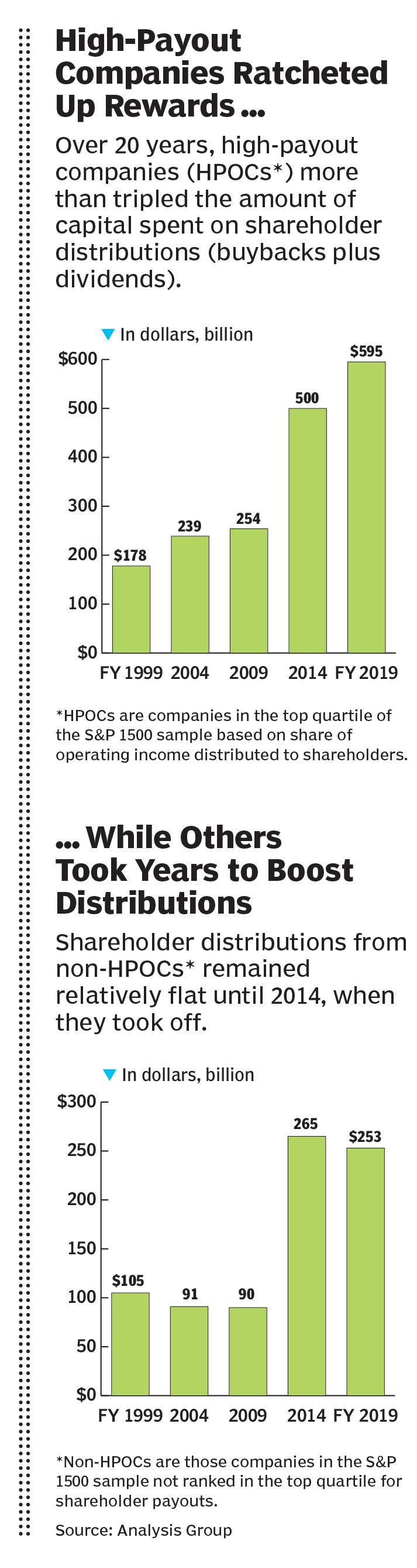
Shareholder Distributions vs. Reinvestment: The Gap Grows |
CFO.com - David Denis, Gaurav Jetley, and Laura Comstock
Although dividends and buybacks have ballooned, the data shows that S&P 1500 CFOs are still mindful of the need to reinvest.
Cash distributions to shareholders via dividends and share buyback programs have kindled passionate debates about the focus of shareholder value. Some market analysts and observers express chagrin at what they believe is a widespread increase in shareholder payouts, led by companies such as Apple, which bought back $70 billion of stock in 2019. Why all the fuss? Critics view these distributions as occurring at the expense of companies’ long-term value.
Buybacks and dividends are not necessarily detrimental. But do increasing amounts of shareholder payouts mean more companies are choosing short-term shareholder gains over reinvesting in their businesses for the long term? If so, what are the consequences for those trying to gauge companies’ valuations and the drivers of their financial strategies? And are historical levels of payouts and reinvestment still useful indicators of the optimal level? Read Article
|
|
|
Will Cryptocurrencies Play by the Rules? |
CFO.com - Ramona Dzinkowski
Nearly seven years ago, CFO asked finance chiefs an accounts receivable question: Would you allow a customer to pay in bitcoin? Now, the issue is one of cash management: Would you allow your treasury team to invest excess corporate cash in Bitcoin?
Tesla and MicroStrategy have. In early February, Elon Musk’s carmaking company changed its short-term investment policy to allow it to invest an aggregate $1.5 billion in balance sheet cash in Bitcoin. MicroStrategy, headed by crypto uber-evangelist Michael Saylor, did the same, storing more than $1 billion of the business analytics’ firm’s reserve dollars in the cryptocurrency. Read Article
|
|
|
A Few Small Banks Have Become Overdraft Giants |
Brookings Institute - Aaron Klein, Senior Fellow - Economic Studies
The explosion of overdraft fees makes basic banking expensive for people living paycheck to paycheck. Banks and credit unions generate over $34 billion in overdraft fees annually by one estimate. What those with money experience as ‘free checking’ is quite expensive for those without. Prior research has focused on who pays overdraft, finding a small number of people (9%) are heavy overdrafters accounting for 80 percent of the fees.
Not as carefully researched is whether this is just a small part of banks’ general business model, or whether for some banks overdraft has become their main source of profit. In fact a few small banks have become overdraft giants relying on overdraft fees as their main source of profit. These banks are really check cashers with a charter. Why do bank regulators tolerate this?
For six banks, overdraft revenues accounted for more than half their net income. Three had overdraft revenues greater than total net income (meaning they lost money on every other aspect of their business). First National Bank of Texas (doing business as First Convenience Bank) made over $100 million in overdraft fees yet posted an annual profit of just $36 million in 2020. Academy Bank and Woodforest National banks likewise made more money on overdraft revenues than profits in 2020. All three were entirely reliant on overdraft fees for any profit in 2019 as well. This is not a one-year blip; it is their business model. Armed Forces Bank, Arvest Bank, and Gate City Bank all rely on overdraft fees for more than half their profit. Read Article
|
|
|
Filer Beware: W-2 Phishing Is Still a Threat |
EHS Today - David Sparkman
IRS offers advice on how to help your employees thwart cyber-crooks.
This is a good time of year to remind your employees that they need to take special precautions to protect against the spreading depredations of W-2 phishing scams.
In a separate development, the Internal Revenue Service (IRS) recently issued a warning for those accounting professionals responsible for making tax filings concerning a different phishing scam where the criminals impersonate the IRS and attempt to steal Electronic Filing Identification Numbers (EFINs). Read Article
|
|
|
Holding Bitcoin Still Risky |
CFO.com - Karen Epper Hoffman
The cryptocurrency’s price volatility and the lack of accounting guidance on holding digital assets keep Bitcoin off most companies’ balance sheets.
At least a couple of technology companies have invested in Bitcoin to widespread wonder. Last year, MicroStrategy adopted Bitcoin as its primary treasury reserve, buying 38,250 in Bitcoin for $425 million between August and September 2020. Digital payments company Square, which supports Bitcoin buying and selling via its Cash App, purchased $50 million worth of Bitcoin in October 2020. (Technology wunderkind Jack Dorsey, CEO of Square and Twitter, believes Bitcoin has the potential to become the native currency of the internet:
“The world ultimately will have a single currency, the internet will have a single currency. I believe that it will be Bitcoin.”) Read Article
|
|
|
The Cost CFOs Refuse to Cut: Employee Retention |
CFO Dive - Jane Thier
As America begins its seventh month of operating amid coronavirus, companies are safeguarding their employee retention budgets, opting to cut costs elsewhere, The Wall Street Journal reported.
When reexamining their budgets, companies overwhelmingly are prioritizing staff retention despite the economic downturn. Fearing the departure of top performers, CFOs are shielding employee retention programs from broad cost-cutting efforts. "Job losses or salary freezes can result in lower morale and prompt employees to look for a new position despite the uncertainty," the Journal wrote.
These concerns have led companies to react in accordance. The U.S. unemployment rate stood at 8.4% in August, down from its 14.7% peak in April. Read Article
|
|
|
SEC Chair Wants Corporate Disclosure of Political Donations in ESG Regime |
CFO Dive - Jim Tyson
Dive Brief:
Allison Herren Lee, acting chair at the Securities and Exchange Commission (SEC), said companies should disclose political donations, allowing investors to gauge adherence to environmental, social and governance (ESG) principles.
"Political disclosure is key to any discussion of sustainability," Lee said in a March 15 speech, adding that many companies that made carbon-neutral pledges "have donated substantial sums to candidates with climate voting records inconsistent with such statements."
Investors should be able to assess the follow-through by companies that have pledged to alter political spending in response to protests against racial injustice, Lee said, noting that the SEC is currently barred from finalizing a rule on political donations disclosure. Read Article
|
|
|
Federal Watchdog Warns of Cybersecurity Risks to Employee Retirement Plans |
CFO Dive - Jim Tyson
Dive Brief:
The Government Accountability Office (GAO) said retirement plans such as 401(k)s face higher risk of cyberattack because the Labor Department has not clarified the cybersecurity responsibilities of employers and other fiduciaries, or provided guidance for safeguarding employees' savings and personal data.
In the absence of Labor Department guidance, companies and other retirement plan administrators might not understand their duties in cybersecurity and plan participants cannot be assured their assets and personal information are safe, according to the GAO, Congress's watchdog agency.
"Without formal clarification from DOL [Department of Labor], fiduciaries could face legal challenges if they fail to meet their responsibilities to protect retirement benefits, plan assets and participant PII [personally identifiable information]," the GAO said. Read Article
|
|
|
Stimulus Includes Surprise Expansion of Executive Pay Curb |
CFO Dive - Robert Freedman
A last-minute addition discourages lofty compensation by subjecting an increased number of employees to a deduction cap.
The $1.9 billion stimulus package enacted three weeks ago contains an 11th-hour provision that increases the number of executives whose compensation is subject to a $1 million tax deduction cap.
Prior to passage of the law, at least five employees were subject to the cap, known as the 162(m) cap: the CEO, CFO and the three highest paid employees other than those two. Read Article
|
|
|
Mexico, Latin America, South America and the Caribbean |
Why Latin America Should Export its Way Out of the Crisis
InterAmerican Development Bank – Beyond Borders, Paolo Giordano
In mid-2020, at the height of the first wave of COVID-19 infections, the IDB argued that the pandemic had particularly devastating economic effects on Latin America and the Caribbean because it had slammed the brakes on three flows that are fundamental to development: finances, people, and goods. This is what economists call a triple sudden stop.
How is 2021 shaping up in these three areas? In this post, I argue that, although there are grounds for optimism and caution in each, the region cannot afford to pursue a way out of the crisis that does not place export development at the heart of its strategy. Read Article
Agreements Reached on CCS’s 2021 Examinations
AlliExNews
Brades – Students in Montserrat and across the region now have the option to defer sitting the Caribbean Examinations Council (CXC) exams scheduled this year.
In a recent statement from CXC, it was announced that an extension will be given for the deadline by which students can decide to defer the sitting of the 2021 examinations. All Candidates will be required to indicate their intent for deferral by 1 May 2021. Read Article
Opportunities for Stronger and Sustainable Postpandemic Growth 2021 Latin American and Caribbean Macroeconomic Report - 2021 Latin American and Caribbean Macroeconomic Report
InterAmerican Development Bank
As a result of COVID-19, Latin America and the Caribbean suffered one of the biggest economic crises in its history. The IDB Macroeconomic Report 2021 analyzes the economic damage our countries have sustained and the opportunities that can help in their recovery. Read Article
Tenth UK-CARICOM Forum Action Plan
CARICOM
At the conclusion of the 10th UK-Caribbean Forum, held virtually on 18 March 2021, the Foreign Ministers of the United Kingdom and Caribbean countries, welcoming the Communiqué signed at the Forum, also agreed on the following Action Plan for a two-year period up to 2023, when the next full Forum meeting is currently envisaged.
This Action Plan is intended to allow for a strategic and sustained approach to the UK-Caribbean relationship, based on ambitious, yet focussed and realistic commitments. It serves as a road map for the practical implementation of the Communique and sets out the enhanced commitments of both the UK and Caribbean Forum countries for a renewed and strengthened partnership. Read Release
|
|
|
Canada, Europe and Great Britain |
Coronavirus: Merkel Aide Warns of Vaccine-resistant Mutations
DeutscheWelle
German Chancellor Angela Merkel's chief of staff, Helge Braun, warned that the country still finds itself "in the most dangerous phase of the pandemic."
Germany must bring down coronavirus infections in the next few weeks or risk new virus mutations that are resistant to vaccines, Chancellor Angela Merkel's chief of staff Helge Braun told the Bild am Sonntag newspaper.
"We are in the most dangerous phase of the pandemic," he added. "The next few weeks will determine whether we can foreseeably get the pandemic under control." Read Article
Variants Fuel Increasing Hospitalizations and Lockdowns in Canada
MSN News – CNN, Paula Newton
Canada continues to see rising new daily cases of Covid-19 and hospitalizations as officials warn the variants are spreading rapidly and are a threat to younger Canadians.
Canadian officials warn Covid-19 variants are spreading rapidly and are a threat to the young. "Even if the end of the pandemic is in sight, the variants mean the situation is even more serious. We're entering the final stretch of this crisis, we just need to stay strong a little longer," said Justin Trudeau, Canada's prime minister during a Covid-19 briefing in Ottawa Tuesday.
Trudeau announced that Pfizer has once again agreed to move up its deliveries of vaccines to Canada. Read Article
Covid: Germany Limits Use of AstraZeneca Covid Jab for Under-60s
BBC
Germany is suspending routine use of the Oxford-AstraZeneca Covid-19 vaccine for people aged below 60 because of a risk of rare blood clots.
The German medicines regulator found 31 cases of a type of rare blood clot among the nearly 2.7 million people who had received the vaccine in Germany.
Canada earlier suspended use of the AstraZeneca jab in people under 55. Read Article
|
|
|
Taiwan’s Continued Success Requires Economic Diversification of Products and Markets
Brookings Institution - Syaru Shirley Lin, Nonresident Senior Fellow - Foreign Policy, Center for East Asia Policy Studies
Editor's Note: Editor’s note: This piece is part of the Taiwan-U.S. Quarterly Analysis series, which features the original writings of experts from the United States and Taiwan, with the goal of providing a range of perspectives on developments relating to Taiwan.
To many observers, both in Taiwan and elsewhere, Taiwan is a multi-faceted success story. Thirty years after democratization, Taiwan has shown that a Chinese democracy can govern effectively, and a high-income economy can continue to grow even as the world suffers from a severe pandemic.
Taiwan has managed the spread of COVID-19 far better than most: It suffered only seven deaths among its 23.5 million people in 2020. Except for a few short weeks of lockdown in March last year, life in Taiwan has been normal. Schools, offices, and restaurants have been open as usual, although with temperature screening, hand sanitizing, and social distancing. Live concerts by Yo-Yo Ma and performances of “Phantom of the Opera” have attracted thousands of people into indoor arenas. Taiwan’s ability to fight COVID-19 illustrates its excellent public health infrastructure and health policy expertise, supported by extensive data and digital technology. Taiwanese people have also demonstrated a high level of trust toward both their government and their fellow citizens, applying lessons learned fighting the SARS pandemic in 2003 to prevent the spread of this latest virus. Read Article
China Media Pushes for Russia Alliance After Joe Biden-Vladimir Putin Spat, Alaska Meeting
Microsoft News – Newsweek, David Brennan
Chinese state media is pushing for closer Beijing-Moscow ties after last week's war of words between President Joe Biden's administration and top officials in Russia and China.
The Biden administration has vowed to push back on both China and Russia over the next four years, as the White House looks to refocus American foreign policy on the U.S.-led international system, traditional alliances, and democracy abroad.
Biden's vow to protect liberal democratic values puts him at odds with the authoritarian systems in Russia and China, and conflict last week with President Vladimir Putin and Chinese officials at bilateral talks in Alaska gave a hint of the great power tensions that might yet characterize his term. Read Article
A Momentous Shift in US Public Attitudes Toward China
Brookings Institute - William A. Galston, Ezra K. Zilkha Chair and Senior Fellow - Governance Studies
Although public opinion rarely determines the specifics of U. S. foreign policy, it typically defines the zone within which policies with public visibility can be sustained over time. Recent survey research has underscored a shift in Americans’ attitudes towards China that is far-reaching enough to sustain the most adversarial stance toward the Middle Kingdom since the Nixon administration’s opening of relations half a century ago.
On March 16, a Gallup poll (“New High in Perceptions of China as the U.S.’s Greatest Enemy”) found:
-
The share of Americans who see China as our greatest enemy has doubled in the past year, from 22% to 45%.Read Article
Japan's Cherry Blossom 'Earliest Peak Since 812'
BBC
The cherry blossom season, Japan's traditional sign of spring, has peaked at the earliest date since records began 1,200 years ago, research shows.
The 2021 season in the city of Kyoto peaked on 26 March, according to data collected by Osaka University.
Increasingly early flowerings in recent decades are likely to be as a result of climate change, scientists say. Read Article
|
|
|
Asia, India and Australia |
Myanmar Coup: What is Happening and Why?
BBC - Alice Cuddy
image captionMya Thwe Thwe Khaing was the first person to be killed
Mass protests have been taking place across Myanmar since the military seized control on 1 February.
Elected leader Aung San Suu Kyi and members of her National League for Democracy (NLD) party are among those detained.
Australians Stranded Overseas Take Frustrations to United Nations, Lobby the Government’s ‘Extreme Restrictions’
News.com.au - Matt Young
It’s a problem impacting Aussies around the world — with a map showing the issue in stark detail. Now the United Nations is involved.
Dylan Efron is currently completing mandatory hotel quarantine. His arrival has left Australians outraged as thousands of Aussies remain stranded overseas.
Australia has been hit with a United Nations complaint and Prime Minister Scott Morrison dubbed a “moral vacuum” over its treatment of stranded Australians and their inability to return home.
A number of Australians who have been left “stranded” overseas since the outbreak of the COVID-19 pandemic have taken their complaints straight to the top, after failing to negotiate a safe passage home with the Australian government’s “extreme restrictions”. Read Article
|
|
|
Africa, Middle East, Eastern Europe and Russia |
The Promises and Perils of Africa’s Digital Revolution
Brookings Institution – TECH Stream, Nathaniel Allen
Across the African continent, the relentless spread of networks, sensors, artificial intelligence, and automation is driving a revolution to an unknown destination. Emerging technologies such as CCTV cameras with facial recognition systems, drones, robots, and “smart cities” are proliferating. Digitization is improving government revenue collection and curbing corruption. Cameras and facial recognition technologies are helping authorities respond to terrorist attacks. Drones are delivering life-saving medical supplies. Yet with each advance there is a cost. Sophisticated malware enables novel forms of criminality, surveillance technology powers new tactics of repression, drones unleash the prospect of an autonomous weapons arms race.
Emerging technology is having a powerful impact on the security and stability of African states. Yet the digital revolution’s ultimate legacy will be determined not by technology, but by how it is used. African countries that take advantage of the opportunities and limit the risks inherent in emerging technology may achieve greater peace and prosperity. Yet many countries could be left behind. As the continent recovers from the COVID-19 pandemic, its leaders face a choice between harnessing emerging technology to improve government effectiveness, increase transparency and foster inclusion, or as a tool of repression, division, and conflict. Read Article
In the Middle East, Poverty is Down But Economic Grievance is Up. Why?
Brookings Institution - Steven Heydemann, Nonresident Senior Fellow - Foreign Policy, Center for Middle East Policy
Editor's Note: Steven Heydemann explores the understudied solidarity-based social mechanisms that have created and sustained economic resilience in the Middle East past, but which are now coming under increasing strain. This piece was originally published by the Lebanese American University.
The political economies of the Arab world present a fascinating but puzzling paradox. On the one hand, the region’s trajectory over the past decade has reflected growing anger and frustration among Arab publics in societies wracked by economic stress and deepening economic precarity. On the other hand, these widely-held economic grievances co-exist with the lowest levels of extreme poverty among developing regions, defined by the number of people living on less than $1.90/day, the current International Poverty Line (IPL). Read Article
China, With $400 Billion Iran Deal, Could Deepen Influence in Mideast
The New York Times - Farnaz Fassihi and Steven Lee Myers
The countries signed a sweeping pact on Saturday that calls for heavy Chinese investments in Iran over 25 years in exchange for oil — a step that could ease Iran’s international isolation.
China agreed to invest $400 billion in Iran over 25 years in exchange for a steady supply of oil to fuel its growing economy under a sweeping economic and security agreement signed on Saturday.
The deal could deepen China’s influence in the Middle East and undercut American efforts to keep Iran isolated. But it was not immediately clear how much of the agreement can be implemented while the U.S. dispute with Iran over its nuclear program remains unresolved. Read Article
|
|
|
Proactive Technologies' Project Partners |
|
Frank J. Gibson Consulting |
"One thing is certain... nothing is certain!"
The rate of change affecting work, the worker, management and the educational institutions that service all three has been accelerating - made worse by the unexpected Covid-19 pandemic. The economy, the consumer, supply chains and operational strategies have all been disrupted in the short-term, casting doubt on the long-term.
Rapid adaptation is the key to survivability, sustainability and growth. Sometimes an experienced outside advisor can help facilitate needed improvements to take the worry out of change and the fear out of growth. Frank J. Gibson Management and Workforce Excellence Advisor
- Business Development & Growth
- Workforce Development and Optimization
- Training and Cross-Training
- Local,/Regional Workforce Development Projects and Community Development
- Facilitated Problem Solving
- Process Improvement Cross-Functional Leadership Coaching and Mentoring
- Internship and Apprenticeship Projects
- Strategic Doing/Strategic Planning
Copyright © 2021 Frank J. Gibson
ALL RIGHTS RESERVED
|
|
PTI Systems
International, Inc.™
|
- Affiliated with Proactive Technologies, Inc. for projects outside the United States;
- Workforce development partner for employers, and education/ training providers who support employers, to ensure every worker can be trained to full job mastery;
- Experienced with governmental, IDB, GIZ and economic development agency sponsored projects;
- Experienced in assuring multinational employers expanding to the U.S. have the skilled workforce they need.
- PTI Systems International sets-up complete worker development and performance management systems, and provides technical implementation support;
- We provide strategies for our project's transition to local management.
- Speakers for seminars and conferences.
Don't complain about a "skills gap," deliberately develop every worker to full job mastery!
© 2018-21 PTI Systems International, Inc.™
|
|
“Tell me and I forget. Teach me and I remember. Involve me and I learn.”
American engineer, statistician,
professor, author, lecturer, and
management consultant
1900 - 1993
“Management is doing things right; leadership is doing the right things.”
Austrian management consultant, educator, and author, whose writings contributed to the philosophical and practical foundations of the modern business corporation
“Sometimes you can't see the road ahead but as you keep going, it gets clearer. Stay the course as the fog of life dissipates.”
Inspirational Speaker, Amazon Best Selling Author, Spoken Word Artist
|
|
U.S. Department of Commerce - Bureau of Economic Analysis |
U.S. International Trade in Goods and Services, January, 2021
The U.S. monthly international trade deficit increased in January 2021 according to the U.S. Bureau of Economic Analysis and the U.S. Census Bureau. The deficit increased from $67.0 billion in December (revised) to $68.2 billion in January, as imports increased more than exports. The previously published December deficit was $66.6 billion. The goods deficit increased $1.3 billion in January to $85.4 billion. The services surplus increased $0.1 billion in January to $17.2 billion. Read Report
U.S. International Transactions, Fourth Quarter, 2020
The U.S. current account deficit widened by $7.6 billion, or 4.2 percent, to $188.5 billion in the fourth quarter of 2020, according to statistics from the U.S. Bureau of Economic Analysis. The revised third quarter deficit was $180.9 billion. The fourth quarter deficit was 3.5 percent of current dollar gross domestic product, up from 3.4 percent in the third quarter. Read Report
New Foreign Direct Investment in the United States
The statistics on new foreign direct investment in the United States provide information on the acquisition, establishment, and expansion of U.S. business enterprises by foreign direct investors. Read Reports
|
|
|
U.S. Department of Commerce - Bureau of the Census |
Monthly Wholesale Trade
January 2021 sales of merchant wholesalers were $531.7 billion, up 4.9 percent (+/- 0.7 percent) from last month. End-of-month inventories were $661.7 billion, up 1.3 percent (+/- 0.4 percent) from last month. January 2021: +1.3 % change in Inventories; December 2020 (r): +0.6 % change in Inventories Read Report
Manufacturing and Trade Inventory and Sales – January, 2021
Sales The combined value of distributive trade sales and manufacturers’ shipments for January, adjusted for seasonal and trading day differences but not for price changes, was estimated at $1,568.5 billion, up 4.7 percent (±0.3 percent) from December 2020 and was up 7.1 percent (±0.4 percent) from January 2020.
Inventories Manufacturers’ and trade inventories for January, adjusted for seasonal variations but not for price changes, were estimated at an end-of-month level of $1,982.4 billion, up 0.3 percent (±0.1 percent) from December 2020, but were down 1.8 percent (±0.3 percent) from January 2020.
Inventories/Sales Ratio The total business inventories/sales ratio based on seasonally adjusted data at the end of January was 1.26. The January 2020 ratio was 1.38. Read Report
|
|
|
Organisation for Economic Co-operation and Development |
U.S. Data versus the World
Find, compare and share the latest OECD data: charts, maps, tables and related publications. Access Data
International Trade Pulse, OECD - March 2021
16 March 2021 - In 2020, global merchandise trade fell by 8% in current US dollar terms. The impact of the pandemic on international merchandise trade was, however, very heterogeneous across economies and products.
- The automotive sector was hard hit, weighing in particular on exports from North America and Europe.
-
While trade in industrial machinery plunged, rising demand for lockdown goods and work-from-home equipment fuelled trade in computers and home electronics, boosting exports from China and Korea. Read Report
|
|
|
How Global Tech Executives View U.S.-China Tech Competition |
Brookings – Tech Stream, Christopher A. Thomas and Xander Wu
The global technology industry is hedging its bets. As the United States and China compete for technological supremacy in advanced semiconductor design and manufacturing, software, and other core technologies, global high-tech companies do not plan to pick sides. Rather, they pragmatically aim to compete in both Chinese and U.S. ecosystems regardless of the extra cost and complexity involved. This is the message from 158 senior business executives working for American, Chinese, European, Japanese, Taiwanese, and Korean global high-tech firms whom we polled about the impact of U.S-China tensions on their industry. While these executives regard as inevitable that American and Chinese technological spheres of influence will to some extent separate, they also expect Chinese systems and solutions suppliers to continue to rely on globally sourced (rather than Chinese-developed) technologies. In addition, these executives expect multinational companies of all stripes to double down on their efforts to keep competing in the Chinese market.
With core technologies a central issue in U.S.-China relations, the Commerce Department and other agencies have recently placed greater restrictions on the technologies that can be exported to China, as well as added major Chinese tech companies to the blacklist of firms that can purchase American technology or receive U.S. investment. At the same time, the Chinese government has said it seeks “technology independence”—the vague goal articulated in the most recent five-year plan to reduce the reliance of Chinese high-tech firms on non-Chinese suppliers. Read Article
|
|
|
IndustryWeek - Jill Jusko
USMCA implementation and challenges remain a work in progress, particularly for the automotive industry.
The year 2020 was a wild and wooly one, by any measure. A pandemic brought the world to a halt, and many pockets of hurt still remain; U.S. presidential politics were on dizzying and dazzling display; deadly wildfires scorched wide swathes of the western United States; and mysterious monoliths began cropping up around the world. And that wasn’t even the half of it.
In the midst of this craziness that was 2020, a not-so-crazy event occurred: a new trade agreement also entered into force. It was, of course, the United-States-Mexico-Canada Agreement, which revised and updated the long-standing North American Free Trade Agreement. Former President Donald Trump, who had been highly critical of NAFTA, made renegotiating the trade pact a priority early in his presidency. USMCA took effect July 1, 2020. Read Article
|
|
|
Tariffs, New Tactics and Shifting Supply Chains: What’s Ahead for International Trade |
IndustryWeek - Shruti Gupta
It’s time for companies to re-evaluate their strategies.
The pandemic and populist governments around the world in recent years have put pressure on globalization. International trade deals—such as USMCA, Brexit and the Trans-Pacific Partnership—will likely continue to evolve as governments enter into, withdraw from and renegotiate existing trade deals.
Trade conflicts such as the years-long tariff war between the United States and China have also threatened well-established business plans and supply chains. Read Article
|
|
|
‘I’ve Never Seen Anything Like This’: Chaos Strikes Global Shipping |
Area Development – The New York Times, Peter S. Goodman, Alexandra Stevenson, Niraj Chokshi and Michael Corkery
The pandemic has disrupted international trade, driving up the cost of shipping goods and adding a fresh challenge to the global economic recovery.
Off the coast of Los Angeles, more than two dozen container ships filled with exercise bikes, electronics and other highly sought imports have been idling for as long as two weeks.
In Kansas City, farmers are struggling to ship soybeans to buyers in Asia. In China, furniture destined for North America piles up on factory floors. Read Article
|
|
|
U.S. and Europe Will Suspend Tariffs on Alcohol, Food and Airplanes |
Area Development – The New York Times, Ana Swanson
The governments agreed to temporarily halt levies on billions of dollars of products as they search for a settlement to a long-running clash over subsidies given to Airbus and Boeing.
The United States and European Union agreed to temporarily suspend tariffs levied on billions of dollars of each others’ aircraft, wine, food and other products as both sides try to find a negotiated settlement to a long-running dispute over the two leading airplane manufacturers.
President Biden and Ursula von der Leyen, the president of the European Commission, agreed in a phone call on Friday to suspend all tariffs imposed in the dispute over subsidies given to Boeing and Airbus for “an initial period of four months,” Ms. von der Leyen said in a statement.
“This is excellent news for businesses and industries on both sides of the Atlantic and a very positive signal for our economic cooperation in the years to come,” she said. Read Article
|
|
|
NAM to Biden: China Policy Needs a Reset |
IndustryWeek - Jay Timmons
'We need a new approach to China—strong and strategic, rooted in American strengths and values and coordinated with our allies. And the time is now.'
The National Association of Manufacturers sent the following letter to President Joe Biden on March 17:
As the United States emerges from the health crisis and economic devastation of the COVID-19 pandemic, manufacturers believe we have an obligation to help shape the new, postpandemic world and assert strong U.S. global leadership, working with allies and partners to rebuild the economy and tackle our shared global challenges. One of the biggest factors in these efforts is the rise of China, its increasing global ambition and the size and reach of its economy. Read Article
|
|
|
Asian Economic Integration Report 2021: Making Digital Platforms Work for Asia and the Pacific |
Deutsche Gesellschaft für Internationale Zusammenarbeit (GIZ) GmbH - Asian Development Bank (ADB)
This year's ADB Regional Integration Report prominently assesses the disruption of the pandemic outbreak in 2020 on global trade in general and the ramifications on Asia and the Pacific in particular. Lockdowns, travel and trade restrictions affected nearly all aspects of cross-border economic activity. The report looks at how regional economies individually or collectively respond to the crisis by, for example, leveraging rapid technological progress and digitalisation as well as increasing trade in services to reconnect and recover. Digital platforms and how they can accelerate digital transformation across the region has been selected as the theme of the 2021 report. In addition, the report continues to feature its annual updates, including the regional integration index and sub-regional cooperation projects. Download Report
|
|
|
Suez Canal: Egypt Begins Inquiry Into Cargo Ship's Grounding |
BBC
Egypt has begun a formal investigation into how a giant container ship blocked the Suez Canal and disrupted global trade for almost a week.
Suez Canal Authority (SCA) adviser Sayed Sheaysha said experts would board the Ever Given on Wednesday to obtain data relevant to the incident.
The probe will examine the vessel's seaworthiness and the crew's actions. Read Article
|
|
|
Education And Workforce Development News |
|
Washington Watch: Policies for Changing Workforce Needs |
Community College Daily News – Jolanta Juszkiewicz
Even before Covid, globalization and technological advances permanently changed the U.S. workforce. The pandemic turbocharged these changes.
In 1970, one in four jobs were in manufacturing; today, it’s one in 10. As automation takes different forms – robotics, 3-D printing, machine learning, nano technology and artificial intelligence – a greater array of jobs is susceptible to automation. Even so, not all jobs are equally at-risk. And, the pandemic has not hit all jobs equally.
Whether due to automation, the pandemic, related shut-downs and retrenchment, or both, workers at the lower rungs of the pay scale – disproportionately held by the disadvantaged and low-income – are most at-risk of displacement. Read Article
|
|
|
Senate Approves Cardona to Head ED |
Community College Daily News – Mathew Dembicki
The Senate on Monday confirmed Miguel Cardona, Connecticut’s education commissioner, as secretary of the U.S. Education Department (ED) by a vote of 64 to 33.
Walter Bumphus, president and CEO of the American Association of Community Colleges, will meet with Cardona this week.
President Joe Biden’s pick for education secretary told the Senate education committee at his confirmation hearing last month that he would like to see students in middle school through high school have more opportunities to explore career and technical education programs to help inform them about potential occupations and postsecondary education choices. Cardona, a technical high school graduate, also noted the important role community colleges will play in the country’s economic recovery by providing access to an affordable, quality education that leads to good-paying careers. Read Article
|
|
|
Technological Innovation Grant Will Create Virtual Factory for Apprenticeship Training Model |
Assembly Magazine
ATHENS, OH—A team of Ohio University professors will create a virtual factory for an apprenticeship training model, thanks to a new grant from the U.S. Economic Development Administration. The team is led by Dr. Jesús Pagán, an associate professor in the Russ College of Engineering and Technology. This grant awarded Pagán and his team $295,643 toward their project that aims to benefit the Appalachian region of Ohio and will promote accessible career-oriented training.
This project’s purpose is to create a virtual factory for an apprenticeship training model where students can receive a professional level experience using digital tools without the expense of a physical factory. Pagán and his team, including Dr. Yuqiu You and Dr. Gursel Suer of the Russ College of Engineering and Technology, have the goal to use this new technology to accelerate workforce development training for the Appalachian region while meeting and exceeding industry recognized credentials. Read Article
|
|
|
Marty Walsh, Boston Mayor with Union Roots, Confirmed As Labor Secretary At Key Time |
NPR
Marty Walsh, the two-term mayor of Boston, was confirmed as the Labor secretary by the Senate in a 68-29 vote on Monday, becoming the first union leader to run the department in over four decades.
Walsh will become the head of the Labor Department at a critical time, as the pandemic has left millions unemployed and raised concerns about workplace safety.
The former union leader will also serve in a Biden administration that has pledged to protect the power of unions and is looking to raise the federal minimum wage to $15 an hour. Read Article
|
|
|
Training And Organizational Development News |
|
Rethinking Leadership Post-Pandemic |
IndustryWeek - Edwin Bosso
A crisis can be the impetus for much-needed organizational improvement.
When it comes to navigating difficulty and disruption, the old adage “never let a good crisis go to waste” is especially true. Although leaders can be triggered to change for many reasons, a crisis such as the pandemic represents a unique opportunity to rethink entrenched methodologies, revise outdated protocols and reorient around a new, long-term vision for recovery and new ways to operate and manage employees.
In other words, a crisis can be the impetus for much-needed organizational improvement. This idea seems to land more squarely with some leaders than others. Agile and visionary executives easily pivot, seizing the chance to transform their companies for long-term success. The rest continue to dig in their heels, maintaining unwarranted fealty to the status quo. Read Article
|
|
|
Leaders Matter. But So Do Managers |
IndustryWeek - Kellogg Insight
In the rush to become a better leader, don’t forget to become a better manager.
That’s the advice from Carter Cast, a clinical professor of entrepreneurship at the Kellogg School. “We talk about inspirational leadership and brave leadership, and I’m all for it,” he says. “But the power and strength of good management doesn’t always get enough attention.”
After all, strong managers coax high productivity out of their teams; they also free the executive team from much of the day-to-day operations so they can focus on more tactical issues. Read Article
|
|
|
From Micromanager to Servant Leader |
IndustryWeek - Doug Meyer-Cuno
Your employees can tell you which one you are. Are you prepared for the answer?
Most entrepreneurs believe they should have all of the answers, especially when considering they incubated an idea into a thriving organization.
I was the classic entrepreneur. In a nutshell, the operating system I created was, “Don’t know what to do in a situation? Go ask Doug. He will tell you.”
Without realizing it, the culture I built was one in which employees did not feel empowered to leverage their own skills and knowledge to solve problems and perform their jobs. In essence, I was a micromanager, and as such I created a culture of tension, trepidation and mistrust unconsciously. Read Article
|
|
|
Access Proactive Technologies' Recent "Proactive Technologies Workforce News" Article Quicklinks |
Located on the left panel below, this includes articles on structured worker development, achieving worker "full job mastery," engineering/quality/safety compliance, ISO/TS/AS quality program support and compliance, and many other contemporary worker development and management topics. |
|
|
Recent Proactive Technologies News Article Quicklinks |
MARCH
by Dean Prigelmeier, President of Proactive Technologies, Inc.
by Stacey Lett, Director of Operations - Eastern U.S. - Proactive Technologies, Inc.
By Frank Gibson, former Program Manager-The Ohio State University - Alber Enterprise Center, currently and Independent Workforce Development and Management Consultant
by Dean Prigelmeier, President of Proactive Technologies, Inc.
FEBRUARY
by Dean Prigelmeier,, President of Proactive Technologies, Inc.
by Stacey Lett, Regional Manager – Eastern U.S. – Proactive Technologies, Inc.
By Randy Toscano, Jr., MSHRM, Executive Director of Human Resources, Paris, Texas Regional Medical Center
by Proactive Technologies, Inc. Staff
by Dean Prigelmeier, President of Proactive Technologies, Inc.
JANUARY, 2021
by Dean Prigelmeier, President of Proactive Technologies, Inc.
by Stacey Lett, Regional Manager - Eastern U.S. - Proactive Technologies, Inc.
Dr. Dave Just, formally Dean of Corporate and Continuing Education at Community Colleges in MA, OH, PA, SC. Currently President of K&D Consulting
by Dean Prigelmeier, President of Proactive Technologies, Inc.
DECEMBER
by Dean Prigelmeier, President of Proactive Technologies, Inc.
by Stacey Lett, Regional Manager – Eastern U.S., Proactive Technologies, Inc.
Proactive Technologies, Inc. – Staff
by Dean Prigelmeier. President of Proactive Technologies, Inc.
NOVEMBER
by Dean Prigelmeier, President of Proactive Technologies, Inc.
by Stacey Lett, Director of East Coast Operations - Proactive Technologies, Inc.
by Proactive Technologies, Inc. - Staff
by Dean Prigelmeier, President of Proactive Technologies, Inc.
|
|
Proactive Technologies, Inc. Partners With Educational Institutions, Workforce/Economic
Development Groups, Government Agencies
|
Structured on-the-job training attracts and engages employers in workforce development partnerships...some projects sustainable for more than 18 years!
This creates a steady need for your related technical instruction, services and a pathway for employment.
These partnerships:
- enhance your institution's opportunity to market your products and services to incumbent workers;
- allow your organization to include structured on-the-job training as a capstone to preemployment preparation;
- document a trainee-to worker's increasing value to the employer - the key to retention - rather than leaving it to chance;
- properly aligns workforce development resources and maximizes the impact and results; allows you to engage an employer's facility, equipment and staff in the training process;
- provides the best, sustainable infrastructure for apprenticeships and internships that last!
- is a win for the trainee, win for the worker, win for the employer, win for the institution and win for the community!
This approach has continued to prove itself since 1988, and does not compete with your school's or agency's products and services; it adds to your efforts the clear, tangible, measurable advantage that employers seek.
Copyright © 2021 Proactive Technologies, Inc.™ ALL RIGHTS RESERVED
|
|
To supplement onsite PROTECH™ system of managed human resource development classes, these regularly scheduled webinars are available to the registered staff of clients:
- Structured On-The-Job Training Instructor Certification
- Structured On-The Job Training Checklist Administrator Certification
- Management Structured On-The-Job Training Project Support Briefing
- Integrating Support for Plant-Wide ISO/AS/TS Quality and Safety Systems with PROTECH Workforce Development System
- Supporting "Pay-For-Value" Systems
- Promoting Continuous Process Improvement While Implementing the PROTECH System for the Accelerated Transfer of Expertise™
- PROTECH Onsite System Administrator Certification
Contact US to attend one of these seminars will send you an e-reservation. Include your client ID, name and user ID number and which webinar you would like to attend.
Copyright © 2019-21 Proactive Technologies, Inc.™ ALL RIGHTS RESERVED
|
|
Help Us Clear Up the Confusion of NDT Terminology |
Quality Magazine - Jeri Matza with contributions by Charles J. Hellier
Effective communication only happens when the intended message is expressed successfully by one person and received and understood by another. If executed correctly, it cuts down the unintended consequences that arise as a result of miscommunication. When a word is chosen to communicate a thought, idea, or description, what assurances are there that the intended meaning will be clearly understood by the recipient? Unfortunately, there are none. This is especially true today as the use of social media, email, texting, and video conferencing have circumvented the need for phone calls and face-to-face communication. With technology moving so quickly, it is more evident now than at any point in history that how we communicate and the amount we are inundated with has created a dilemma where so much non-verbal communication is being ignore.
The importance of choosing the right word may not seem critically important to everyone; however, using the wrong term in the nondestructive testing industry (NDT) can have severe consequences. Read Article
|
|
|
The New Metrology Paradigm |
Quality Magazine - Eric Felkel
The role of metrology is shifting.
This is especially true in modern industrial settings and for increasingly exacting applications. Once perceived as a necessary evil residing in the quality control department validating the integrity of finished parts and components, today metrology is viewed more as an enabling technology that truly adds value. This is increasingly leading to its deeper integration with the overall manufacturing process.
The move to the production floor is additionally accompanied by a paradigm shift from manual metrology solutions to automated solutions, and an overall move away from contact metrology systems to measurement using light, so called optical metrology solutions. Read Article
|
|
|
NASA Ingenuity Mars Helicopter Prepares for First Flight |
NASA
NASA is targeting no earlier than April 8 for the Ingenuity Mars Helicopter to make the first attempt at powered, controlled flight of an aircraft on another planet. Before the 4-pound (1.8-kilogram) rotorcraft can attempt its first flight, however, both it and its team must meet a series of daunting milestones.
Ingenuity remains attached to the belly of NASA’s Perseverance rover, which touched down on Mars Feb. 18. On March 21, the rover deployed the guitar case-shaped graphite composite debris shield that protected Ingenuity during landing. The rover currently is in transit to the “airfield” where Ingenuity will attempt to fly. Once deployed, Ingenuity will have 30 Martian days, or sols, (31 Earth days) to conduct its test flight campaign.
“When NASA’s Sojourner rover landed on Mars in 1997, it proved that roving the Red Planet was possible a
d completely redefined our approach to how we explore Mars. Similarly, we want to learn about the potential Ingenuity has for the future of science research,” said Lori Glaze, director of the Planetary Science Division at NASA Headquarters. “Aptly named, Ingenuity is a technology demonstration that aims to be the first powered flight on another world and, if successful, could further expand our horizons and broaden the scope of what is possible with Mars exploration.” Read Release
|
|
|
Iceland Volcano Eruption: Onlookers Flock to See Mount Fagradalsfjall |
BBC
Thousands have flocked to a volcano in Iceland which erupted near the capital, Reykjavik.
Lava started to burst through a crack in Mount Fagradalsfjall on Friday evening, in the first eruption of its kind in more than 800 years.
The site was initially blocked off, but from Saturday afternoon people were allowed to make the trek.
|
|
|
Aggressive Asian Hornets Gain Foothold in Pacific Northwest |
DeutscheWelle
Native insects have few defenses against the invasive hornets, which can quickly eradicate an entire hive of honeybees. But experts in Japan say the "murder hornet" serves as an important part of the broader ecosystem.
The hornets have been blamed for attacks on several hives of honeybees in which entire colonies were wiped out
Local authorities in the Pacific Northwest of the United States and Canada's province of British Columbia are waging an aggressive campaign to eradicate colonies of "murder hornets" that appear to be gaining a foothold in the region after arriving from Asia.
Since 2019, experts in British Columbia alone have reported at least seven nests or sightings of the aggressive insects, which are native to Japan, the Korean Peninsula and other parts of mainland Asia. They have been blamed for attacks on several hives of honeybees in which entire colonies were wiped out. Read Article
|
|
|
Cyber Security And IT News |
|
How to Hide Your iPhone's Unique Name From Apps (and Why You Should) |
Apple News – Mashable, Jack Morse
Your iPhone has trouble keeping secrets. Thankfully, there's something you can do about it.
What you do on the internet, what apps you download, and, often, where you go are all data points that can be linked to an iPhone's so-called advertising identifier (Android phones have a similar Advertising ID). Combined with commercially available databases, this unique alphanumeric string can be enough for third parties to tie an iPhone's actions back to the real name of its owner.
We were reminded of the real-world consequences of this Friday, when the New York Times published an article exposing the movements of individuals involved in the Jan. 6 riot at the U.S. Capitol. The newspaper obtained a data set that linked phone location data to advertising identifiers, which, combined with other available databases, allowed the paper to link that location data to real people. Read Article
|
|
|
Water Supply Cyber Breach Thwarted |
IndustryWeek - Peter Fretty
Hackers use remote access software to attack Florida city's water treatment facility.
All cyberattacks are scary. However, when the attack threatens the potential safety of thousands of people, the reality of the threat hits home. This is exactly what happened in the Florida city of Oldsmar when hackers attempted to poison the city’s water supply, an event announced on Monday.
The hackers used the remote access software TeamViewer (used for IT remote control, desktop sharing, online meetings, web conferencing and file transfer between computers) to make malicious changes to the water supply chemical treatment. Read Article
|
|
|
The Different Threats To Your Computer |
The Computer Warriors
We have clients in our offices all the time thinking they have a virus on their computer. However, like a human cold, there are different classifications of “viruses” your computer can catch. In today’s post, we break down the various infections that threaten your computer.
Malware
Malware is short for malicious software. Many things that people call a ‘virus’ is malware. Malware is any harmful software that infects your computer. A virus falls underneath the malware umbrella. Below are the different kinds of malware infections floating out on the web. Read Blog
|
|
|
Protecting Against Cyberattacks in a Remote Worker World |
CFO.com - Raul Anaya
Companies should invest in training to help employees ward off social engineering attacks, which use social media, personal profiles, and websites.
This year will continue to focus on the fast-growing threat of cyberattacks and the scale of damage they can do. The pandemic and continuation of remote working, along with greater reliance on mobile devices, have created additional opportunities for cybercriminals to exploit. Cybersecurity breaches grew by 11% in 2019, and the average cost of a breach to an organization was $13 million. While investment in cybersecurity technology has increased, so has the sophistication of attacks.
To safeguard their business, companies need to prepare their networks, processes, and employees to identify and recover from cyber threats more aggressively than ever before. The following are some attack scenarios and cybersecurity best practices, which together can help businesses build a strong and holistic defense against cyber criminals. Read Article
|
|
|
Your Loved Ones, and Eerie Tom Cruise Videos, Reanimate Unease With Deepfakes |
The New York Times - Daniel Victor
To those fearful of a future in which videos of real people are indistinguishable from computer-generated forgeries, two recent developments that attracted an audience of millions might have seemed alarming.
First, a visual effects artist worked with a Tom Cruise impersonator to create startlingly accurate videos imitating the actor. The videos, created with the help of machine-learning techniques and known as deepfakes, gained millions of views on TikTok, Twitter and other social networks in late February.A tool that allows old photographs to be animated, and viral videos of a Tom Cruise impersonation, shined new light on digital impersonations. Read Article
|
|
|
Cyber Attack Taps Operations at Molson Coors |
IndustryWeek - Peter Fretty
Molson Coors acknowledges meaningful cyber incident in regulatory filing on Thursday.
Every business operating in today’s digital world is at risk of a cyber incident. And, simply put, any breach is a significant affair. Why? Compromised systems increase doubt. Doubt in what your equipment is telling you. Doubt from customers that you are taking your responsibility to protect their data seriously.
However, when a breach impacts critical infrastructure or a food and beverage manufacturer, it seems to take the seriousness to another level. After all, in either instance, the impact could result in serious injuries or even fatalities. Read Article
|
|
|
Who is Watching Your Cameras? |
IndustryWeek - Peter Fretty
After hackers accessed Verkada's system, live feeds surfaced on-line once again demonstrating the need for better cybersecurity.
When news surfaced that San Mateo, CA-based camera manufacturer Verkada Inc. suffered a breach, it did not take long to realize the extent. Within hours there were reports of live feeds from over 150,000 of its security cameras including those in prisons, hospitals, schools, police stations, tech offices and manufacturing environments including Tesla Motors.
How did it happen? A group of hackers accessed the data collected through compromised administrative credentials. The hackers claiming responsibility for the incident said the breach was intended to show the dangerous pervasiveness of video surveillance. Read Article
|
|
|
Cyber Crime Is Up -- Way Up |
IndustryWeek - Peter Fretty
It’s that time of year when the the annual cyber security and cyber crime stats start rolling in from the previous year. The most recent being the 2020 Internet Crime Report issued by the FBI’s Internet Crime Complaint Center.
The annual report includes information from 791,790 complaints of suspected internet crime—an increase of a whopping 69.4% from 2019—and reported losses exceeding $4.2 billion. The top three crimes reported by victims in 2020 were phishing scams, non-payment/non-delivery scams and extortion. It should not come as a surprise to the IndustryWeek audience that ransomware was also a significant factor. Read Article
|
|
|
Swiss Verkada Camera Hacker Says Attacks Were “Easy, Fun Anarchism”—U.S. Files Charges Over Data Theft |
CFO Dive – Forbes, Thomas Brewster, Associate editor at Forbes, covering cybercrime, privacy, security and surveillance.
Verkada hackers talks about attacks before US files charges.
The hacker who managed to access surveillance feeds from Verkada says their attacks have always been in the name of “fun anarchism” and meant to expose bad security practices in the capitalist world.
Hacker Tillie Kottmann has been charged by the Justice Department over allegations they’d broken into multiple organizations over the last three years and dumped the information online or leaked it to the media. Though not included in the indictment, Kottman was in the headlines earlier this month after claiming to have hacked Silicon Valley surveillance camera startup Verkada, and 150,000 video feeds from inside Tesla’s factories, schools and hospitals, as first reported by Bloomberg. Read Article
|
|
|
Human Resource Management News |
|
Has the Employee-Employer Relationship Changed? |
IndustryWeek - Adrienne Selko
As they adapted to the pandemic, GE Appliances and Cummins created stronger workforce relationships.
It’s often said that a person’s true nature is revealed by the way they handle a crisis. The same could be said of a company.
Trust, empathy, transparency and strong communication skills are sought-after personal traits and important building blocks of company culture. When the pandemic hit, those building blocks became even more important, setting the stage for a new relationship between employees and employers.
“It was principles, not processes that were front and center for us,” explains Thomas Quick, vice president, human resources, for GE Appliances, a Haier company. Read Article
|
|
|
Burnout is More of a Systemic Workplace Issue than an Employee Issue |
IndustryWeek - Adrienne Selko
The structure of the workplace is a main driver of employee burnout. Burnout is a manifestation of chronic workplace stress.
“We view burnout as an individual’s issue, but the real problem is that something is out of balance in the workplace,” explains Paula Davis, founder of the Stress and Resilience Institute. “It boils down to too many job demands and too few job resources.”
Burnout is a systemic issue that is based on a variety of factors. “It’s influenced by how leaders conduct themselves as well as how people interact within a team,” says Davis. Of course, organizations are also under stress from a variety of sources which include regulations, financial and market conditions. So, the goal is to have a holistic approach to viewing an organization and its interactions and then alleviating burnout. Read Article
|
|
|
DOL Creates New Whistleblower Protocols |
EHS Today - David Sparkman
OSHA oversees enforcement of whistleblower provisions in 25 different statutes.
The U.S. Department of Labor (DOL) has announced that the Occupational Safety and Health Administration (OSHA) will now be responsible for overseeing worker retaliation complaints that are filed under the Criminal Antitrust Anti-Retaliation Act (CAARA) and the Anti-Money Laundering Act (AMLA).
In addition to enforcing whistleblower protections for workers regarding federal health and safety laws, over the years OSHA also has been made responsible by Congress for overseeing the enforcement of the whistleblower provisions of 25 different statutes. In fact, only about 62% of the whistleblower claims OSHA investigates deal with safety and health violations. Read Article
|
|
|
Seems Like Everyone is Happy with Marty Walsh as New Secretary of Labor -- Well Almost |
EHS Today - Staff
"Walsh has a reputation as a consensus builder and has displayed a willingness to work with a wide array of constituencies."
Two groups that don't always see eye to eye are agreeing on the confirmation of Marty Walsh as the Secretary of Labor.
The American Federation of State, County and Municipal Employees (AFCME) is thrilled about Walsh. Read Article
|
|
|
Environmental, Health & Safety News |
|
The Latest Pandemic Plot Twist |
EHS Today - Nicole Stempak
For the past year, EHS Today has been reporting how companies can protect workers from COVID-19. That’s meant securing personal protective equipment, social distancing and increased cleaning. For the past few months, we’ve focused on vaccination strategies, attitudes and requirements.
The latest plot twist in the ongoing vaccination debate? State legislative mandates.
NBC News reports some state lawmakers are now interested in legislation against vaccination requirements. Read Article
|
|
|
How is Osteoarthritis Affecting Your Workforce? |
IndustryWeek - Adrienne Selko
Osteoarthritis is the most common form of arthritis, affecting 32.5 million U.S. adults,
While there are estimated to be more than 100 types of arthritis, osteoarthritis (OA) is the most common form, affecting 32.5 million U.S. adults, according to The Osteoarthritis Action Alliance.
If you think that is bad, it’s going to get worse. By 2040, the same group expects 78 million will have some form of arthritis.
As all health issues affect the workplace Brian Gifford, IBI's Director, Research and Analytics, recently presented a webinar on this topic and offered some interesting metrics. Read Article
|
|
|
OSHA Cites BEF Foods, Inc.’s Lima Facility After Production Worker Suffers Partial Arm Amputation from Cleaning Auger |
U.S. Department of Labor
LIMA, OH – While cleaning an auger used to rice potatoes, a 39-year-old production worker found her left arm caught in a running auger. The worker suffered multiple lacerations and the partial amputation of her arm. Co-workers had to cut the auger apart to free her arm.
An investigation in September 2020 by the U.S. Department of Labor’s Occupational Safety and Health Administration determined that BEF Foods Inc. failed to shut down and isolate energy to the auger during maintenance work, a process known as lockout/tagout. The company, which operates as Bob Evans Farms, also failed to train employees on the required use of lockout/tagout procedures when conducting maintenance activities.
OSHA has proposed penalties of $136,532 for two repeat violations of machine safety standards. The agency cited BEF Foods Inc. for similar violations in 2016 at the same facility. Read Article
|
|
|
Reduce Arc Flash Risks with Motor Control Centers |
EHS Today - John Kay
The right technologies and proper installation can reduce exposure to arc-flash events and other electrical hazards.
Industrial companies have put a greater focus in recent years on addressing a top electrical safety risk: arc flash events. Arc flashes can be created by a wide range of actions, from a dropped tool, to the build-up of conductive dust, to improper work procedures. And the resulting massive heat and energy waves created by them can reach temperatures of up to 35,000 degrees Fahrenheit.
Arc flash events create serious risks in nearly all industrial operations. The proper use of appropriately sized and applied low- and medium-voltage motor control centers (MCCs) can reduce the likelihood of arc flash events, but the risk still exists. Fortunately, MCCs can be enhanced to further reduce risks to both people and equipment. Read Article
|
|
|
OSHA to Ramp Up Coronavirus-Related Inspections |
EHS Today - Staff
OSHA launches a national emphasis program to prioritize enforcement efforts during COVID-19.
The Occupational Safety and Health Administration (OSHA) launched a national emphasis program (NEP) March 12 in response to President Joe Biden’s Executive Order on Protecting Worker Health and Safety during COVID-19.
The NEP means OSHA will focus enforcement efforts in the coming months on coronavirus-related inspections. In a press release announcing the NEP, the agency made clear it will prioritize companies that put the largest numbers of workers at serious risk of contracting the coronavirus and employers that retaliate against workers who exercise rights protected by federal law or make complaints about unsafe or unhealth conditions. Read Article
|
|
|
Understanding the Total Cost of an Injury |
EHS Today - Rick Barker
Don’t overlook the often-hidden and indirect costs of worker injuries.
One reason that safety initiatives can struggle to achieve sufficient support is that those of us responsible for safety in our organizations haven’t consistently conveyed the total injury costs to key decision makers. Some costs associated with an injury are apparent and easy to assign to a specific incident. Other costs are embedded within larger issues or are less easily attributed to any specific injury. These two types of costs are often referred to within EHS as direct and indirect costs; however, it may be more appropriate to describe them as visible and hidden costs.
An iceberg is often used to illustrate the two types of costs. It’s notable that you will see the same concept being used if you search online for “hidden cost of poor quality.” This concept of hidden cost is not unique to safety, and it is likely to already be understood by members of the management team. The iceberg image conveys two important aspects about the types of costs. The more obvious point is that some costs are visible but accompanied by less visible costs. The iceberg image also conveys that more of the costs are hidden below the surface than are visible above it. Read Article
|
|
|
 |
Having trouble finding, selecting, training and keeping the skilled workers you need? Are your employee turnover costs a concern?
Let's start with what we already know:
- Classes alone will not train workers to perform your tasks...
- Quality Control policies and Process Documents are not a substitute for task training...
- Putting 2 people together and hoping for the best is not a training strategy...
- Wishing and hoping won't develop the skilled workers you need...
The cost of one worker malperformance or one worker's under-capacity or under-performance - due to lack of proper training - can more than justify the investment to train all your workers properly!
AND, unstructured, uncontrolled, undocumented task training is going on all day, every day. But if you cannot explain the process, you surely cannot measure and improve it.
Proactive Technologies's approach to structured on-the-job training takes place where, and while, the work is performed. You need no additional staff and structured on-the-job training does not interrupt your work schedule like unstructured, haphazard and ad hoc training or classroom learning does.
You probably have most of the pieces are already in place; they just need structure around them to make the training experience work for everyone through the accelerated transfer of expertise™.
As part of every project, Proactive Technologies provides the support to set-up, implement, manage, document and revise the worker development system so you can stay focused on business.
Copyright © 2019-21 Proactive Technologies, Inc.™ ALL RIGHTS RESERVED
|
|
|
|
EMPLOYERS!
If your organization sees training as a cost, not as an investment, maybe you should consider another approach!
- Cuts the employer's internal costs of training;
- Lowers the costs associated with turnover;
- Drives new-hires and incumbent workers to "full job mastery;"
- Increases worker capacity, work quality, productivity and compliance (ISO/AS/TS training and records requirement, engineering specifications and safety mandates);
- Creates framework for cross-training, retraining and worker certification;
- Establishes the framework for employer specific/job-specific apprenticeships and internships - registered or not;
- Builds career development tracks and succession plans for hourly (and salary) workers;
- Ensures the increased and maintained "Return on Worker investment" through any type of change...
ALL OF THIS FROM ONE APPROACH!
This structured on-the-job training is performed where, and while, the work takes place!
You need no additional staff, and this will not disrupt your work schedule or burden your existing staff!
If your firm is partnered with local career and technical educational institutions, use of shared employer's equipment, facilities and paid wages of trainer(s) and trainee(s) are attractive match for potential grant assistance.
for more information.
Copyright © 2019-21 Proactive Technologies, Inc.™
ALL RIGHTS RESERVED
|
|
|
|
|
|
Copyright © 1988 - 2021 Proactive Technologies, Inc.TM
ALL RIGHTS RESERVED
|
|
|
|
|
|
|