| |
Greetings colleagues!
Welcome back to school, pumpkin spice everything, football and almost sweater weather.
In our last message to you, we were winding down for summer break and assessing the impact of reduced federal and state funding for school mental health.
While we continue to see a reduction in federal grant opportunities to fund school mental health, we are heartened by the potential support of private foundations and philanthropists who recognize the critical needs in Washington state and beyond.
Families look to all of us as partners in helping their students achieve their full potential. Ensuring students have the tools and resources to sustain their mental health is an essential component in meeting their academic and life goals. These go together. One does not happen without the other. Full stop.
To this end, the SMART Center continues to work with federal, state and local agencies, elected officials, and other partners to maximize the funding we do have for conducting implementation studies, offering training and technical assistance, and supporting workforce development for you and your teams.
This newsletter highlights this work in progress. We welcome your comments at uwsmart@uw.edu.
In partnership,
The SMART Center Leadership Team
Eric Bruns, PhD, Larissa Gaias, PhD, Aaron Lyon, PhD, Kelcey Schmitz, MSEd, Jennifer Stuber, PhD
| | | |
WSW, our program to train school social workers in partnership with Washington's six schools of social work, is hosting another graduate student cohort while the future of the grant program is being litigated due to recent cuts made to the School Mental Health Program by the U.S. Department of Education.
We were fortunate enough to join forces with the Workforce Development Initiative in the UW School of Social Work to continue our work amidst the uncertainty.
High need schools districts across Washington state will continue to benefit from employing highly prepared graduate students who can provide leadership in schools designing systems of support for student behavioral health needs.
| | |
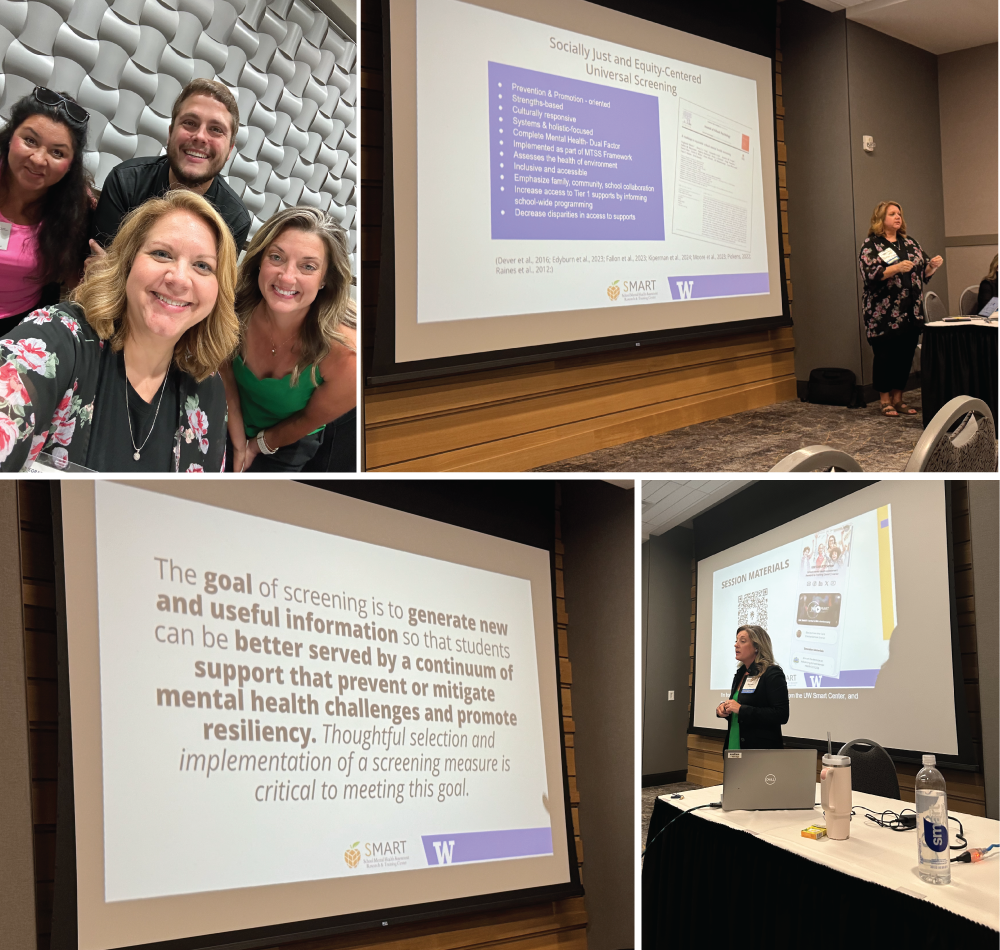
SMARTies co-presented with colleagues and partners from ESD 105 and UW College of Education's Haring Center for Inclusive Education at the
Integrated MTSS Conference in Wenatchee, WA this summer.
Sessions included:
Inclusionary and Integrated School Mental Health and MTSS: A Comprehensive Systems Approach to Supporting All Learners
Dr. RinaMarie Leon-Guerrero, Dr. Carol Davis, Kelcey Schmitz
Transforming Behavioral Health Integration: A School Based Regional Model with Interconnected Systems Framework
Brandon Riddle, Rayann Silva, Anthony Maldanado, Erica Mears
Fostering Educational Equity through Social, Emotional, Behavioral, and Mental Health Screening
Brandon Riddle, Rayann Silva, Kelcey Schmitz, Mari Meador
| | |
BRIDGE Study
The UW SMART Center seeks Washington school districts interested in participating in a research study on how best to make an evidence-based school mental health (SMH) strategy work in real world districts.
The BRISC Redesigned In Districts to Grow Evidence (BRIDGE) study aims to test how best to enhance implementation of a brief, evidence-based SMH intervention to ensure it is as user friendly, effective, and feasible as possible. During the project, the UW SMART Center will work closely with four districts seeking to train middle and high school counselors on the Brief Intervention for School Clinicians and Counselors (BRISC). In two of these districts, the SMART research team will work with school partners (e.g., administrative leaders, directors of school supports, school counselors) to redesign training, consultation and implementation supports for BRISC so it is optimized to fit the needs and workflows of schools and staff persons and thus improve BRISC engagement and outcomes. All four districts will then implement BRISC with middle and high school students, two with and two without these enhancements.
All districts and schools chosen to participate will benefit in multiple ways:
1. Free training and consultation to school staff (approx. 6 school counselors per district) on BRISC: a research-based, 3-4-session individual intervention for students with emerging or newly identified mental health concerns.
2. Data collection by the UW SMART research team to evaluate BRISC implementation success and student outcomes (e.g., coping, mental well-being, school success).
3. Payments to all participating schools (from $6,000 to $8,000 per school) as well as smaller honoraria for participating administrators, practitioners, and students.
Participation will be limited to four districts in the state, so please
contact us soon so the team can evaluate your district and schools’ appropriateness for the study. Initial study activities will begin in
Fall 2025.
For more information, please contact the study team at bridgestudy@uw.edu.
If you have questions, feel free to email Eric Bruns, Ph.D., study principal investigator, at ebruns@uw.edu.
| | |
New Study: USABILITY
Receive a digital gift card (students $200, teachers $250) for completing all study activities.
The SMART Center is conducting a research study called “USABILITY” to evaluate how appealing SEL programs are and how easy (or hard) they are to implement.
We are asking elementary general education teachers (K-6) and students (4-6) to complete virtual testing of two (2) SEL programs and to share feedback as well as complete brief surveys.
Participants will complete a virtual session lasting approximately 2 hours (teachers can split between two sessions, if desired).
If you are an elementary school teacher or parent/guardian of an elementary school student, please contact usability@uw.edu for any questions about participation.
Please see the project webpage here > for more information.
| | |
The University of Washington ALACRITY RUBIES Study
The UW ALACRITY Center is conducting a research study to learn how we can help educators better support autistic children who exhibit challenging behaviors in elementary schools. This study will evaluate two different ways for educators to learn a behavioral intervention called RUBIES (Research Units in Behavioral Interventions for Educational Settings), which teaches educators how to use evidence-based behavioral strategies to better support their autistic students in the classroom, and to respond more effectively when challenging behaviors occur.
RUBIES is a school-based adaptation of RUBI, which has been widely used in clinic settings and has shown significant improvements in reducing challenging behavior in autistic children (and stress in parents).
Learn more about the RUBIES study by watching our informational > video
(or click on the image below).
| | If you are an educator or parent of an autistic student and are interested in participating, please reach out to the study team at rubies@uw.edu. | | |
WSW Skills Institute | Tiered Solutions to Complex School-Based Mental Health Topics
October 8, 15, and 22 | 9am – 12pm PDT
Virtual – $100/per session or $250/for all three sessions
Clock Hours Offered
Session 1 – October 8th
Asking is Caring: Suicide Prevention and Intervention for ESAs
(PESB-approved)
Session 2 – October 15th
Centering Care: The Role of ESA’s in Preventing School Violence Through Threat Assessment and Mental Health Intervention
Session 3 – October 22nd
MTSS Approaches to Chronic Absenteeism, School Refusal, and
School Re-Engagement
| | |
| |
Brief Intervention for School Clinicians (BRISC)
BRISC is a research-based, engagement, assessment, brief intervention and triage strategy for mental health practitioners working
in middle and high schools.
To meet the overwhelming demand for BRISC training and support, a
web-based self-paced BRISC e-learning with implementation supports is now available to license
by districts, communities or
individual practitioners.
For more information contact us at brisc@uw.edu.
| | |
|
Soon, K., Suter, J. C., Linkous, O., Davis, C. A., & Bruns, E. J. (2025). Adapting Community-Based Wraparound for Use as an Intensive Intervention in Schools. Journal of Positive Behavior Interventions, 0 (0). https://doi.org/10.1177/10983007251335916
A team from the Wraparound Evaluation and Research Team, School Mental Health Assessment, Research, and Training (SMART) Center, and Center for Disability at the University of Vermont, have completed a federally-funded study to adapt and test a Wraparound care coordination model for the education context. An author’s manuscript of a new article published in the Journal of Positive Behavior Interventions presents results from an expert consensus process, with recommendations for how to adapt materials for community-based Wraparound so they are feasible and acceptable for the school setting. WERT and SMART at the University of Washington and the National Wraparound Implementation Center are now mobilizing these recommendations in the field nationally. If you are interested in implementing or evaluating school-based Wraparound, contact wrapeval@uw.edu
Bruns, E.J., Ehde, C., Gaias, L.M. et al. Behavioral Health Student Assistance Programs: Leveraging Non-Traditional Mental Health Providers to Address Workforce Shortages and Mitigate the Youth Mental Health Crisis. Adm Policy Ment Health (2025). https://doi.org/10.1007/s10488-025-01465-8
The youth mental health crisis demands scalable solutions. Our new study evaluates Washington State’s Behavioral Health Student Assistance Program (BH-SAP), which uses trained paraprofessionals in schools to extend behavioral health services. Throughout the 2022–23 school year, 60 Student Assistance Specialists reached thousands of students with prevention, group, and individual interventions. Students reported improved hope, stronger connections, and fewer behavioral incidents—with 96% saying the program helped. Findings suggest that with proper training and supervision, paraprofessionals can meaningfully expand the behavioral health workforce and help schools respond to urgent needs. Read the full study here: https://link.springer.com/article/10.1007/s10488-025-01465-8
Stuber J, Hullenaar K, Ehde C, Bruns E (2025). Asking is Caring: Integrating Families into School-Based Suicide Prevention Efforts. School Mental Health , doi: https://doi.org/10.1007/s12310-025-09796-5
Youth suicide is a significant public health concern in the USA, ranking as the second leading cause of death for youth and young adults. Schools are increasingly being called upon to be involved in suicide prevention efforts, ideally in partnership with parents and caregivers; however, few school-based suicide prevention interventions incorporate families into their strategies. The current study evaluates the feasibility, acceptability, and short-term outcomes of Asking is Caring (AiC), a mental health promotion and suicide prevention program delivered by families to families in coordination with schools.
|
| UPCOMING EVENTS FEATURING SMART | | |
Washington Association of School Social Workers 2025
Fall Conference
October 16-17 | Vancouver, WA
Rachel Barrett & Nikki York
MTSS Approaches to Chronic Absenteeism, School Refusal
and School Re-Engagement
School Social Worker Role in Threat Prevention and Response
National PBIS Leadership Forum
October 21-23 | Chicago, IL
Tona McGuire & Kelcey Schmitz with Kathleen Lane, University of Kansas
Screening, Triage, & Assessment: Data-informed Approaches to Meeting
Students' Multiple Needs
Keith Hullenaar & Mari Meador with Jennifer Freeman, University
of Connecticut
Enhancing School Safety: Physical Safety Measures & Considerations for
Integrating School Resource Officers Within the PBIS Framework
Kira Mauseth with Tawni Barlow, Medical Lake School District, WA
Facilitation of Resilience Building for Educators & Youth in Recovery
from Crisis
Tona McGuire & Rayann Silva with Mark Weist, University of
South Carolina
Selecting Evidence-based Practices in Support of Mental & Behavioral
Health for Students
Collaborative for Academic, Social and Emotional Learning
(CASEL) Exchange
Blueprints for Tomorrow: Designing the Next Era of Learning
November 4-6 |Minneapolis, MN
Cathy Corbin & Taylor Ullrich
The SEL-dom Seen: Measuring SEL Implementation Across System Levels
2025 Association for Behavioral and Cognitive Therapies
Bridging the Divide: Promoting Rigorous Science and Inclusive Affirming Therapies
November 20-23 | New Orleans, LA
Freda Liu & Rose Reyes with Yasmin Landa, University of California, Berkeley
Addressing Clinician Bias to Promote Equitable Implementation of Evidence-based Practice in School Mental Health
2025 Advancing School Mental Health Conference
Building Resilient Futures: Advancing School Mental Health for Success
in School, Life, and Work
December 1-4 | Orlando, FL
Eric Bruns, Larissa Gaias, Casey Ehde, Bethlehem Kebede with Erin Wick & Christy McWherter, Capital Region ESD 113, WA
Washington State’s Behavioral Health Student Assistance Program: Installation, Evaluation, and Local Implementation
Evaluating the Impact of the TRAILS Intervention on Student Mental Health Outcomes
Washington State’s Behavioral Health Student Assistance Program: an Exemplar Model Backed by Satisfied School Partners
Freda Liu, Megan Frye, Kristy Ludwig, Jodie Buntain-Ricklefs, Elizabeth McCauley with Elizabeth Connors, Yale University
When the Rubber Hits the Road: Implementation Strategies for Behavioral Health Care Coordination and Systems Integration in School Mental Health
| | SMART CREATED & CURATED RESOURCES | | |
The UW SMART Center specializes in promoting high-quality, culturally-responsive programs to meet the social, emotional, and behavioral needs of all students. Stay informed and inspired by subscribing to our quarterly newsletter.
| | | | |