Decoding Medical Debt and Credit Scores

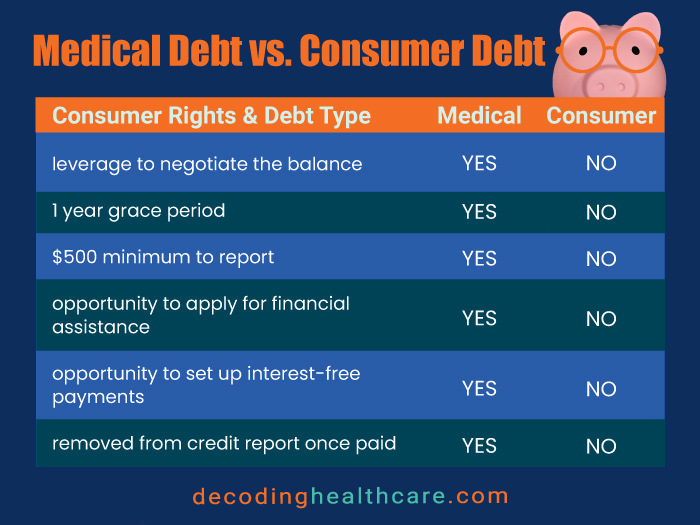
Many people pay medical bills with credit cards not realizing the consequences of turning medical debt into consumer debt.

chart comparing medical debt vs consumer debt rights

We are continuing to modify and rearrange our website content to be more useful for you. As DHC Insider readers, you get to read the new article first.


States Push to Cap Hospital Charges to Control Healthcare Costs   


In an effort to lower healthcare expenses for employers and patients, a growing wave of state legislatures is proposing or passing laws that cap what hospitals can charge commercial insurers. States like Indiana and Vermont have already implemented caps indexed to Medicare rates (for example, limiting hospital charges to around 200% to 260% of Medicare prices), while states like Michigan, Maine, and Delaware are weighing similar aggressive price ceilings. Supporters argue these caps target inflated hospital markups that drive up private insurance premiums, but hospital leadership heavily opposes the trend. Healthcare executives warn that imposing strict price ceilings without addressing rising operational costs could threaten hospital financial stability, lead to service cuts, or even force safety-net facilities to close. So this is another trend to watch and see if it helps out-of-control costs or ends up having unintentional downsides! 


Read the article for more details

Private Equity Exploits Dispute Process, Driving Up Healthcare Premiums 


While the federal No Surprises Act has successfully protected patients from unexpected emergency and out-of-network medical bills, private equity–backed physician groups are abusing the law’s arbitration system in ways that drive up overall healthcare costs. According to the Texas Association of Health Plans and others, a small number of consolidated corporate provider groups have flooded the Independent Dispute Resolution (IDR) process with millions of claims—far exceeding initial federal projections—to extract out-of-network payouts three to four times higher than standard market rates. Over a third of these disputes stem from Texas alone, where specialized third-party firms file mass claims for a cut of the winnings. While patients are still shielded from direct balance bills at the doctor's office, experts warn that this rampant arbitration gaming adds billions in wasteful spending that ultimately trickles down to employers and families through higher monthly health insurance premiums. 


Read the article for more details

Work Requirements for Medicaid Beneficiaries on the Horizon 


If you get your health coverage from Medicaid through your state’s expansion for adults under 65 (in 40 states plus D.C.), major changes are headed your way. Under 2025 federal legislation, most adult enrollees will soon be required to participate in and log at least 80 hours per month of work, school, job training, or volunteering to keep their health insurance. While full federal enforcement kicks off in January 2027, several states—including Nebraska, Montana, Arkansas, and Iowa—are rolling out early or "soft" implementation throughout 2026. The most critical step you can take right now is to ensure your state Medicaid office has your current mailing address, email, and phone number so you don't miss important notices. 


Recent surveys show that over half of Medicaid beneficiaries are completely unaware these rules are coming, putting millions at risk of accidentally losing coverage simply due to paperwork delays. Many people will be exempt, including pregnant individuals, parents caring for children under 14, full-time students, and people with disabilities or qualifying health conditions. If you fit into an exempt category or already work 80 hours a month, you will need to submit documentation or complete your state’s eligibility checks to prove it, or risk losing your benefits. Keep an eye out for mail from your local Medicaid agency so you can submit your reporting or claim an exemption before the deadline. 


Read the article for more details


Monthly Money-Saving Tip

Save Money on Gastroenterology Procedures 


ColonoscopyAssist is a program that “helps uninsured and self-pay individuals to schedule low cost and convenient gastroenterology procedures. Through the program, you can select a nearby provider and easily schedule a colonoscopy, endoscopy, or other gastroenterological procedure at a deeply discounted rate.” It offers transparent, flat-rate, all-inclusive pricing for several procedures in over 40 states. You can select the procedure you need and your city or ZIP code on their facilities page to see the local providers in the program. 


Relevant Resource Share

Alternative Healthcare Options: Voz Salud 


For those looking for alternative healthcare options, Voz Salud is a healthcare membership program created in partnership with LaaSy Health and Voz Media to offer affordable medical access without open enrollment restrictions. It’s available to anyone but is primarily aimed at Hispanic and Latino communities in the U.S. The platform offers tiers ranging from simple telehealth and generic prescription coverage ($29.99–$84.99/month) to bundled medical cost-sharing for major care ($300/month). 


Pros: it provides immediate, 24/7 virtual urgent care, virtual mental health support, and included generic medications at a low cost, making it an accessible option for uninsured individuals or small business owners.


Cons: It’s not traditional health insurance—the lower tiers offer no coverage for hospitalization or emergencies, there are waiting periods for in-person visit reimbursements, and the comprehensive healthshare tier does not guarantee claim payouts under state insurance law.


You can learn more or view plan details at salud.voz.us. 

Learn more about Alternative Healthcare Options, which includes Alternative Health Plans from Decoding Health Care.


Did you find this newsletter helpful? Share it!

X Share This Email
LinkedIn Share This Email

Did someone send this newsletter to you and you want to subscribe?


Feedback & Sponsorship

If you have feedback or ideas for future newsletters or blog topics you want us to research and decode for you, please let us know!

If you have a product or service that promotes medical financial literacy or health and wellness, and you want to get in front of our audience, contact us.

Contact us at info@decodinghealthcare.com


Need to make your voice heard regarding healthcare legislation?

Call your Senator 866-426-2631


About Decoding Health Care

We are consumers just like you! As small business owners and entrepreneurs, we understand the difficulty of navigating the medical system while protecting your finances from the impact of high medical bills. We are here to help by teaching you to reduce out-of-pocket costs, shop for estimates and lower prices, negotiate lower medical bills, and save money on healthcare expenses with or without insurance.


Decoding Health Care provides independent and educational information and does not endorse any specific insurance plans or other health coverage products.