Bytes and Insights Logo

Learn21's Weekly EdTech Update

June 5, 2025

Swipe Right for Learning: Rethinking Screen Time in Schools

By: Danni Tymitz

The conversation around student screen time is evolving, and for good reason. As digital tools become increasingly embedded in teaching and learning, the question isn’t just how much time students spend on screens, but what they’re doing while they’re there.


For years, educators and parents alike have defaulted to the binary of “active” vs. “passive” screen time. Passive screen time often refers to scrolling through feeds, watching videos, or consuming content without interaction. Active screen time, by contrast, might involve creating digital art, coding a program, collaborating on a shared document, or designing a website.


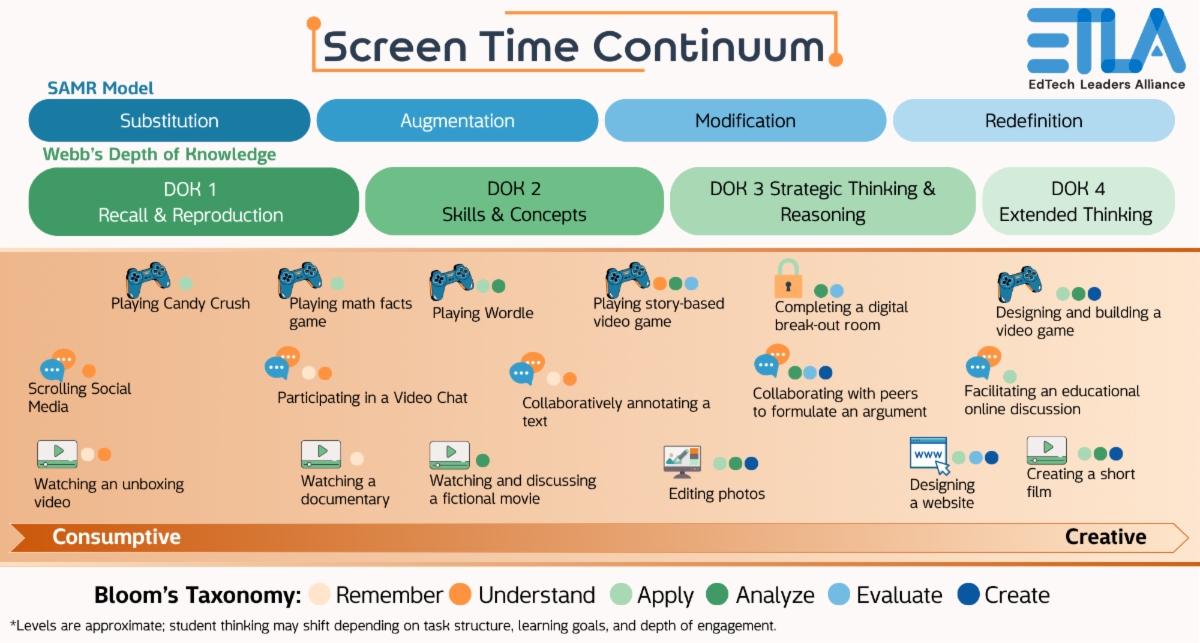
But even that binary falls short. A more useful model is a continuum of screen time, ranging from consumptive to creative use. This shift allows us as educators to move beyond blanket assumptions and focus instead on the depth of student engagement and thinking.


Consumptive screen time is the digital equivalent of passive consumption—watching videos, clicking through slides, or engaging in games with limited challenge or purpose.


Creative screen time invites students to become producers, not just consumers: designing, building, writing, coding, and problem-solving. These are the digital spaces where real learning lives.


This framework echoes Depth of Knowledge (DoK) with creative screen use aligning with higher-level thinking: extended tasks, strategic use of tools, iterative problem solving, and application of multiple skills. A student coding a simple game is not just engaging with technology, they’re synthesizing logic, design, storytelling, and perseverance.


Similarly, video games can be rich learning environments when intentionally selected and integrated. Games that involve critical thinking, collaboration, and design are very different from those that simply entertain.


As the American Academy of Pediatrics (AAP) has recognized in its updated guidance, the quality of digital interactions matters more than the quantity. While past recommendations were focused on time limits, the AAP now advises schools and families to consider the developmental needs of learners, the context of digital use, and the educational value of screen-based experiences.


For school leaders and educators, this means our role is not to eliminate screen time but to curate and guide it. Whether through computer science lessons, multimedia storytelling projects, or collaborative digital research, we have the opportunity to frame screen time as a vehicle for creativity, agency, and deeper learning.


It also means we must help students learn to self-regulate and reflect on their screen habits supporting them as they develop the metacognitive and digital citizenship skills necessary to thrive in both digital and physical worlds.


And yes, even in schools, balance matters. Especially during summer break, students benefit from unstructured play, physical movement, and time outdoors. But as we build or revise instructional plans for the year ahead, we should also take stock of our digital practices:


  • Are we reserving screen use for tasks that truly benefit from it?
  • Are students being given time to create, not just consume?
  • Are we modeling and encouraging intentional, meaningful digital use?


When we ask better questions about screen time, we can shift the narrative from one of restriction to one of intentionality and empowerment for our students and ourselves. Use the Screentime Continuum at your school - Download the PDF.

Media Literacy Minute

Media Literacy Minute

In Deep Trouble: Tech-Powered Harassment in K–12 Schools

The Center for Democracy & Technology’s new report, In Deep Trouble, examines how students are using digital tools, including AI, deepfakes, and anonymous apps, to engage in tech-powered sexual harassment and abuse. The report reveals a troubling rise in nonconsensual image sharing, deepfake pornographic content, and social media harassment in school communities. CDT calls for stronger digital literacy education that includes consent, privacy, and ethical technology use, as well as policy support for victims and training for educators.


Why Kids Can’t Stop Saying “Six Seven”

This lighthearted but revealing article explores how TikTok audio trends like “six seven” go viral among children. Experts caution that while these phrases seem harmless, they reflect how deeply platform-driven content shapes communication habits and cultural references, even among very young kids.

Read more →


Fake Summer Reading List Fools Newspapers

An AI-generated fake book list made to look like a legitimate summer reading guide fooled several local news outlets into publishing it. The incident serves as a cautionary tale about the speed and automation of misinformation and the need for stronger source verification in journalism and education.

Read more →

The Pulse of Progress: What the 2025 CoSN EdTech Leadership Report Tells Us About the Road Ahead

By Stacy Hawthorne, Ed.D.

Each year, CoSN’s State of EdTech District Leadership report offers a window into what’s happening behind the scenes in K-12 technology leadership. This year, that view is sharper and more urgent than ever.

The 2025 report paints a picture of an EdTech landscape in flux: priorities are shifting, budgets are tightening, and the pressure to lead with clarity and impact has never been higher.


One of the most telling findings? Cybersecurity is still a top priority, but district leaders are moving beyond reactive measures. The shift toward strategic, system-wide approaches signals real progress and a recognition that culture, policy, and people are just as critical as firewalls and filters.


Meanwhile, AI has officially arrived on the priority list, but not without uncertainty. Leaders acknowledge its potential, but many are still unsure how to implement AI in meaningful, equitable, and ethical ways. The takeaway? We need more than tools, we need frameworks, training, and brave conversations.


And amid these tech-heavy conversations, one human insight stands out: building leadership capacity is emerging as a top challenge. That’s a powerful reminder that innovation doesn’t scale without skilled people to lead it.


The report also doesn’t shy away from hard truths: staffing shortages, flat budgets, and increasing complexity are the new normal. But rather than leaning into despair, it calls on us to double down on smart strategy, shared leadership, and solutions rooted in community needs.


Whether you're a CTO, superintendent, instructional leader, or policymaker, this report is a must-read. It offers not only data but direction and a challenge to all of us: If we want better outcomes for students, we need stronger systems, smarter policies, and a deep commitment to developing the people who make it all possible.


Download the full report from CoSN and share it with your team. Then ask: What needs to shift in your district—and how will you lead that change?

Big Ideas

AI’s New Ally: The Emerging Power of Collective Human-AI Problem Solving

In a new preprint, researchers show that human-AI collaboration can generate more novel and creative ideas than either working alone. These hybrid teams aren't just faster—they're smarter, solving complex problems in ways neither party could do independently. What does it mean when the best "team member" might be part human, part machine?

Read the article


A Real Tooth Fairy: Scientists Grow Human Teeth in the Lab

King’s College London researchers have achieved a regenerative medicine milestone: lab-grown human teeth. These bioengineered teeth could one day replace implants, offering natural regeneration instead of artificial fixes. Could dentistry be the first frontier of truly personalized regenerative health care?

Read the article


Beyond the Spectrum: Scientists Claim Discovery of a New Human Color

A new pigment, YInMn Blue, may be unlocking colors we’ve never seen before—literally. Scientists now say we’ve found a shade that lies outside the traditional color gamut humans typically perceive. Could this discovery redefine not just art and design—but how we understand perception itself?

Read the article

If you'd like to take a hiatus from Bytes & Insights, please use the Update Profile link below. This will allow you control over which emails you receive from Learn21.

X Share on X
LinkedIn Share on LinkedIn

www.learn21.org

LinkedIn        X        YouTube        Instagram