The Spring 2021 Montana NSF EPSCoR newsletter is now available! Read more about what's happening with CREWS leads, researchers, and students, learn about EPSCoR and its history in Montana, and keep up to date with announcements, events, and opportunities, plus much more. You can find this newsletter and all other past Montana NSF EPSCoR newsletters online at https://www.mtnsfepscor.org/resources/newsletters.
|
|
Antony Berthelote Moves into New Position at Salish Kootenai College |
|
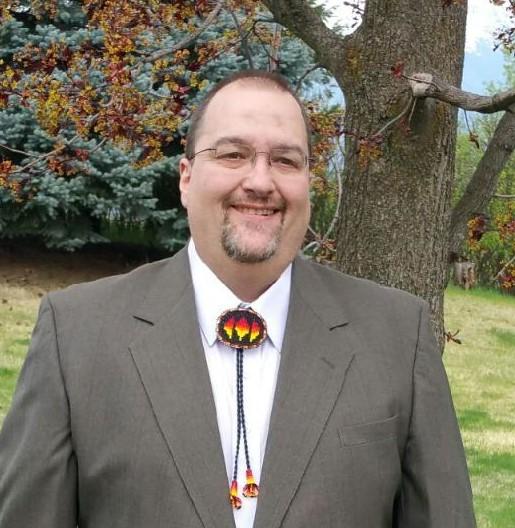
Antony Berthelote, a CREWS project lead at Salish Kootenai College (SKC), recently moved into the new position of Vice President of Enrollment Management and Student Affairs at SKC. This position, created to respond to student success needs, works with the current Vice President of Academics and Vice President of Business Affairs at SKC to unify multiple initiatives and future directions for the college. Berthelote was previously the only Confederated Salish and Kootenai Tribal STEM Ph.D. instructor at the college and now oversees 14 Departments and approximately 25% of the SKC family in his new role. Although Berthelote will no longer be teaching in this role, he says “I am still excited every day to do what I am now doing. I get to integrate all the student services on campus to better our student experiences.” |
|
Libby Metcalf Named Inaugural Joel Meier Distinguished Professor of Wildland Recreation at University of Montana |
Libby Metcalf, a CREWS project lead at the University of Montana working with the Natural Resource Social Science team, was named as the inaugural Joel Meier Distinguished Professor of Wildland Recreation in the W.A. Franke College of Forestry and Conservation. This honor recognizes Metcalf’s exceptional leadership and accomplishments in research, teaching, and service in and beyond the Parks, Tourism, and Recreation Management arena. The endowed professorship was sponsored by Joel and Patti Meier, both active environmentalists and philanthropists who have supported many UM programs in the past. |
|
Postdoctoral Researcher Rafael Feijo de Lima Presents at Montana Chapter of the American Fisheries Society Annual Meeting |
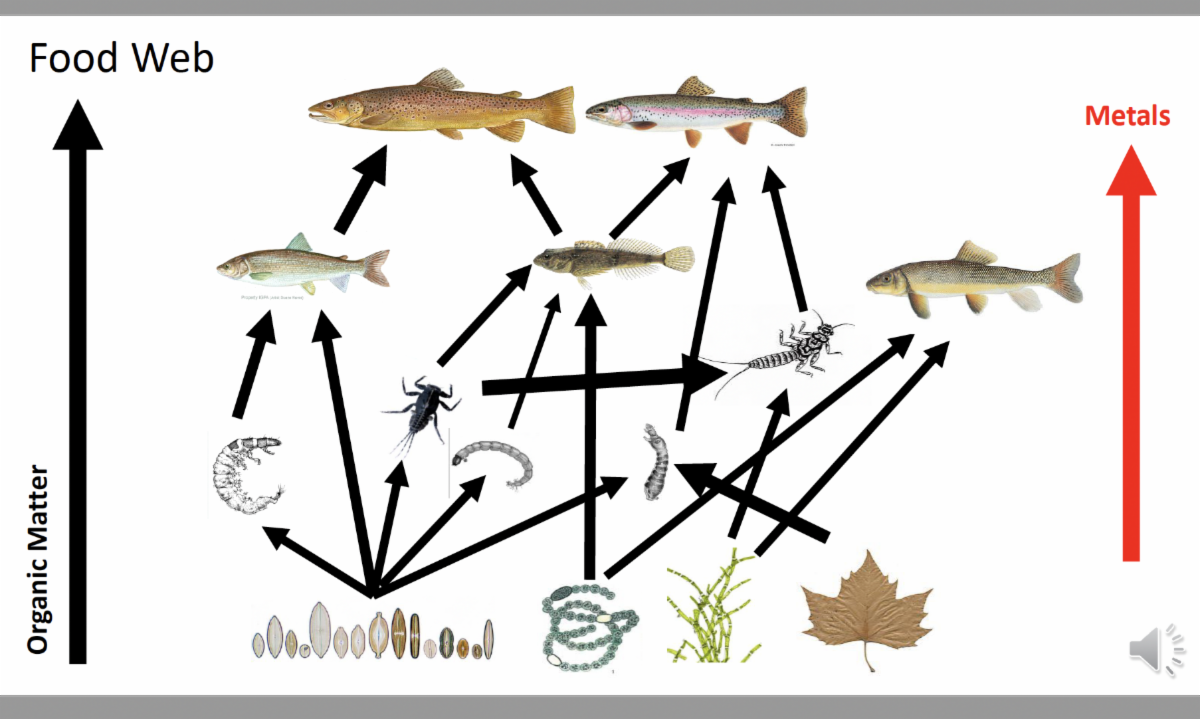
In early March, Rafael Feijo de Lima, a CREWS postdoctoral researcher at the University of Montana working with the Upper Clark Fork River (UCFR) team, presented at the Montana Chapter of the American Fisheries Society annual meeting. His talk, titled “Disentangling the impacts of multiple stressors in the Upper Clark Fork food web,” focused on ongoing multidisciplinary efforts to disentangle the effects of multiple stressors and provide information to restoration efforts and stakeholders in the UCFR. As described in the presentation abstract, “The UCFR headwaters suffer from mining legacy impacts and also nutrient enrichment caused by land use and other natural features of the watershed. These impacts historically led to a major decline in riverine integrity. The Montana EPSCoR-CREWS project has one of its main objectives to determine how heavy metals contamination, coupled with nutrient enrichment, alter aquatic ecosystems, acting as subsidies and stressors in the UCFR.” This presentation was produced as a collaborative effort among several CREWS researchers and students across UM and MSU, including Feijo de Lima, Ben Colman, Wyatt Cross, Taylor Gold-Quiros, Jose Ruiz Sanchez, Joe Shaw, and Maury Valett. |
|
Saying Goodbye and Best Wishes to spectrUM's Hedi Casquilho-Gray |
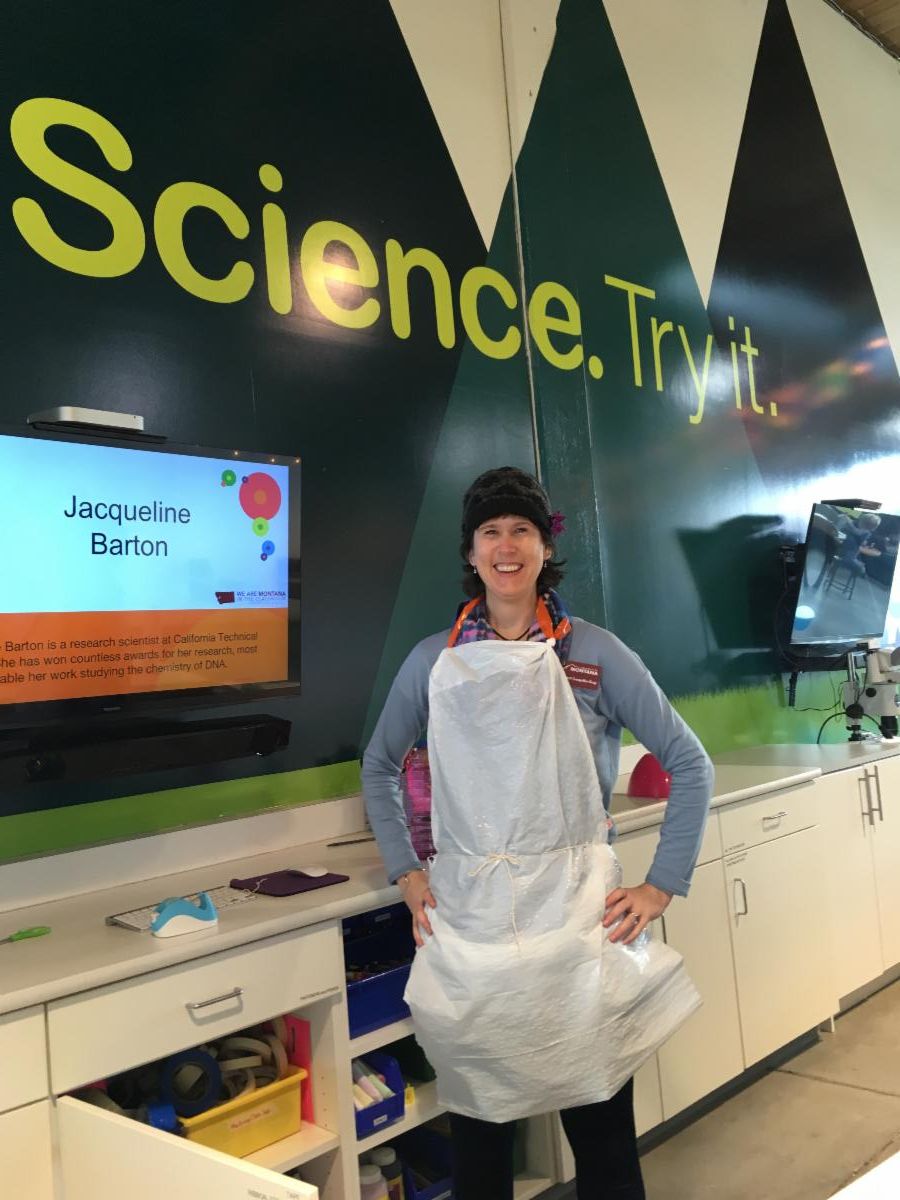
CREWS is saying a bittersweet farewell to our colleague Hedi Casquilho-Gray, who will be leaving her position at the University of Montana in June to begin a new career as a high school science teacher in Hawaii. Hedi will be joining Teach for America, which trains and supports promising leaders to teach in low-income communities. As associate director of finance and operations with UM’s Broader Impacts Group (BIG) and a biologist by training, Hedi has shared her expertise as both a grant administrator and an informal science educator with the CREWS broader engagement team. When she isn't managing spectrUM Discovery Area’s funds, Hedi is often behind their Discovery Bench leading fun, hands-on STEM activities with K-12 students and their families or pitching in at many of spectrUM and BIG's outreach programs and camps. Hedi always brings a wonderful sense of humor and creative problem-solving attitude to whatever she's doing, whether that's "counting the beans" or making slime with kids. Hedi will be missed by CREWS, but we wish her well in her teaching career and are certain her students will benefit from her love of science and learning.
|
|
CREWS Commercialization Intern Highlight:
Alyson Welch
|
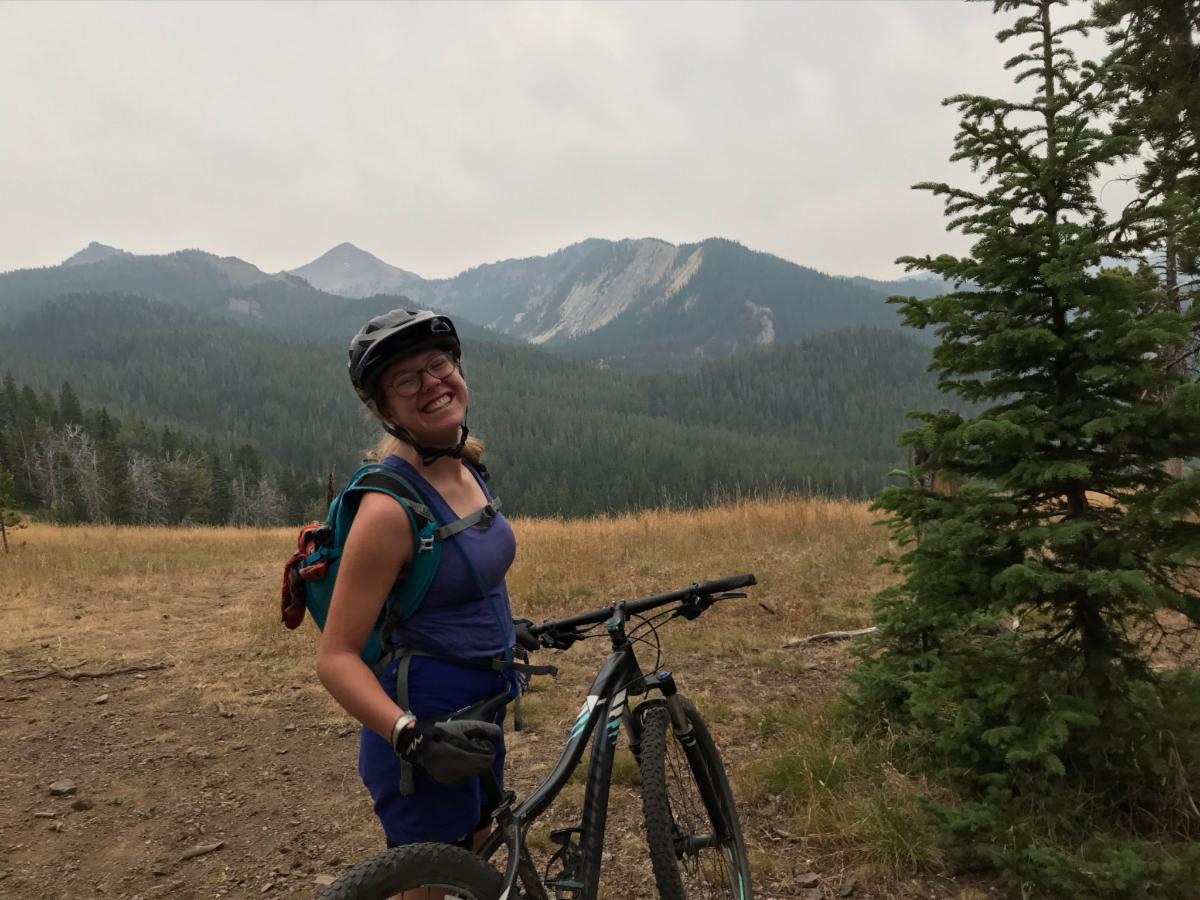
Alyson Welch is a third-year undergraduate student at Montana State University studying biological engineering who has spent the year working on a CREWS innovation and commercialization internship with Drs. Wyatt Cross and Robin Gerlach as her advisors. The basis for her internship project is to address the inefficiency of an ecological studies method called invertebrate separation. Ecologists use invertebrate separation, which is typically carried out by handpicking the bugs out of samples under a microscope, to identify the invertebrates in benthic river bottom samples. Identifying the invertebrates in these samples is key for determining the health and status of rivers. To address inefficiencies in this method, Welch is using digital imaging to take pictures of the bugs in the samples. She hopes that by identifying the invertebrates from the images rather than handpicking, this advance will make the method of study much more time-efficient while still remaining cost-effective. When she’s not working on her internship project, Welch enjoys spending her free time outside. |
|
|
|
About EPSCoR
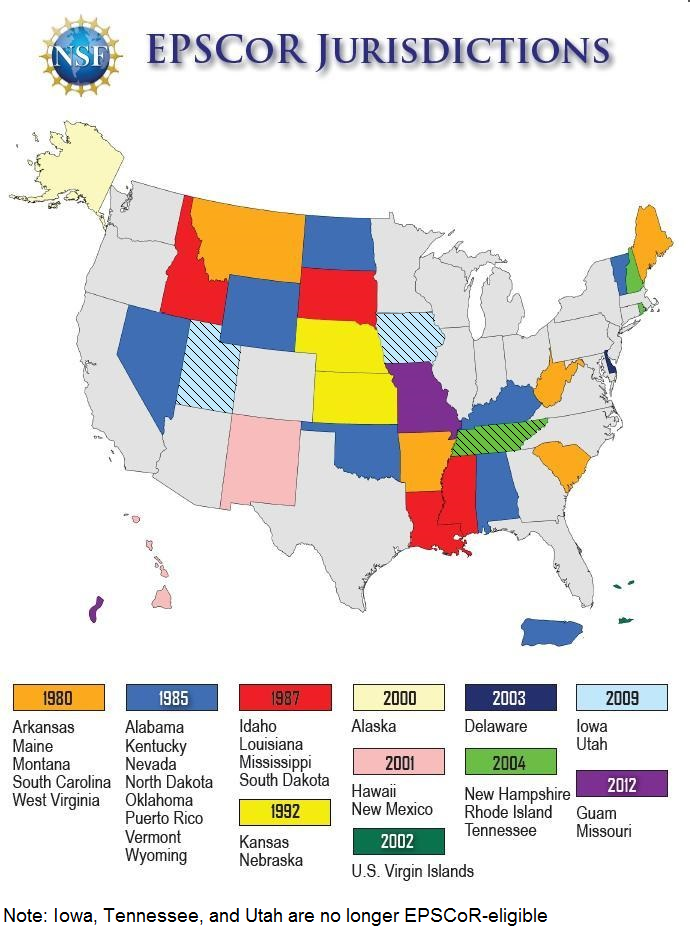
The Established Program to Stimulate Competitive Research (EPSCoR) is a program developed by the National Science Foundation to “enhance competitiveness of targeted jurisdictions by strengthening STEM capacity and vulnerability." Created in 1978 in response to concerns over uneven distribution of federal research and development grants, EPSCoR has grown over time to now span five federal agencies and twenty-seven jurisdictions, which includes states and territories like Guam and the U.S. Virgin Islands. At a national level, EPSCoR has five goals: 1) Catalyze research capability across and among jurisdictions; 2) Establish STEM professional development pathways; 3) Broaden participation of diverse groups and institutions in STEM; 4) Effect engagement in STEM at national and global levels; and 5) Impact jurisdictional economic development.
EPSCoR awards are granted through multiple pathways. For example, Track-1 awards provide up to $4 million per year for up to five years with a focus on improving the research competitiveness of jurisdictions, whereas Track-2 awards provide up to $1 million per year for up to four years with a focus on building interjurisdictional collaborative teams of EPSCoR investigators. Researchers in Montana have even been granted Track-4 awards, also called EPSCoR Research Fellows, that provide non-tenured investigators the opportunity to further develop their research potential through extended collaborative visits to top private, governmental, and academic research centers.
Based on the success of EPSCoR, many other national programs have been developed that follow an EPSCoR-model, including the National Institutes of Health’s IDeA Networks of Biomedical Research Excellence (INBRE), the Department of Defense’s Defense Established Program to Stimulate Competitive Research (DEPSCoR), and NASA EPSCoR.
|
|
EPSCoR in Montana
Montana was one of the five initial jurisdictions selected to participate in the program starting in 1980 (along with Arkansas, Maine, South Carolina, and West Virginia), and at that time received $3 million over the course of five years. In the program’s early years in Montana, the majority of support from EPSCoR awards went to Montana State University and the University of Montana, but over time support has expanded to include institutions across the Montana University System, tribal colleges, and private colleges.
Since 1980, EPSCoR has supported seven Track-1 projects, six Track-2 projects, and two Track-4 projects in Montana. These projects are listed below in descending chronological order; to learn more about each, please click the respective link:
|
|
The Next RII Track-1 Proposal
Another important aspect of EPSCoR is the Montana Science and Technology Committee (MSTC). This committee “is charged with providing the Board of Regents, the Commissioner of Higher Education, the Montana legislature, and the Governor with policy advice on how to advance Montana’s science and technology landscape and more closely tie university research activities to Montana’s societal and economic needs.” In addition to developing and communicating Montana’s Science and Technology Plan, MSTC plays an important role with Montana NSF EPSCoR by overseeing the state’s active Track-1 project and serving as the steering committee for the program. The MSTC also serves to select future EPSCoR project proposals based on whether the stated research area is one of the most compelling long-term issues for Montana and has the best potential to improve the future research and development competitiveness of the state. For a complete list of MSTC members please visit https://mus.edu/che/arsa/Research/mstc-membership.html.
The next RII Track-1 project, which will focus on a new set of research questions, is slated to begin in 2023. We’re excited to announce that our own Rob Walker has been named the next RII Track-1 Project Director. A big congratulations from Montana NSF EPSCoR and everyone on the CREWS project - we are looking forward to your leadership on the next project!
|
|
Role Models Matter Training
Now Available to Watch
|
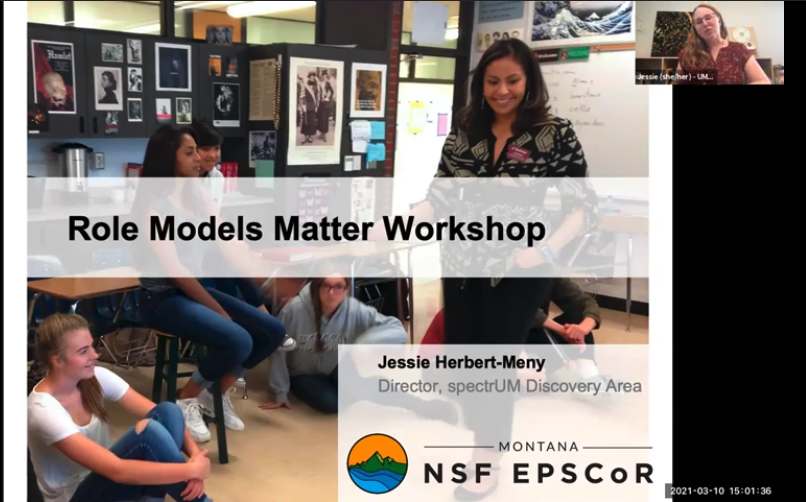
Jessie Herbert-Meny from spectrUM Discovery Area presented a virtual “Role Models Matter” training to students on the CREWS project in early March. As part of the training, Herbert-Meny focused on how to build skills to effectively engage public audiences, taught participants the key ingredients to a successful role model interaction, and shared opportunities to engage with youth and the public in science and science research. READ MORE
|
|
|
|
CREWS Working Group Websites |
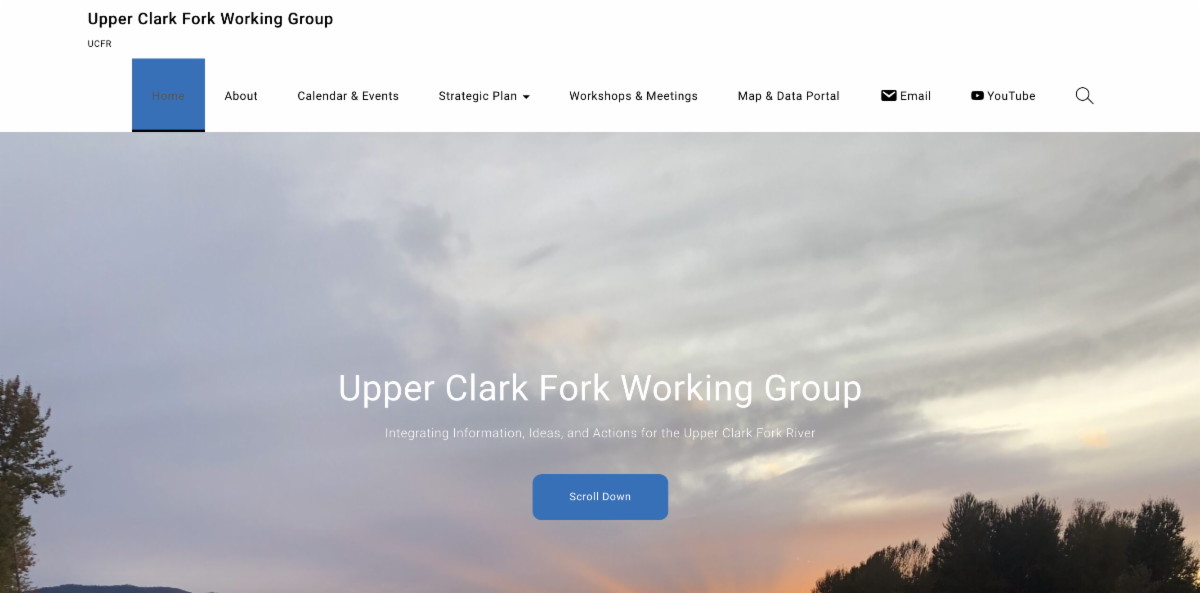
Have you seen our CREWS Working Group websites? The Upper Clark Fork Working Group (UCFWG) and Judith River Watershed Working Group (JRWWG) now have their own websites! Learn more about each group’s focus, find relevant resources and presentations, and keep up to date with research progress and opportunities to engage through these websites. To visit each site, click on the buttons below.
|
|
|
|
CREWS-U Webpage Goes Live |
A new webpage for CREWS-U is now available on the Montana NSF EPSCoR website! CREWS University or “CREWS-U” is a resource for Montana professionals ranging from land resources managers and wastewater operators to K-12 teachers and informal educators who wish to obtain professional development and resources that relate to the research findings and broad concepts of the Montana NSF EPSCoR Track-1 CREWS project. This page will continue to be updated as new resources are made available. For questions about CREWS-U or to submit a suggestion for a new course or resource, please contact Suzi Taylor at taylor@montana.edu or Madison Boone at madison.boone@montana.edu.
|
|
|
|
Upcoming Events and Opportunities |
|
CREWS Team Meetings
CREWS-JRW Team Meeting
Tuesday, April 20 at 12 p.m.
CREWS-PRB Team Meeting
Thursday, April 29 at 1 p.m.
UCFWG Topic Discussion
Thursday, May 8 at 12 p.m.
|
|
Trainings and Workshops
Water Quality Professional Panel
Monday, April 19; 3:00 p.m. - 4:30 p.m.
Join the Water Quality Professional Panel to learn more about the types of careers that can be found in the environmental water fields. The panelists, partners of the Upper Clark Fork Working Group, will represent federal agencies, state agencies, and private companies at various stages of their careers. More information
|
|
Did you know that April is Citizen Science Month?
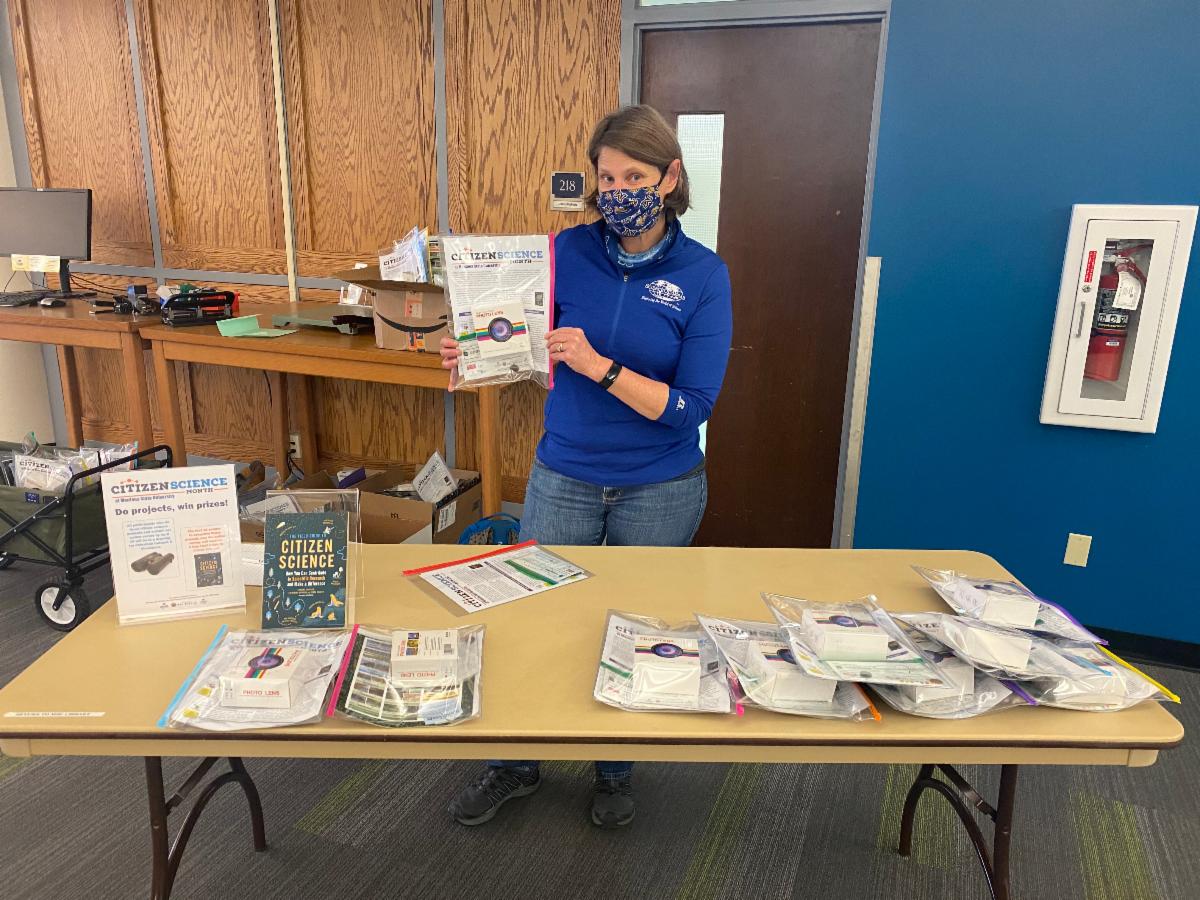
Citizen science connects scientists and everyday people to help accelerate research and discovery. It can involve one person or millions of people collaborating towards a common goal and is a valuable way to engage the university community and have the public learn about, participate in, and contribute to science through both informal recreational activities and formal research efforts. To celebrate Citizen Science Month, Montana NSF EPSCoR, in partnership with the Science Math Resource Center, Montana State University Library, and others, gave away free citizen science kits on April 12 and 13 at the Library. Each kit contained the necessary materials and instructions to participate in five different citizen science projects, as well information on similar kinds of research at MSU and more ways to get involved in citizen science programs (for example, through SciStarter.org). READ MORE
|
|
|
|
Do you have an idea, story, event, or opportunity that you would like included in a future Montana NSF EPSCoR newsletter? Please contact Madison Boone at madison.boone@montana.edu
|
|
|
|
|
|
|