E-Newsletter | October 2, 2020 |
|
For centuries, fire has been an essential aspect to survival while also being one of the greatest liabilities, especially in Colonial America. Controlled use in cooking fires, housewarming, and candlelight allowed settlements to flourish and thrive. However, if command of this vital element slipped, it could have disastrous effects on the very people it aided. Old Newbury, like all its neighboring towns, lived with this fear every day. With little means to suppress or extinguish a blaze without help from the weather, townspeople fought conflagrations with the strongest tool they possessed: community.
During these early fires, total loss of a structure was almost inevitable unless an alarm was sounded early by watchful neighbors and the flames could be overwhelmed with sheer force of numbers. The citizens of Newbury had primitive appliances and methods to employ when a blaze began. “Ladders borne on the shoulders of men from the nearest workshop or farmhouse were raised to the roof of the burning building; and water, by means of buckets passed from hand to hand, was thrown with more or less dexterity upon the devouring flames.”
As Newburyport grew, structures were built increasingly close together. The mercantile center became so populated that it separated from the more spread-out agricultural town of Newbury in 1764. Only the most expensive buildings in this new settlement were constructed out of brick, so the timber of the downtown houses, shops and warehouses posed a significant threat to the bourgeoning community. It was fast becoming a dense, wooden firetrap.
The success of the society depended on the expectation that all available community members assisted in an emergency, either to aid in the suppression of the flames or salvage any personal belongings from a home or business in peril.
|
|
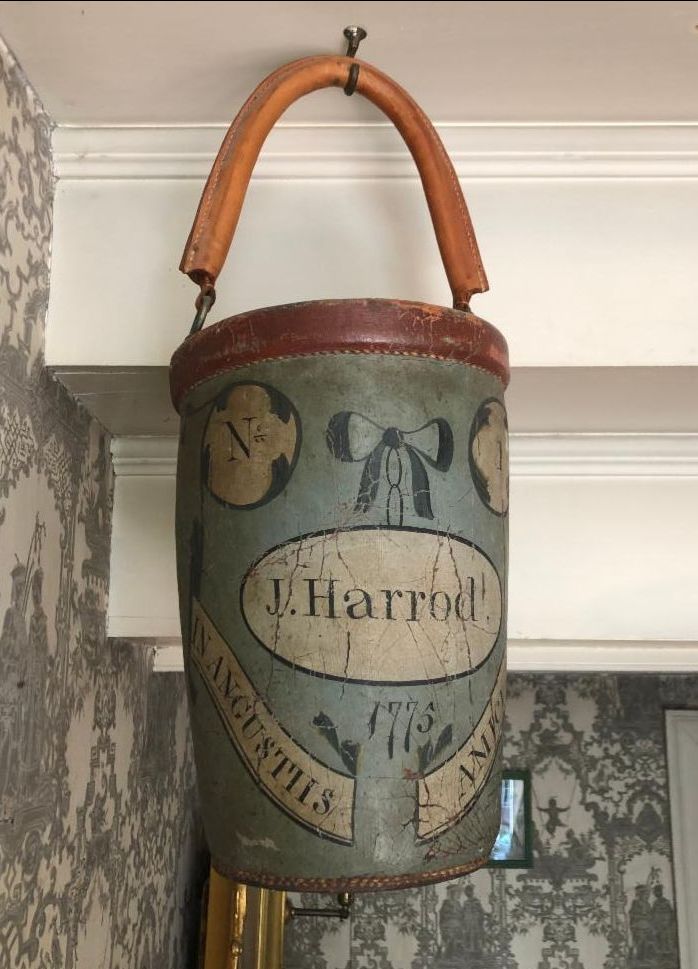
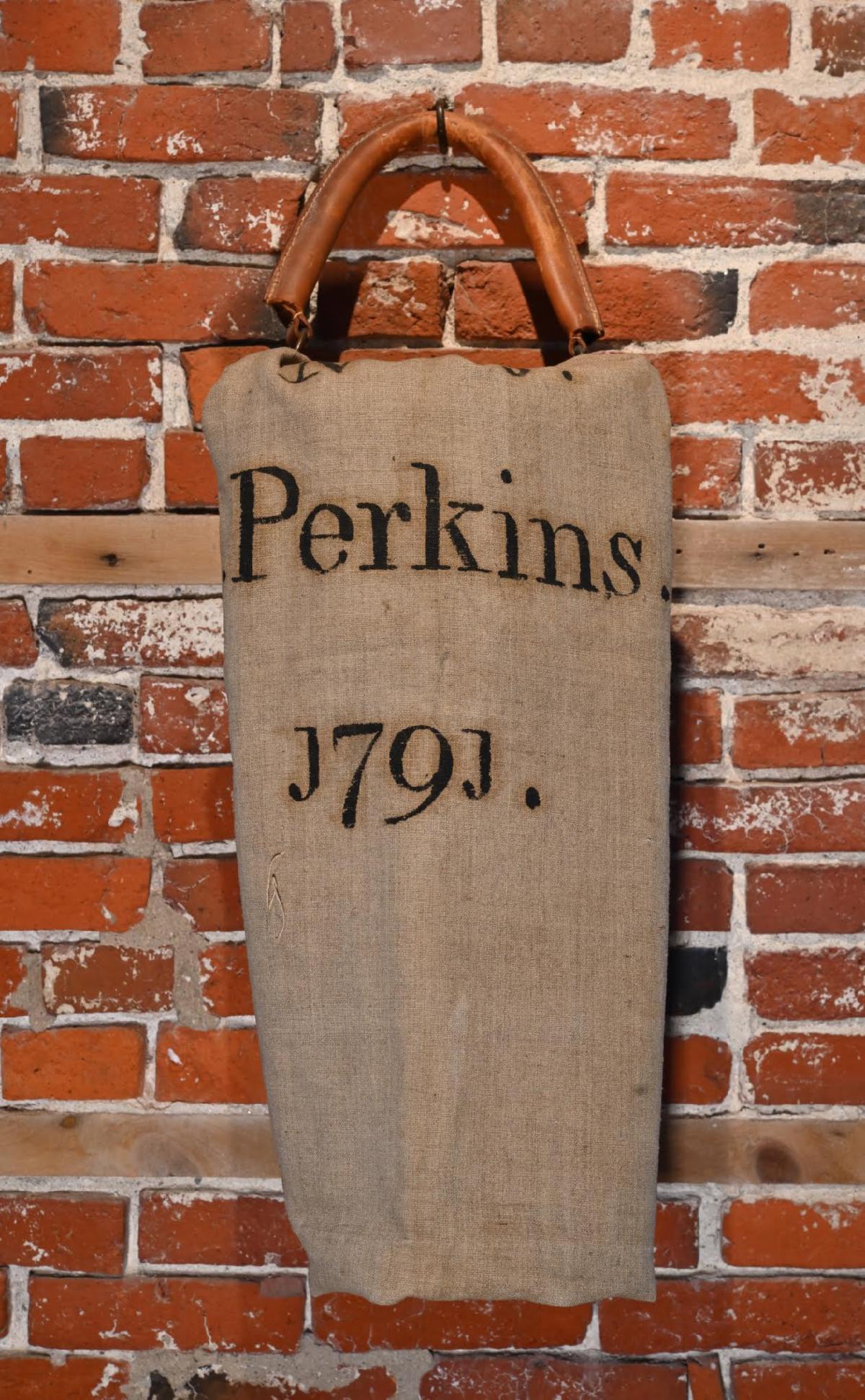
18th century fire bucket from the Harrod family of Newburyport. Linen salvage bag belonging to Abraham Perkins (1768-1839), lived at 18 Fruit Street. From the collections of the Museum of Old Newbury. |
|
Fire buckets, therefore, became essential and ubiquitous safety equipment in almost every household. It was common practice to keep these containers near the entranceway of one’s home. Constructed of leather with leather-covered rope handles, fire buckets held between two and three gallons of water. Rolled up in each bucket would also have been a large coarse linen bag used to quickly gather up and remove possessions from a burning structure. Fire buckets and bags were typically the property of individual people and their names and bucket number were painted on the side.
Once an outbreak of fire occurred, a “bucket brigade” was formed. It consisted of two lines of people extending from either a town well or nearby resident’s well to the fire. Buckets of water were passed down the first line to the fire and empty buckets were returned via the second line back to the well to be refilled. Having a name on the fire bucket allowed for its return to the rightful owner after it was used communally to fight a blaze. The Newburyport Herald would regularly run notices of lost fire buckets if they were not brought back.
Firefighting slowly formalized as fire engines developed and volunteer associations formed. Newbury was petitioned by concerned citizens in 1753 to allow a fire engine, or a ‘hand tub,’ which probably would have consisted of “a cistern on wheels, fitted with pumps worked by levers and supplied with water brought in buckets from the nearest available source of supply.” By 1761, the town had imported a more advanced engine model from London and supported an organized company of 15 men to respond to fire emergencies.
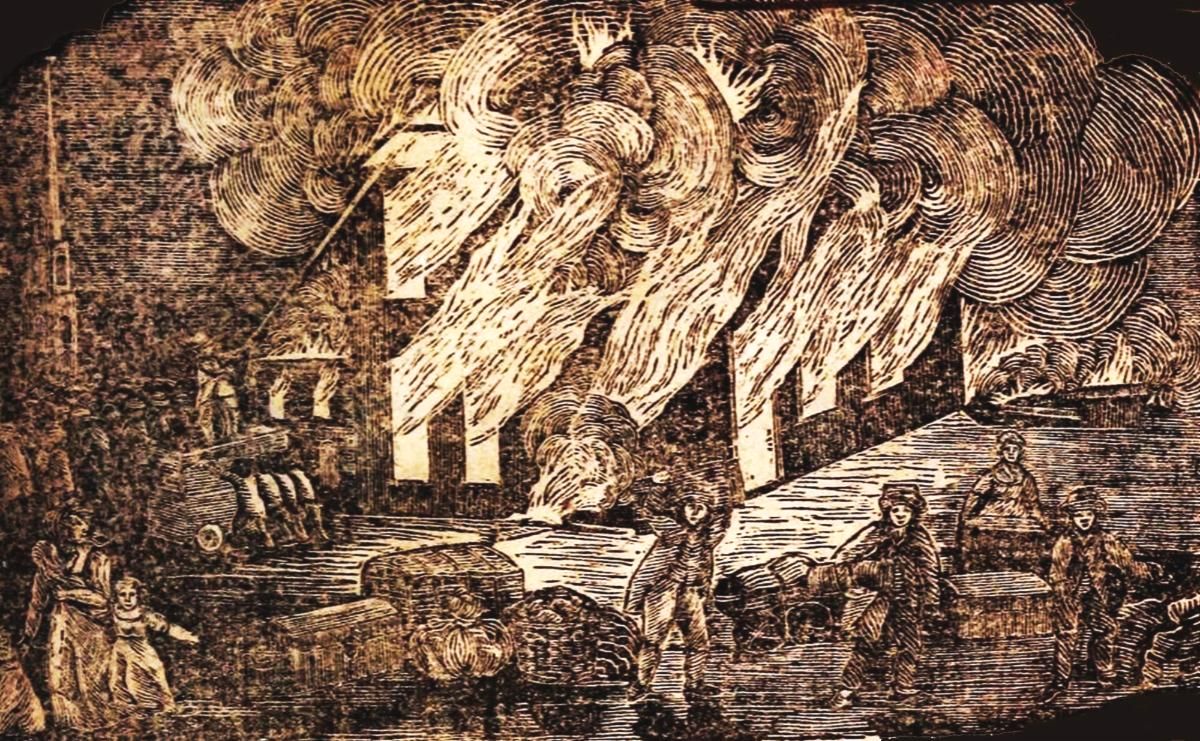
Unfortunately, all the fire engines, buckets and preparation were not enough to subdue the Great Fire of 1811. The blaze, which started in Mechanics Row (now Inn Street) on the night of May 31, resulted in the destruction of downtown. Nearly 250 buildings were burned, most of which were stores and dwelling houses. It was estimated that 16.5 developed acres were destroyed, “containing a much larger proportion of wealth of the town than any other part.”
Drastic action to ward against fires were instituted in Newburyport after that, including the Brick Acts of 1811 and 1812. They mandated that all new buildings rebuilt between Federal and Market street had to be made of stone and brick and that firewalls were to be constructed between the sections of the buildings. They also limited the height of the structures so fireman could more easily reach the top stories.
Despite its devastating nature, fire helped create the Newburyport we know today.
|
|
Woodcut illustration from an 1811 publication entitled "An Account of the GREAT FIRE which destroyed about 250 buildings in Newburyport on the night of the 31st of May 1811, taken principally from the statements which have appeared in the public newspapers." From the collections of the Museum of Old Newbury. |
|
Online Silent Auction a Success!
Two mature Clivia plants, generously donated to the museum by MOON member Dolores White, have found new homes.
Betsy Ware and Lindsay Cavanagh were the two high bidders. Many thanks for your support of the museum.
Susan C.S. Edwards, executive director, Museum of Old Newbury, explains, "This is the first time we tried something like this and it worked pretty well."
Similar to a silent auction, people were asked to submit their bids via email. After the first bids came in, the standings were shared with all participating folks.
Colleen Turner Secino, marketing and membership engagement for the museum, explains, "Updates of the most current bidding were sent to participants each day leading up to the close of Tuesday, September 29. Even if you just want to follow the process, not unlike walking around an in-person silent auction to see what's what, it is important that you submit at least one email bid so you are included on the standings distribution."
The process is still being fine-tuned, but plan on seeing future "Silent Auction" opportunities. Turner Secino, quips, "To paraphrase John Van Buren, be sure to bid early and often."
|
|
"Yeat Yeat, Don't Tell Me!" Airs Today at Noon!
Join your hosts Jack Santos, Custom House Maritime Museum, and Colleen Turner Secino, Museum of Old Newbury, for the area's most informative and fast-paced trivia show.
Zoom in for all the fun here.
|
|
Puzzle Me This...Long May She Wave
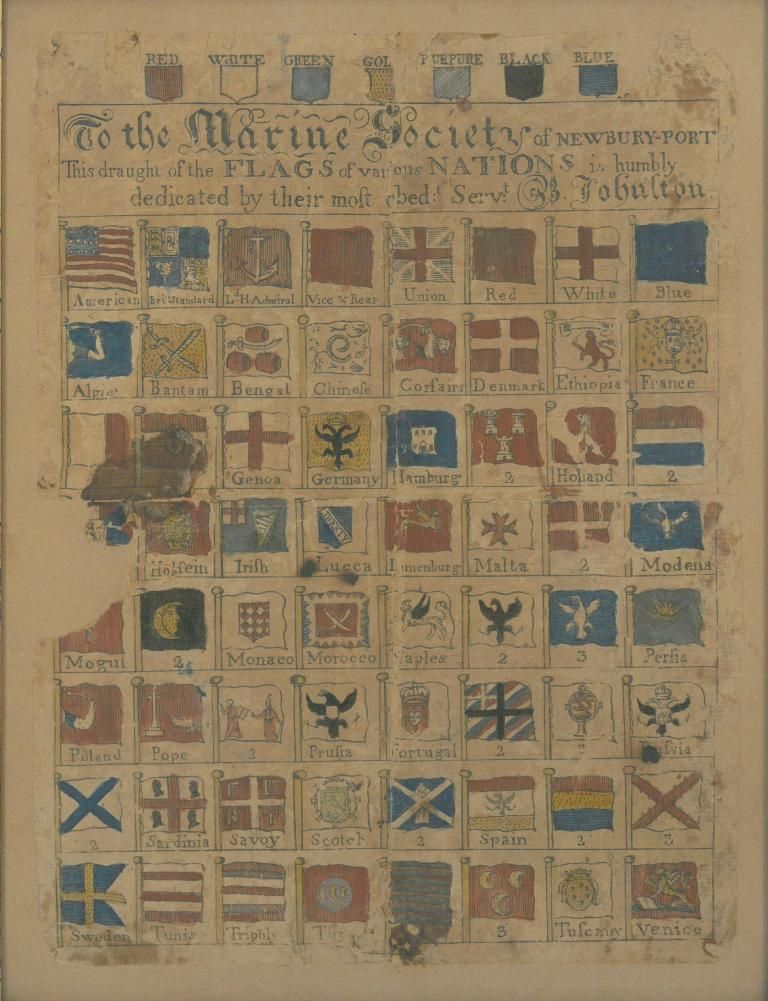
Sixty-four marine ensigns of forty nations are shown here and dedicated to the Marine Society of Newburyport, founded in 1772. Flags were an important means of identification at sea, and charts such as these would have been consulted by shipmasters. The ensigns for America and France, shown here, date this chart between 1777 and 1792.
About “Flags of Various Nations” - Colored engraving, ink and watercolor on paper by Benjamin Johnston (1742-1818), Newburyport, before 1792. From the collections of the Museum of Old Newbury.
Click on the image to begin.
|
|
Something is Always Cooking at the Museum
Fall is in the air! What better way to warm up than with former museum board member and volunteer extraordinaire Peg McClure's scrumptious roasted hens with stuffing. Hens are surprisingly easy to work with and positively delicious...robust without being overly gamey. Chance of a nice red to accompany the meal? 100-percent!
Cornish Hens with Apricot Rice Stuffing
4 Cornish game hens
1 cup sliced fresh mushrooms
3/4 cup chopped pecans
1/2 cup chopped onions
6 tablespoons butter, divided
1 cup cooked wild rice
1/2 cup chopped dried apricots
1 tablespoon minced parsley
1/2 teaspoon salt
1/4 teaspoon pepper
1/8 teaspoon cayenne pepper
1/2 cup apricot preserves
1 tablespoon white vinegar
In a large skillet, sauté mushroom, pecans and onion in 4 tablespoons butter until tender. Stir in rice, apricots, parsley, salt, pepper and cayenne. Spoon about 3/4 cup mixture into each hen; tie legs together.
Place hens, breast side up, on rack in a shallow roasting pan. Melt remaining butter, drizzle over hens. Bake, uncovered, at 350ºF for 2 hours. In a small saucepan, warm preserves and vinegar. Spoon over hens and bake 15 minutes longer. Serves 4.
|
|
During this difficult period of COVID-19, we rely on your support more than ever. We are working to reschedule many of the programs that we have had to postpone, as well as develop new, online programs for you to enjoy and keep us connected. We hope, if you are able, that you will consider a donation to the museum. Thank you for your continued support.
|
|
Museum e-Newsletter made possible through the
generosity of our sponsors:
|
|
|
Museum of Old Newbury
98 High Street
Newburyport, MA 01950
978-462-2681
|
|
|
|
|
|
|
|