Hearing The Word


A weekly newsletter delivering context and insight into the Sunday Gospels.


July 12, 2026

Fifthteenth Sunday in Ordinary Time

Matthew 13:1-23


On that day, Jesus went out of the house and sat down by the sea. 

Such large crowds gathered around him

that he got into a boat and sat down,

and the whole crowd stood along the shore. 

And he spoke to them at length in parables, saying:

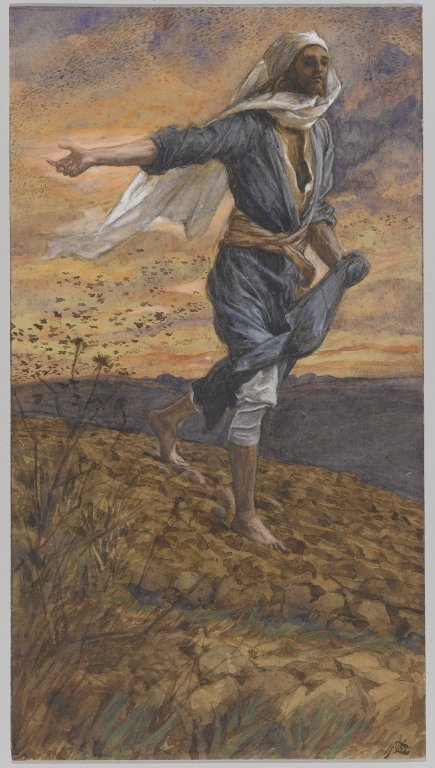
"A sower went out to sow. 

And as he sowed, some seed fell on the path,

and birds came and ate it up. 

Some fell on rocky ground, where it had little soil. 

It sprang up at once because the soil was not deep,

and when the sun rose it was scorched,

and it withered for lack of roots. 

Some seed fell among thorns, and the thorns grew up and choked it. 

But some seed fell on rich soil and produced fruit,

a hundred or sixty or thirtyfold. 

Whoever has ears ought to hear."


+


A VIEW FROM THE PULPIT ...

providing insight into the Gospel's meaning


Rich Soil, Growth, Receptivity


Rev. David M. Friel, S.T.D.

Director of Liturgy, Saint Charles Borromeo Seminary + Ambler, Pa.


Jesus proposes a fourfold image in this parable: seed that falls 1) on the path, 2) on rocky ground, 3) among thorns, and 4) on rich soil. He interprets the meaning Himself, identifying the first three groups as deficient because they 1) lack understanding, 2) have no roots, and 3) give in to worldly anxiety. The fourth group is different, symbolizing the person who both hears and understands the Word of God.


Something important to note is what Jesus does not propose in this image. There is no fifth category of seed that falls on rich soil and immediately sprouts into a full-grown plant. It is clear that Jesus is pleased with those who fall in the fourth category, despite the fact that time for growth will be required for them to come to full stature. Hearing and understanding are praised, even though they be partial. The gradualness of human life seems not to bother Jesus; it seems, in fact, to delight Him.


Another thing not to miss is the imagery’s lesson on agency and receptivity. Just as in the first reading from Isaiah, which portrays the Word of God as precipitation that nourishes and fertilizes the earth, so in this parable God’s Word is presented as coming to us gently, from above. Our task is to receive the blessing that is showered upon us, not to plant or grab or seize it for ourselves. We should certainly tend the soil of our hearts, but our lives aren’t sustained by our own efforts. We live by every word God sends down to nourish us. He is the primary actor in our growth toward holiness.


A VIEW FROM THE PEW ...

offering testimonies on how the Gospel is meaningful


Called to Sow, Not to Judge


~Jennifer Dusza

Saint Mary Catholic Church + Schwenksville, Pa.


When I read the Parable of the Sower, I typically envision God sowing the seeds of grace on all His people, and I think about what type of “soil” I am - whether I fully accept it, partially accept it, or reject it altogether. That kind of self-examination is both necessary and fruitful. This time, however, I approached the passage from a different perspective. I put myself in the position of the Sower.


In the parable, the sower simply sprinkled the seed everywhere- generously over all types of soil and terrain without bias or judgment. He doesn’t stop to assess which soil seems fertile and which is unlikely to bear fruit. We should strive to be more like this- doing good always. It is not our job to judge whether another is “worthy.” It is simply our job to be Christlike to all we cross paths with. Our responsibility is to reflect the Will of God in our thoughts, words, and actions. Ultimately, how another responds to us is between him and God.


In my own life, sowing seeds takes simple but intentional forms: praying before and after meals, even at restaurants; inviting others to attend Mass with me, even if they aren’t currently practicing their faith; and remaining faithful to the truth of the Church’s moral teaching, even when they are unpopular in today’s culture. As I grow in my spiritual life and my understanding of Church teachings, I also grow in the comfort of not needing acceptance from the world around me. If my actions are done with love, compassion, and truth then I can be at peace knowing that my role is simply to plant the seeds. God is the One who prepares the soil, nurtures the growth, and brings forth the fruit. My intention is never to offend or pressure others into accepting my beliefs. Rather, I am called to faithfully sow the seeds of the Gospel and lovingly respect each person's freedom to receive or reject the goodness that God offers to all His children.


How would you rate the overall quality of our Commentary Series?


X Share This Email
LinkedIn Share This Email
Instagram