| | |
POLICY & ADVOCACY UPDATE
Issue #79, 17 September 2026
| | | |
- From the AA CEO James Goodwin
- Advocating for our workforce in Canberra
- Migration reforms announced
- One Nation's migration policy announced
- Apprenticeship and traineeship numbers continue to fall
- Capital city preliminary data for the 8 months to August
- Job vacancies up in July
- Passenger Movement Charge debated in Parliament
- Tourism employment surges in the June quarter
- Overseas arrivals for July 2026
- Regional towns take centre stage at 2026 Top Tourism Town Awards
| |
| |
From the AA CEO
Home Affairs Minister Tony Burke made his much-anticipated migration policy announcement at the National Press Club in Canberra today. It’s a poor outcome for our sector but the Government has continually signalled that migration cuts have been coming, in a bid to try to appease the political pressure the government is under on immigration.
| | | | |
Cuts to migration will make an already tight labour-market even tighter, forcing industries to compete for a smaller pool of workers. I was at the speech with colleague Stephen Ferguson from the Australian Hotels Association – read our media statement here.
There is more detail below but in short, working holiday makers have been targeted with the introduction of a ballot system for second and third year visas. This would be a 40 per cent cut in the number of working holiday makers compared to this year and distorts the incentive to work in regional areas.
In addition, our sector will not be considered a priority sector for skilled visa processing and there were no announcements about how the workforce shortages will be addressed through training more locals for the skills we need.
We have raised these concerns directly with Home Affairs, Austrade, and the Skills Minister Andrew Giles and Tourism Minister Don Farrell in Canberra over the past week. We will continue to work through the details in coming days.
James Goodwin
Chief Executive Officer
| | |
Advocating for our workforce in Canberra
Migration, visa processing, and workforce funding were the dominant topics during our meetings with Home Affairs, Austrade, ACCI, and the Hon Andrew Giles MP, Minister for Skills and Training, in Canberra last week. With migration such a sensitive issue at the moment, these meetings gave us a platform to advocate for our industry, arguing that significant cuts to migration targets, particularly for skilled migrants and international students, would negatively affect the accommodation sector, especially without adequate funding to support it. Working Holiday visas were also discussed, given how vital these visas are to our industry, both as a source of labour and as tourists in their own right. As motivated and mobile workers, they form an essential part of our workforce, often filling roles and regional locations that are difficult to staff through other visa pathways. We were clear about the challenges posed by the current halt and slowdown in WHM visa processing, which is leaving employers and working holiday makers alike in the lurch. We pushed for changes to the conditions required for second- and third-year visas, and argued for dissolving the postcode system used to delineate regional and remote areas, which we believe creates arbitrary distinctions that don't reflect where the workforce need actually exists.
Days after these meetings, the Government unveiled its migration reform package, confirming a ballot system for second- and third-year Working Holiday visas — 45,000 places in year two, 5,000 in year three — alongside a commitment to stabilise processing times to three months. It's a sign our message on processing delays landed, though the existing regional work requirement remains in place, meaning the postcode issue we raised is still very much unresolved.
These meetings, and the speed with which policy has followed them, underscore just how live this issue is right now, and how important it is that our industry's voice is heard clearly amid the broader political noise. We'll continue to push the case that migration and workforce policy need to reflect the realities of accommodation businesses on the ground.
| | |
Migration reforms announced
The Labor government has announced their long-awaited reforms to migration, aiming to bring Net Overseas Migration forecasts down from 292,100 in the year to March 2026 to 245,000 in this financial year and 225,000 by 2027-28. For an industry that leans heavily on visa-dependent labour, several of these changes are worth watching closely. These include:
- Tighter enforcement to ensure people without valid visas leave the country.
- Improving the integrity of student visas, including restrictions on family members accompanying students (with exemptions).
- Introducing a No Further Stay condition to all visitor visas to ensure they are only used by genuine visitors and not as a pathway to extending a stay in Australia.
- Changing the Working Holiday Maker Program to introduce a ballot system for second- and third-year visas – 45,000 places for year two, 5,000 for year three – with the existing regional work requirement retained. Processing times will be stabilised to three months for all WHM applicants except those from the UK.
- Ministerial Direction 119 will be updated to fast-track priority sectors, including healthcare, construction, education, law enforcement, defence, resources, agriculture, aquaculture and fishing.
The Department of Home Affairs is yet to release comprehensive details of the cuts to the specific Working Holiday and Work and Holiday visas, nor has it released specific numbers for international students. Minister for Home Affairs Tony Burke has maintained that immigration is fundamentally a strength to Australia, and that the reforms are about ensuring the system is better targeted to the country's current needs rather than shutting the door on the people who help keep it running. For more information, please see here.
| | |
One Nation's migration policy announced
One Nation announced its migration policy on Monday, 14 September, proposing to cut the temporary migrant population by roughly 750,000 over three years to achieve "net-negative" migration. The plan would cap main student visas at 100,000 grants a year (cutting the student visa population, including families, from around 590,000 to 350,000), replace the graduate visa with a new capped visa limited to 20,000 grants a year (down from a population of roughly 270,000 to 40,000), and end new family/dependant visas for temporary skilled workers, while leaving the primary employer-sponsored skilled visa program uncapped.
Industry reaction to the policy has flagged two particular concerns. The cut to international student numbers is expected to hurt not only the broader economy and tourism sector, but the accommodation workforce directly, where international students make up a significant share of staff, particularly in CBD properties. There are also concerns about the proposed restriction on secondary visas for skilled visa holders: while a preference for single applicants may be manageable at junior levels, it becomes unworkable for senior recruitment -- roles such as hotel general managers or head chefs -- where confining the talent pool to single applicants only would significantly narrow the available candidates.
| | |
Apprenticeship and traineeship numbers continue to fall
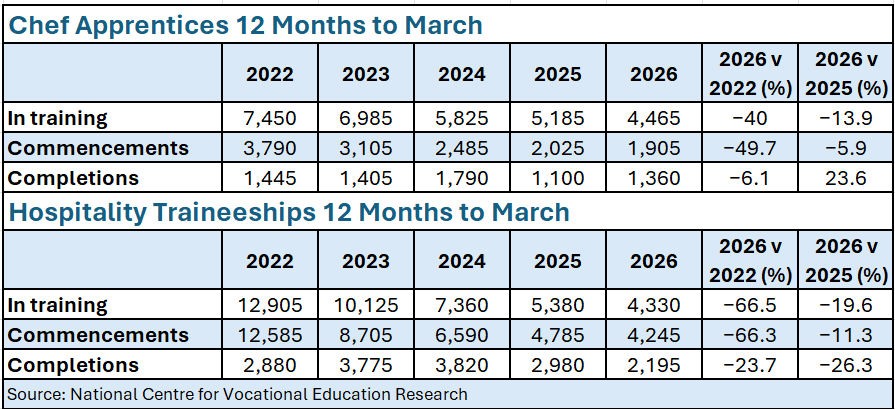
The latest NCVER apprenticeship figures, released this week for the year to March 2026, confirm that chef apprenticeship and hospitality traineeship numbers continue to decline. Nationally, trade commencements fell 1.1% over the year, while non-trade commencements dropped 13.4%. The steepest falls in apprenticeships were in the ACT and Tasmania, while non-trade occupations fell hardest in Victoria and Western Australia.
As the table below shows, chef commencements and in-training numbers have both fallen sharply over the year to March 2026, down 5.9% and 13.9% respectively. Completions, however, rose 23.6% – from 1,100 to 1,360 – largely reflecting apprentices who started during the COVID-19 incentive boost now finishing their training. Hospitality traineeships tell a similar story, continuing to fall across all three measures following the earlier withdrawal of incentives. Commencements are down 11.3% on the previous year, in-training numbers have fallen 19.6% to 4,330, and completions are down 26.3% to 2,195.
| | |
Capital city preliminary data for the 8 months to August
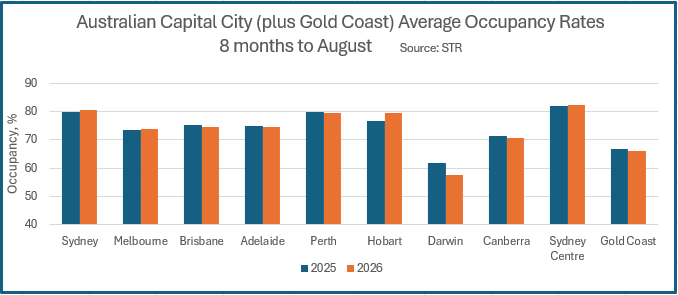
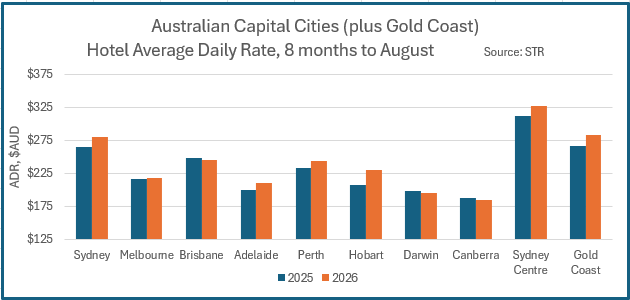
Preliminary capital city CoStar data for the 8 months to August shows a mixed picture across Australia's capital cities, with some markets posting occupancy gains and rate growth, while Brisbane, Canberra, and Darwin recorded softer conditions on one or both metrics.
- Sydney saw a 0.9% increase in occupancy to 80.5%, while ADR increased 5.8% to $280.34.
- Melbourne occupancy rose 0.4% to 73.7% and ADR increased 0.9% to $218.53.
- Brisbane occupancy fell 0.9% to 74.6% and ADR decreased 1.2% to $244.70.
- Adelaide occupancy fell 0.5% to 74.5%, and ADR rose 5.2% to $209.99.
- Perth occupancy fell 0.3% to 79.5%, and ADR was up 5.0% to $244.31.
- Hobart occupancy rose 3.6% to 79.4% and ADR rose 11.0% to $230.57.
- Darwin occupancy fell 6.5% to 57.7% and ADR fell 1.7% to $194.70.
- ACT and Canberra occupancy decreased 0.6% to 70.8% and ADR was down 2.2% to $183.82.
- Gold Coast occupancy was down 0.8% to 66.0% and ADR up 6.3% to $283.47.
| | |
Job vacancies up in July
Online job advertisements rose 3.9% to 212,327 in July 2026, but were down 2.0% over the 12 months to July, according to data released last month by Jobs and Skills Australia (JSA). The picture varies across hospitality roles: hotel and motel manager listings slipped 0.5% for the month and 6.9% for the year; chef ads fell 0.4% and 6.2% respectively; and cooks fared worst, down 2.8% for the month and 23.8% for the year.
Separate JSA data tells a similar story. Hospitality, retail and service manager vacancies rose 10.5% in the May quarter compared with the previous year and were up 1.4% over the 12 months to May 2026. Food trades vacancies (cooks, chefs, butchers, bakers, pastrycooks) fell 1.7% for the May quarter year-on-year and 10.8% over the 12 months to May, while hospitality worker vacancies overall rose 3.5% for the May quarter year-on-year but were down 27.9% annually. Read together, both datasets point in the same direction: annual demand for skilled kitchen labour is contracting even as broader hospitality management vacancies hold up, suggesting the pressure is concentrated in back-of-house roles rather than the sector as a whole.
| | |
Passenger Movement Charge debated in Parliament
In the Federation Chamber on Thursday, 10 September, MPs continued debate on the Passenger Movement Charge Amendment Bill 2026, which would raise the charge from $70 to $80, netting the government $755 million over 4 years. Labor’s Claire Clutterham defended the increase as a modest measure supporting border protection, customs, immigration and biosecurity. The Coalition remained firmly opposed, with Alison Penfold, David Littleproud, and David Batt warning that it risks damaging tourism competitiveness and regional economies, citing Treasury's own modelling that a 1% increase in airfare costs translates into a 0.5% reduction of tourists coming to Australia in the short term and a 2.5% decrease in the medium term. Alison Penfold also noted that the bill does not guarantee that the additional revenue will be reinvested in border infrastructure. The Greens’ Elizabeth Watson-Brown also opposed the bill, framing it as a cost-of-living hit on families, while raising separate calls for stronger flight-delay consumer protections and investment in high-speed rail. The debate was adjourned without a vote.
| | |
Tourism employment surges in the June quarter
Tourism jobs grew 4.1% in the June quarter 2026 compared to the same period in 2025, according to data released this week by the Australian Bureau of Statistics (ABS) — well ahead of the broader economy, which grew 2.6% over the same period. Accommodation led the way, with filled jobs up 17.7% on June quarter 2025, the largest increase of any tourism-related industry. At 136,600 filled jobs, this is just short of the peak of 137,300 recorded in the March quarter, but the highest June quarter result on record.
| | |
Overseas arrivals for July 2026
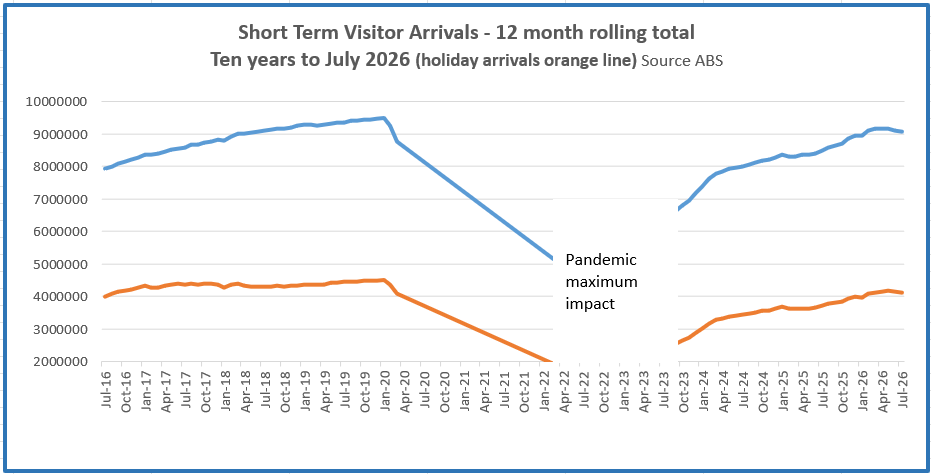
Reflecting the travel difficulties created by the middle east crisis and consequent global economic conditions, according to ABS data released last week, short-term visitor arrivals in Australia decreased by 4.3% in July 2026 to 710,980 compared with July 2025. Holiday arrivals also dropped by 5.2% to 277,540. Employment and education were the only two categories to increase year-on-year, at 9.9% and 0.7% respectively. New Zealand remained the largest source market, contributing 134,260 visitors, followed by China with 117,440 and the USA with 46,450. Among the top ten source countries, New Zealand, India, South Korea, and Taiwan recorded arrival volumes above their July 2019 levels.
The 12-month rolling total provides a clearer picture of underlying trends by smoothing monthly fluctuations and highlighting both the recent recovery and the remaining gap to pre-COVID visitation levels, particularly among holidaymakers. In the 12 months to July 2026, total arrivals reached 9,068,890, an increase of 6.9% compared with the year to July 2025. Holiday arrivals totalled 4,113,310, up 11.2% over the same period. For context, annual holiday arrivals peaked at 4.48 million in the year to December 2019, indicating that while the sector continues to recover, it has not yet fully returned to pre-pandemic levels.
| | |
Regional towns take centre stage at 2026 Top Tourism Town Awards
Stanthorpe, Queensland has been crowned Australia's Top Tourism Town for 2026, taking out the Gold award at a ceremony held at Parliament House on Monday, 14 September. Presented by the Australian Tourism Industry Council, the awards celebrate the regional towns and guides delivering standout visitor experiences. In the Small Tourism Town category, Airlie Beach, QLD took Gold, ahead of Gulgong, NSW (Silver) and Portarlington, Victoria (Bronze). Portsea, Victoria won Gold in the Tiny Tourism Town category, with Toogoolawah, QLD and Port Arthur, Tasmania taking Silver and Bronze respectively. For the full list of winners, see here.
| | |
Drop me an email at policy@accommodationaustralia.org or give me a call on 0418 277 919 if you have any national policy issue that you think AA should be following up. If you know an AA member who is not receiving this advocacy report but wants to, then encourage them to email me and we can add them to the distribution list. Back issues of the fortnightly advocacy updates can be found here.
Kind Regards
Jenny Lambert OAM
National Policy Director
Accommodation Australia
| | | | |