|
Last night, I went to the movies with my son to see Wildwood. We settled into our seats, and almost immediately, I noticed how loud the theater was. Not just loud in the way we've come to expect from movie theaters. It was painfully loud.
I found myself reaching into my bag for my AirPods. I put them in, turned on noise cancellation, and left the music off. I wasn't trying to escape the movie. I just needed to make the experience more comfortable. It worked beautifully. I could still hear the dialogue, follow the story, and enjoy the movie with my son. The overwhelming volume was gone, but everything that mattered was still there.
And yes, I recognize the irony of using technology to make a technology-driven experience more enjoyable.
This morning, while reading yet another article about parents' perceptions of screen time in schools, I found myself thinking about those AirPods.
Wouldn't it be wonderful if we could turn down the volume on our national conversation about educational technology? Not to silence anyone or ignore legitimate concerns, but to hear what people are actually saying. I think we're hearing a lot of noise and sometimes missing the conversation.
Three Perspectives, One Complicated Conversation
Over the past couple of days, I've encountered three different perspectives on children and technology.
First, I read an October 9 New York Times guest essay by child psychiatrist Dr. Jonathan Slater, titled I'm a Child Psychiatrist. Screens Are Not the Problem.
Dr. Slater argues that our focus on screen time risks distracting us from deeper challenges facing children, particularly inadequate access to mental health services. Drawing on research examining children's technology use and mental health, he distinguishes between the amount of time spent on screens and patterns of compulsive or addictive use.
His point isn't that technology is harmless. It's that counting hours doesn't necessarily tell us which children are struggling, why they're struggling, or what support they need.
Then, this morning, I read an Education Week article by Alyson Klein examining how educators perceive parents' attitudes toward technology in schools.
According to the survey of 596 educators, 57% of urban educators said parents in their communities believe the amount of technology used in schools is about right. That number fell to 40% among suburban educators and 38% among educators in rural areas and towns. The headline suggests that resistance to educational technology is strongest in suburban and rural communities.
That's an interesting finding, but there's an important distinction worth examining. The survey asked educators what they believe parents think. It didn't ask the parents themselves.
Meanwhile, the National Parents Union's May 2026 survey asked parents directly and found that 74% believed their child's school used computers and tablets about the right amount. Only 17% thought schools used them too much. Interestingly, 75% of those same parents supported establishing daily screen-time limits, while just 1% wanted no screen time for learning at all.
So, which perspective is right? Or is that even the right question?
We're Not Necessarily Hearing Contradictions
Here's what strikes me about these findings: they aren't necessarily contradictory.
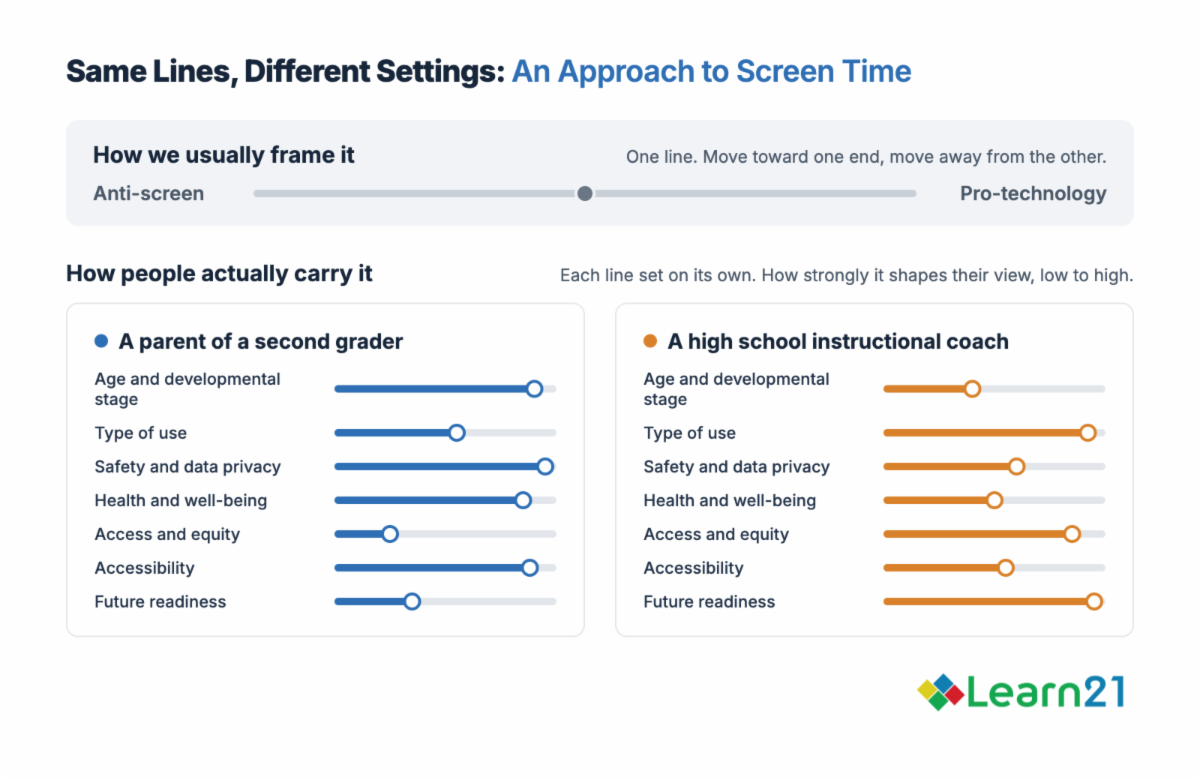
A parent can believe their child's school uses technology about the right amount and still want reasonable limits. They can appreciate a digital learning experience and question whether another one is worth the time it consumes. They can be concerned about social media, compulsive technology use, or excessive reliance on digital worksheets while enthusiastically supporting opportunities for students to code, create, collaborate, and solve authentic problems. That's not inconsistency. That's discernment.
In fact, one of the most interesting observations in the Education Week article comes from a suburban Chicago teacher who describes parents questioning time spent on adaptive learning platforms while enthusiastically supporting digital projects where students program robots and create objects using 3D printers.
Think about that for a moment. The same parents. The same school. The same general category of technology. Very different reactions. What changed? The purpose.
When parents can see students creating something meaningful, their perceptions of the technology may change. When technology appears to be little more than a digital substitute for a worksheet, they may reasonably question its value.
Of course, even that distinction deserves scrutiny. Not every creative project produces meaningful learning, and not every adaptive learning experience is without value. This reminds us that the conversation is far more sophisticated than a simple debate about how many minutes students spend looking at screens.
The Danger of Listening Only to the Loudest Voices
Something else caught my attention in the Education Week article.
Lila Byock, a Los Angeles parent and founder of Schools Beyond Screens, raised the possibility that the parents whose concerns receive the most attention aren't necessarily representative of all families. She pointed to the disproportionate influence of affluent parents in shaping public conversations. That's worth considering, particularly when educational leaders are trying to understand what their communities want.
We should absolutely listen to parents who are concerned about technology. Their experiences and questions matter. But we also have a responsibility to seek out the perspectives of families who aren't attending every school board meeting, writing opinion pieces, or participating in organized advocacy.
What does the parent whose child finally has reliable access to advanced coursework think? What about the family whose student uses assistive technology to communicate or participate more fully in the classroom? Or the parent who has watched their child become deeply engaged in learning because a teacher found a creative way to use technology?
This is a reminder that demographic differences deserve investigation, not assumptions. A rural community's relationship with educational technology may be shaped by different opportunities, challenges, and experiences than those of an urban or suburban community.
Good leadership requires us to understand those differences rather than turn them into competing headlines.
Turning Down the Volume Is Not the Same as Tuning People Out
I want to be careful with my movie theater analogy because there's an important difference between filtering out distractions and ignoring information we don't want to hear. Research that challenges our assumptions isn't noise. Neither are parents who disagree with us or students who tell us that technology is making their school day harder. Those perspectives are signals that deserve our attention.
The noise comes when we reduce complex findings to simplistic headlines, treat isolated experiences as universal truths, or allow the conversation to become a contest between people who supposedly love technology and people who supposedly hate it. Neither camp adequately represents the thoughtful educators and families I've encountered across the country.
Most people want children to be safe, healthy, engaged, and prepared for the future. They want learning experiences that are meaningful and developmentally appropriate. They want technology to serve children rather than the other way around.
Those are goals we can build on. Perhaps we'd make more progress if we spent less time arguing about which side is winning and more time identifying where we already agree.
A Challenge for Educational Leaders
Here's something I'd encourage every educational leader to try.
Before your next conversation about screen-time limits, device policies, or educational technology purchases, invite a few people who don't usually participate in those discussions. Include parents, teachers, and students with different experiences and perspectives.
Then ask them two questions:
- Tell me about a time technology made learning possible, more meaningful, or more accessible.
- Tell me about a time technology got in the way of learning or well-being.
Listen to both answers with equal curiosity. Resist the urge to defend an existing practice or immediately propose a solution.
You might discover an instructional experience worth expanding. You might identify a digital practice that needs to disappear. You might learn that a concern you assumed was about screen time was actually about instructional quality, communication, student well-being, or access. You might also find that the people you expected to disagree with have more common ground than anyone realized.
Last night, my AirPods didn't eliminate the sound in the theater. They helped me experience it differently. I could still hear the story without being overwhelmed by the volume. That's what I'd like us to accomplish in our conversations about educational technology.
Not fewer voices. Not less research. Not an escape from uncomfortable questions. Just enough space to hear the nuance, understand what matters, and make better decisions for students.
When we turn down the rhetoric, we might finally hear the learning.
|