E-Newsletter | November 20, 2020 |
|
A Bridge Too Far
Crossing the Merrimack, Timothy Palmer & the Chain Bridge
|
|
During early colonial settlement, the Merrimack River between Newbury and Salisbury was vital to commercial and agricultural pursuits. As it was dangerous and unpredictable, a safe way to cross this section was essential for successful trade routes to flourish between developing eastern cities such as Boston, Salem, Portsmouth, and Portland.
The first formal crossing in this area began humbly as a ferry service that navigated the water on either side of Carr’s Island. A floating bridge was built in the late 17th century to facilitate travel, but as downtown Newburyport prospered, its location at the foot of what is now Jefferson Street was not as convenient. The crossing was moved further down river to Ring’s Island.
|
|
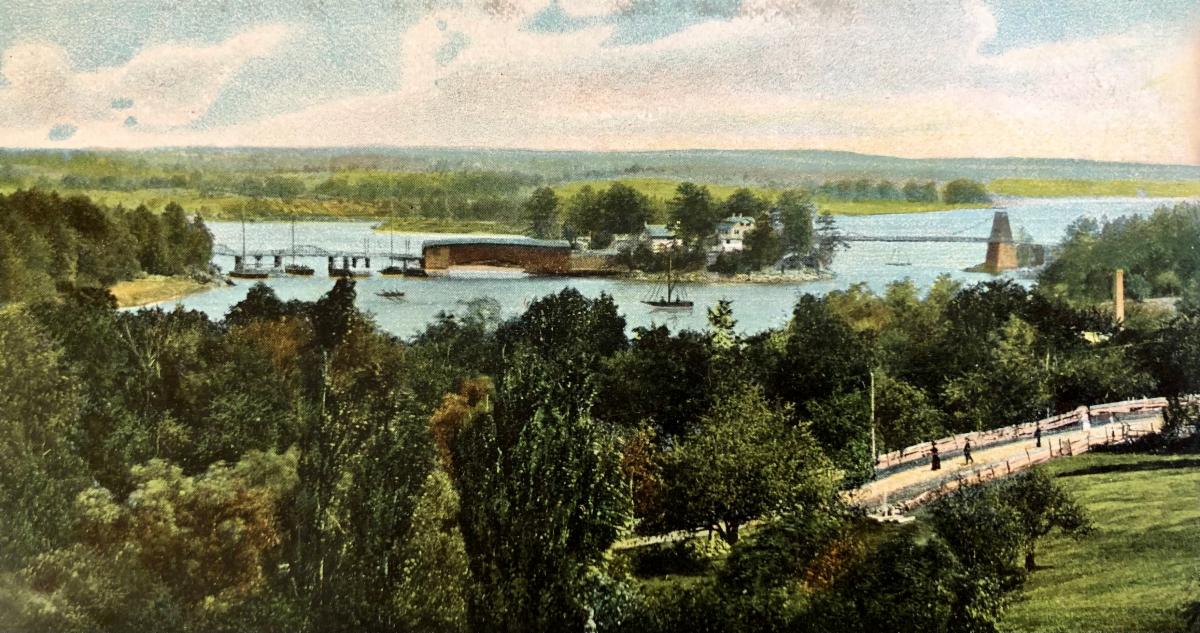
Essex-Merrimack Bridge featuring the covered span over the northern branch and chain suspension bridge over the southern branch. From the collections of the Museum of Old Newbury.
|
|
The owner of Carr’s Island, Mr. George Carr, was also awarded “Deare Island” through a 1672 court petition. The islet was harvested for timber, and sheep were left to graze on the remaining pastureland. This small patch of land, however, also served as an alternative convenient and safe up-river crossing from Newbury to Salisbury (now Amesbury). Initially “rope ferries” were constructed, which acted simply as guidelines that a ferryman could pull on and move sideways across the river.
By the later 18th century, the Deer Island crossing was well traveled, and an ambitious bridge project was proposed by local community leaders. A formal petition was submitted to the State in 1791 and proposed “That a bridge across Merrimack River from a place called the Pines in Newbury in the county of Essex to Deer Island, so called, and from the said Island to Salisbury in said County would in the opinion of your petitioners very greatly subserve the public interest and convenience by affording a safe, prompt and agreeable conveyance to carriages, teams and travelers at all seasons of the year, and at all times of tide, whereas great dangers are incurred and great delays often suffered by the present mode of passing in Boats.”
|
|
Timothy Palmer. From the collections of the Museum of Old Newbury. |
|
Surprisingly, the architect chosen to construct this massive and critical piece of infrastructure was local house wright, Timothy Palmer, who had never built a bridge in his life. As a young man, Palmer served as a local military man in the Revolutionary War.
It is thought that he may also have been apprenticed to Daniel Spofford, an architect known for building large-scale public buildings such as meetinghouses and churches that required structural support for large spans of roof and floor.
A born engineer, Palmer may have based his design on a 16th century Palladian arched bridge pattern. The structure had to be 1,030 feet long, with a 160-foot span on one side of Deer Island and 113-foot span on the other, over a tidal, volatile, 35-foot-deep river. Without any local precedent to follow, the young architect proceeded with apparent confidence.
The pilings were stone-filled wooden cribs anchored deep under water and the truss system consisted of specially selected tree trunks that bent naturally at the appropriate angle for supports.
When the Essex-Merrimack bridge, a true feat of engineering, officially opened in 1793, Palmer was lauded for his momentous achievement of building the longest bridge span in the country at the time.
The Massachusetts Magazine wrote, “The two large arches, one of which is superior to anything on the continent, were both invented by Mr. Timothy Palmer, an ingenious house wright of Newburyport, and appear to unite elegance, strength and firmness beyond the sanguine expectation.”
After traveling to build similar truss bridges across other major river crossings, Palmer returned to Newburyport where he was Surveyor of Highways from 1800 to his death in 1823.
In 1808, he rebuilt and enclosed the shorter span on the Amesbury side of the river. This covering limited the structure’s exposure to the elements and protected the wooden frame. It lasted until 1883, after which is was replaced with an iron truss bridge of a similar design.
In 1810, Palmer also witnessed the replacement of his heroic 160-foot span from Newburyport to Deer Island with a wrought-iron suspension bridge designed by James Finley and built by John Templeman.
|
|
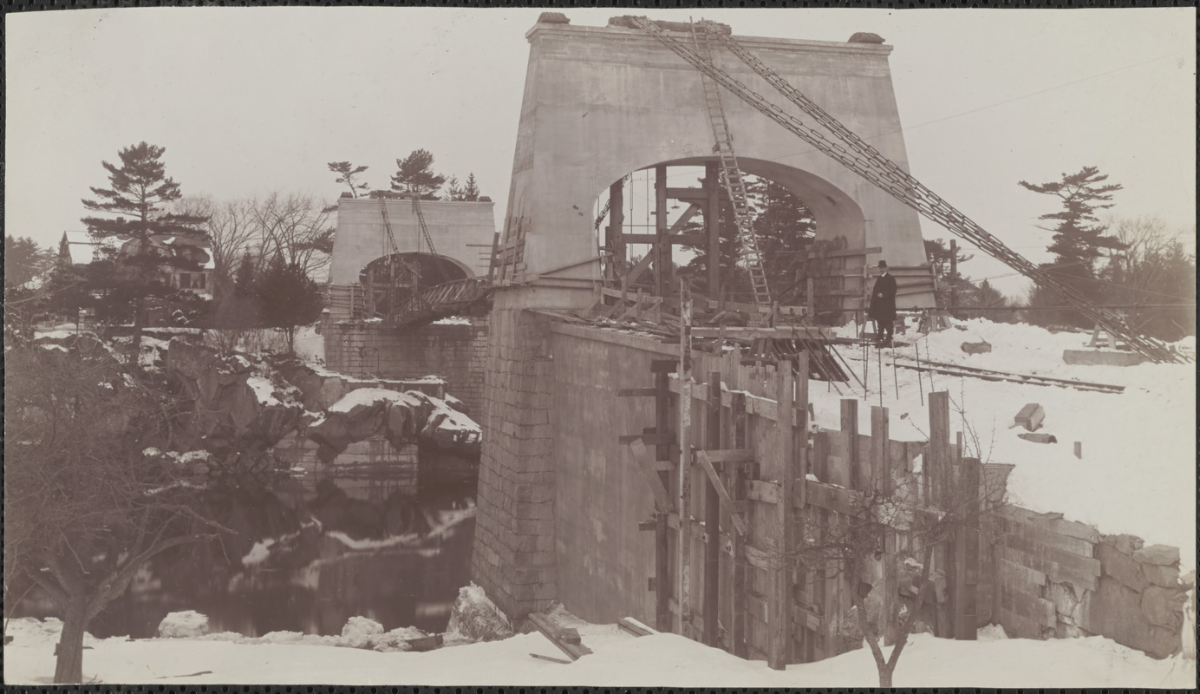
Rebuilding the Chain Bridge, circa 1910. From the collections of the Museum of Old Newbury. |
|
Locally dubbed the Chain Bridge, it managed to span 244 feet of the mighty Merrimack River and provided about 40 feet of clearance depending on the tide.
The suspension bridge suffered a partial collapse in 1827. Under a heavy snow load and in conditions of extreme cold, five of the ten chains snapped, dropping an oxen cart with men and horses into the river. It was repaired with twelve support chains and survived until 1909.
It was finally replaced by George F. Swain with a similar and architecturally sympathetic bridge, which became a beloved symbol of innovation in Newburyport.
With its restoration in 2003, the Essex-Merrimack Chain Bridge’s location is considered the oldest continually occupied, long span, bridge crossing in the country. According to the Massachusetts Department of Public Works Historic Bridge Inventory, it is also Massachusetts' only highway suspension bridge.
|
|
Puzzle Me This...We're Ready for Our Long Shot |
|
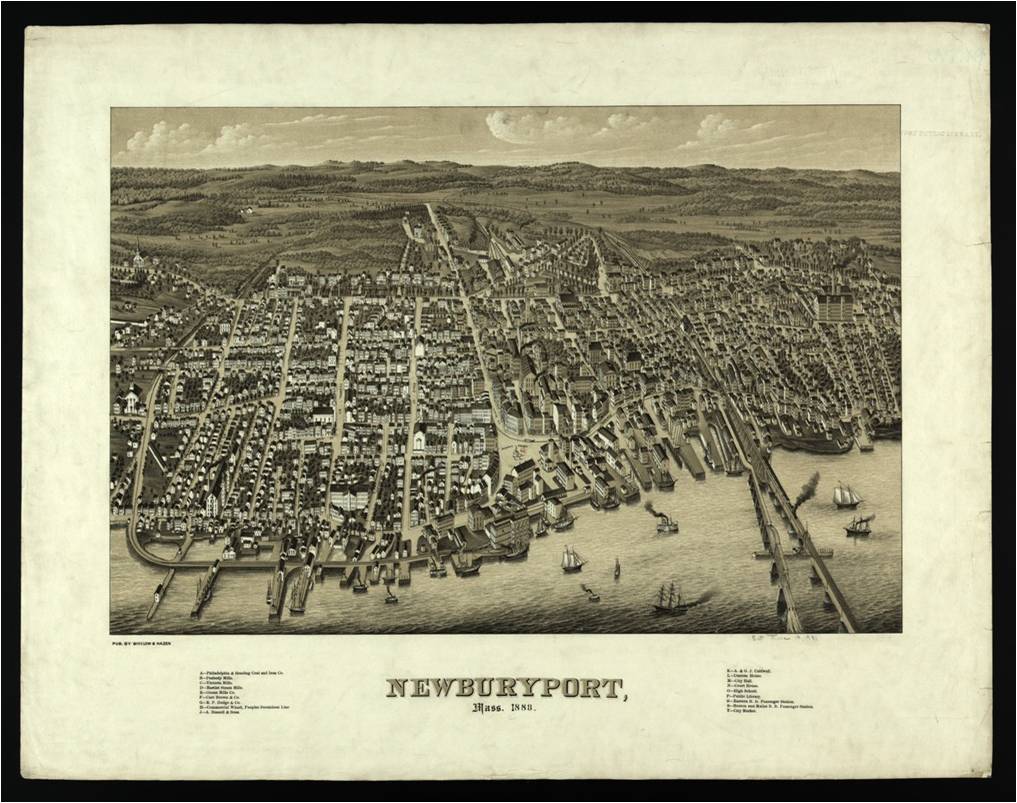
BIRDS EYE VIEWS celebrated civic pride and provided a panoramic vista of a town or city as if from above.
From the 1850s to the early 1900s, thousands of American communities posed for this new kind of urban/town portrait.
About this image: Bird’s Eye View of Newburyport, 1880, Drawn and pub. by J. C. Hazen & E. H. Bigelow, Boston. From the collections of the Museum of Old Newbury.
Click on the image to begin.
|
|
Something is Always Cooking at the Museum
With Thanksgiving less than a week away, let's kick off the cooking frenzy with a classic from Maureen Fionte. (Editor's note: I freeze mine in individual portions; defrost and enjoy on a moment's notice.)
Congo Bars
1 pound light brown sugar
2/3 cup butter
3 eggs
1 teaspoon vanilla extract
2 1/4 cups flour
2 1/2 teaspoon baking powder
1 teaspoon salt
1 cup chocolate chips
1 cup chopped walnuts
Cream butter and brown sugar. Add vanilla and eggs. Add flour, baking powder and salt. Mix. Add chocolate chips and nuts. Mix again. Bake at 350ºF for 23 minutes in a 13"x9" buttered pan.
(Editor's note: last week's Egg Bake called for 1/2 cup melted butter, but alas, the original recipe did not specify where to use it. Our best guess would be to drizzle it over the bread at the bottom of the dish for added flavor and "crispability!")
|
|
Order your 2021 Cushing House Calendar now. Perfect for holiday or anytime gifts.
The 8.5"x11" wall piece features heavy grade, high quality, tear off pages for each month and includes a "Notes" section for handwritten reminders.
Each page features a crisp, clear image from the collections of the Museum of Old Newbury.
$16.50 per calendar, shipping included (for orders of more than 4, please contact us).
|
|
Missed last week's show?
Play along, here.
Watch and play along on Newburyport's fastest half-hour of historic trivia. Laugh and learn with your hosts, Jack Santos, Custom House Maritime Museum, and Colleen Turner Secino, Museum of Old Newbury, every other Friday on "Yeat Yeat, Don't Tell Me!" Watch last week's episode here.
NOTE: Holiday Broadcast Schedule
Due to the holiday weekend (and Christmas also falling on a Friday this December, the next "Yeat Yeat, Don't Tell Me!" (Nov. 27) will be postponed until Friday, Dec. 4 @ noon (get the Zoom link here), and the last episode of Season 1 will take place on Friday, Dec. 18 at noon (mark your calendar now and get that Zoom link here).
We will be back for Season 2 starting Friday, January 8, 2021. Yeat Yeat, we can't wait.
|
|
During this difficult period of COVID-19, we rely on your support more than ever. We are working to reschedule many of the programs that we have had to postpone, as well as develop new, online programs for you to enjoy and keep us connected. We hope, if you are able, that you will consider a donation to the museum. Thank you for your continued support.
|
|
Museum e-Newsletter made possible through the
generosity of our sponsors:
|
|
|
Museum of Old Newbury
98 High Street
Newburyport, MA 01950
978-462-2681
|
|
|
|
|
|
|
|