|
Scheduling and Ordering Errors Can Cause Severe Delays in Radiation Therapy
By Matthew A. Taylor, PhD, Scott Symington, MMS & Mohammad Bakhtiari, PhD
| |
What Is Radiation Therapy?
Radiation therapy is one of the most widely used treatments for cancer. It delivers precisely targeted doses of ionizing radiation to destroy cancer cells while minimizing damage to surrounding healthy tissue. Nearly half of all cancer patients will receive radiation as part of their care, whether to cure the cancer, control its growth, or relieve symptoms.1 A single course of radiation therapy may involve hundreds of individual actions performed by multiple professionals from different disciplines. Like other high-reliability fields, such as aviation and nuclear power, radiation therapy departments must manage this complexity through systematic approaches and robust safety cultures.
PA-PSRS Reports of Severe Delays in Treatment Caused by Errors in Scheduling or Ordering of Radiation Therapy
In our recent study of radiation-therapy-event reports that were submitted to the Pennsylvania Patient Safety Reporting System (PA-PSRS), we found that nearly 30% of the events described a delay in radiation therapy.2 The delays in initiating radiation therapy were frequently caused by errors in scheduling or ordering and, in some events, resulted in severe outcomes for patients.
In one reported event, radiation therapy was delayed by nearly two months due to miscommunication between providers during the patient referral process. After the patient’s cancer diagnosis, an oncologist sent a message referring the patient to a second provider; however, this provider replied stating they were not accepting new patients. The oncologist subsequently failed to refer the patient to a third provider. Approximately two months after the diagnosis, the patient’s son contacted the clinic to follow up about scheduling a consult for treatment. At this point, the oncologist detected the delay. This substantial delay resulted in the patient requiring a new biopsy and restaging of the disease.
In another reported event, radiation therapy was delayed by one month due to failures in the referral process. Initially, the provider evaluated the patient and made a referral to radiation oncology. Two weeks later the provider’s office realized the referral was sent to the wrong group of specialists and then sent a second referral. One week after that, the office learned the second referral also was misdirected. The office sent a third referral to the correct group. During this prolonged delay, the patient’s tumor progressed and caused a total lung collapse.
| |
Strategies to Prevent Treatment Delays Caused by Errors in Scheduling or Ordering
-
Establish a clear and standardized process for referral submission and order entry, including defined roles and responsibilities for each step.3
-
Implement verification steps for the scheduling team to confirm receipt of the referral and accuracy of the order (e.g., correct patient, site, side).3,4
-
Consider utilizing an electronic health record system with built-in checks to ensure referrals are sent to the correct group of specialists and orders match the intended treatment plan.3
| | |
For more findings and strategies from our recent study, see our article entitled “Risk Factors and Mitigation Strategies in Radiation Therapy: A Study of Patient Safety Events From 40 Hospitals” at doi.org/10.33940/001c.154896.
Note: Details of the PA-PSRS event narratives have been modified for readability and to preserve confidentiality.
| | |
References
1. National Cancer Institute. Radiation Therapy to Treat Cancer. U.S. Department of Health and Human Services, National Institutes of Health. https://www.cancer.gov/about-cancer/treatment/types/radiation-therapy. Updated May 15, 2025. Accessed January 26, 2026.
2. Taylor MA, Symington S, Bakhtiari M. Risk Factors and Mitigation Strategies in Radiation Therapy: A Study of Patient Safety Events from 40 Hospitals. Patient Safety. 2026;8(2):154896. doi:10.33940/ 001c.154896
3. Wright JL, Yom SS, Awan MJ, et al. Standardizing Normal Tissue Contouring for Radiation Therapy Treatment Planning: An ASTRO Consensus Paper. Pract Radiat Oncol. 2019;9(2):65-72. doi:10.1016/j.prro.2018.12.003
4. Taylor MA, Yonash RA. Risk Factors for Wrong-Site Surgery: A Study of 1,166 Reports of Informed Consent and Schedule Errors. Patient Safety. 2024;6(1):117084. doi:10.33940/001c.117084
| | |
Reporting Transfusion-Transmitted Infections (TTIs) to the Pennsylvania Patient Safety Reporting System (PA-PSRS)
The Centers for Disease Control and Prevention (CDC) recently updated the Hemovigilance Module in the National Healthcare Safety Network (NHSN) as well as the criteria used to classify TTIs. You may have been contacted by CDC and asked to report events resulting from transfusions into the Hemovigilance Module of NHSN. Please remember that reporting these events to NHSN is optional but reporting them to PA-PSRS is mandatory.
In Pennsylvania, facilities that transfuse blood products into humans are mandated through the Medical Care Availability and Reduction of Error (MCARE) Act (40 P.S. § 1303.401 – 1303.411 (2007)) to report transfusion-related events, such as TTIs, to PA-PSRS. To monitor and track TTIs, the Department of Health’s Healthcare Associated Infection Prevention Division and the Patient Safety Authority request that you include the key words: “Transfusion-Transmitted Infection (TTI)” in the event description in PA-PSRS. This will enable the Department to more easily identify TTIs and provide support to facilities when needed.
Please note that suspected outbreaks or unusual occurrences of disease are also reportable to your local health authority or the Pennsylvania Department of Health. If you have questions, please contact the Division of Healthcare Associated Infection Prevention within the Department of Health at ra-dhhai@pa.gov or Patient Safety Authority at patientsafetyauthority@pa.gov.
| | |
Upcoming Events
Register now for free learning
| | |
Master Class Writing Workshop in Quality Improvement Studies
We are now open to applications for our Spring 2026 Master Class Writing Workshop in Quality Improvement Studies!
-
Did your facility complete a project to improve patient care? If you publish your work, other facilities can learn from your experience and replicate your successes.
-
Our free, online workshop teaches healthcare workers to write quality improvement (QI) studies and submit them for publication.
-
Session 1, Introduction to Writing a QI Study, will be held on Thursday, April 9, from 3 to 5 p.m. ET on Zoom. Learn the typical elements of a published QI study so you can write one yourself.
-
Session 2, Roundtable Manuscript Critique and Discussion, will be held on Thursday, June 4, from 3 to 5 p.m. ET on Zoom. Review your manuscript with other participants to help revise it for publication.
-
To apply: Summarize your completed QI project in 500 words or less using this fillable template.
-
Deadline: Submit your application by Friday, February 20.
| | |
Around the Commonwealth
Here's what's happening in patient safety in PA
| | |
2026 PA HAI Summit: Registration Is Now Open!
The Pennsylvania Department of Health, Bureau of Epidemiology, and the Philadelphia Department of Public Health are pleased to present the 2026 Pennsylvania HAI Summit: Strengthening Core Principles and Exploring New Innovations in Infection Prevention and Control.
This free virtual conference will be held on May 12 and 13 over two half days. The objective of the Summit is to provide Pennsylvania healthcare personnel from all facility types with updates on scientific advances related to healthcare-associated infections (HAIs), multidrug-resistant organisms, antimicrobial stewardship, and current Pennsylvania-specific epidemiologic data. Continuing education credits will be available.
|
| |
DOH Survey for Healthcare Providers
As part of the Pennsylvania Department of Health’s efforts to increase surveillance for harmful algal bloom (HAB)–related illnesses throughout Pennsylvania, the Division of Environmental Health Epidemiology has developed a short survey to gauge healthcare provider awareness of HABs and HAB-related illness.
This survey is anonymous and voluntary. All medical professionals are eligible to complete the survey, and survey responses should be submitted by April 1, 2026, for those who would like to participate. Please reach out to the Division at dehe@pa.gov with any questions. Thank you.
|
| |
Lessons From Event Reports
Engaging Staff in Solving Safety Issues
After a health system experienced multiple events in which a patient received an insulin injection with another patient’s pen, with no improvements following root cause analysis and process changes, the safety team published an article in their patient safety newsletter soliciting ideas from staff. Suggestions included storing insulin pens differently and using patient-specific barcoding, and one employee informed them about an insulin pen best practice assessment tool that was developed by the American Society of Health-System Pharmacists (ASHP). Through this article, the team also connected with a hospital that had successfully implemented patient-specific barcoding using the same electronic health record system.
Following an assessment with the ASHP tool and a nurse survey on insulin pen best practices (the results of which were also shared in the patient safety newsletter), a new process was developed that includes pharmacy validation of the correct insulin and patient-specific barcoding, which prevents nurses from administering insulin if the barcodes on the pen and the patient do not match—with another hard stop in place if the manufacturer barcode is mistakenly scanned. The team continues to refine this process as new issues arise and reviews literature to identify opportunities for improvement, and nurses report that they feel better protected from making a medication error and feel that they are keeping their patients safe.
|
| |
Just Published in Patient Safety
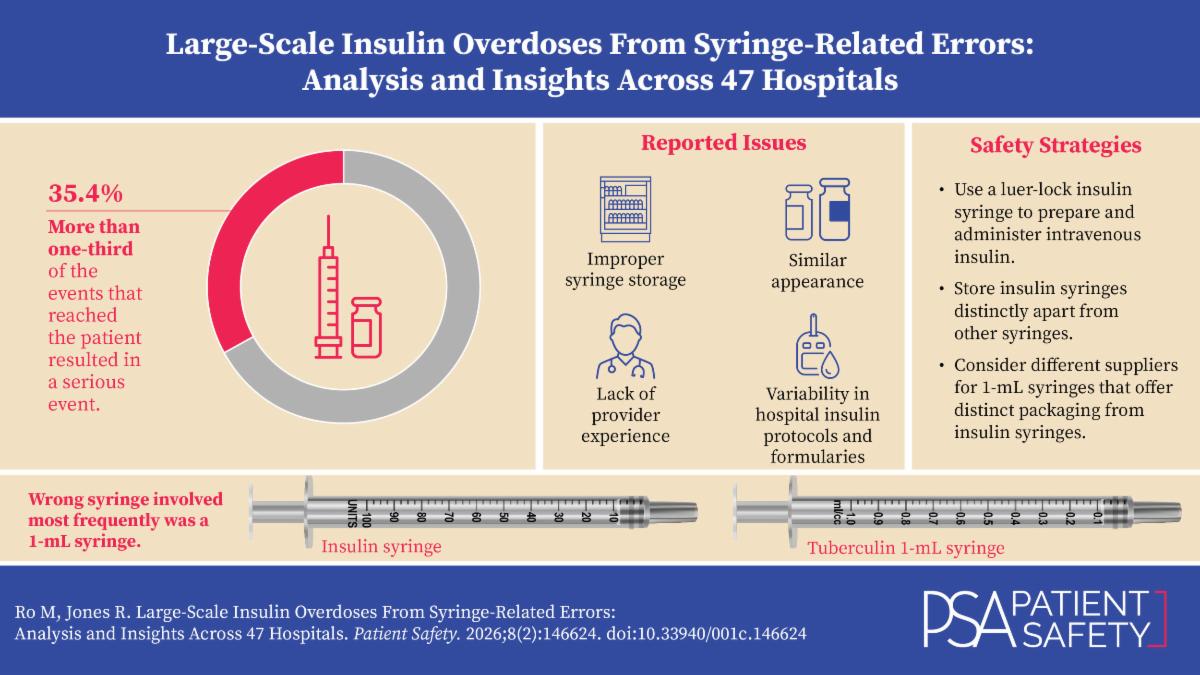
Large-Scale Insulin Overdoses From Syringe-Related Errors: Analysis and Insights Across 47 Hospitals
| | |
Although insulin is used daily by millions of people around the world, it is considered a high-alert drug that has been associated with more medication errors than any other medication type or class. One challenge in administering insulin is that it is measured in “units” rather than milliliters (mL), requiring unique insulin syringes with the appropriate markings. Using a syringe intended for other medication to administer insulin could lead to an overdose of up to 100 times the intended dose. To identify contributing factors and develop strategies to reduce the risk of wrong dose errors related to the use or selection of syringes, researchers focused on event reports submitted by Pennsylvania facilities over the last decade that involved U-100 insulin and syringe-related issues resulting in dosing errors or near misses.
Some of the key takeaways of their detailed study—which encompassed 74 reports from 47 facilities—are that over a third of errors that reached the patient were serious events and among reports specifying syringe volume, 73.8% involved a 1-mL syringe. Contributing factors included using the wrong syringe due to improper syringe storage, similar cap color or packaging, and provider’s lack of experience. Variability in hospital insulin protocols and formularies was also observed. The authors encourage facilities to evaluate and standardize their existing insulin protocols and formularies, and implement the suggested safety strategies for preventing syringe-related insulin dose errors.
|
| | | |