|
Week of March 24, 2025 | Vol. 15, Issue 12
| | |
Bourne Insights
Key Topics of Conversation this Week
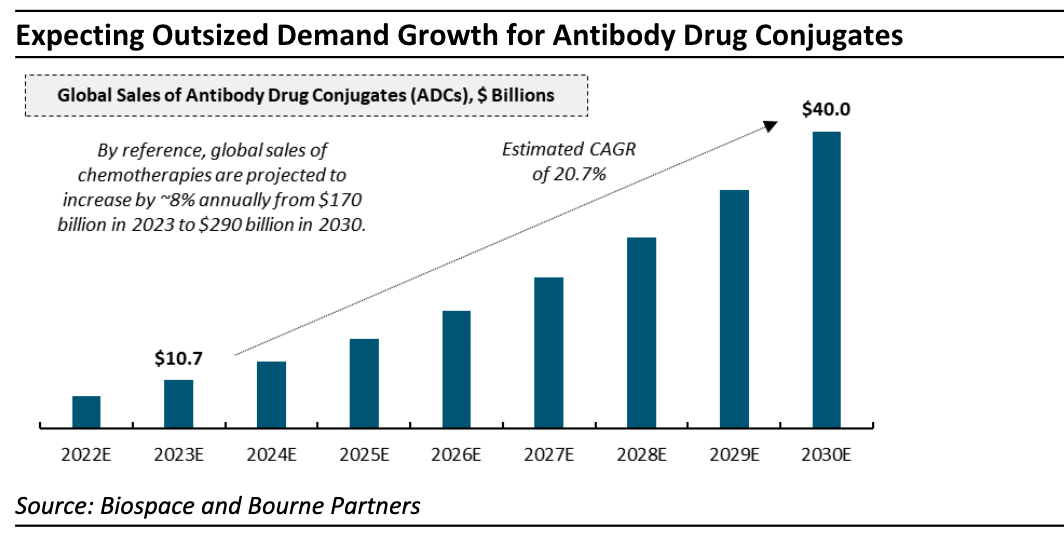
| | | | We continue to see an upswing in partnership arrangements in the anti-drug conjugate (ADC) space --consisting of larger pharma companies funding smaller biopharma firms to carry out initial discovery and development and taking over once an ADC asset has been “de-risked.” Most recently, Roche entered into third strategic collaboration in the ADC space already this year. Specifically, Roche will pay $36 million of upfront cash payments to Oxford BioTherapeutics with the potential for milestone payments that could exceed $1 billion. Essentially, Roche will leverage Oxford’s proprietary database on membrane protein abundance, with around 7,000 cataloged proteins across solid and hematological cancers and healthy tissues. Once the targets are identified by Oxford using its target discovery platform, the two companies will then validate the drug candidates together -- before Roche takes over for R&D and commercialization. This follows two other ADC partnerships in January between Roche and both Innovent Biologics and Araris Biotech. Read More | | | | Actions and commentary by the Trump administration do not appear to be having much financial impact on the Chinese CDMO WuXi Apptec -- yet. We have been closely watching how WuXi Apptec is being impacted by Trump’s tariffs on Chinese pharma imports as well as the speculation around the possible reintroduction of the BIOSECURE Act (or something similar) in 2025. Investors clearly remain very concerned as evidenced by the underperformance of WuXi Apptec’s share price (down 36% over the past three years -- vs the S&P 500 index being up 25%) However, Wuxi Apptec continues to appear to be resilient. For the full-year 2024, Wuxi Apptec reported sales growth of 5.2% (excluding the winddown of COVID-19 related projects) driven by strength of its small-molecule business, WuXi Chemistry, as well as recent manufacturing capacity expansions in China and Switzerland. Also, more importantly, management provided investors with guidance of 10% to 15% sales growth in 2025, which appears to us to be in line with the broader CDMO space. Read More | | | | It appears that the Trump administration will continue the Biden administration’s efforts to protect and support the controversial 340B program as it currently is. Specifically, the new Department of Health and Human Services (HHS), now under Robert F. Kennedy Jr. (RFK), has asked the courts to reject lawsuits brought by several pharma companies (e.g., Eli Lilly, Bristol Myers Squibb and Novartis Pharmaceuticals) challenging how the program is executed. Today, a third of hospitals use the 340B program for their drug purchases, representing well over $50 billion annually. Last year, pharma companies introduced a new “rebate model” for 340B drugs, which included delayed payments, as a response to apparent abuse of the program by larger hospitals and health systems. This new rebate model was opposed by the former Biden administration (and the hospital lobby), and the pharma companies backed down. However, the pharma companies did subsequently sue the Biden administration for blocking their right to implementation flexibilities within the 340B statute. Read More | | | | We see Dr. Mehmet Oz comfortably on track to be confirmed by the Senate as the new administrator of the Centers for Medicare & Medicaid Services (CMS) following his recent appearance in front of the Senate Finance Committee. Notably, in our view, the Senate testimony by Dr. Oz highlights the Trump administration’s focus on reducing prescription drug prices -- even if that means supporting the Inflation Reduction Act (IRA), which was passed in 2022 without a single Republican vote. When asked when he would defend the IRA against ongoing court challenges by the pharma industry, he replied: “It’s the law. I’m going to defend it and use it.” To date, multiple pharma companies have attempted to challenge the Medicare price negotiations in federal court. All six have failed and are in appeals. Separately, on the topic of Medicaid, Oz would not comment on possible funding cuts implied by the recent Republican budget resolution. However, he did indicate that he was in favor of Medicaid work requirements and removing undocumented individuals from receiving Medicaid benefits. Read More | | | | We continue to monitor the trend of pharma companies shifting their manufacturing towards the United States in response to the Trump administration’s focus using tariffs and trade policy tools to rebuild the U.S. domestic pharma manufacturing infrastructure. Most recently, Johnson & Johnson (NYSE: JNJ) announced plans to invest over $55 billion domestically over the next four years, representing a 25% increase compared to the previous four years. This includes over $2 billion in a new 500,000 square foot, state-of-the-art biologics production plan in Wilson, North Carolina. Also, JNJ plans three new advanced manufacturing facilities and the expansion of several existing sites across the company’s “Innovative Medicine and MedTech” businesses. Finally, JNJ is targeting investments in R&D and information technology infrastructure to support drug discovery and development and workforce training. This follows similar announcements from other major pharma companies such as Eli Lilly and Co (NYSE: LLY) and Merck & Co (NYSE: MRK), among others. Read More | | |
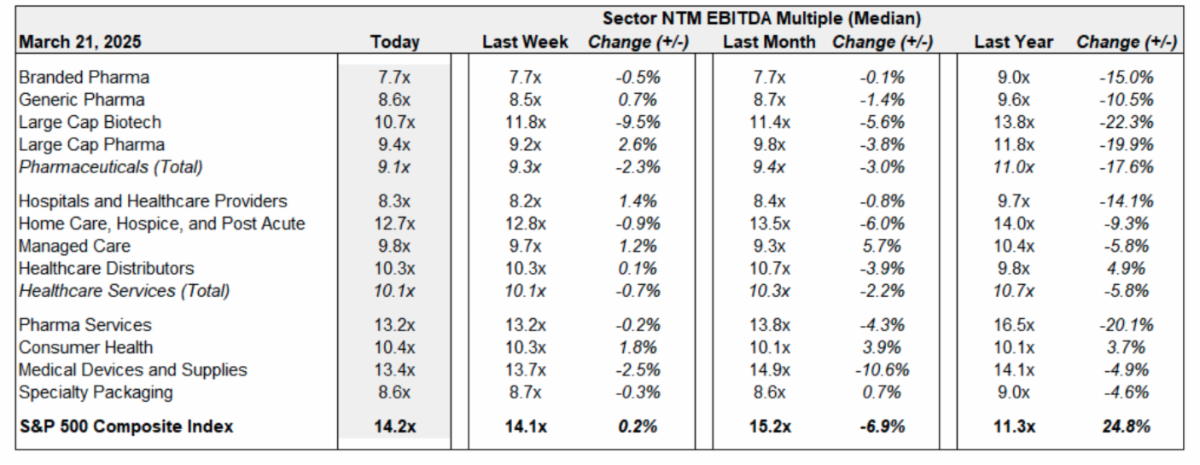
Note: Market values as of the close of business March 21, 2025
Source: S&P Global Intelligence
| | Active Banking Deal Contacts | | Select Banking Transactions | | | | |