Your Monthly News & Updates | |
|
|
As many of you know, the Medfield Historical Society offers a range of services.
On Monday nights, we gather to organize new donations and care for the museum. This is also the night that we ask local groups to work with us if they need help. For example, the Medfield High School yearbook committee is assembling their 100th yearbook this year and is looking to include images from old yearbooks and other photos from 100 years ago. We are the group that sends the yearbook in for scanning each year so that there will be a digital copy, we also maintain a collection of past years for visitors to enjoy. And, we manage a rather extensive collection of old photos.
On the first and third Saturday mornings, we open our doors for drop in visits. As usual, this past week, we were visited by two families in town who had never been in the museum and wanted to learn more. In addition, we had a great group of descendants of the Smith family who came to Medfield from across the country as far as California to visit the museum and walk the town so that they could learn more about their own family history.
Then there are the school groups. As you know, we organize the annual third grade visits to all of the historical sites across town in the Spring. And, we also host the girls from the Montrose School for a visit each fall. In addition, we support multiple special requests from the Scouts in support of various badge and non-badge activities.
And then there are the adult presentations – which you will read more about later in this newsletter. Each year we host a minimum of five presentations that celebrate history local and beyond. As a special treat this year, we will also be hosting a class of how to get started with Genealogy in the spring!
We do a lot. And we love doing it. However, we could use your help.
We receive no funding from the town and have a number of bills that must get paid each year in order to keep operating. Our largest bill covers insurance for our collection as well as liability insurance to support keeping the museum open to the public. Then there is heat and electricity. Because we house the town archives and a large number of historic artifacts, we must maintain the temperature – and more importantly the humidity level in the building. Beyond that, we must maintain the building, pay for speakers (usually one a year), buy archival storage, host our website, and buy office supplies such as printer ink and stamps. Whew!
This year we cancelled our internet service at the museum to save money – opting instead to use the hotspot from our phones for those that have that. But the savings from that went into upgrading our alarm system (another expense I forgot to mention above). We have always had a security alarm but we never had a fire alarm! For obvious reasons this is pretty important to us. Although we have been moving the most precious items into the safe, there is so much that can't fit in there!
So, if you have ever been a member, thank you and know that now is the time to send in your annual dues – before we start our annual fund drive! If you have never been a member before, hopefully you see how much good your help can do. In addition, if we are fortunate enough to get extra funds this year we will (1) hire an electrician to fix the lights in the safe – we use a flashlight right now (2) buy a dedicated computer for our scanning station – I bring my personal laptop and (3) add create a new exhibit for James Plimpton – inventor of the four wheeled roller skate and son of Medfield!
Any amount will help! If you would like to send in a "little extra" with a specific purpose in mind, we are happy to direct your support according to your wishes. THANK YOU!
| |
|
PeggySue Werthessen
President
| |
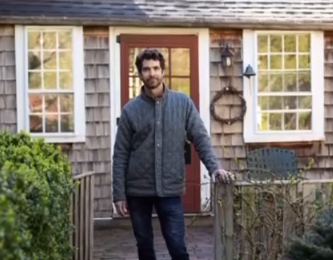
"The Tragedies and Triumphs of Restoring a Historic New England Colonial" with Lee McColgan | |
|
Monday, Nov 4, 2024
7:00 pm
First Parish Unitarian Universalist Church
26 North Street, Medfield
McColgan will tell his story of restoring the 300-year-old Loring House in Pembroke, Massachusetts. Trading his corporate career for a life of craftsmanship, McColgan spent 18 months battling deteriorating bricks, shattered windows, and a punctured foundation, all while learning from master preservationists. His talk will delve into the unexpected challenges of using period materials and techniques, the lessons learned from traditional crafts, and the emotional toll of living in a home under constant repair. McColgan will not only consider the physical restoration process but also reflect on the deeper philosophical connection between history and our homes, and the value of preserving the past to find meaning and purpose for the future.
Lee McColgan is the founder of Helve Historic Trades, specializing in woodworking, blacksmithing, and masonry. His craftsmanship has contributed to projects at notable sites such as Boston’s Old North Church and Louisa May Alcott’s Orchard House. His expertise has been featured in Architectural Digest, The Boston Globe, and The Wall Street Journal.
The presentation is free and open to the public.
| |
|
by PeggySue Werthessen
On a recent glorious fall day, Medfield recently celebrated MEMO Discover Medfield Day. First organized in 1980, "Medfield Day" is a great way to get to know the town and the many civic organizations that make Medfield such a great community. In large part due to the hard work of one of our volunteers, Laurie Conn Kearney, Medfield Historical Society shared a special exhibit of artifacts that are now part of the cell phone in your pocket – a rotary phone, a calculator, a flashlight, camera, maps, and more. It is amazing to think how much this little device has changed the way we think about a lot of things.
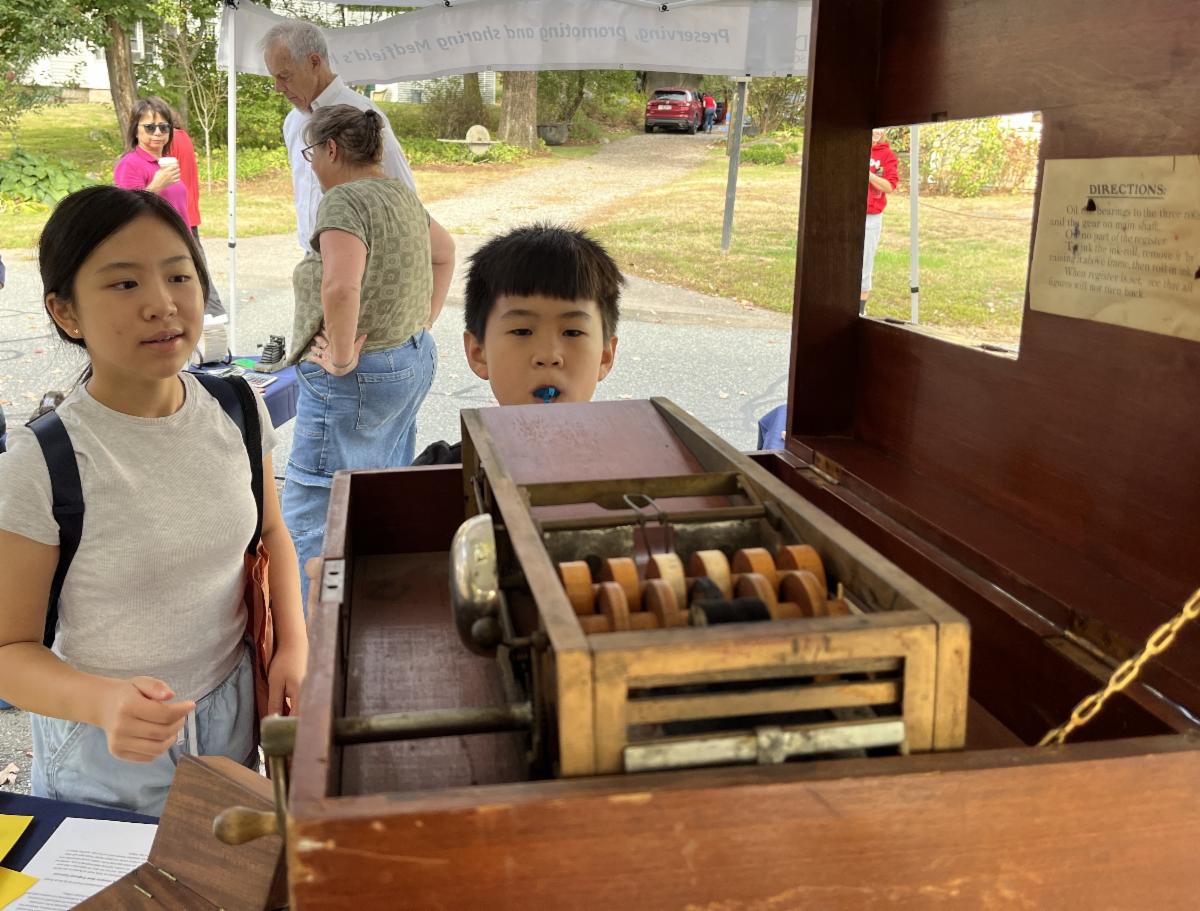
In addition to the "cell phone" items on display, we brought over a voting box from early 1900 so that everyone could vote on a very important question: "Should kids be allowed to have internet smartphones before they get to high school?" Not only did this question connect really well to our display, it was posed to us by a lovely young school girl who had recently stopped in at the Historical Society for a visit just while we were getting the box ready for display.
| |
|
In 1900, very few of the residents in Medfield would have been able to vote. More than half of the 2,926 residents counted in the 1900 census were patients at the Medfield Insane Asylum! (Now known, of course, as the Medfield State Hospital). Another large sub-section of the population were laborers at the remaining Straw Hat Factory on North Street – not local citizens. So who was left? How many people could vote in Medfield in 1900? I actually don't know.
Here is what I do know. Race was outlawed as a barrier to voting in 1870 – of course that didn't stop many from trying to limit the voting rights of marginalized communities. They just imposed new barriers. Women still couldn't vote. What we do know is that there were only 335 dwellings in town at that time.... and 334 people voted in the 1900 presidential election – an overwhelming majority voting in favor of McKinley and Roosevelt at 68%. For the record, only 166 voters turned out for the local elections the prior year so, much like today, voter turnout varies significantly when there is a national election.
Back to OUR vote! We believe that voting is an incredible privilege and wanted to give everyone a chance to use the old voting machine – even our littlest citizens in pre-K. If you could hold a crayon, you could vote. By the end of the day, we had 519 votes! Thirty-eight percent were adults and the rest were kids! To illustrate just how important voting is, the final vote was in favor of letting kids have cell phones – but only just barely at 52%. If it were up to the adults, 84% believed that kids should wait until high school. That is an amazing difference! See kids, voting matters!
The conversations that we had with the kids were very insightful. Even though cell phones are quite "new," many of them couldn't imagine a world before they existed. Also a sign of our times: some kids didn't know that you could get a basic cell phone without a screen! This would allow kids to stay in contact with their parents without all of the related trappings. Also interesting was that a significant number of high school students wrote in "No Social Media" on their voting card regardless of whether they voted yes or no.
As a special treat – four of our youngest voters drew us a picture rather than voting :)
| |
October Program Recap – A Boston Grande Dame Celebrity with Medfield Ties | |
|
by David Temple
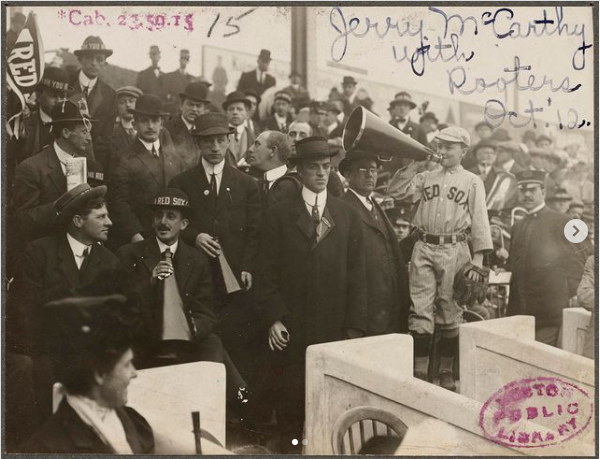
Isabella Stewart Gardner (“Mrs. Jack”, 1840-1924) was the most influential, compelling, and free-spirited Boston socialite in her time. Today she is most remembered for Fenway Court, her home/art museum. But in her heyday, she was also a big fan of the Red Sox and other athletic endeavors...and her circle included some Medfield friends, Charles Martin Loeffler and Dennis Miller Bunker.
Upwards of 50 people came to hear Jay Hurd talk about her life at the October 7 historical society presentation in the old meetinghouse. Jay is a baseball historian, former librarian at Harvard’s Widener Library, and graduate of Medfield High School. His late parents, Paul and Toni Hurd, served as copresidents of the historical society for some 20 years. Jay has presented at the National Baseball Hall of Fame Museum and historical societies on baseball topics.
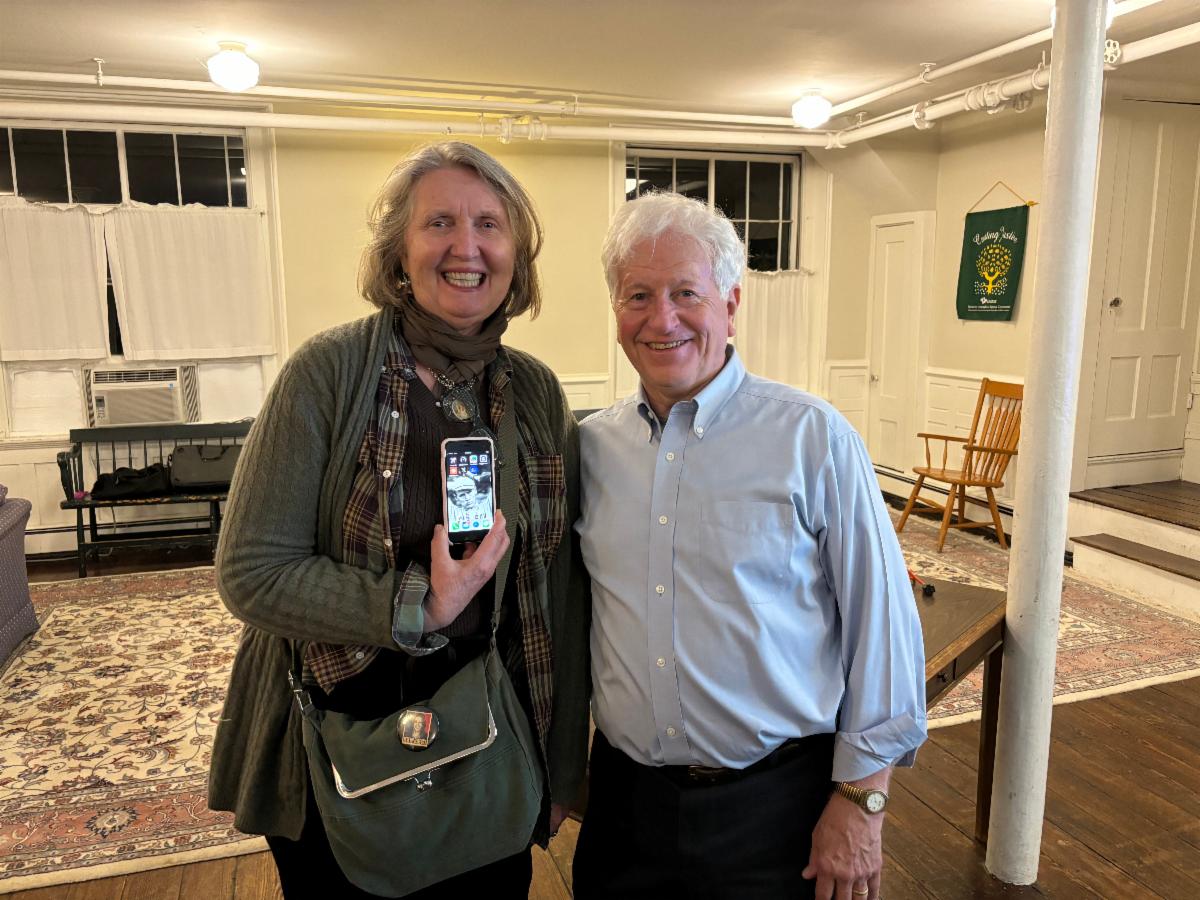
| Surprise visitor Durinda Wood with Jay Hurd. | |
A surprise celebrity-descendant visitor at the presentation was Durinda Wood, shown in the photo with Jay. Durinda Wood grew up in Holliston and still has family there, but she now lives in California. She said she's the granddaughter of Smoky Joe Wood (1889-1885).
Wood was a standout pitcher for the Red Sox 1908-15, helping them win the World Series in 1912 and 1915. In 1912 he was 34-5, 1.91 ERA, but his potential HOF career was cut short by injuries. The other two dominant Red Sox pitchers of that era were Cy Young and Babe Ruth. Durinda is showing a picture of her grandfather on her phone.
| |
|
Mrs. Jack – Art Collector, Muse, Mentor, and Mascot:
Isabella Stewart Gardner and the Boston Red Sox
| |
|
by Jay Hurd
On a Saturday evening in December of 1912, Dr. Karl Muck, conductor of the Boston Symphony Orchestra, awaited the arrival of a most important patron. He had learned during his tenure that he could not commence the evening’s program until Mrs. Isabella Stewart Gardner occupied her customary seat. Even Dr. Muck, a friend of Mrs. Gardner, could not have imagined what he, his orchestra, and the audience were about to witness on this evening. Striding into Symphony Hall, a white band with red letters declaring “Oh, You Red Sox!”, wrapped around her head, Mrs. Isabella Stewart Gardner proclaimed her adoration for the Boston Red Sox and celebrated her team’s triumph over the New York Giants in the 1912 World Series. The Town Topics reported:
“It looks as if the woman had gone crazy. With this band bound like a fillet
around her auburn hair, she appeared in her conspicuous seat at a recent
Saturday night Symphony Concert, almost causing a panic among those
in the audience who discovered the ornamentation, and even for a
moment upsetting Dr. Muck’s men so that their startled eyes wandered
from their music stands. ”
In 1912 Mrs. Gardner was 72 years old, and she continued to draw attention to herself and shock Boston society.
|  | |
|
In Boston’s Royal Rooters, Peter J. Nash states that the band around Mrs. Gardner’s head was a Royal Rooter sash, emblazoned with the words “Oh, You Red Sox!”, taken from the title of a popular song written and composed by George P. and Ellen Ashworth for the 1912 season. The Royal Rooters, led by Michael T. “Nuf-Ced” Mcgreevy and Boston mayor John Francis “Honey Fitz” Fitzgerald, raucously supported the home team and crudely challenged the opponent, whether in Boston or away. Whether or not Mrs. Gardner’s head band was a Royal Rooter sash, a Royal Rooter head band, or a cloth with her own handwritten letters remains moot, and although the fine details of the evening’s event may remain nebulous, she did indeed arrive at the symphony as described above.
Read more >>
| |
Don't Let the Truth Get in the Way of a Good Story | |
|
As a regular reader of the Portal, and myself a docent and amateur historian, I often accept the research and conclusions of others as fact without questioning validity. As we approach Thanksgiving, I thought a story passed on to me by Thelma Spicer relating to the Mayflower would be most appealing.
About thirty miles northwest of London, on the M40, lies the village of Jordans in Buckinghamshire, England. In the 17th century, Jordans became a center for Quakerism and is in fact the burial place of William Penn, the founder of Pennsylvania.
Now we know from numerous historic sources that it was common practice to recycle the old beams and timbers from dismantled ships by using them in the construction of barns, and that this practice was allegedly quite common in Buckinghamshire.
Here’s where the story gets off course: According to the University of Exeter, James Rendel Harris (1852 – 1941) , a biblical scholar in his late 60s, “believed that timbers from the old Mayflower had been used to construct the barn. He breezily told the press that he had been attending a funeral in the area when a man told him this fact – though he was now ‘unable to trace’ this mysterious local expert. He was compelled to investigate the farmstead. According to his research, two local farmers, who had shares in the Mayflower in the 17th century, may have received its timbers after it was broken up. Harris put this information together with details gleamed from the history written by the Plymouth Colony’s first governor, William Bradford. According to this most venerated of Pilgrim Fathers, a large beam on the ship had cracked; low and behold, one of the barn’s timbers had been repaired with a fishplate. Harris also brought in experts to examine both the brickwork (who found it supposedly dated to the period) and the timbers (shown to belong to a vessel similar to the Mayflower’s size). More speculative were the deductions he made from carved inscriptions on the timber – the letters ‘HAR’, he argued (and if you squint), maybe referring to Harwich (the ships port of registration).”
“If the story seems dubious, the circumstances of Harris’s life might make us even more suspicious. He was a veteran member of the Quakers, and had ceremonially opened a Quaker Hostel in the village just a few years prior – which itself had only recently been re-founded as a Quaker settlement. He was also a leading figure in the English Mayflower Club, and an author of Mayflower plays. So, Harris had a motive – ‘providentially happy’ as one newspaper put it – to unexpectedly find the Mayflower in Jordans. Not only did the discovery boost the wider interest in the Mayflower as the 300th anniversary in 1920 drew nearer, but it also gave an air of historical legitimacy and importance to the fledgling Quaker community.”
| 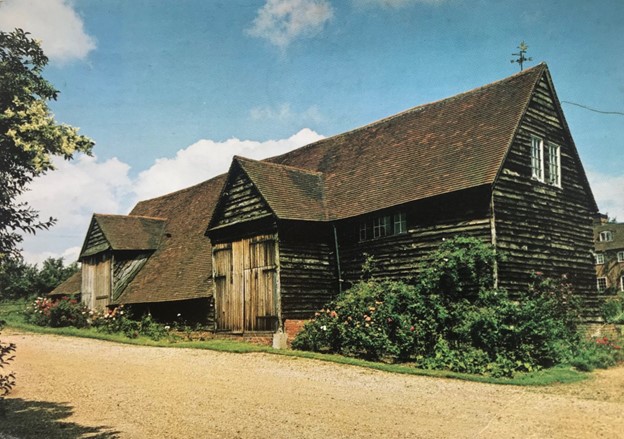 | The Mayflower Barn as depicted in a postcard. | |
Not surprisingly, people in both Britain and the United States were enthralled with this Mayflower Barn. In spite of numerous attempts by university professors and reputable historians to question Harris’ version of historical fact, Old Jordan, which included the Mayflower Barn and Friends Meeting House with guest rooms, became a world-renowned tourist attraction. By the time Thelma and her husband Nigel visited the Mayflower Barn in June of 1981, it’s fortunes and popularity had waned appreciably. Since 2006, the barn has been privately owned and is no longer a museum open to the public.
So unfortunately, we will never know definitively where the pieces of the Mayflower ended up. The ship may have become a victim of an old saying attributed to Mark Twain: “Never let truth get in the way of a good story”. On the other hand, maybe it is somewhere in Buckinghamshire. But certainly the days of James Rendel Harris’s monumental discovery and the extensive historical scrutiny and excitement that it created are over.
| |
|
by Richard deSorgher
Reprinted from "This Old Town, Remembering Medfield" by Richard deSorgher with his permission.
| |
|
On this Veterans' Day we stop to honor and give thanks to all veterans, including a former Medfield veteran from the (current) War on Terror. He answered his country's call and was sent to Iraq. His name is Steven Reichert. Staff Sergeant Reichert, a graduate of Medfield High School with the Class of 1998, grew up on Green Street. He became a sniper with the 2nd marine Division in support of Operation Iraqui Freedom II.
On the morning of April 9, 2004, a squad-sized patrol was sent to prevent anti-coalition forces from interfering with a pilgrimage. Staff Sgt. Reichert, a trained sniper/scout, established a position on top of an oil tank with a 50-caliber rifle to cover the patrol's movement in the town. He occupied this position with full knowledge that he would be extremely vulnerable to enemy fire.
| |
Staff Sgt. Steven Reichert | |
|
As the patrol moved toward the town, Reichert and his spotter, Corporal Winston Tucker, noticed a dead animal had been placed alongside a dirt road the squad was approaching. Reichert radioed the patrol and redirected them to the east side of the road. Upon inspection it was reported that two wires were leading out of the animal. Suspecting this to be an improvised explosive device (IED), the Explosive Ordinance Disposal unit was called in and the area secured.
Read more >>
|
|
People and Places of the Past | |
The Wise Fools: How the Football Players of the 1962 Sophomore Class at Medfield High School Remember Their First Winning Season | |
|
In 1962, there was a lot of optimism in Medfield over the high school football team’s prospects. Practically the whole team from the 1961 squad was back and ready to play. The freshmen of last season were now about to enter our sophomore year, but before classes began the Medfield Warriors were beginning double sessions in August just like the year before. All the sophomores had a year’s experience, and we felt confident about our chances of being much more competitive in the season of 1962. We practiced for the first couple of days in T-shirts and shorts with helmets and cleats. We all knew what was coming next on the agenda, as full equipment and contact would soon be upon us.
Like the year before, most team members knew each other, but there was one very enthusiastic and distinctive addition to the freshmen class. A new family had just moved from North Carolina into the large red brick house at corner of Main and Miller Streets, now the site of Park Street Books. Enter Graeme Justice, along with his mom, dad, and sister Leslie. As Graeme was entering his freshmen year at Medfield High School, he was hard to miss. He was a bit of a showoff, very sociable, outgoing and made friends quickly. He had a ready smile with a ruddy complexion, and he tanned up in the summer with a muscular frame.
| 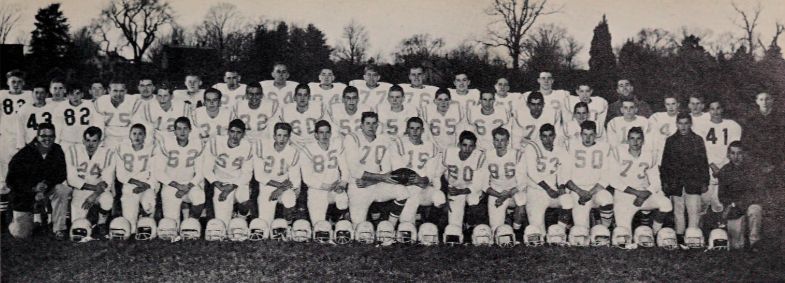 | |
Front Row L. to R.: Coach Keyes, Jim Horgan, Ken Clive, Bill Asprey, Joe Sabbag, Frank Rogers, Tim Flaherty, Steve Harrison, Mike Rogers, Bob Emmel, Larry Moore, Richard Catenacci, Les Bowman, Graeme Justice, David Catenacci, Mgr. Coach Abel. Middle Row: Bruce Little, Steve Hinkley, Ken Stockwell, Bruce Allen, Bob Seeley, Frank Martino, Ronnie Kerr, John Miner, Craig Magnussen, Bob Curry, Dave Clarke, Stan Baker, Joe Horgan, Paul Simpson, Ricky Davidson, Peter Iafolla, Don Clive. Back Row L. to R.: Dave Nilson Craig MacIntosh, Lee DeSorgher, Bob Souza, Rodney Cook, Chris Stagg, Camerpn Daley, Tom Flanagan, Wayne Limmler, John Roskilly, Doug Vliet, Phil Clancy, Jay Halloran, Bill Callachan, Coach Langton. | |
|
“I don’t think people in Medfield know Graeme once had polio as a young child. He was paralyzed and spent some time in an iron lung. He now has good upper body strength, after years of physical therapy. The only lingering effect is that his right leg was just a bit thinner than his left leg,” his mom said with her musical southern twang.
Graeme was a very talented kid who we first noticed at the Medfield swim pond on Green Street, where he was a devoted member of the swim team. At Medfield High School Saturday night dances, Graeme was a big hit on the dance floor, with his hand stands and splits, which fell just short of break dancing. He even won a trophy with the words, “Medfield High’s Best Dancer” inscribed on it. Most everyone thought Graeme showed great potential as an athlete. His father was a member of the Republican National Committee. Later in the election year of 1964, Mr. Justice worked on the election campaign for Barry Goldwater. His mother was a housewife and his sister, Leslie attended the junior high school classes in the eighth grade.
Read more>>
| | | | |