September 20, 2022
Dickinson Research Extension Center Updates

2021 Acid Soil Management with Hard Red Spring Wheat


Ryan Buetow
Extension Cropping Systems Specialist
Dickinson Research Extension Center
North Dakota State University
1041 State Avenue
701 456-1106
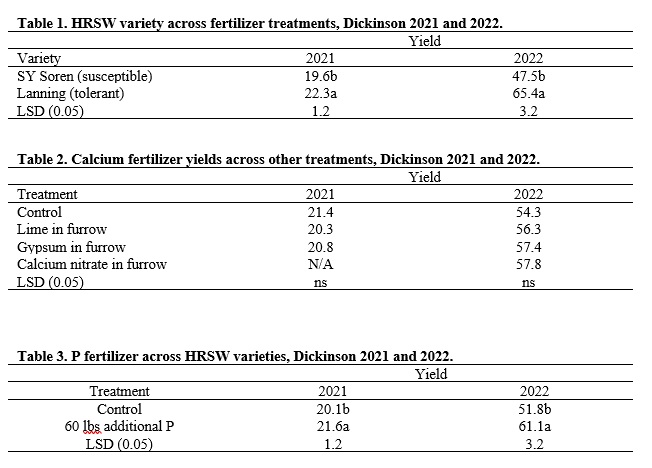
No-till practices paired with heavy nitrogen (N) fertilizer use have lowered the soil pH on many acres in the Northern Great Plains. Acid soil where the pH drops below 5.5 has impacts nutrient availability, soil microbial activity, herbicide efficacy, stunted roots from aluminum (Al) toxicity and other plant/soil interactions. These areas can be improved from surface liming or lime incorporation; however, liming can be costly. For many producers facing this issue, especially those farming rented land, there is a search for alternative options to reduce yield loss on acid ground. Research has been conducted in western North Dakota on adaptive management strategies for mitigating the symptoms of aluminum toxicity and soil acidity including variety selection, in-furrow fertilizer application, and seed treatments. Variety selection showed a significant difference in yield (Table 1). Calcium in-furrow did not have an impact on yield (Table 2). Across HRSW varieties a yield bump of 1.5 bushel in 2021 and 9.3 bushels in 2022 was shown from seed placed phosphorus (P) (0-45-0) applied at high rates (60 lbs P2O5/ac) (Table 3). This mechanism doesn’t appear to be as strong for HRSW as shown in similar durum trials. The data suggests use of tolerant HRSW varieties along with in-furrow P fertilizer can be used to reduce symptoms of an acid soil. Ideally, producers should apply tons of lime to increase the soil pH above 5.5 because varieties and fertilizer may limit yield loss; but do not fix soil issues with pesticide breakdown and carryover, soil microbiological activity, and nutrient tie-up. All the aforementioned issues are caused by acid soil.


‌
‌
‌
NDSU Dickinson Research Extension Center logo
The NDSU Extension does not endorse commercial products or companies even though reference may be made to tradenames, trademarks or service names. NDSU encourages you to use and share this content, but please do so under the conditions of our Creative Commons license. You may copy, distribute, transmit and adapt this work as long as you give full attribution, don’t use the work for commercial purposes and share your resulting work similarly. For more information, visit www.ag.ndsu.edu/agcomm/creative-commons.

County commissions, North Dakota State University and U.S. Department of Agriculture cooperating. NDSU does not discriminate in its programs and activities on the basis of age, color, gender expression/identity, genetic information, marital status, national origin, participation in lawful off-campus activity, physical or mental disability, pregnancy, public assistance status, race, religion, sex, sexual orientation, spousal relationship to current employee, or veteran status, as applicable. Direct inquiries to Vice Provost for Title IX/ADA Coordinator, Old Main 201, NDSU Main Campus, 701-231-7708, ndsu.eoaa@ndsu.edu. This publication will be made available in alternative formats for people with disabilities upon request, 701-231-7881.