June 17, 2022

This newsletter will be off on Monday in observance of Juneteenth and will return to your inboxes on Tuesday, June 21.

Top stories

■ Infighting overshadows big plans at the Washington Post: New top editor 'Ms. Buzbee is now on the defensive, yet to completely win over the newsroom and facing internal strife that has eclipsed some of her bold plans.' (New York Times) / 'More news in here: Taylor Lorenz has been moved from the features staff to the technology team. Cameron Barr, the WaPo's No. 2 editor, has been asked to review her articles before publication' (Ben Mullin) / ‘Fwiw Cameron has always read my stories ever since I got here, he reads all big stories that go on the site. He's an awesome editor!! I love his feedback and working with him’ (Taylor Lorenz) 


■ 50 years after Watergate, a generation of frightened editors (POLITICO) / Washington Post owner Jeff Bezos bought a Watergate lock for $62,500 (Washingtonian) 


■ ‘CNN’s new boss wants to rely less on ratings to make money. Among the ideas he’s considering: new show segments that advertisers can sponsor and a premium section of the website for paying subscribers.’ (Gerry Smith) / New CNN boss seeks to create a less divisive news network (Bloomberg) / Listen: Who survives at the new CNN? (The Ringer) 


■ ‘The host was wonderful and friendly on this interview I did last night - but my heart sank so fast when I saw the chyron. So many words to describe what I was instead of who I am.’ (Keri Blakinger) 


■ When Fox News writes about you (Jessica Valenti) / Playing in the FoxNews.com sandbox (POLITICO)


■ What the hell has been going on at MPR? (Racket) 


■ Ben Smith talks state of journalism: 'It’s not like the media wasn’t making mistakes and being ideological and bumbling and biased before. It’s just now, it’s all much more on display, like we were always idiots, it’s just on display now. And people can attack it' (Jewish Insider)


■ ‘I feel proud, and I feel mad as hell’: Gloria Steinem on Ms. Magazine at 50 and feminism today (New York Times) 


■ With 'Corrections', Seth Meyers feels like he's getting away with something (The Wrap)


Press freedom


■ Julian Assange can be extradited, says UK home secretary (BBC News) / Journalist or spy? WikiLeaks founder to face US trial (AP via Christian Science Monitor) / 'Every serious press freedom group in the world has protested this.' (Edward Snowden)   


■ Uvalde hires private law firm to argue it doesn't have to release school shooting public records (Vice) / 'Many reporters have asked for — and been denied — records dealing with the Uvalde school shooting. Now we know how many: 148 according to this denial I got yesterday.' (Lauren McGaughy) / 'To gain a clear picture of the Uvalde shooting response ProPublica + Texas Tribune have submitted *70* requests (and counting) for public records. Now agencies are fighting almost every one. Here’s what they don’t want to release:' (​​Lexi Churchill)


■ Dom Phillips case renews focus on threats to environmental reporters in Amazon (VOA) / Exam confirms remains found in Amazon were of British journalist, report says (Reuters) 


■ Al Jazeera releases image of bullet it says killed reporter (AP via ABC News)

Lies and misinformation: A primer on how conspiracy theories form

While journalists are chasing facts, some people are creating their own and spreading lies and disinformation designed to harm others. 


New York Times writer and author Elizabeth Williamson is among the journalists confronting the rampant rise and spread of conspiracy theories. In her critically acclaimed book, “Sandy Hook: An American Tragedy and the Battle for Truth,” Williamson traces a throughline from the 2012 mass shooting at Sandy Hook Elementary School to QAnon to coronavirus myths and the Jan. 6 Capitol insurrection. 


“What I learned was that it is less politics or ideology than psychology that determines whether someone will be a conspiracy theorist and how committed they will be,” she said during a June 10 National Press Club Journalism Institute program. “It's important for all of us as journalists to remember that people who embrace these theories are doing it for different reasons.”


Social media fuels the fire


People who already feel misaligned gather online to share what they have learned about a news event while picking apart the official story for anomalies. Contributing even a piece of information — fact or not — gives an individual a sense of belonging and ownership — and a community “conspiracy blob” grows.


“There's a lot of psychic income that comes from embracing and spreading these things as a group,” Williamson said. “These people were once really isolated. … The internet — and social media in particular — has allowed them to find each other and find that group identity. And so it's much more of a calling than it is a specific thing.”


Take a creative approach


Challenge your audience to play a game that tests its resistance to fake news. 


Where fact-checking is a traditional way to combat disinformation, Williamson cautions that getting people to disabuse themselves of lies will always be tough given the psychology behind belief in conspiracy theories. Prebunking — also known as inoculation theory — is an important step to prevent the spread of false claims. 


University of Cambridge social psychology professor Sander van der Linden created the Bad News Game to help build psychological inoculation against online disinformation. It works by asking players to become a fake news spreader.


“Once people participate in this, if they are conspiratorially minded, one of the things that they're really interested in is having the inside track, like being the sole possessors of some kind of information,” Williamson said. “This uses that propensity for them to say, when they go online and they see actual conspiracy theories, that they'll recognize, ‘Oh, I know how the sausage is made. I created a conspiracy theory on my own. I know that that's not real.’ ” 


When mistakes happen


A challenge for journalists and news organizations confronting the spread of disinformation is reporting through the chaos following a breaking news event. 


After tragedies like the Robb Elementary School shooting in Uvalde, Texas, there’s a massive flood of coverage, which can lead to rushed stories, mistakes, or confusion. 


“We're sort of in this Catch-22 in our initial reporting,” Williamson said. “Basic on-the-ground errors tend to fuel people who have an interest in discrediting the official story.”


Even though some conspiracy theorists might latch on to these errors, it is crucial to correct inconsistencies as soon as possible.  


The best prevention for this is to — of course — slow down as you gather the facts. But mistakes can happen, either in reporting or from sources themselves. 


Try this: Acknowledge a mistake with full transparency, explain how it happened, and what steps your news organization is taking to prevent these in the future. 


Disinformation strategies are hardening


Sandy Hook was one of the first high-profile mass shootings that generated a viral campaign of disinformation in which thousands claimed it was a hoax.


The reason for this, Williamson said, was that the timing coincided with an influx of social media use. Fringe individuals like Alex Jones of Infowars were joined by ​​individual conspiracy theorists who actively helped spread lies.


Over time, such lies have been adopted as a strategy by people on the far right who oppose new gun legislation.


“That doesn't really mean that they want to convince people that it didn't happen,” Williamson said. “The goal here is just to muddy the waters.”


Try this: Recognize and report on the motives behind why a politician or other public figure might jump in on a disinformation campaign and participate in public arguments on social media.


“The more time you spend engaged in those kinds of fights, the less time we as a society are engaged in a more productive policy-oriented conversation around gun violence,” Williamson said.

Facts in a Time of Fiction: Reporting the truth amid lies and disinformation

We love producing this newsletter for you. If you depend on it for your daily dose of media news, we hope you’ll support our work with a tax-deductible donation today. 


Thank you to readers Cynthia Andrews, Mark Kellner, Bill Mitchell, Jen Reeder, Scott Rodd, David Wilson for donating today to support this newsletter!

Manager's Minute: How do you deal with staffers who don’t take their vacations?

Jill Geisler, Bill Plante Chair in Leadership & Media Integrity at Loyola University Chicago and Freedom Forum Fellow in Women’s Leadership, on how (and why) managers should encourage employees to take time off.

Manager's Minute: How do you deal with staffers who don’t take their vacations?

Read next: Let’s replace the term ‘work-life balance’


Get more career advice: Read Jill's columns | Watch Manager's Minute videos

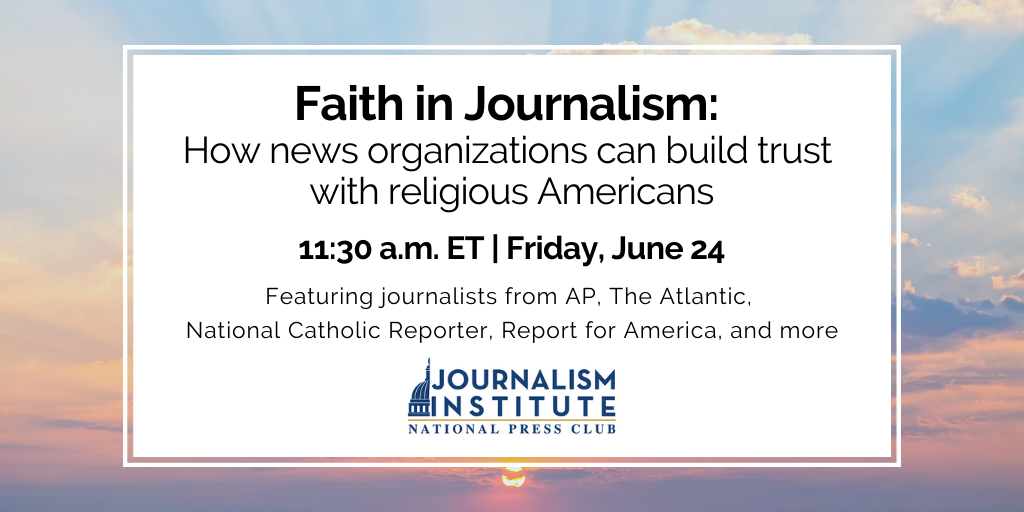
More than 75 percent of Americans say religion is an important part of their lives. How do these Americans see themselves and their faith reflected in news coverage? What does reporting on faith get right and wrong? How do editors and reporters think about who they’re reaching with these stories and who they’ve lost? And how might this coverage build trust in journalism among communities who have been historically misrepresented?


Registration is open for this program, which will take place on Friday, June 24 at 11:30 a.m. ET. Participants will learn:


  • How journalists of faith navigate challenges from inside their newsrooms and from inside their faith communities
  • Whose faith is centered in coverage and whose is marginalized, mischaracterized, or misunderstood
  • Which best practices can help extend our community’s understanding of itself


Panelists include:


The conversation will be moderated by Julie Moos, the Institute’s Executive Director, and is supported by an operational grant from the Deseret Management Corporation.

Resources

This newsletter is written & edited by the National Press Club Journalism Institute staff: Beth Francesco, Holly Butcher Grant, and Julie Moos. Send us your questions and suggestions for topics to cover.

Get this from a friend? Subscribe, and view the archives.

If you value this newsletter, consider supporting The Latest with a tax-deductible, recurring gift to the Institute: Even $5 a month will help fund the technology and time it takes to provide this important service.  
Facebook  Twitter  Linkedin  Youtube  

The National Press Club Journalism Institute promotes an engaged global citizenry through an independent and free press, and equips journalists with skills and standards to inform the public in ways that inspire a more representative democracy. As the non-profit affiliate of the National Press Club, the Institute powers journalism in the public interest.