How to Transform the Pain of Difficult Times to Grow
Liz Driscoll Jorgensen
When life is at its most stressful, unpredictable, and seemingly random I have always used specific inspirational writing to help focus and center my own fearful "monkey mind." The same wise words are comforting, familiar and new again as I have read them in different decades help me to feel grounded and as I have come to learn, there is always a meaning to my pain if I stay with the pain and allow it to be my teacher. This is not the same as saying "Everything happens for a reason," instead it is a way of embracing our inevitable pain and suffering to grow emotionally and spiritually.
Pain grows when we mentally "fight" against it and it festers when we deny it, turning into compulsions, nightmares, and worse. One of my hopes for the aftermath of the losses of COVID-19 is that we begin to accept the inevitable nature of human suffering and willingly enter into its wisdom.
I have spent many hours this past year or so helping others and sitting in my own deep pain. Both of my parents died within 14 months of one another (as well as a dear mentor and another friend) and I was able to observe how others have faced great losses.
I also realized that many whom I believed to be kind, thoughtful friends were not able to be there for me, even in a symbolic way at the time of my greatest need in decades. I have let myself feel this pain as well, and let them go to their own journeys, without expectations or resentments.
The hardest part of surviving pain and loss is the winnowing of close relationships that can happen due to others' inability to sit with our suffering and in parallel their fear and acknowledgment that great loss is coming to them one day as well. It is a certainty that we don't have to run from, and peace comes from this acceptance.
I have loved listening to the podcast, "Terrible, Thanks for Asking" by author Nora McInerny. Nora lived through the death of her 35-year-old husband as the mother of their infant son and the loss of her father all within six months. She interviews many people who have lived through circumstances almost unbelievable in their tragic details and who tell it straight, giving hope, but avoiding "toxic positivity" at all costs. These are my favorite people- those who are part of a secret club of pain and yet, they choose to try and live and be as kind and good as possible without being martyrs. Wow. Check Nora out here: https://www.noraborealis.com/
There have been so many lessons in the past year, what it is we really need, what we can let go of and what we were too "attached" to that in the clarified sight of staying safe and well over having 'stuff' we see as silly.
Let it go, give it away, share with those who suffer more than we have, these are my lessons as well as the precious qualities of true friendship, the subtle joy of sacrificing in the short term for the deep joy of days to come.
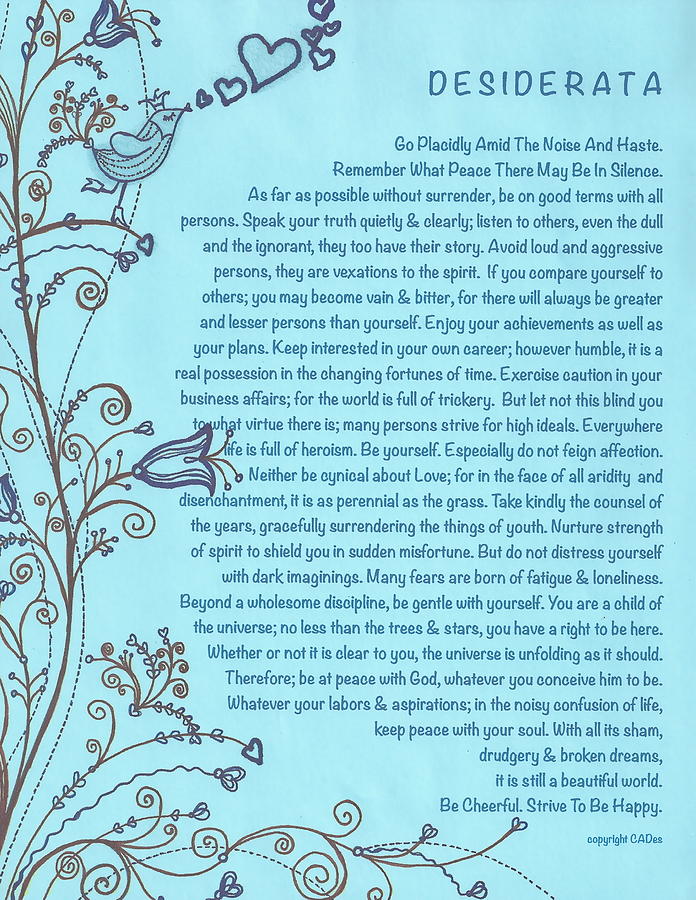
In closing this sad but honest blog- I am sharing the Desiderata, written by American writer Max Ehrmann in 1912, a poem that seems inspired by the ancients, and gives me comfort every time I read it. The name "Desiderata" is derived from the word 'desideratum', defined as "that which is needed, something which is wanted or needed' The word sounds mystical, however, when I read the poem/prayer, it is a simple set of instructions about how to be sane, kind and ok in any storm.
I have always had a copy of The Desiderata in my office or home and since I was a teen I have found it to be a guide.
Sending you all care and hope for continuing to find your own meaning in this time of new life and renewal as we mourn and accept all we must lose along the way to be human.
|
|
Insight Counseling is working from our offices and safely outdoors for all programs and services. |
|
Young Adult Services at Insight Counseling
Is your young adult child struggling to become more independent, experiencing anxiety, depression, or stress-related issues? We are here for them and for you with the highest quality care.
To meet our client's needs we continue to provide our services outdoors, in the office with Medical grade HEPA Air Filters and social distancing, and supplementing online and by text and phone.
Our intensive group program is designed for young adults struggling to ‘launch’ and become self-sufficient for college, work, and independent living. Groups meet two times per week and we also provide supplemental individual and family therapy as well as sober coaching services.
Nina Leventon, LMSW, and Clare Gelissen, LMFT are the co-leaders of the program and will maintain text, phone, and online contact with all group members between sessions.
Our services for young adults include college and career coaching, communication with outside agencies, institutions and professionals, and family therapy structured to allow young people to thrive and ‘launch’ in a healthy, appropriate manner. All Insight Counseling staff will also team with outside physicians, therapists, and other providers to make a seamless and efficient team approach for every client and their family members.
Nina Leventon will also be providing sober coaching to clients who require additional support in between group program hours. Each family and young adult will be given an individualized treatment plan that may also include medical services, referral for Medication-Assisted Treatment (MAT) with our physician Vicki Sara Blumberg MD, and more. In addition, Naturopathic Physician Veena Verma-Dzik, ND is available for consultations for medical issues that may be contributing to emotional symptoms as well as for overall health concerns.
For any questions or for further information please contact: Christine Brooking, Office Manager
|
|
ASK DR. V
Every month we will be sharing in-depth advice from our Resident Naturopathic Physician, Dr. Veena Verma-Dzik in this new feature. This month Dr. V answers your questions about gluten.
"Can a gluten-free diet have an effect on mental health?"
Question: "Dr. Verma, my daughter has been on medication for depression for years now. She sees a therapist, which has helped a lot. The medication helps keep her emotions from spiraling down and keeps her even-keeled. However, she still struggles with being happy. Her diet is pretty typical for a teen, cereal for breakfast, sandwiches for lunch, pretzels or chips for a snack, and then whatever I cook for dinner. I hear a lot about gluten-free diets. Is that something even worth trying?"
Dr. V: Following a gluten-free diet is hardly a fad or a myth. There is evidence to support its benefits for our mood and mental health, and being highly beneficial for those suffering from many psychoneuroimmunological conditions including anxiety, depression, brain fog, ADHD, and more.
What is gluten?
Gluten is a storage protein that is found in many types of grains. Gluten is a mixture of many proteins, the most commonly known ones are glutenin and gliadin. The gliadin protein is composed of a sequence of peptides that are resistant to digestion within the gastrointestinal tract. Because gliadin cannot properly be digested, the residues build up within the GI tract compromising the integrity of the intestinal lining, which then allows the partially digested gluten to pass through the lining and enter the bloodstream. Once gluten enters the bloodstream, immune cells find the gluten and react by creating an immune response and inflammation.
How does gluten affect the brain?
There are few ways in which gluten has an effect on our mental health. One is by causing an imbalance in the gut microbiome. As you all know, the gut is not only comprised of your digestive system but also your neurological system, also known as the Gut-Brain Axis. The inflammatory state that can be induced by gluten within the gut lining creates an imbalance in the microbiome and increased intestinal permeability. The increase in permeability allows lipopolysaccharides produced by bacteria within the gut to leak through the intestinal lining, and cause systemic inflammation, which ignites further inflammation in the brain, known as neuroinflammation. Once neuroinflammation occurs, neurological and psychological diseases develop. Some studies suggest that serotonin and GABA levels are also affected, but more studies are needed to confirm this.
Another aspect of gluten sensitivity that is worth mentioning is that those with non-celiac gluten sensitivity are not able to absorb all of the nutrients. As a result, a deficiency occurs, which can further worsen symptoms associated with psychoneuroimmunological conditions. Some of the most common deficiencies include iron and B12.
So, the question remains, is it worth trying a gluten-free diet to improve your mental health? Absolutely! Evidence exists about the relationship between gluten and our psychological and cognitive health. Addressing all factors contributing to the state of your health is extremely important, and consuming a gluten-free diet as part of the treatment approach can be highly beneficial.
__________
Randomized Controlled Trial Nutr J. 2019 Aug 31;18(1):50. doi: 10.1186/s12937-019-0475-x. The study evaluating the effect of probiotic supplementation on the mental status, inflammation, and intestinal barrier in major depressive disorder patients using gluten-free or gluten-containing diet (SANGUT study): a 12-week, randomized, double-blind, and placebo-controlled clinical study protocol
|
|
Insight Counseling, LLC
(203) 431-9726
|
|
|
|
|
|
|