MEHER SPIRITUAL CENTER

Meher Baba's Home in the West

October Newsletter 2026

Meher Nazar Collection

"Again, what is spirituality? Poise, perfect poise. Make the most of every situation. He who upsets no one is a good man. He who is upset by no one is a God-Man!"


-Meher Baba


Lord Meher, online edition, by Bhau Kalchuri, pg. 2096

Dear Family and Friends,


Jai Baba from Myrtle Beach. A few reminders about upcoming programs:


  • Mark Trichka and Lisa Brande, tonight, Friday, October 30th, 7:15 p.m. at the Meeting Place.  Mark and Lisa will share their lively and devotional music. Following their performance, the video of Meher Baba, "The Ancient One," will be shown.


  • Steve Klein and Billy Goodrum, Saturday, October 31st, 7:15 p.m. at the Meeting Place. Stories, songs and prosems.  As this program is being held on Halloween, costumes are optional!


Meher Baba once said:


“The purpose of life is to realize our oneness with the Infinite; this can be achieved through love for God. Divine love makes us true to ourselves and to others. It makes us live honestly, comprehending that God Himself is Infinite Honesty.


“Divine love is the solution to all our difficulties. It frees us from every kind of binding. It makes us speak truly, think truly and act truly. It makes us feel one with the whole universe. Divine love purifies our heart and glorifies our being. I give you my love and blessings.” *


In Baba's Love and Service,


Buz Connor,

For Meher Center board and staff


*Bhau Kalchuri, Lord Meher, Online Edition, p. 3218.

"Work is always [done] by Baba, the Master, never by anyone else"

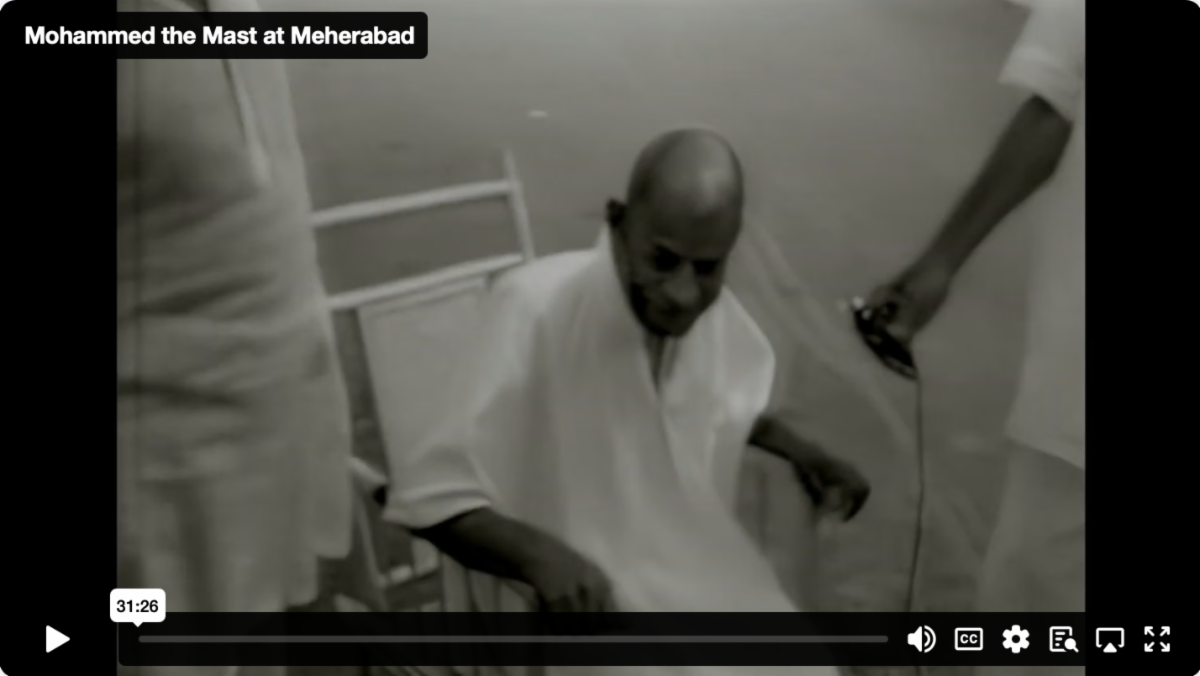
Mohammed was one of the best known of the masts - God intoxicated souls - that Meher Baba worked with over the years. He was also one of Baba's favorites. Mohammed was first brought to Baba in 1936. A year later, Baba took him to Cannes, France. Afterward, Mohammed lived the rest of his life at Meherabad until his death in 2003. In this extraordinary video, three of Baba's close mandali, Sarosh Irani, Padri Driver and Sidhu Kamble, "interview" Mohammed and give a taste of what it must have been like to serve a soul Baba said was on the fifth plane. The video was shot by Irwin and Edward Luck as part of their "Human Side of God" interviews. It was digitized and edited by Robert Fredericks.


Video, 31:26

Meherabad, India

June 1971

Courtesy of TechnoBaba Films

Raja Gopichand: A Play done by Masts

An excerpt from Lord Meher

Meher Nazar Publications

"Masts have a volcano of love within themselves." *


The following is an excerpt from Lord Meher, pp.1947-1948


Thirty-six masts and mad were staying at lower Meherabad at this time, and Baba was occupied in serving them. Pleader had been summoned from Benares in late May (a few months ahead of schedule). He and Baidul were the supervisors of the mast and mad ashram, carrying out their duties according to Baba's instructions. Baba would cut the hair of the masts and mad, and bathe, shave and feed them himself.


Most of the mandali, such as Pendu, Padri, Sidhu and Vishnu, were also engaged in work related to the mast ashram. Dr. Nilu had a medical dispensary and was treating the poor free of charge; Chhagan was the Master's night watchman; Masaji was the cook; and Kalemama was in charge of construction work. Officially without any duties, Gustadji was seemingly happily unoccupied in the joy of his silence.


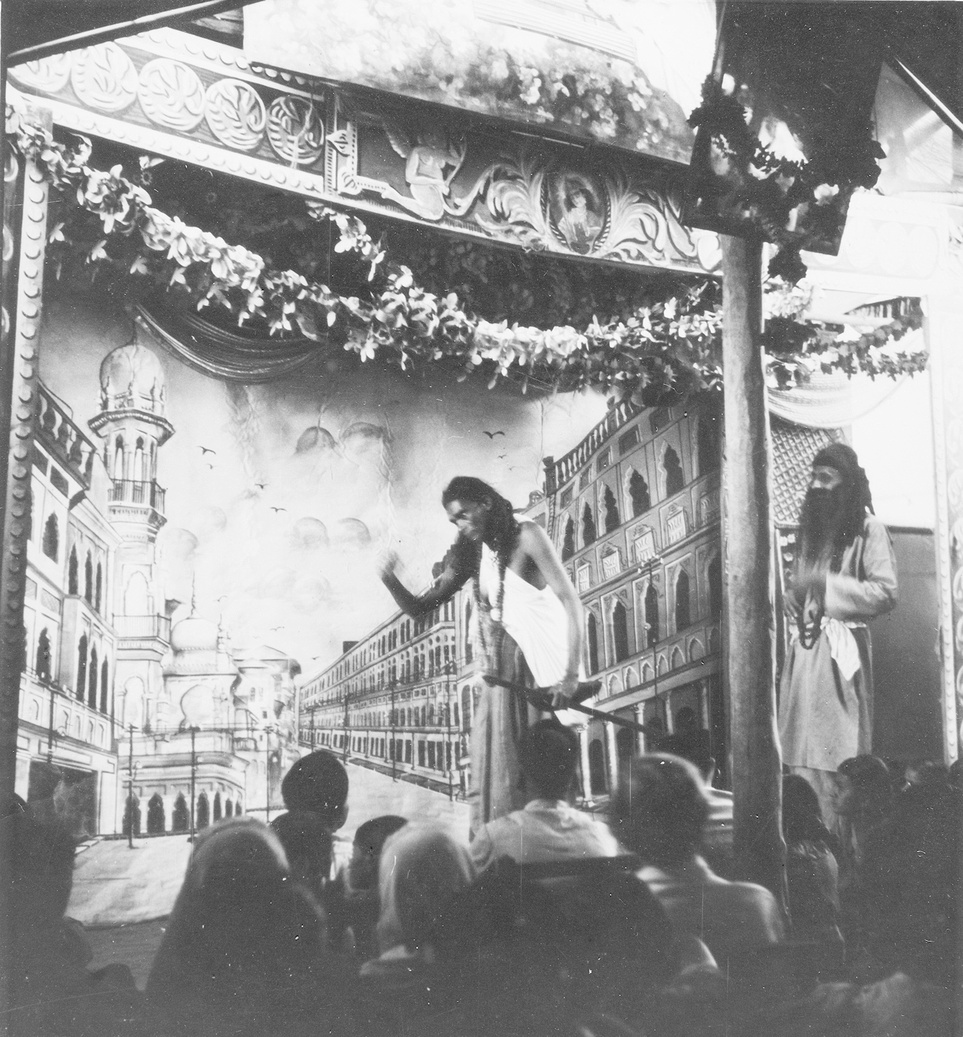
On 21 August [1938], Baba had instructed Pleader to rehearse the masts and mad to perform a play about King Gopichand.  Baba had given them one month. It was a strange order and extremely difficult to carry out. How could the masts and mad be made to act in a play? But according to Baba's wish, Pleader devoted himself wholeheartedly to the task. With great exhortation he began rehearsing these unconventional actors, painstakingly teaching them their lines. Eruch and Homi helped Pleader produce the play. Pleader rented costumes from Poona, and a stage with floodlights and backdrop was erected at lower Meherabad for the production.


On Sunday, 25 September 1938, Raja Gopichand was enacted, and lovers from Bombay, Poona, Nasik and Ahmednagar came for the unique performance, including Rustom, Goher and the Dadachanji girls. The women mandali from Upper Meherabad also attended. None had ever seen anything quite like this. The masts and mad played their parts so well, the audience was amazed at how good they were.


The full program was performed by the inmates of the mad and mast ashram. It was a marvelous event in this Avataric advent, never to be seen again. How could masts be made to act when they are unconscious of their physical bodies? How could mad persons be controlled to participate in a play? Yet, both groups did so to near perfection as if professional actors! It was an unequaled spectacle — the result of nothing but the Master's leela! His own divine play!


Baba was very pleased and embraced Pleader, saying, "Today my work is done, and on this stage of the universe I give you my embrace."


Two days after the play, on 27 September, eighteen of the 36 inmates were sent away to their respective towns or villages. Although this left eighteen in the mast and mad ashram, Mohammed Mast was the main occupant at this time and he received most of Baba's attention. Mohammed would take hours in everything he did — to eat, bathe, dress; every physical function was torturous for those who cared for him — and all the caretakers had been ordered to comply with his every whim and wish.


*Lord Meher, p. 4989


For Meher Baba's explanation on The Difference Between Ordinary Madness And Mast States from The Wayfarers, click this link:

https://www.mehercenter.org/excerpt-from-the-wayfarers/


Life on Center: New Display at Meher Abode

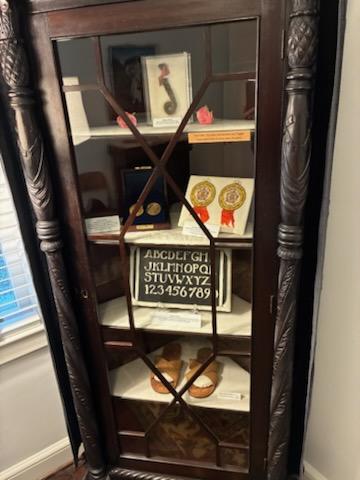
The East West Gathering Display at Meher Abode

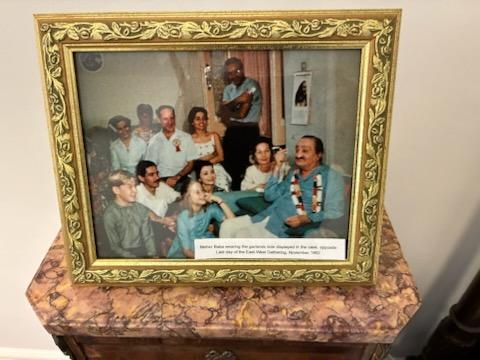
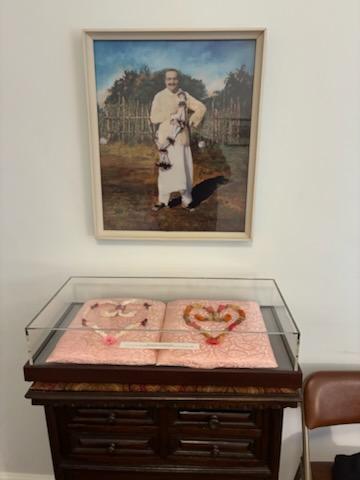
In addition to the current New Life display, there are new treasures and items on view in Dr. Donkin's room commemorating the 1962 East West Gathering. The most precious are two garlands worn by Beloved Meher Baba on the last day of the darshan program in the Westerner's morning session. In the photo next to the bed you will see that Baba is wearing the garlands. 


The photo hanging on the wall near the cabinet is of an afternoon session for Easterners and Westerners. 


In the china cabinet is a small case containing the Mastery in Servitude medal created by sculptress Vivian Agostini who was inspired by her profound experience of meeting Baba at the Gathering to craft the medallion. Baba approved the design and production in 1964.


The two badges were especially made for Westerners to gain entrance to the Guruprasad grounds.  

Baba’s Bookshelf

Part I: The Detectives

By Valerie Mckean

Photo Courtesy Meher Nazar Publications

Not long ago, I listened to a talk given by Meher Baba’s sister, Mani. She told the pilgrims gathered in Mandali Hall of Baba’s love of detective stories and mentioned with delight the enjoyment she felt when reading to Him. I began to wonder how and when His appreciation of detective stories began. 


When Baba was still young and called Merwan Irani, He enjoyed Arthur Conan Doyle’s Sherlock Holmes and later Egdar Wallace. He also became a devoted fan of the detective Sexton Blake, whose early adventures appeared in the inexpensive boy’s weekly magazine, The Union Jack. The stories were exhilarating, with titles such as ”Doctor Zebra’s Doom,” “The Tsar’s Double,” and “The Stolen Mummy.” Merwan wrote a letter of appreciation to the author of one of the stories. The character of Sexton Blake first appeared on the scene in 1893, and over the next eighty-five years, 200 different authors contributed close to 4,000 stories. 


Sexton Blake attended medical school. However, he chose not to practice medicine and instead set up a detective agency in rooms on Baker Street — just up the street from where Sherlock Holmes rented rooms. Sexton Blake was physically fit and ready for any fight or brawl, a master of disguise; he often went undercover to solve crimes from the inside. He was aided by his assistant, Tinker and his devoted bloodhound, Pedro.


Baily Jamshed Irani, Baba’s boyhood friend and later disciple, was studying English and preferred Gujarati magazines; he resisted reading the Sexton Blake stories in English that Baba encouraged him to read. However, Baba insisted and Baily finally promised to read them. Bailey later acknowledged, “Regular reading of Sexton Blake's detective novels really developed my interest in reading English.” (1)


The Meher Ashram School for Boys opened its door in May 1927. Mandali member Ramjoo Abdulla, called it a “gem of an institution.” He once told Mani that one of the things initially drew him to Meher Baba was their shared interest in Sexton Blake. During those early days of May, after arti, Ramjoo told those gathered a Sexton Blake story every night. “Baba seemed to take a ‘keen interest’ in them and the mandali enjoyed them after the day’s work.” (2) 


During the war years, Margaret Craske, who lived in India from 1939 to 1946, began reading to Baba and the women mandali in the East room of Meherabad. Delia de Leon and others from England would send Margaret books on a regular basis. During the Blue Bus Tours, Margaret would keep the books with her bedroll. 


Baba was fond of Ellery Queen, as well as John Dixon Carr, the master of the locked door mystery. When it came to Agatha Christie, the Queen of Crime, He preferred the character Hercule Poirot over Miss Marple. Baba was especially keen on Rex Stout’s brilliant, portly armchair detective, Nero Wolfe, who rarely left his New York brownstone apartment, solving crimes while attending to his orchids and dining on gourmet meals, using the power of logic and deduction. Archie Goodwin, Wolfe’s young humorous assistant, pounded the pavement doing Wolfe’s legwork.


Rex Stout was a prolific author - some thirty three novels and forty-one short novellas and short stories were published between the years 1934-1975. Sometime after Margaret Craske arrived in the United States to teach at American Ballet Theatre, Baba wrote to her and asked her to send him every book that Rex Stout had written. Margaret enlisted her associates and dancers to seek out bookstores during their tours. She wrote, “Every one of the books that Rex Stout had written up to that time was found, parcelled and sent to the dancers’ beloved Master. It was fortunate for these young dancers that they were able to do some small personal service for Baba.”(3)  

Mani said, “To read to Him was my greatest pleasure, and my highest award from Beloved Baba was when He turned around to Mehera and said, “I’m always happy when Mani’s reading to Me because it makes Me feel like I’m watching a play.” (4) 


It is easy to imagine Mani, herself a master story-teller, imitating Agatha Christie's Belgian detective, Hercule Poirot, “The little grey cells— remember always the little grey cells, mon ami.”  


Did Baba and Mani chuckle when she read to Baba from Rex Stout's novel The League of Frightened Men, in which the great detective Nero Wolfe tells his assistant, Archie, “I love to make a mistake, it is my only assurance that I cannot reasonably be expected to assume the burden of omniscience”? Mani recalled, “I would use different voices as I am never tired of repeating. When you are Baba’s, everything that you have, no matter how silly, how insignificant that thing you have, He uses it. He uses it. It is for Him.“ (5) 


It wasn’t always easy reading to Baba, for sometimes He'd stop the reader after a few minutes and other times the reading would go on for considerable time. On occasion, just as the mystery was about to be solved, He would smile, stop the reading and motion the reading would be continued later. When Delia de Leon returned to India in 1948 for a several month stay, she was given the opportunity to read to Baba from the thriller books that Margaret had sent to Baba. This could happen at any hour. She wrote, “He would start walking all about the house and insisted that I walk behind him still reading, much to the amusement of all” (6)


In one of the Family Letters, Mani summed up the role played by the detective novels and their authors: “Baba has said ‘Creation is really a mighty joke, but the laugh is at my own expense — and now the jest is proving a burden on my chest’. And so they too have served Him, all the authors whose stories have served to entertain the Author of Creation's Story and helped ease to some extent the strain of His universal burden. Could we but say as much!” (7) 


Many of the great detective novels that Baba enjoyed can be found on the shelves of the Saroja Library at Meher Spiritual Center.


1. From Baily’s Memoirs, by Baily Jamshed Irani, p.6

2. Combined Diary, Day 144 folios #2v252-2v255, May 7-9, 1927, AMBPPCT  

3. The Dance of Love, by Margaret Craske, p.76 

4. The Joyous Path: The Life of Avatar Meher Baba’s Sister, Mani,Vol II, by Heather Nadel, p. 619

5. “Reading to Baba” Mani S. Irani, Mandali Hall, Meherazad, India July 17, 1993, Mandali Hall Talks

6. The Ocean of Love: My Life with Meher Baba, by Delia de Leon, p.178 

7. 82 Family Letters – To the Western Family of Lovers and Followers of Meher Baba,   p.269 

You can find all previous newsletters and searchable video and audio offerings

 on our website.


MEHER BABA

ARTICLES

THE CENTER

CONTACT