|
|
This Week in Farm to School
January 13, 2022
|
|
Farm to school connects local agriculture, schools, and partners to benefit students, educators, farmers, families, and communities.
|
|
Follow us on Instagram! 📸
We are very excited to connect with our farm to school friends through another platform – Instagram! That’s right, the Farm to School Coalition of North Carolina has an Instagram page (@f2scoalitionnc)! Here we will be highlighting and celebrating farm to school efforts in North Carolina, sharing out farm to school resources, and more. Be sure to tag us and share your farm to school experiences with us!
|
|
Conversations on Food Justice – Keeping Americans Fed: The Power and Exploitation of Immigrant and Migrant Farming Communities
Today! January 13, 2022 // 1:30 pm EST
In this session, the Aspen Institute will discuss the social, economic, and structural barriers that exploit immigrant and migrant farmworkers and push families to the margins. You'll also hear from the people and organizations who are forging a new vision for an agricultural industry that values the land, and the people who tend to it. Finally, the session will examine why improving the conditions of farmworkers should be a legal, economic, and moral imperative for all of us.
Growing Connections for Farmers in Northeastern North Carolina - A Virtual Event
Today! January 13, 2022 // 7 - 8:30 pm EST
Tune in for the virtual film premier and community discussion of “Growing Connections for Farmers in Northeastern N.C.” co-hosted by Community Food Strategies, an initiative at the Center for Environmental Farming Systems. Growing Connections for Farmers in Northeastern N.C. is a mini-film uplifting local voices on the interconnectedness of farming, food insecurity, and resiliency by highlighting the importance of farmers in North Carolina and how we can support them. Click here to view the promo video.
Local Food Systems Response to COVID Webinar Series
Tomorrow! January 14, 2022 // 12 - 1:30 pm EST (ongoing monthly)
Join the USDA each month for a facilitated cross-sectoral discussion on topics including customer retention and engagement, emergency food, cooperative business models, state policies, and consumer behavior.
CEFS’ CORE (Committee on Racial Equity) Intro to In-Betweens Virtual Webinar Series
January 26, 2022 // 1 pm EST
In-Betweens are monthly shared learning and study groups on the intersection of food and race. This webinar will share how you can start your own In-Betweens as a part of your institution’s ongoing racial equity community of practice. Participants will gain access to the updated CORE In-Between guide.
2022 North Carolina Child Hunger Leaders Conference
February 17, 2022 // 9:30 am - 4 pm
This year's conference is once again hosted by the Carolina Hunger Initiative, a part of the UNC Center for Health Promotion and Disease Prevention. The conference was started by No Kid Hungry NC, which is a partnership between UNC and Share Our Strength supported by the same team as the Carolina Hunger Initiative. This conference will be a chance for North Carolinians to celebrate each other, share stories of their success and innovations, and look to what the future might be for Child Nutrition in our state.
|
|
NC Farm to Preschool Network Statewide Survey Results
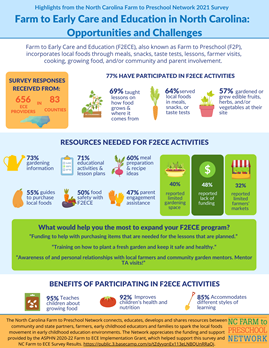
On January 10, 2022, the NC Farm to Preschool Network released the results of their statewide 2021 North Carolina Farm to Early Care and Education (F2ECE) Survey, which shows that North Carolina providers are incorporating local foods in ECE settings even as challenges and resource needs exist. Launched in early 2021 and completed by 656 early care and education (ECE) providers in 83 of North Carolina’s 100 counties, the survey assessed activities, strengths, challenges, resource needs, and program characteristics. Research from the National Farm to School Network and others shows that farm to ECE activities helps create high-quality learning environments that promote lifelong health and wellness for children and families and can help create a more just food system.
Survey results will be used by the N.C. Farm to Preschool Network Advisory Committee (and our partners) to create an action plan with ECE providers to grow an equitable movement within our programs and communities so that “all North Carolina children get a healthy start and develop to their full potential in safe and nurturing families, schools, and communities” (vision statement from the N.C. Early Childhood Action Plan).
|
|
Teaching in Nature’s Classroom: A Free Online Course for Educators
This free 15-week course designed by the Wisconsin School Garden Network was developed as a companion to the book Teaching in Nature’s Classroom: Principles of Garden-Based Education. This course is an opportunity for educators new to outdoor and garden-based learning, as well as educators who are experienced in the field, to consider best practices and reflect on their own teaching practice in outdoor learning environments, with a focus on school and community youth gardens. This course is online and offered from January 24 - May 9.
|
|
School Nutrition Association Awards
Recognize a School Nutrition colleague by nominating them for an SNA Award. Nominations are due by March 1, 2022! Review eligibility requirements, along with nomination criteria, via the link below.
|
|
School Nutrition Foundation Equipment Grants
Deadline: January 31, 2022
The School Nutrition Foundation is teaming up with industry partners to provide new kitchen equipment to deserving districts. Apply now for the 2022 SNF Equipment Grant Program, featuring applications for not one but FIVE grants! Eligible applicants have the opportunity to win equipment grants, each worth between $20,000 to $100,000 of equipment. Applications and photos must be submitted by a School Nutrition director. The recipients will be notified in late March. This year, only finalists will be asked to submit a 2-3-minute video.
Food and Agriculture Service Learning Program
Deadline: January 31, 2022
Food and Agriculture Service Learning Program (FASLP) is a farm-to-school program that supports projects that bring together school cafeterias and classrooms and fosters community engagement between local farms and schools. The goal of these efforts is to not only increase access to school meals for underserved children but also improve their quality. FASLP is focused on the development of leadership skills, knowledge, and qualities necessary to prepare students for food, agricultural, and related careers.
WNC Farm to School Jumpstart Grant
Deadline: August 2022
The Appalachian Sustainable Agriculture Project’s Growing Minds Jumpstart Grant is now open! Eligible schools and organizations can apply for funding in the amount of $500 to $1,000 to support their farm to school project. Funding can be used to start new projects or to expand upon existing activities. Pre-k through 12 schools, homeschool groups, teacher and nutrition education programs, and community-based organizations serving children and families are eligible to apply (see below for more details). Schools/organizations must be located within the 23 westernmost counties of North Carolina (Alleghany, Ashe, Avery, Buncombe, Burke, Caldwell, Cherokee, Clay, Graham, Haywood, Henderson, Jackson, Macon, Madison, McDowell, Mitchell, Polk, Rutherford, Swain, Transylvania, Watauga, Wilkes, Yancey) or the Qualla Boundary. Applications are due on the 15th of each month through August 2022, starting on January 15, 2022.
|
|
Increased Funding to Support School Meals and to Help Continue Serving Healthy Meals to Students
The U.S. Department of Agriculture (USDA) announced an adjustment in school meal reimbursements to help schools continue to serve children healthy and nutritious meals. This move will put more funds into school meal programs across the nation this year, making sure federal reimbursements keep pace with food and operational costs while ensuring children continue to receive healthy meals at school.
|
|
Taking Stock and Looking Forward: Food Justice
Jessica B. Harris, Navina Khanna, and Ashanté Reese discuss systemic racism, justice for Black farmers, and how we move toward a food system for all.
|
|
|
|
|
|
|