|
This Week's Contents
(scroll to see the full content of each article; you can click the cup below to compensate the writers)
| | | |
Rachel Hakimian Emenaker,
"Deep Roots Among Fallen Trees"
| |
Charles Ross
"Mansions of the Zodiac”
| | And please consider our sponsoring venues | | |
Tala Madani, "Be Flat"
by T.s. Flock
| | |
Tala Madani, “Be Flat”
by T.s. Flock
University of Washington, Henry Art Gallery, Seattle, California
Continues through August 17, 2025
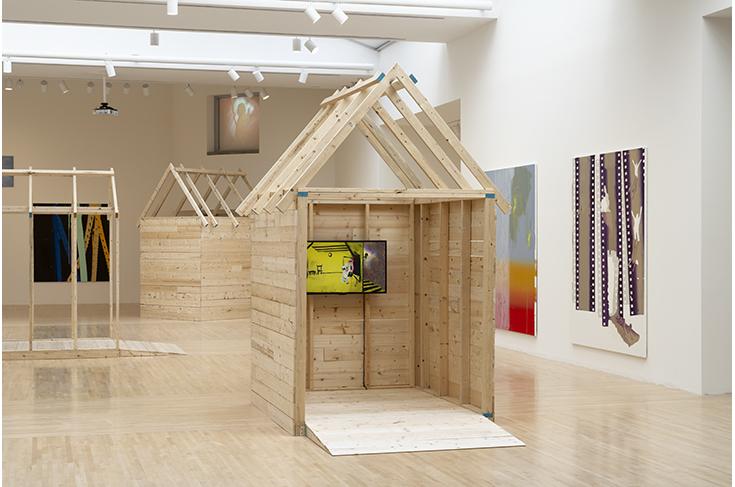
For their monographic exhibit of works by Tala Madani, the curatorial team at the Henry Gallery made many excellent decisions, in terms of both selection and installation. Presentation is never to be taken for granted, of course, but Madani’s works present an additional challenge, as they are widely varied in scale and format, from very small paintings to short animations to canvases that tower over the viewer.
|
| |
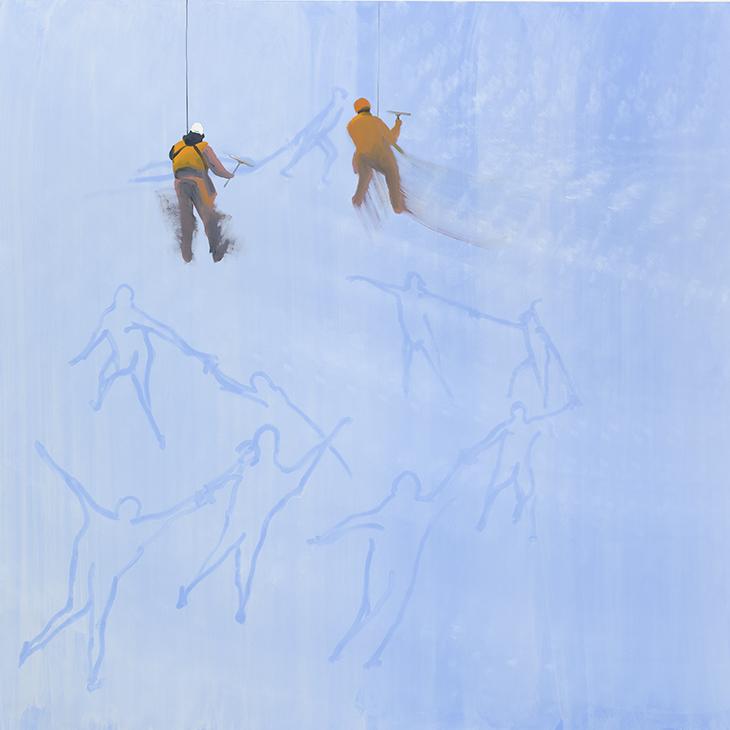
Tala Madani, “Squeegee Men 3,” 2024, oil on linen. All images courtesy of the artist and David Kordansky Gallery, Los Angeles.
Photo: Jueqian Fang, courtesy of the Henry.
| | |
Let’s start with the latter. In Madani's largest canvases depicting window washers, the world is reduced to the essentials — a surface to be cleaned, buildings so vast we do not see their edges, only figures suspended in a colorful void. Sometimes the bands of color seem rendered by a single stroke of the squeegee, as if the paint itself were merely a residue. Within these rough flat tints, you may find barely sketched silhouettes that sometimes appear as if smudged on by fingers.
In this play with immensity and erasure, scale is everything. The seemingly infinite facades of the skyscrapers Madani depicts demand attention, induce vertigo, and establish dominance through size. In our increasingly bold global oligarchy, art and architecture share this obsession with monumentality — a luxury that, ironically, rests on the humblest gestures and most precarious labor. The real builders, those who polish, clean and make visible the invisible, are themselves made invisible by their status — precariousness in poverty and immigration status, and readily exploited, from the USA to the UAE. In this troubled reflection, we who stand below and at a great distance, are also left suspended, between fascination and indifference, intimacy and helpless witness.
|
| Tala Madani, “Shit Mom Animation,” 2021, single-channel video animation, 7:54 minutes, edition of 4, with 2 AP. | | |
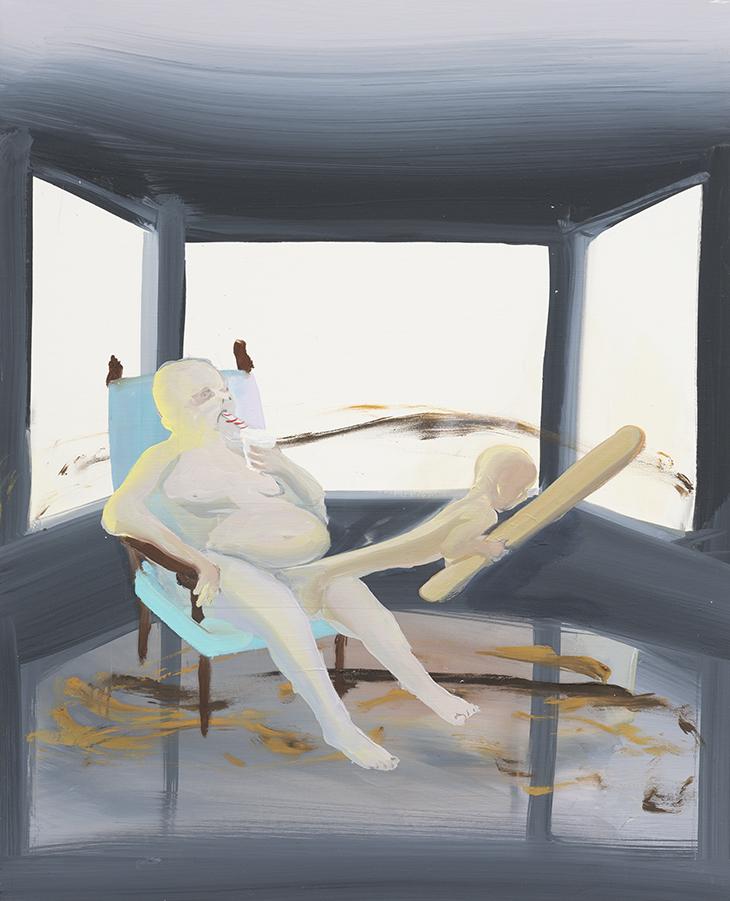
Power dynamics are a primary motif in Madani’s works, taking on a more grotesque and satirical character in her “Bad Father” paintings. In these much smaller windows into an alternate reality, fatherhood is no longer an honorary title or a role to be assumed when convenient. It is an irrevocable physical attachment. The children are unruly protuberances that act of their own accord. The father can no longer flee or ignore his role. He is rooted to the life he has generated.
These children are not the idealized reflection of a lineage, but the grotesque extension of masculinity reduced to its purest absurdity — loud, violent, confused. They scream, struggle and take bats to the furniture. For once, the mother is not there to take the blame, to be the guarantor of a failing upbringing. There's no womb to point the finger at, no mother figure to accuse of having spoiled or neglected too much. There are only these men and their children, bound by a cord that cannot be cut.
In these absurd yet terribly logical scenes, Madani holds a mirror to the certainties of a patriarchal view of fatherhood and shakes them. The child is no longer an idea, an inheritance, a name. The farce that treats boys as a means for men to project their own ego into the future, as “legacy” rendered with vulgar literalism, forces a revelation: The power to give life is not an insignificant privilege nor a way of generating an instrument of one’s own will, but an existential condition from which no one, irrespective of gender, can turn away.
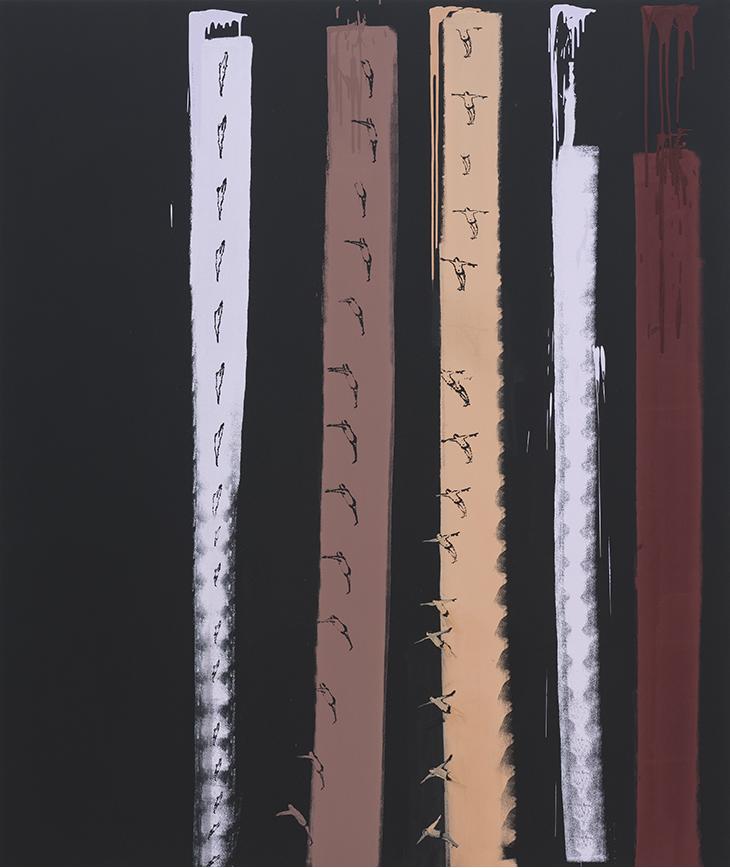
| | Tala Madani, “Film Fall (purple),” 2024, oil on linen. | | Tala Madani, “Sports Dads (R&R),” 2024, oil on linen. | | |
To insist even this much might be considered blasphemous to the current order, but Madani doesn’t end her provocations there. With her triptych of “altarpieces”, she turns the solemnity of religious iconography against itself, moving from the groin to the fundament. The images are, quite simply, the rear end of a man bent over, anus and hanging scrotum in full view, rendered in painterly monochrome.
This holy image was not entirely Madani’s invention. She is reproducing an actual altarpiece, whose backside portrayed the Cyclopean gaze of an asshole forever directed to the crucifix, a rectum exposed like so many theological gaps. By hiding this element behind the altarpiece, we need not assume that the original’s creator was totally irreverent, though it may look as such. To our modern eyes, trained by centuries of iconoclasm and an increasing disgust with the body’s imperfect frankness, what passes for sacred and profane remains in flux.
With Madani, this trio of fundaments is also the most literal example of her ability to point to the otherwise hidden, the invisible work that supports all apparent grandeur. What any official history emphasizes — authority figures, sacred ideals — only holds because something else is exploited or denied. In the balance Madani maintains between the comic and the tragic, we are forced to reckon with the embarrassing revelation that the veneer of the divine always conceals a much cruder truth.
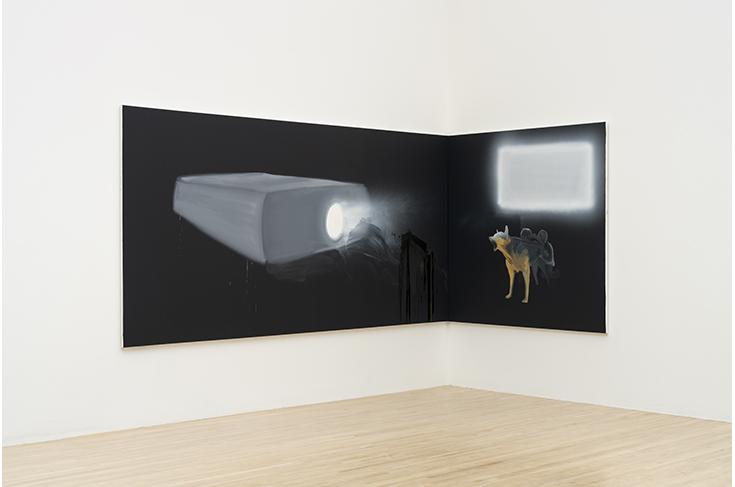
| Tala Madani, “Corner Projection (Alsatian),” 2019, oil on linen. | |
This reversal is fully in line with Madani’s approach. Where sacred art once imposed moral and spiritual authority, it now substitutes a corporeal grotesque which demystifies any pretension to grandeur. Humor in this context is not content to be a mockery, it becomes a tool of delegitimizing power structures without direct challenging them. It’s a consistent feature among artists who grew up amid theocratic and authoritarian regimes, though such plausible deniability regarding interpretation never offers full protection to artists.
This threat of violence — even of dismemberment — comes out more explicitly in Madani’s animations, if still with a morbid playfulness. They are hand drawn: Soft colors, round shapes, a feigned naivety reminiscent of one’s first sketches scribbled in crayon or finger paints. This childlike style belies the more adult content that follows. Madani knows where to press, and does so free of irony.
For example, a hand plays with a spring, makes it dance, bends it with the amazed insistence of a child who is just discovering the flexibility of things. Then the spring cuts. Suddenly, a finger falls off. The hand continues, fascinated, oblivious to its own wound. One more shot. Another. By the end, all that remains is a trembling stump, brutalized by the mechanics of its own game.
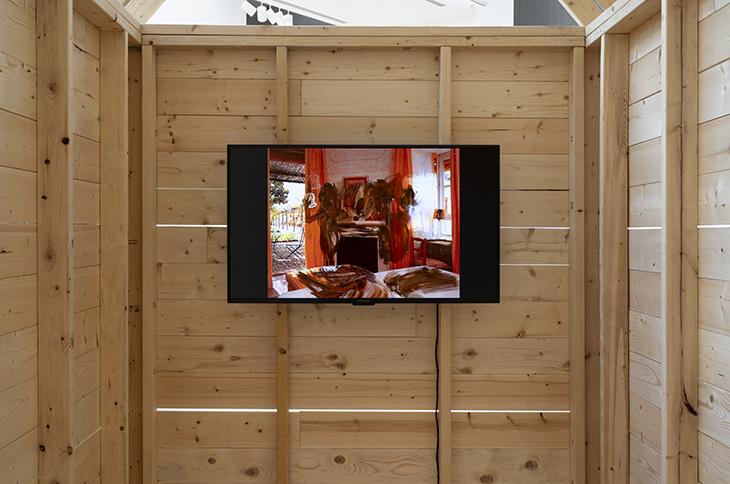
| Tala Madani. “Be Flat,” installation view, Henry Art Gallery, University of Washington, Seattle. 2024. | |
In another, a succession of men transforms into furniture and appliances as they read instruction manuals. Their grumbling and grunts of horror only add to the absurdity. Then a child appears, smashing their inanimate but sentient forms — a bloodless blood bath.
Then there is the image of a young girl projected in a dark room where two viewers observe her in a white void. Suddenly, it is she who scrutinizes them, who pulls them into the screen, and shoves them — in a most extreme inversion — into her birth canal and finally allows the void its total erasure.
What begins in play ends in dismemberment; what seems a simple task becomes a trap. With Madani, the absurd is never gratuitous. It is the weapon of unease, the lever that pries the lid off the ark. We watch, we laugh, we cringe. And when it’s time to look away, we realize that it is too late: We are already swallowed.
| | | |
T.s. Flock is a writer and arts critic based in Seattle and co-founder of Vanguard Seattle. | | |
Rachel Hakimian Emenaker, "Deep Roots Among Fallen Trees”
by Liz Goldner
| | |
Grand Central Art Center, Santa Ana, California
Continuing through May 11, 2025
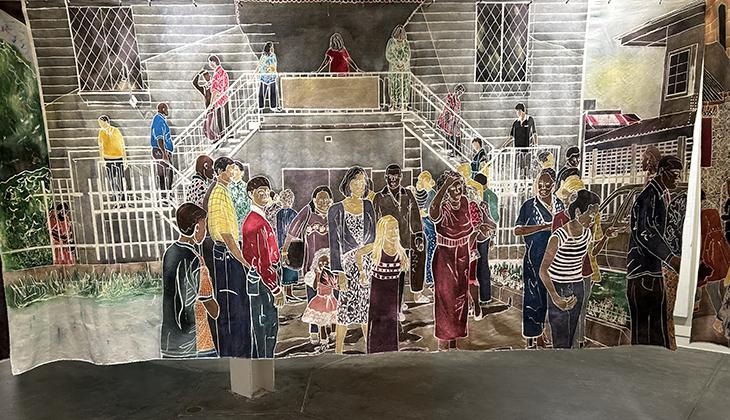
The title “Deep Roots Among Fallen Trees” describes the creative and philosophical perspective that Rachel Hakimian Emenaker has gained from her self-described diasporic upbringing. The 32-year-old, of Armenian ancestry, grew up partly in Moscow, reveling in its then-vibrant performance and protest art scene (much of it a reaction to the previous Soviet era’s artistic oppression). She also grew up partly in Paramaribo, the capital of Suriname, a former Dutch colony on the north coast of South America whose profoundly mixed culture includes people of Middle Eastern, Indonesian, Indian and African ancestry.
| | |
Rachel Hakimian Emenaker, “Deep Roots Among Fallen Trees,” 2024.
All images courtesy of the artist and Grand Central Art Center, Santa Ana.
| | |
Having moved four times while growing up and speaking several languages, Emenaker developed compassion for those displaced from their roots who, in the words of the artist, forged new “identities and histories through the fusion of old and new, memory and materiality.” Emenaker believes that diasporic communities blend their identities with one another while maintaining aspects of their ancestral cultures. In a vibrant installation we gain insight into how such new and distinctive cultural identities are formed.
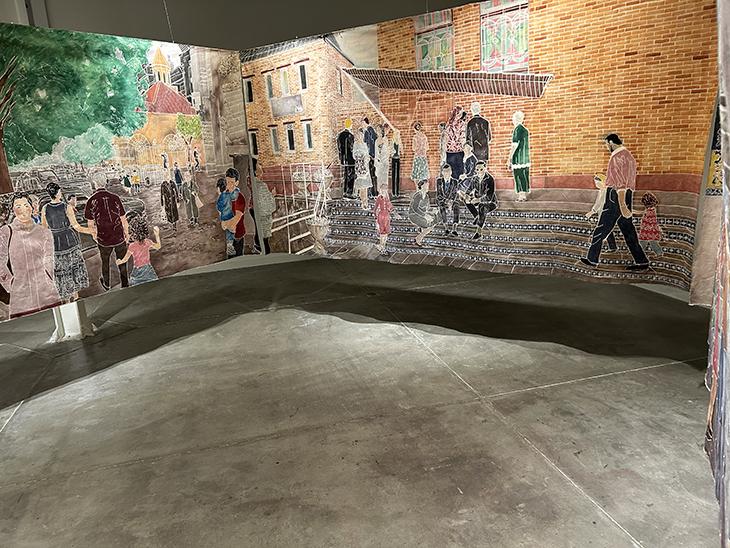
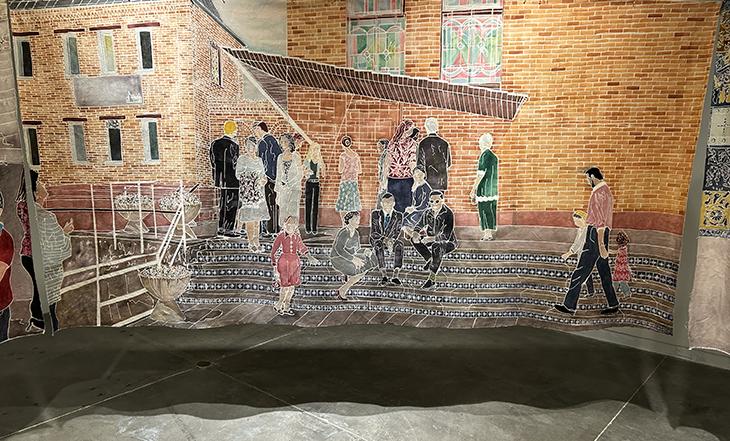
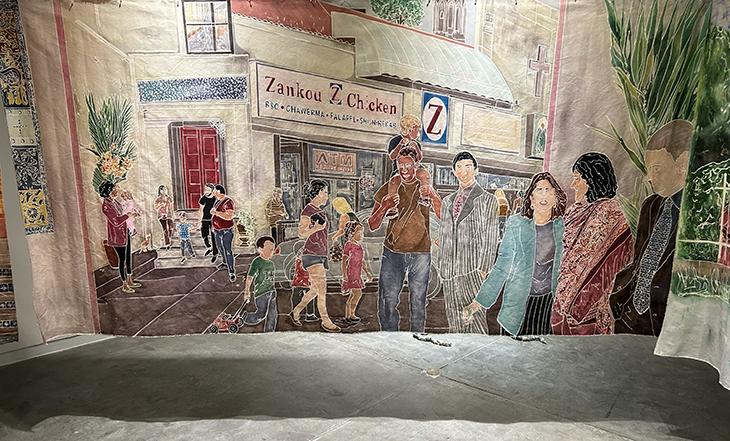
Emenaker’s cosmopolitan background is the foundation on which she illustrates gatherings of people of all ages, races and backgrounds from the many places she has lived in and visited. The people in this immersive artwork, many accompanied by their children, meet each other, converse with each other, and even worship with each other.
| | Rachel Hakimian Emenaker, “Deep Roots Among Fallen Trees,” 2024. | | |
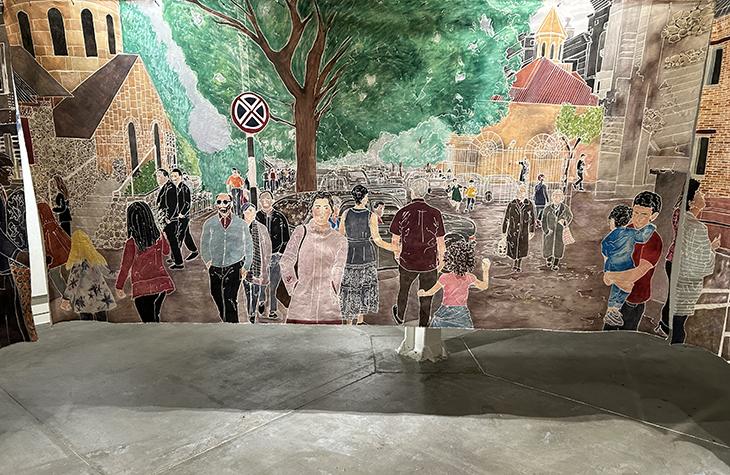
The substructure of “Deep Roots Among Fallen Trees” is the supporting architectural features of cities where Emenaker has lived, including buildings, churches, stairways, and thoroughfares in Russia, Eastern Europe, and Suriname. The architecture is inspired by old family photos, memories of places that she has lived in and visited, with embellishments conjured up from her imagination. By portraying architecture, she symbolically engages with various cultural histories, languages, and identities. A Los Angeles neighborhood in the series, near her current home, is identified by a Zankou Chicken outlet, an ATM, and tropical foliage.
To create this unusual work, Emenaker has painted nearly life-size people, supported by the architecture, onto four canvas panels, each approximately 13 feet wide by six feet high, all hung from wooden frames from the ceiling. She has joined the four panels to create a welcoming, light-filled enclosure that elicits feelings of comradeship with other visitors in the gallery.
| | Rachel Hakimian Emenaker, “Deep Roots Among Fallen Trees,” 2024. | | |
Her artistic method begins with outlining the figures, structures, passageways, cars and trees with white wax. Then she carefully paints the details of the many elements within the work with fabric dye, which she explains is permanent and cannot be changed once applied to the canvas. This technique necessitates that she work with her mistakes, creating a fluid, living work of art. The figurative aspects of her work reveal an artist who has assiduously practiced her craft to create finely wrought images of people and buildings.
“Fallen Trees” is a metaphor for Emanaker’s depiction of the many architectural structures that she has lived in and among, but which no longer exist. In these spaces loss and regeneration coexist, while her memories of the places they represent are simultaneously illusive and preserved. She muses that the architecture in her panels is more than just physical structures. It is shaped by many people, and carries imprints of those who have lived and moved within those spaces, along with their conversational and cultural exchanges. She adds that when trees fall, their ecosystems intertwine and regenerate into new species; just as people of the diaspora intertwine and regenerate. Rumi, the 13th century Persian poet, wrote, “Sorrow … pulls up the rotten roots, so that new roots hidden beneath have room to grow.”
| Rachel Hakimian Emenaker, “Deep Roots Among Fallen Trees,” 2024. | | |
Emenaker also includes a series of hand-dyed batik panels that depict three buildings that have been destroyed. In layered shades of blue, they are abstracted architectural remains, speaking to loss, memory and fragility. Ceramic tiles are arranged on the floor outside of the installation. These convey fragments of her daily life: cartoons, historical references, recipes, family text messages, and images detailing war and ongoing violence. Emenaker explains that “[t]he tiles act as metaphors for the compartmentalization required to live in a world overloaded with information.”
In 2011, at age 19, Emenaker left Moscow to attend Biola University to study political science, intending to attend law school. While taking studio art classes there, she discovered that “politics can inform art,” and decided to devote herself to the creative process. After graduation, she moved to Armenia for three years, working with mentally disabled Syrian Armenian refugees. She returned to California to immerse herself in her studio practice, receiving an MFA in painting from UCLA in 2024.
| Rachel Hakimian Emenaker, “Deep Roots Among Fallen Trees,” 2024. | While still young and relatively new to the artistic vocation, Emenaker has acquired decades of interactive, meaningful life experiences. She mines these experiences in “Deep Roots Among Gallen Trees” to create an unusual and beautiful installation. | | |
|
|
Liz Goldner is an award-winning art writer based in Laguna Beach. She has contributed to the LA Times, LA Weekly, KCET Artbound, Artillery, AICA-USA Magazine, Orange County Register, Art Ltd. and several other print and online publications. She has written reviews for ArtScene and Visual Art Source since 2009.
Liz Goldner’s Website.
| | |
Charles Ross, "Mansions of the Zodiac”
by Ann Landi
| | |
Harwood Museum of Art, Taos, New Mexico
Continues through September 7, 2025
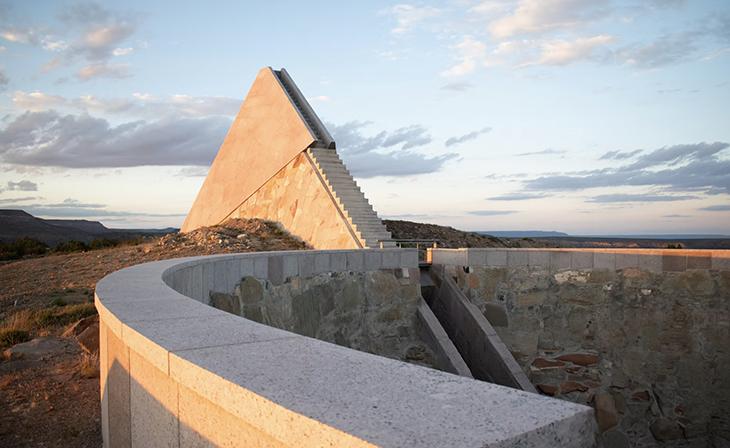
Though never as prominent as contemporaries like James Turrell and Michael Heizer, Charles Ross has had a long and esteemed career originally as part of the late-1960s Land Art movement. Like both Heizer and Turrell, Ross has an immense ongoing project in the desert, known as “Star Axis.” It bears a resemblance, at least in photographs, to ancient Incan or Aztec monuments of unknown religious import. The New York Times has described the colossus, situated on 400 acres within a 76,000-acre cattle ranch in the New Mexico desert, as an “11-story naked-eye observatory made of sandstone, bronze, earth, granite and stainless steel …” Says The Santa Fe New Mexican, “[I]t is an earth star sculpture with angles determined by earth-to-star alignments so stars and other celestial phenomena can be experienced in human scale, no telescope necessary.”
| | |
Charles Ross, “Star Axis: Solar Pyramid,” a tetrahedron built
to the angles of the sun at summer and winter solstices.
| | |
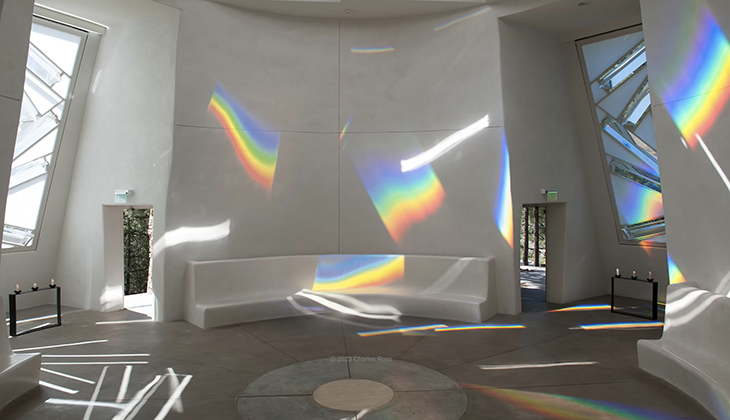
Charles Ross, “Solar Spectrum, Dwan Light Sanctuary,”
installation, Montezuma, New Mexico.
| | All images courtesy of the artist. © Charles Ross / Artist Rights Society (ARS), New York. | | |
I have not seen “Star Axis,” but I have visited another massive work, “Dwan Light Sanctuary,” a temple-like building in Montezuma, NM, for which Ross created 24 enormous prisms in homage to the visionary art dealer Virginia Dwan, who died in 2022. I myself was seriously underwhelmed, but the kids in my entourage, striking yogic poses on the stone steps, were loving it.
Ross discovered a passion for making art while studying mathematics at UC Berkeley. His first foray into light-themed work that would become the ongoing focus of his career occurred when he began using acrylic to construct transparent geometric forms of varying shapes filled with liquid that functioned as prisms. He showed these at galleries in New York and California, including Dwan, through the late 1960s as they became increasingly more complex and ambitious.
| | |
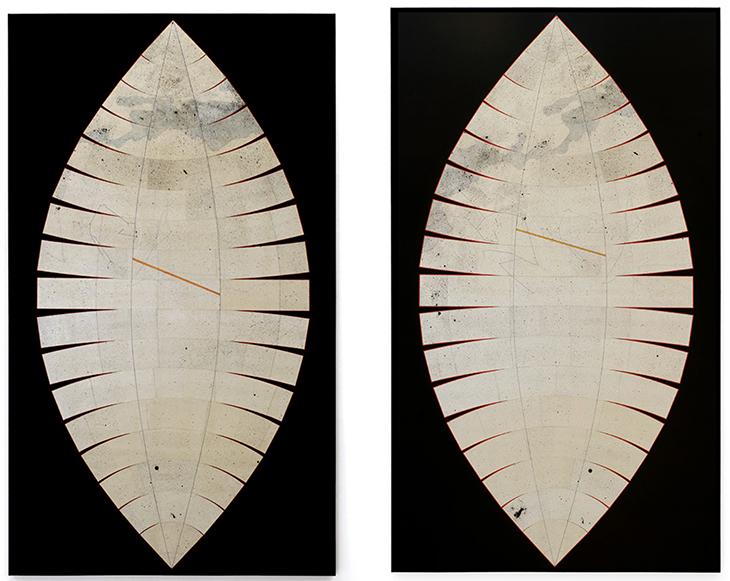
Charles Ross, “Mansions of the Zodiac: Tau,” 1973-76/2012, acrylic paint and collage using bakelite powder
xeroxes of Verenberg photographic star atlas images on canvas, 190 x 63 1/2”.
| | |
One of his works from that era, “Prism Column,” is present here, a rather understated but gleaming sentinel that refracts and reflects the dark blue walls and wood floor of the gallery. Another of Ross’s early works screening just a few feet away, “Sunlight Dispersion” (1972), is a 16 mm film about 25 minutes in length. It consists entirely of a succession of looped time-lapse clips that show the solar spectrum moving through the artist’s studio. The video captures rainbow patterns on a table, floor, and different objects, sometimes suggesting an art-school still-life setup shot through a prism. This may have been radical in its day, but it now seems flat and anti-climactic compared with many video masterworks of the past 50 years.
Ross fares better in the large gallery where his “Mansions of the Zodiac” are displayed. These are twelve “Star Maps,” created between 1973 and ’76 and reworked in 2012, each measuring 109 by 63 1/2 inches. In each a notched elliptical shape is positioned against a dark ground. According to the museum’s text, they are “two-dimensional views of the sky overlaying the passage of time onto the spatial arrangement of stars. Ross’s maps employ mathematical precision akin to Renaissance perspective, blending mythology with technology to illustrate cosmic order.” Maybe so but I didn’t know how to make sense of what look like splotches of blue-ish wash and faint diagrammatic lines perhaps alluding to the constellations.
| | |
Charles Ross, “Mansions of the Zodiac: Aries,” 1973-76/2012, acrylic paint and collage using bakelite
powder xeroxes of Verenberg photographic star atlas images on canvas, 190 x 63 1/2”.
| | |
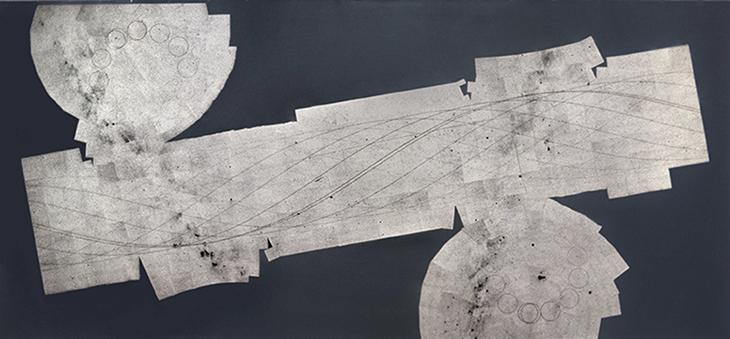
The most (literally) sensational piece here, “Point Source / Star Apace: Weave of Ages” (1975/86), is described as “mixed media on paper mounted on canvas, created with 428 photographs from the Falkau Star Atlas which covers the entire celestial sphere from pole to pole, the viewpoint is that of the observer at the center of the earth.” Never mind all the astrophysical data, I just grooved on the big, jagged shapes, reminiscent of the collages of Abstract Expressionist painter Conrad Marca-Relli.
It's clear that Ross is an exemplar of the Land Art movement, but this show is not smartly curated and too compacted to demonstrate clearly what his accomplishments and overall achievement have been. A smaller retrospective with more gallery space (of which there is plenty upstairs) might have steered us through the full arc of his career and thus offered more compelling evidence of his importance. This was a missed opportunity.
| Charles Ross, “Point Source / Star Apace: Weave of Ages,” 1975/86, mixed media on paper mounted on canvas, created with 428 photographs from the Falkau Star Atlas which covers the entire celestial sphere from pole to pole, the viewpoint is that of the observer at the center of the earth, 106 x 225”. |
| | |
For more than 30 years Ann Landi has reported on the art world for ARTnews, The Wall Street Journal, The New York Times, and magazines like Smithsonian and Art & Antiques. From 2016 till 2022, she published a website for artists called Vasari21, which has now been repurposed into a weekly Substack newsletter, Vasari21Redux. She operated the Wright Contemporary in Taos, NM, from 2022 to 2024. | | | |
Visual Art Source is a nonprofit platform, our mission to further the discourse of both visual art, the the Visual Art eNewsletter, and social, political and cultural issues as seen through an art critical lens, The Democracy Chain eJournal.
You are invited to support the writers who make it all possible. Please click the any of the cups. Please forward the eNewsletter and while you are at it follow us on social media.
| | | | | |
© 2025 TDC/VAS
Contact Information:
231 Cedar Heights Dr., Thousand Oaks, CA 91360
Ph: (213) 482-4724
| | | | | |