|
30 November 2023 — The Alaska Packers Association and the Great Star Fleet
What do the Star of India, Balclutha, and our own flagship, Kaiulani, have in common?
They were all once part of the Star Fleet, the ships that sailed for the Alaska Packers Association in the early years of the 20th century. The APA, a sprawling business headquartered in San Francisco and dedicated to selling Alaskan salmon to the world, oversaw the last great commercial sailing fleet.
The Alaska Packers Association (APA) was formed in 1893 in San Francisco. The market in Alaskan salmon had seen a drop in prices in the prior decade due to too much competition and not enough consumer demand. In response, twenty-five of the thirty-three Alaska fishery-related businesses banded together to form the APA to coordinate operations and pursue a better marketing plan. The salmon business entailed taking workers and supplies by sea, primarily from San Francisco, up to Alaskan fishing grounds in the spring and then bringing the men and canned fish back in fall. For a few years, this was accomplished by chartering ships, but soon the APA shifted to purchasing vessels, supplementing them with chartered ships as needed. To transport over the ocean the small army of fishermen and cannery workers, along with canning machinery and coal to fuel it, tin to fabricate the cans, and box shooks to make the wooden crates that held the cans, required a lot of space—what maritime historian Harold Huycke dubbed “floating warehouses.” The APA needed plenty of room aboard its vessels, but had no need for speed. The economical choice was to purchase wooden sailing vessels, which could be had for bargain prices as the general market for ships was turning towards steam. The sailing vessels were crewed by the same men who would be fishing for the salmon in Alaska.
|
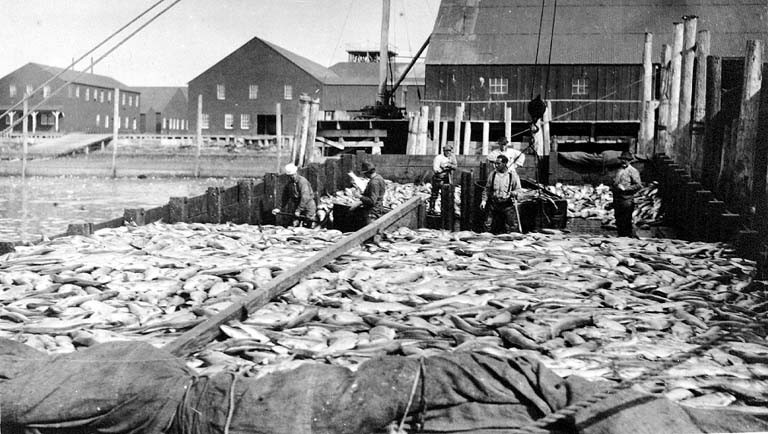 | Salmon catch at the Alaska Packers Association cannery, Nushagak, Alaska. Photo: John Nathan Cobb; PD | Around the turn of the century, the preferences of the APA shifted from wooden ships to more durable iron-and steel-hulled vessels, beginning with the iron-hulled Euterpe, which you will remember from our last installment of Sea History Today, and the barques Coalinga and Himalaya. Among the ships to follow was a foursome of ships that had begun their sailing careers with James P. Corry and Co. of Belfast, which favored ship names beginning with “Star.” The APA leadership so approved of the Corry tradition that had bestowed the names Star of France, Star of Russia, Star of Bengal, and Star of Italy, that it changed the names of its other iron- and steel-hulled sailing ships to “Star” names, and thus the North American Star Fleet was born. The APA would of course also own and charter smaller vessels and steamers, but it is remembered in the maritime community for its sailing fleet. |
|
|
The 19 ships of the Star Fleet:
Star of Alaska (ex-Balclutha)
Star of Bengal
Star of Chile (ex-Coalinga)
Star of England (ex-Blairmore, ex-Abby Palmer)
Star of Falkland (ex-Arapahoe, ex-Steinbek, ex-Durbridge)
Star of Finland (ex-Kaiulani)
Star of France
Star of Greenland (ex-Hawaiian Isles)
Star of Holland (ex-Homeward Bound, ex-Otto Gildemeister, ex-Zemindar)
Star of Iceland (ex-Willscott)
Star of India (ex-Euterpe)
Star of Italy
Star of Scotland (ex-Kenilworth)
Star of Lapland (ex-Atlas)
Star of Peru (ex-Himalaya)
Star of Poland (ex-Acme)
Star of Russia
Star of Shetland (ex-Edward Sewall)
Star of Zealand (ex-Astral)
| |
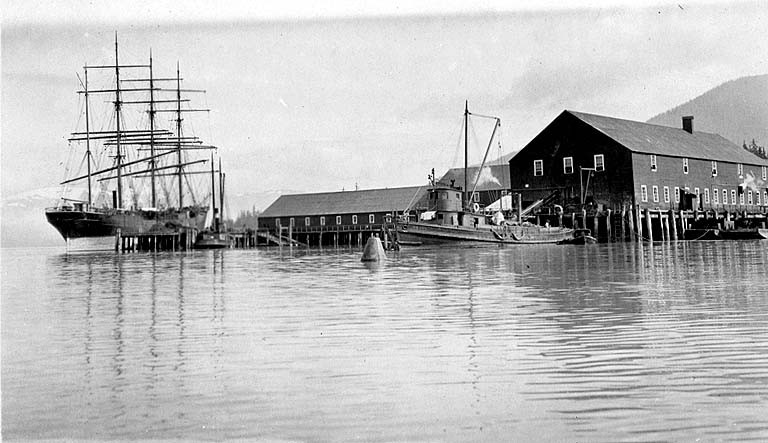
Star of Greenland at the dock of the Alaska Packers Association cannery, Wrangell, Alaska, August 1918. Photo: John Nathan Cobb; PD | |
|
The APA established an efficient process of catching, canning, and delivering salmon to distribute in the continental US, but of course production is only half of the challenge of business. As the San Francisco Maritime National Historical Park’s Diane Cooper phrased it, the company had to deal with the question: “How do we find more consumers who know what canned salmon is, what to do with it, and want to buy it?” Cooper explained:
At that moment in time the vast majority of the salmon pack went to foreign markets. Although salmon was known along the northeast coast and the west coast, fresh salmon was expensive and considered a delicacy indulged in by the rich. In these areas canned salmon did not rate. Throughout the rest of the United States, Americans were unaware of salmon and its great nutritious value.
The APA set out to spread the word about canned salmon. The can labels, often a bright red to catch one’s attention on the shelf, featured homey scenes of fishing and delivering salmon to market, illustrations drawn from nature, or nostalgic images of home life. The Alaska State Library has a lovely sampling of these labels. The biggest tool in the APA marketing toolbox, however, was the cookbook How to Eat Canned Salmon, first produced by the Karluk Packing company and then adopted by the APA and distributed in 1904 in a special edition for the St. Louis World’s Fair. How to Eat Canned Salmon offered enticing recipes for dishes like salmon croquettes to persuade households to introduce their product into their weekly menu planning.
|
|
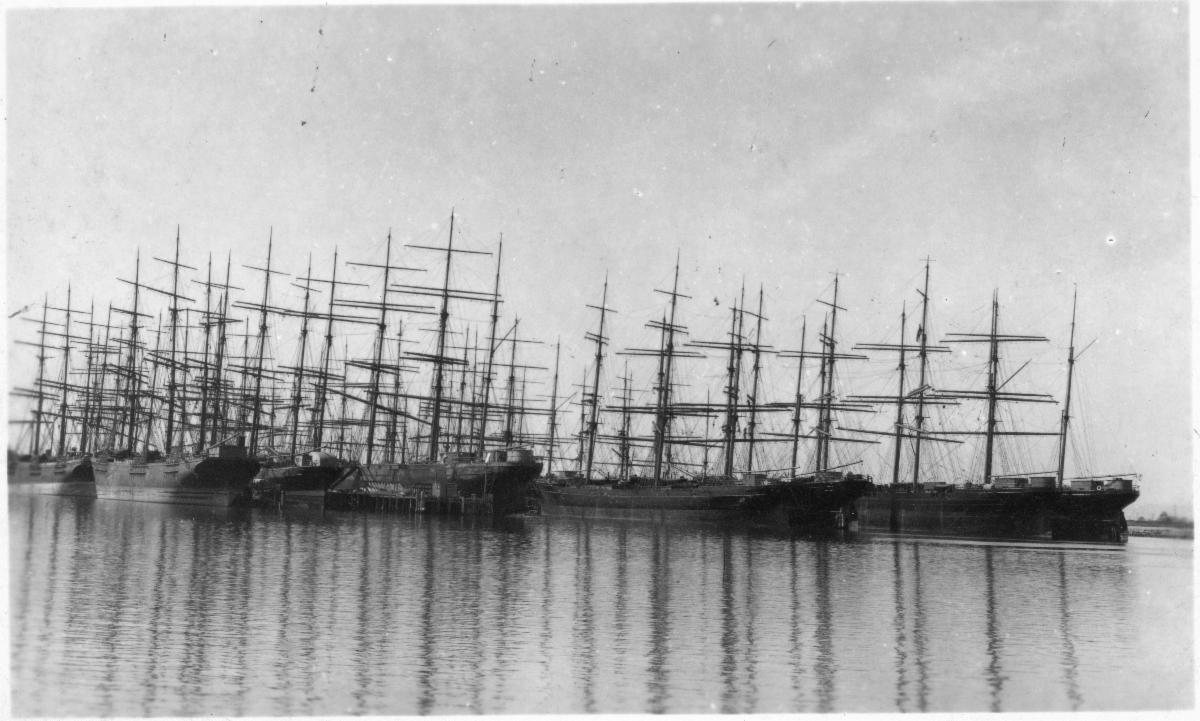
The sailing ships of the APA wintered in what is now known as Fortman Basin, Alameda, California. Photo: PD | |
|
Each spring, the ships loaded with coal, supplies, and men sailed up to the canneries around Bristol Bay, including Nushagak, Kvichak, Ugashik, Naknek and Egegik, and to other locations such as Chignik, Karluk, Alitak, Fort Wrangell, and Loring. Harold Huycke described the routine:
Crews were split into gangs of from 12 to 18. Prior to World War I, gangs numbered 18 men. Two were assigned to keeping quarters on the ship clean, one man to repair and keep nets in order, and the balance of the gang to do the ship’s work under way. Upon arrival of the ship at its cannery both anchors were let go and a swivel shackled into the chains so the ship could swing freely. As the stores were unloaded, the upper yards were lowered to improve stability. All hands then turned to in getting the cannery ready for operation, doing everything from carpentry to overhauling the boats and barges. The Chief Mate was beach boss, more often than not, and it was he who had to make order out of chaos. With the growing strength of the fisherman’s union, delineations were made in the work performed by fishermen, and eventually [their] carpentry and miscellaneous chores were lessened.
Over the summer months, fishermen brought in the salmon and the cannery crew processed and canned it, packed the cans in crates, and loaded it onto the ships. In the fall, once the ships had been loaded with all of the processed salmon, they headed back to San Francisco to unload, and then on to Alameda for the winter.
| |
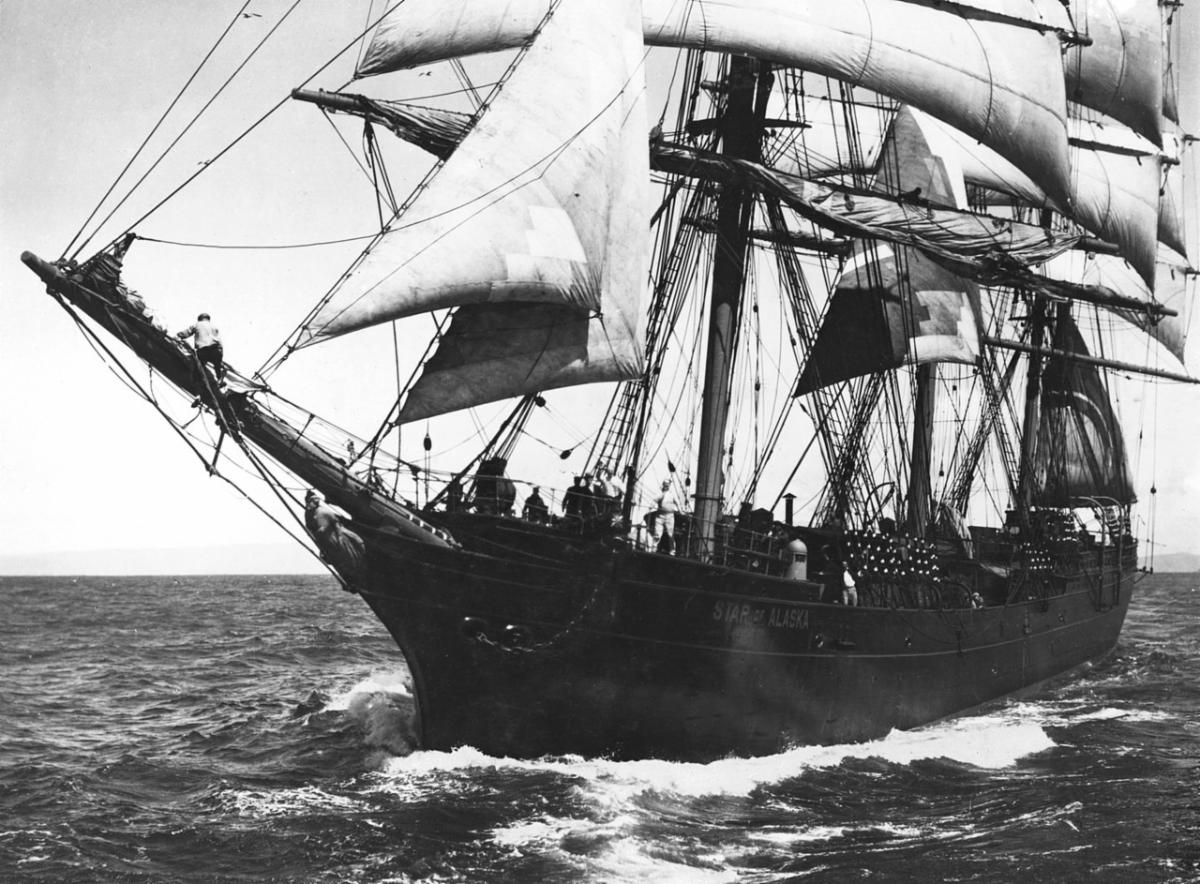
Star of Alaska, one of the two surviving Star Fleet ships, now in San Francisco under her original name, Balclutha. Photo: PD | |
|
By the 1920s the APA, which had since become part of California Packing Company (CALPAC) corporate family, was slowly transitioning to steam, beginning with the gradual sales of its aging wooden ships, including several sales to Hollywood—mostly to be blown up or sunk on camera. Then, gradually, the Star Fleet was sold off. The very last ship to go was Star of Finland, sold in 1939. You can read about the rest of her story in Sea History.
Today, we can still visit two veterans of the great Star Fleet—Star of India in San Diego, and Balclutha (Star of Alaska) in San Francisco. And, in some way, we can thank the Alaska Packers Association for keeping them active and cared for during that time, when the merchant shipping world was abandoning sail for steam.
Extra Credit
Sockeye and the Age of Sail: The story of the Alaska Packers Association
Alaska Canneries and the Fishing (public Facebook group)
Golden Harvest: Fifty Years of Calpak Progress
Sea History Today is written by Shelley Reid, NMHS senior staff writer. Past issues can be read online by clicking here.
| | | | |