|
NJAAW News and Resources
July 1, 2026
| | Lifelong Strong New Jersey | |
Affordability is Top Concern Among Older Adults
One of the core pillars of MPAs across the country is affordability in aging. It is also a central focus of the Sherrill Administration, which makes it a top issue for New Jersey's work towards adopting an MPA.
Reinforcing this focus on affordability, AARP New Jersey has released the results of a new Vital Voices survey, which highlights the growing affordability crisis facing older residents and the risk it poses to the state’s ability to retain them.
In the survey of residents age 45+:
- 35% say they have considered leaving the state in the past year
- Of those, (79%) say they are likely to move
- (67%) citing a desire for a lower overall cost of living.
- 92% of older residents say being able to afford groceries and everyday necessities is important, underscoring the financial strain many households are facing.
Read the full survey report Vital Voices NJ
| | Age-Friendly Movement in NJ | | |
Ocean County Leading the Way on Multisector Planning for Aging
Ocean County has become the first governmental body in New Jersey to adopt a comprehensive plan on population aging, a fitting and crucial achievement for a county that is home to the state’s largest concentration of retirement communities.
The Age-Friendly Ocean County Multisector Plan for Aging - officially launched at an event in Toms River on June 23 - is the product of a collaboration among the Jersey Shore county’s elected officials, senior services staff, and partners at Rutgers University.
Ocean County joined the AARP Network of Age-Friendly States and Communities in 2023 and was selected as a recipient of the New Jersey Age-Friendly Grants Program in 2025.
As it embarked on its age-friendly work, Ocean County’s Board of Commissioners engaged Rutgers Cooperative Extension of Ocean County to work with its County Office of Senior Services. More than 8,000 residents and stakeholders provided input on the plan through surveys, focus groups, interviews, public forums, and town hall meetings aided by an innovative and fruitful collaboration between county leaders: Age-Friendly Ocean County, the Ocean County Health Department’s Partnership for a Healthier Ocean County, and the non-profit hospitals that are part of Hackensack Meridian Health and RWJBarnabas Health.
Continue reading here: AgeFriendlyNJ.org
| |
Bergen RoundTable: Connecting the Resource & Referral Dots
Wednesday, July 15
10:30 AM - 12 Noon
Community Baptist Church, 224 1st Street, Englewood
(breakfast available at 10:15 AM)
One of the more pressing problems for older adults and others is not knowing where to go for the help they need. Many turn to their health care providers or to town officials, who also may not be aware of the many programs, benefits and resources available to their residents.
The meeting will open with brief presentations by providers of services about the programs and services they offer. This will be followed by networking and exchanging contact information and resources.
Register HERE
| |
The Mature Driver Resource Center - Train the Trainer Event
July 16th from 10am-11:30am
via Zoom
The Mature Driver Resource Center—hosted by the Alan M. Voorhees Transportation Center and funded by the New Jersey Division of Highway Traffic Safety—is currently hosting Train-the-Trainer presentations for community members who are in a position to inform and instruct mature drivers about driving safer, longer, and achieving lifelong mobility.
A free online training will be held on July 16. Register here: Train the trainer
The Resource Center also offers in-person training. The training would be free and open to staff from any nearby municipalities or non-profit organizations interested in becoming equipped to work with mature drivers.
If interested, please contact Andrew Olsen at andrew.olsen@ejb.rutgers.edu
| | |
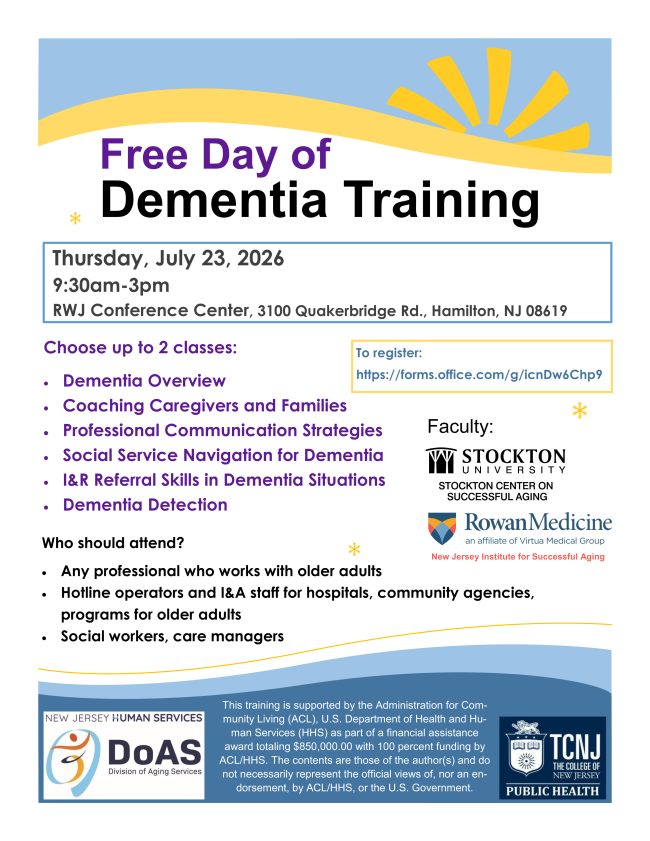
Free Dementia Training
Thursday, July 23, 2026
9:30am-3pm
RWJ Conference Center
3100 Quakerbridge Rd., Hamilton, NJ
The New Jersey Division of Aging Services is pleased to announce a free education offering for a Day of Dementia Training. All staff who work with dementia caregivers and people living with dementia are welcome!
There are classes designed for staff who are new to the dementia world, such as dementia detection and an overview of dementia. There are also classes for front desk and I&R staff, service coordinators, and care managers.
Register for this free event here: REGISTER
Download the flyer here: Flyer
| | |
Making Your Senior Center Hearing-Friendly
Tuesday, August 18, 2pm via Zoom
The NJ Association of Senior Centers (NJASC) invites you to a virtual event to help you make your senior center – or community space – more accessible for people with hearing loss
Hearing loss is common among older adults and often goes undiagnosed - or laughed off as part of aging. Even a slight hearing change can make it difficult for people to enjoy group activities, conversations, and community events. When spaces are designed with hearing-impaired individuals in mind, more people can fully participate in conversations, events, and social settings.
Speakers
- Elizabeth Hill, Executive Director, Division Of The Deaf And Hard Of Hearing, New Jersey Department Of Human Services
- Colette Reasonover, NJAAW Intern and Rutgers DSW candidate
Register for this free event here: Hearing Friendly
| |
From the Front Lines:
Ideas to improve New Jersey’s Age-Friendliness
By Sheila Brogan, LSW, ACSW, Ridgewood, NJ
Sheila Brogran is a geriatric social worker and early leader in NJ’s age-friendly movement. See below for her recent letter to NJ State Leaders:
As a geriatric social worker practicing for over 40 years in Bergen County and co-chair of Age Friendly Ridgewood, I welcome the opportunity to provide you and your administration with feedback and ideas on how substantial improvements can be made on serving and giving assistance to older adults in our great state. Since 2021, when New Jersey declared itself an Age Friendly state and issued its Age Friendly Blueprint in 2024, little has been accomplished, and more work needs to be done. There needs to be systemic changes to policies, procedures, and application processes and funding to support the necessary work to truly be an Age Friendly state. The state must do its part and also help with funding age friendly efforts in municipalities beyond the one-time grant awards. The grants, funded for one year, are insufficient to allow municipalities to build age friendly initiatives and sustain these efforts. It seems wasteful to start a program that cannot be funded locally by municipalities with their skyrocketing health insurance costs and other expenses hit hard by inflation.
Areas for improvement are as follows:
HOUSING
A consistent refrain from older adults, heard by those of us working with this population, is the need for affordable housing. Affordability is key, whether it is the older adult who would like to age in place in their own home or downsize to a smaller home, an ADU, townhouse, or an apartment. New Jersey needs to look at its housing stock and diversify it. Older adults make up between 20 and 25 percent of the population living in Ridgewood and the surrounding municipalities in northern New Jersey. These well-established suburbs, incorporated over 100 years ago, primarily consist of a central business district surrounded by neighborhoods of single-family homes.
Read Sheila's full list of suggestions here: BLOG
| | |
Untapped Potential: The Older Workforce in America
As NJAAW wraps up its Age Friendly Grant from NJ DHS to foster age-friendly employment in New Jersey, this article by Valerie Flores, West Health Mosaic, is particularly timely.:
The United States is undergoing a major demographic shift. By 2034 older adults are projected to outnumber children for the first time in the nation’s history. Falling birth rates coupled with longer life expectancies are driving this shift, with significant implications for families, communities, public programs, and the economy. Older adults can play a role in strengthening the U.S. workforce that is currently facing a shortage, as many adults age 60 or older want or need to work longer. An intergenerational workforce is also beneficial to employers, as it can bring a diverse set of strengths to companies. There are opportunities for states and employers to help create conditions that support this workforce and promote economic security and healthy aging.
The Workforce Shortage
The U.S. is experiencing a worker shortage, with more open jobs than available workers. Demographic trends — including birth rates, life expectancy, and immigration patterns — influence the size of the available workforce and broader economy. When employers cannot find enough workers, businesses struggle to grow, meet demand, and maintain services. Workforce shortages also affect how many workers are contributing to payroll taxes that support public programs, like Social Security and Medicare.
With a growing aging population, the U.S. has a unique opportunity to support older adults who want or need to remain in or return to the workforce.
Read the full article here: Untapped Potential
| | The Case for Home and Community Based Services | | |
Many service providers and residents in New Jersey, as well as across the country. are preparing for the impact of H.R.1, the federal bill that will cut millions of dollars from New Jersey programs that support residents with Medicaid, SNAP benefits and many more programs.
One service that will be deeply impacted is Home and Community Based Services (HCBS) which enable tens of thousands of NJ residents to live at home with support instead of a more expensive nursing home. Many of them will eventually need more skilled nursing and to move to a nursing home, AND every day they can remain in the community saves the public money.
Read below for two strong arguments for HCBS:
| | |
A Lifeline for New Jerseyans: The Importance of Protecting and Expanding NJ FamilyCare Home and Community-Based Services
Read the JIA Fact Sheet here:
Importance of HCBS
| |  | |
Home and Community-Based Services Improve Outcomes While Reducing Costs
Read the report here: CLPC
| | |
Elder Mistreatment Prevention Toolkit for Public Health
Public health practitioners play a key role in the prevention of elder mistreatment as community leaders, conveners, and trusted sources of information. However, many lack extensive knowledge of the resources that may be available to them. To that end, Trust for America’s Health and its Age Friendly Public Health Systems team have partnered with the Education Development Center and the National Alliance for Caregiving to provide a toolkit to support the public health sector in preventing elder abuse and mistreatment.
The toolkit can be accessed and downloaded by clicking here: AFPHS Toolkit
| |
The Age Rebellion
By Lyndsey Simpson
Many of you heard Lyndsey Simpson as she joined us by video at our conference. Founder of 55/Redefined, Lindsay is a driving force removing age-related barriers in the workplace.
In her new book, Lindsey challenges the outdated narratives around what it means to "retire" and society's' expectations of aging, The rest of your life starts now - and can be the best chapter yet!
To see Lyndsey's video from the Aging in Every Sector conference, click: CAFE
| | | Is our information useful to you? Then please consider a financial contribution today. As a nonprofit 501(c)(3) organization, New Jersey Advocates for Aging Well relies on foundation grants and other donations to fund our work. We welcome your support, your suggestions and your input for advocating for NJ's oldest residents as we celebrate our 25th anniversary and strategize for the next 25 years. | | | | |