| | |
POLICY & ADVOCACY UPDATE
Issue #82, 15 October 2026
| | | |
- From the AA CEO James Goodwin
- Pressing the button on migration
- Coalition migration policy announced
- Hotels losing share of international holiday visitor nights
- Capital city hotel performance for September
- Overseas arrivals up in August 2026
- eeger puts people-powered careers in the national spotlight
| |
| |
From the AA CEO
Migration is front and centre as Federal Parliament returned this week and the debate has certainly hotted up. Our industry's concerns about proposed changes to the Working Holiday Maker program have taken on a new dimension with the launch of the 'Big Red Button' social media campaign (more below).
| | | | |
The clever video asks Australians to imagine what would happen if someone pressed a giant red button and removed migrant workers from our economy. The result is humorous but powerful. It has attracted millions of views and impressions across social media and national news coverage and is helping bring our industry's workforce challenges into the broader public conversation. I encourage every member to share the video through your own social media channels and networks.
It has struck a chord in Canberra and also sends a shot across the bow to the Albanese Government, and all parties, that they must consult with and work constructively with our sector on policy matters.
Meanwhile, the political pressure is mounting on Working Holiday Makers. The Opposition has moved a motion in the Senate demanding the tabling of documents relating to the Government's Working Holiday Maker decision. The timing is critical with the proposed changes approaching, and businesses, workers and prospective visa applicants need certainty about what the new arrangements will mean in practice.
I have held meetings with the Department of Home Affairs, and it is clear that the operational details of the proposed ballot and caps have not yet been finalised. Officials are continuing to work towards implementing the changes by the end of November, but important questions remain unanswered. The government is listening to our proposal to increase the number of days people must work in the regions in Year 1 to even out the distortion the changes will have. They are also not likely to have country allocations within the ballot and are examining our recommendation to introduce a merit system for those going above the minimum to either be excluded from the ballot or increase their chances in the ballot. Although these are minor amendments, at the fringes of the policy announcement, they will make a difference if implemented. We continue to work with the government to share your concerns and oppose the changes but at the same time aim to find practical improvements as we head towards the implementation date. Thanks for your support.
James Goodwin
Chief Executive Officer
| | |
Pressing the button on migration
With the Coalition’s migration policy announced last Tuesday by Angus Taylor (more detail below), the positions of the three major parties are now on the public record, and they converge on a common premise: that migration should fall substantially, with a particular focus on lowering net overseas migration. The Coalition has proposed cutting a third of annual overseas migration in the first year and reducing temporary visa holders by 650,000 over four years. What remains missing from the debate is analysis of what these settings would mean for the economy.
For the accommodation sector, this is a significant omission. Accommodation providers depend on skilled and semi-skilled migrant workers across housekeeping, food and beverage, maintenance, and management roles. Working holiday makers also play a vital role in supporting operations, particularly in regional and seasonal destinations. An industry that continues to face workforce shortages has limited capacity to absorb a substantial reduction in labour supply without consequences for service delivery, operating costs and business growth.
This is the context for the Australian Hotels Association’s new social media campaign. Using humour to highlight the role migrant workers play across the economy, the "red button" campaign reimagines what Australia would be like without migrants.
The industry is not arguing against reform. It is calling for migration policy to be informed by evidence and workforce realities. Broad policy settings can have very different impacts across sectors and regions, with regional and remote communities likely to feel the effects most acutely. As the debate continues, Accommodation Australia will continue advocating for a balanced, evidence-based approach. To view the social media video, click here. It was posted on all AHA national and branch social media platforms this week and has already had millions of views and hundreds of thousands of interactions as well as attracting national mainstream media interest including from 7NEWS, News24, and the Daily Telegraph.
| | A screenshot from the innovative video campaign on migration launched by the AHA/AA this week. | | |
Coalition migration policy announced
In a press conference last Tuesday, Angus Taylor announced the Coalition's migration policy, which aims to cut Net Overseas Migration to 100,000 per year for the first two years before lifting it to 130,000 in year three and 160,000 from year four, well below Labor's 225,000 target. There is good news for employers: permanent skilled migration is retained at up to 185,000 places with a stronger focus on skills and sponsorship, temporary skilled migration would grow, including 15,000 new Skilled Project Visas a year that we hope could cover projects like new hotel builds, and the ballot and caps on second- and third-year Working Holiday Maker extensions would be scrapped.
The news is less welcome on the student pipeline. Temporary Graduate Visas would effectively be abolished and international student commencements cut to 240,000, which will hit the hotel workforce and CBD properties in particular. Importantly, the Coalition said regional migration programs supporting tourism and hospitality would be protected, and we will be watching closely to see how that commitment is delivered. Accommodation Australia will keep engaging with all parties and update members as more detail emerges.
| | |
Hotels losing share of international holiday visitor nights
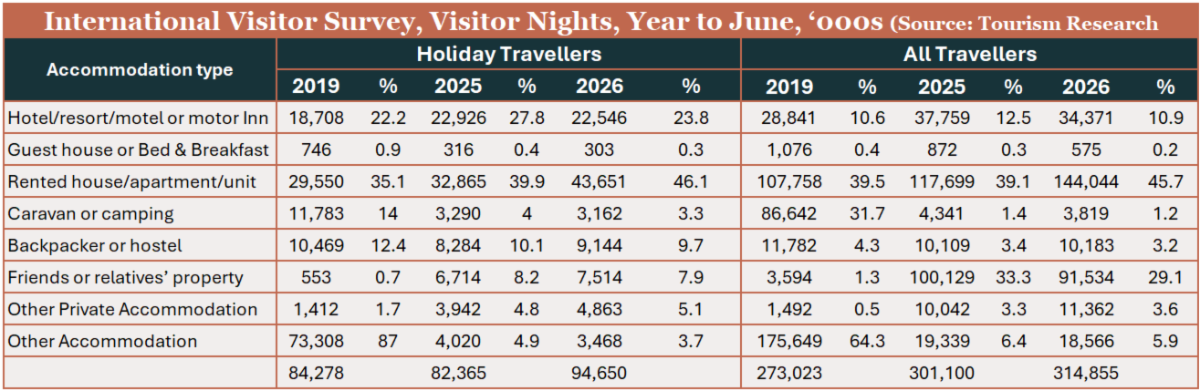
Last month, Tourism Research Australia (TRA) released International Visitor Survey (IVS) accommodation data for the year to June 2026. The holiday nights figures across the capital cities, Gold Coast and regions point to a mixed and increasingly competitive picture for the hotel sector. International holiday visitor nights have grown strongly since 2019, reaching 94.7 million in the year to June 2026. However, this was slightly below the year to March 2026, when holiday visitor nights were 96.2 million (a 1.6% fall), and total international visitor nights also eased, from 321.9 million to 314.9 million (down 2.2%). Hotels also lost ground in the latest year, with their share easing from 27.8% in 2025 to 23.8% in 2026 (see table below). This reflects the ongoing expansion of rented houses and apartments, and reinforces the challenge short-term rentals pose to hotels. Over the longer term, more traditional and lower-cost segments, including backpacker/hostels, caravan and camping, and friends and relatives, have also lost relative share, signalling a gradual but persistent shift in how international visitors choose to stay in Australia.
The data also enabled AA to examine the regional dispersal of international visitors in depth. The regional share of international holiday visitor nights has been virtually unchanged over the past decade, at 30.0% in 2016 and 30.1% in 2026. Within the regions, however, hotels have lost considerable ground, with their share of international holiday visitor nights falling from 20.7% to 17.3%. Over the same period, the share held by regional rented houses and units (such as Airbnb) rose from 23.3% to 42.5%, an increase of nearly 20 percentage points. The full analysis of regional dispersal of international holiday visitor nights is available here.
| | |
Capital city hotel performance for September
Preliminary capital city CoStar data for the month of September shows a mixed picture across Australia's capital cities, with most markets posting occupancy gains and rate growth, while Sydney, Adelaide, Darwin, Canberra, and the Gold Coast recorded softer conditions on one or both metrics.
- Sydney saw a 1.7% decline in occupancy to 77.4%, while ADR increased 1.3% to $201.53.
- Melbourne occupancy rose 9.8% to 75.6% and ADR increased 16.3% to $242.25.
- Brisbane occupancy rose 4.1% to 78.3% and ADR increased 1.7% to $253.49.
- Adelaide occupancy fell 0.4% to 75.9%, and ADR rose 3.5% to $202.35.
- Perth occupancy rose 2.6% to 86.7%, and ADR was up 7.0% to $257.40.
- Hobart occupancy rose 2.2% to 76.1%, and ADR increased 1.7% to $191.77.
- Darwin occupancy fell 4.5% to 70.2% but ADR rose 1.7% to $235.64.
- ACT and Canberra occupancy fell 1.7% to 77.4% but ADR was up 1.3% to $201.53.
- Gold Coast occupancy was down 0.1% to 72.0% and ADR up 6.6% to $292.41.
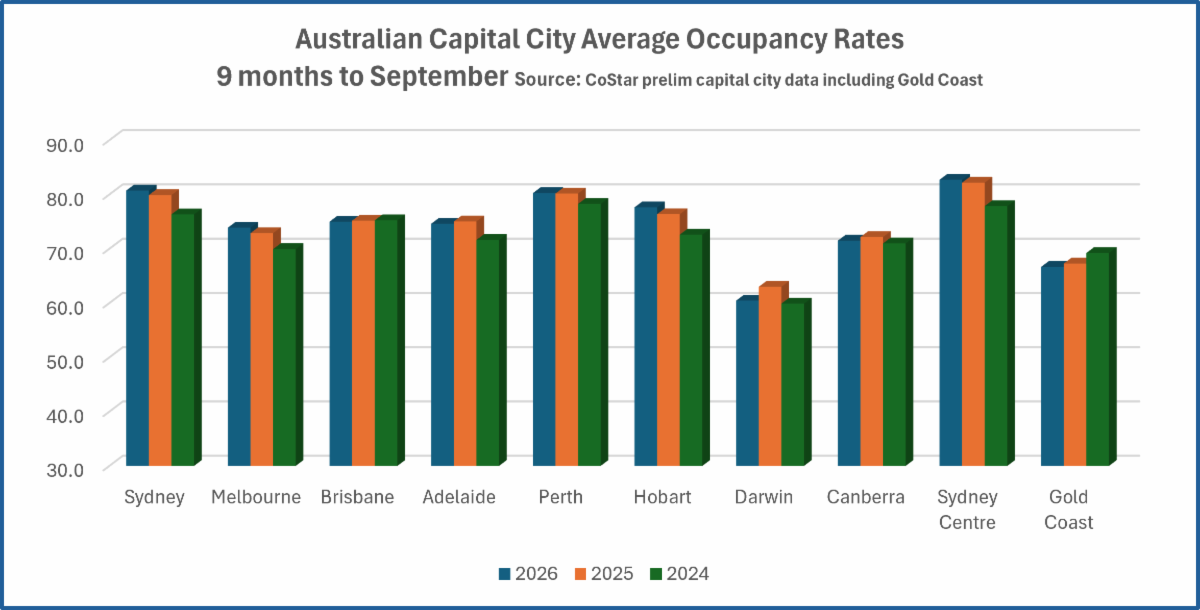
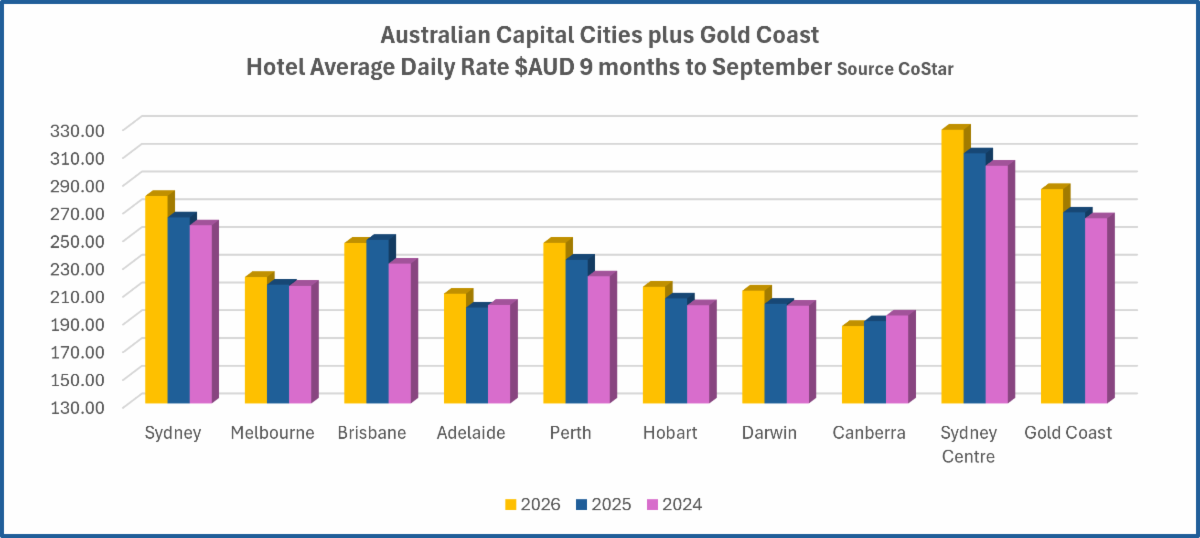
The graphs below derived from the CoStar data show the average occupancy rate and ADR experienced in the capital cities in the first nine months for each of the last three years. Over the nine months, five cities have recorded a decline in average occupancy compared to 2025: Adelaide, Darwin, Brisbane, Gold Coast, and Canberra. Canberra and Brisbane are the only capital cities to see a fall in average room rate. The Gold Coast has recorded the strongest increase in ADR, up 6.3% to $284.47 averaged over the nine months, with Sydney, Adelaide, Perth, and Darwin also showing strong ADR performance.
| | |
Overseas arrivals up in August 2026
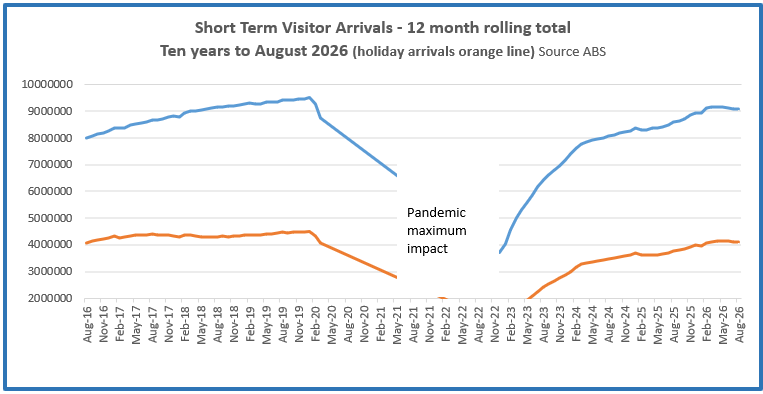
According to ABS data released this week, short-term visitor arrivals to Australia reached 755,530 in August 2026, up 0.3% from August 2025. Holiday arrivals increased as well, rising 1.1% to 371,940, which indicates that growth in holiday travel outpaced overall visitor growth. New Zealand remained Australia’s largest source market, with 110,210 visitors, followed by China with 106,990 and Japan with 62,600. Of the ten leading source countries, only the UK, India and South Korea recorded arrival volumes above their August 2019 levels.
The 12-month rolling total offers a clearer view of the underlying trend by smoothing month-to-month volatility. It highlights both the recent recovery and the remaining shortfall relative to pre-COVID visitation levels, particularly among holidaymakers. In the 12 months to August 2026, total arrivals reached 9,071,100, up 5.7% compared with the year to August 2025. Holiday arrivals totalled 4,117,360, an increase of 9.6% over the same period. By comparison, annual holiday arrivals peaked at 4.48 million in the year to December 2019. The sector is therefore continuing to recover, but has not yet returned fully to pre-pandemic levels.
| | |
eeger puts people-powered careers in the national spotlight
AI can’t handle the heat. And it can’t take you on a journey. But people can!
That’s the message behind eeger’s exciting new national campaign, ‘An Un-Automated Career’, celebrating the people and experiences that make Tourism, Hospitality, and Travel special.
And the momentum is growing! Australia’s national jobs and careers platform has attracted 381,000+ visitors, 18,500+ registered users and 811,000+ page views, with over 132,000 jobs advertised. With the campaign appearing on billboards and digital channels across Australia, there’s never been a better time to get involved.
Looking for your next great team member? Advertise your jobs at eeger.com.au.
| | |
Drop me an email at policy@accommodationaustralia.org or give me a call on 0418 277 919 if you have any national policy issue that you think AA should be following up. If you know an AA member who is not receiving this advocacy report but wants to, then encourage them to email me and we can add them to the distribution list. Back issues of the fortnightly advocacy updates can be found here.
Kind Regards
Jenny Lambert OAM
National Policy Director
Accommodation Australia
| | | | |