Welcome to Quips, a newsletter about ministry happening in our Southeastern Pennsylvania Synod and beyond.

Quips comes from the mission statement of our synod

"to equip the saints for the work of ministry."

The stories you will read here are just that, saints doing ministry

that shares the love of Christ with our neighbors because we are Lutherans together: Loving God and loving neighbor.


Contact us to share your story..

Burnished Blessings Ministry Emerges from Book Study

Submitted by Pastor Tim Johansen

Temple Lutheran, Havertown


Last year, some of Temple Lutheran's congregation leaders read a book called The Coming Revolution in Church Economics: Why Tithes and Offerings Are No Longer Enough, and What You Can Do About It. 


In this book, Mark DeYmaz and Harry Li describe their process in forming various entrepreneurial ministries that allow the church to live out its mission while staying financially viable. In their first attempt to do this, Temple launched an entrepreneurial ministry called “Burnished Blessings.”  


"Thanks to a Forward Together in Faith Grant from SEPA Synod, we were able to purchase a laser engraver, a computer, and some supplies. Burnished Blessings has been a wonderful outlet for some of our crafty members to make items as an act of stewardship to their church." said Pastor Johansen


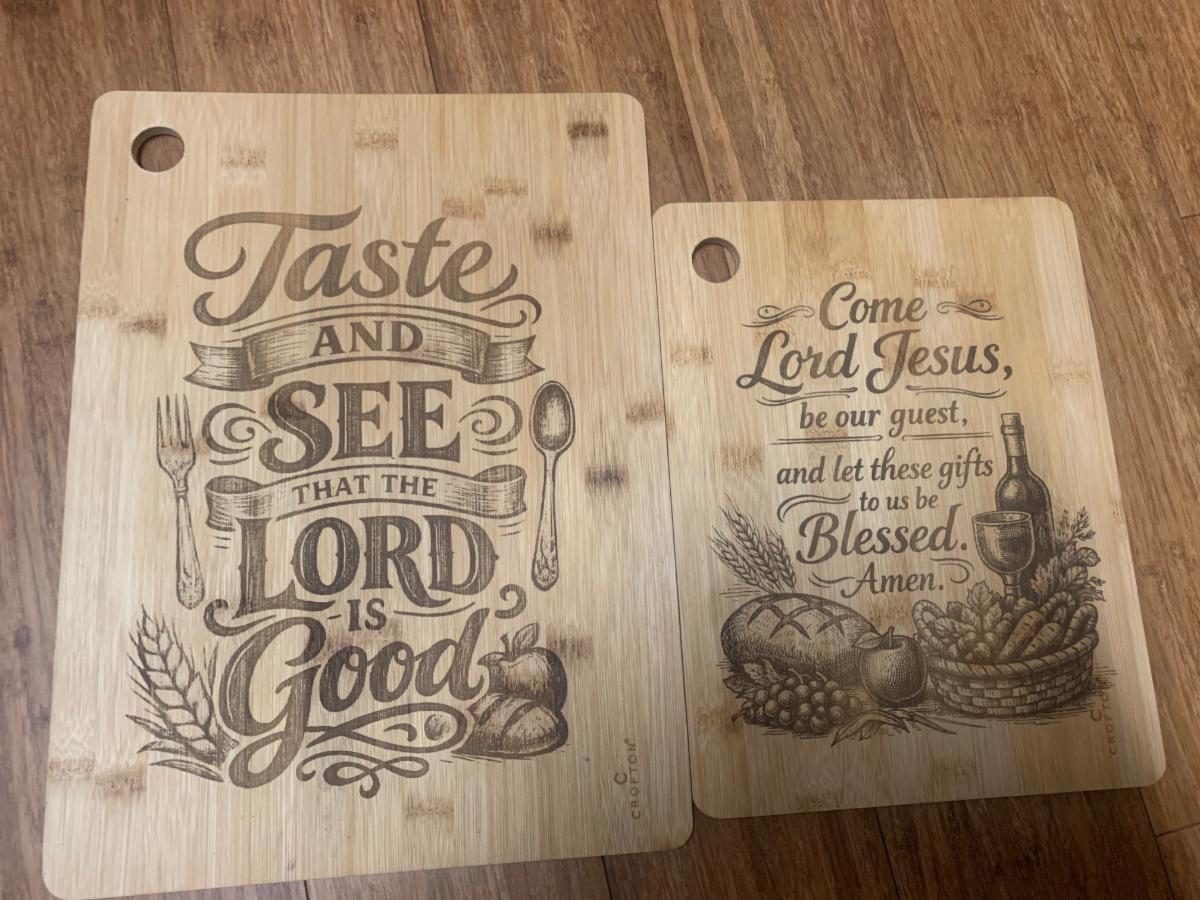
Over the last few months, Temple has made ornaments, cutting boards, notebooks, wallets, coasters, and much more! A craft fair featuring some of the products made by Burnished Blessings is scheduled for Saturday, October 3.


Johansen added, "We’ve worked with a local scout pack to make plaques for their fifth graders receiving the “Arrow of Light.” We also make dog tags for each of their scouts—a more affordable and practical option to the traditional cub scout belt loops."


As this ministry continues to grow, Temple is hopeful for the funds it will bring to their ministries, but most of all, they are grateful for an opportunity to harness peoples’ gifts to care for their church. 

St. John's, Ridge Valley Launches RideMatch Program

St. John's Lutheran Church, Ridge Valley was one of the congregations in the first cohort group of Love Revolution. Throughout the Love Revolution process, participating congregations were asked to listen to their communities and discern where a need might exist that the congregation could meet or support.


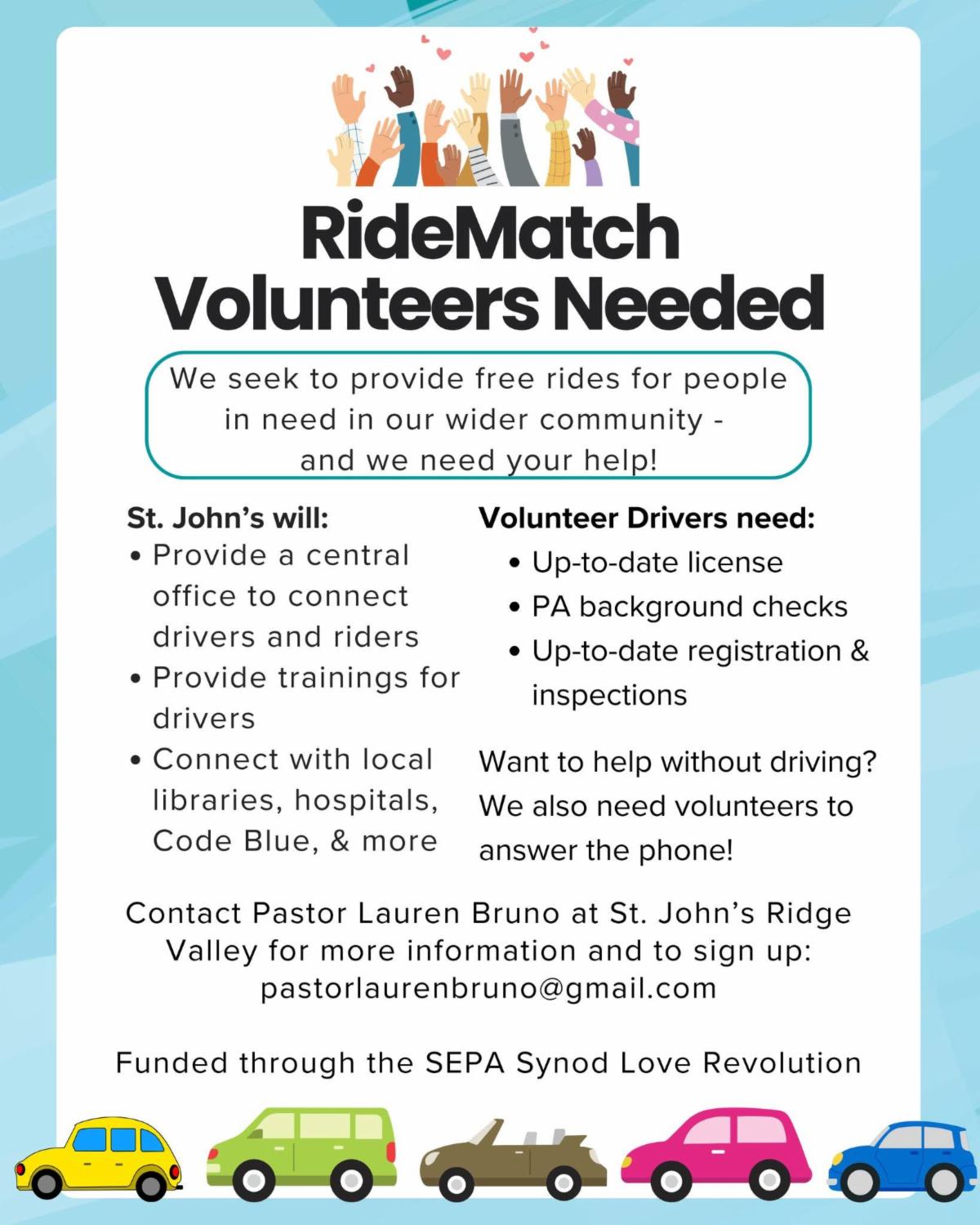
The Transportation Team at St. John's met for a year to build an ecumenical coalition between local churches to provide rides for local community members who cannot drive themselves. Their hard work has paid off and the RideMatch program is beginning.


The goal for the RideMatch program is to provide 250 rides by the end of the year with 60 drivers, beginning the program in September with volunteer training, with a coalition of 3 churches.


If you'd like to volunteer or learn more, contact St. John's

From the ELCA Mission Support Memo:

Mortgage miracle: The power of generosity

A story by Annalise Rivas from First Lutheran Church, St. Peter, Minn., in the Southwestern Minnesota Synod


In March 2023, First Lutheran Church in St. Peter, Minnesota, was grappling with questions many congregations faced: How can we rebuild, reform and renew after the COVID-19 pandemic? At that time, our Stewardship Committee was also trying to find a new approach to the annual stewardship campaign as an additional way to renew our congregational life. Amid these searches, our team eventually decided to start with a low-cost resource from the ELCA called “The Generosity Project,” originally developed in the Rocky Mountain Synod and refined by the ELCA Congregational Stewardship team. This resource is focused on building intergenerational relationships and fostering a generous mindset of abundance. After getting some tips from the ELCA director of Congregational Stewardship, we learned that the tool kit was designed for flexible, self-directed use, allowing us to combine recommendations in ways that fit our community’s needs and strengths.


In October 2023, our congregation committed to four “seasonal” worship services using resources from The Generosity Project, adapted for our liturgical settings and congregational size. Our Stewardship and Worship committees, along with the music director who was all in, worked diligently to introduce the ideas behind The Generosity Project before we had our first service. We made sure the bulletin was set up in the weekly format our congregation was used to and that the music matched biblical themes. Then we printed everything here at our church. However, for these special services, we gathered around tables, included food, showed videos, and incorporated conversation and connections.


The first service was a bit sparse, but once people left they started talking about making new friends. By April 2024, we had seen increased interest in our intergenerational worship services. Newer members were welcomed into the congregation, and many members, both new and longtime, formed deeper connections with one another. From these experiences, the seeds of generosity were firmly planted. The energy continued with information in our newsletters and weekly emails about generosity and the ways that we wanted to foster our community through a study in generosity. Our congregation council helped us find funding from an endowment to purchase supplies and provide special fellowship for these seasonal services. 


The following year, our stewardship theme kept generosity at the forefront of our congregation’s goals by focusing on “Ripples of Generosity.” During the year, congregation members and committees told their stories: how they saw generosity benefiting themselves and how their own generosity impacted our community. We made a point of reaching out to the youth in the congregation through a video series called “I Like Giving,” which featured short but impactful stories about ways to give of what God has given us. We also followed up on the success of intergenerational worship services by having conversation starters and crafts at tables for fellowship after worship each week, assuring the generosity of connections continued. 


About this time our congregation also began planning a campaign to secure commitments to reducing our building mortgage. When we began The Generosity Project, our mortgage was over $1 million. However, as part of our commitment campaign, we chose not to focus on the remaining balance. Instead, we planned to throw a celebration gala for when we reached the threshold of dipping under $1 million. As we planned this celebration, which we were able to do as an open-invitation, no-cost seated meal catered by our local ELCA college, an anonymous couple in our congregation stepped forward with an amazing offer of generosity. They would contribute up to $600,000 toward the mortgage retirement if the congregation could come up with the remaining balance. With some careful planning, our Finance Committee launched a mortgage retirement campaign in September 2025, with a goal to raise $300,000 by the close of the year. At first, this project seemed like a long shot. But as the campaign progressed and people began to see that it was possible, we ended up far exceeding our goal. It was as if we were unleashing generosity that had previously been tied to the burdensome mortgage. By the close of 2025, our congregation had paid off a mortgage we expected to hold until at least 2038 and had funds left over to establish an endowment for building maintenance needs in the future. Suddenly our celebration gala had a lot more to celebrate! On the first Sunday after we announced that we had reached our goal for our mortgage retirement campaign, a congregation member approached me and said straight out: “This would never have been possible if we hadn’t started the journey with The Generosity Project.” As we look ahead to a future free from our mortgage, we are striving to be generous neighbors, reaching outside now that our walls are secure, and living out the call of The Generosity Project: “to witness the Holy Spirit’s powerful, transforming work in our lives and that of the generations and households gathered and sent, filled with God’s grace and generosity.”


Check out The Generosity Project resources here and see how it can transform generosity in your place. 

Looking for inspiration? Check out The Forum for Congregational Life’s Congregations Project

In 2008, The Congregations Project was founded by Lilly Endowment Inc. as a ministry of Duke Divinity School. Under the name "Leadership Education at Duke Divinity," they aimed to strengthen Christian institutions that enable U.S. congregations and pastors to flourish. In 2026, The Congregations Project publicly launched a new identity for this work under the new name: the Forum for Congregational Life.


The Congregations Project

The Congregations Project brings together original stories, case studies and curated content from across the web, The Congregations Project offers a place to engage real examples of how congregations are making a difference in the lives of their members and surrounding communities.


There’s no shortage of meaningful work happening in congregations, but often these stories are only shared with people in a church’s local context. They can be hard to find by other church leaders and curious Christians alike who are looking for new ways to address ministry challenges and opportunities.

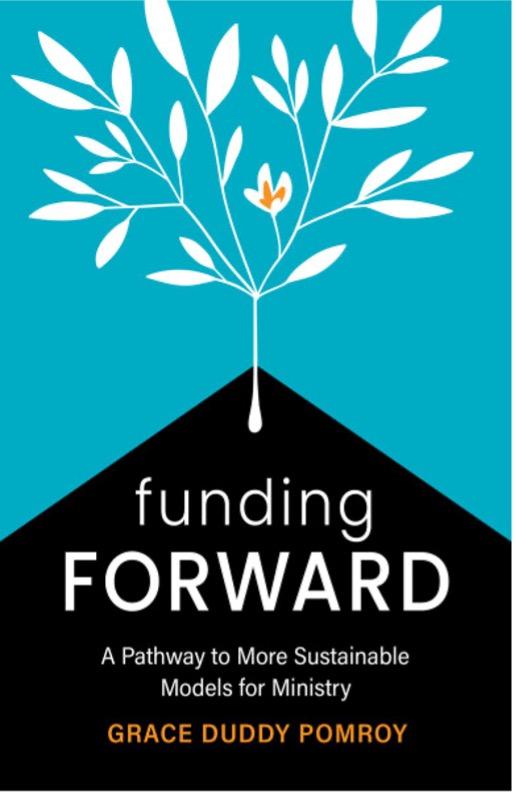
Grace Duddy Pomroy: How congregations can create more sustainable financial models

In her book “Funding Forward,” a financial educator at Luther Seminary argues that the most successful congregations engage spiritual practices like discernment before focusing on money.


This interview appeared in the Faith and Leadership newsletter published on September 1, 2026


People often think their church’s financial problems require technical solutions: more cash in the bank, more members in the pews, says Grace Duddy Pomroy. But she argues that even congregations experiencing worry, grief and fear about their financial situation need to step back and look at the bigger picture first.


“Looking at both the money and the mission really matters, and looking at the broader community needs comes into play,” she said. “That allows us to begin to see a future of what God has for us.”


Pomroy is the director of the Stewardship Leadership Program at Luther Seminary and author of “Funding Forward: A Pathway to More Sustainable Models for Ministry.” The book is based on the findings of a research project involving 200 congregations in the United States and Canada. Using surveys and interviews, researchers examined the conditions and practices that help a congregation shift its financial model.


Each chapter includes Scripture and a prayer as well as questions and practices for church leaders who want to put the ideas into action. An e-book version is also available. A second phase of the study, focused on rural and small-town congregations, is currently underway.


Pomroy spoke with Faith & Leadership’s Sally Hicks about the research findings and why spiritual practices are such an important part of stewardship. The following is an edited transcript.


Faith & Leadership: It’s surprising how far into a book about funding you get before you actually talk about money. Why don’t you start with fundraising ideas?

Gracy Duddy Pomroy: That’s on purpose. I get in conversations around this issue all the time, and congregations assume this is a technical challenge that is solely financial — that if they can figure out how to get this magical pot of gold in the sky to come down and solve their finance issues, then everything will be fine. And that’s not the case at all. I do a lot of reeducating to help people understand that there’s usually a bigger issue behind the scenes, and often there’s more than one bigger issue behind the scenes.


Another reason I don’t start with money is that many pastors don’t see financial challenges as in their domain. They’d rather have someone else take on this challenge because they weren’t trained how to in seminary.


Many seminaries are beginning to address this, which is wonderful. But regardless, if you care about your congregation and you feel the tug of God’s mission, then this challenge is for you as well. You might actually have skills and gifts to bring to it, too.


F&L: You name three things that need to be in alignment: God’s mission, community need and underutilized assets. Why do those three things have to be aligned first?

GDP: This was not something that we had originally expected, but it was a key insight that came through the interview process. When these three things come together, we tend to see the most success, both missionally and financially.


What’s fascinating is that most church leaders will say to me, “Well, Grace, I don’t want to think about my mission until the money thing is resolved,” or, “We just need more people in church. Then we can figure out this whole asset situation.”


I think those are distractions that actually keep us from focusing on the main thing. It depends on the site, but usually underutilized assets aren’t as much of the issue as we think they are. It’s knowing what the mission is and knowing what the community actually needs.


Our neighbors want to be in conversation with us no matter how much money we have in the bank. Yet we often assume we need to be in a position of power in order to have that conversation; we’ve become accustomed to that dynamic between churches and neighborhood. This is one of the unlearnings. We need to be able to meet our neighbors on common ground.


F&L: For the pastor or lay leader or congregant who says, “That all sounds great, but the roof is leaking,” what do you say to them?

GDP: It might need to be repaired tomorrow, in which case, OK, we’ve got to do that.


But sometimes churches are dealing with financial issues where they do have a bit more runway. Getting to know the exact length of that runway is very, very important in order to consider what’s on the table today and what might be on the table tomorrow.


The other challenge is that discernment takes time. If we want to get everything fixed and then start a discernment process, we actually have a longer timeline. Discernment does not happen overnight.


F&L: Are there different challenges for different-sized congregations? Or is it more that every church is different in the way they approach this?

GDP: Yes and yes. I would say every church is different — and that’s actually the beautiful part of this; each church has a unique identity entrusted to them by God.


However, there are some patterns that we’ve seen. In my experience, it’s actually less about size and more about context. We have seen some real differences across urban, suburban and rural/small-town contexts. And while there are distinct similarities, I think, between urban and rural contexts, suburban seems to be something that’s entirely different. Many suburban congregations haven’t even run into some of these same concerns yet because they often have a higher membership and a little more money in the bank at the moment. Other suburban congregations are beginning to see a pattern of decline, though. It’s just not quite as far along as what we’re seeing in some urban and rural sites.


F&L: The pattern of need is different.

GDP: It is. Urban and rural communities, particularly if they’re smaller congregations, tend to have a lot of similarities to each other in terms of their connections with their community. Their assets may be different, and the assets available in their community might be different.


People have often assumed, for instance, that in a rural or small-town site, you can’t do housing, there are no grants available, all of that. Yet even just at the beginning of our research, we’re beginning to see how those projects are emerging.


They might take different shape. For instance, a community might have land that’s been donated to them, which is something entirely unheard of at an urban site. Imagine having multiple acres of farmland donated to your church. You’re deciding, should we have a solar farm? Should we rent this out to a local farmer? Should we sell the land?


F&L: You say that assets are more than money. What are the less obvious assets?

GDP: Assets include everything. It includes the tangible and the intangible. And you’re right, it’s really easy for us to focus on the financial and property-based assets. However, even when it comes to property, we often miss some pieces of the equation.


For instance, my congregation has some underutilized space right in front of our church. It was overgrown for a long time. Nobody really paid attention to it. I guarantee you, if the congregation made a list of its top property assets, this space would just completely be ignored. Yet that is still a property asset — imagine using it for something like pickleball.


Similarly, we often don’t think about what the gifts and skills of people in our community are. We have someone in my congregation who formerly worked as a florist. No one on their time and talent inventory is thinking about the flowers! But one of the beautiful things that this member has done is helped people in our community understand how to better care for the flowers at their own homes.


F&L: How do outside partnerships work in terms of stewardship? What’s the alternative to the charity model you referred to earlier?

GDP: It can be wildly challenging for us to change our own financial mindsets about actually needing something from our outside partners. But the beautiful thing is when we both receive and give, that’s when we lean into mutual relationship. That’s when we live into beloved community together. That’s when we undo some of these dangerous power dynamics.


I think a lot of churches have assumed that outside partners won’t want to support our work because we are a religious organization, because we would be seen as proselytizing. Being clear about the variety of work that your congregation does is vital because an outside partner may want to support some of those items and not others, or they may want to give to the project as a whole.


Beyond that, in this rural and small-town project, we have seen a lot of congregations receiving grant funding from larger foundations as well as from regional bodies, denominational bodies. It’s been fascinating to see how receiving those funds has opened up space for creativity that they could never have imagined before because their budget was solely focused on keeping their doors open and the lights on. They just needed that creative spark.


Sometimes we don’t need a huge gift. Sometimes all we need is a little bit of runway to get us started. And that’s often how outside partners can help us, in addition to creating more sustainable funding. In the book I share a lot of stories about how outside funders can open doors in ways that we can’t.


F&L: What about the offering plate? It still is the primary source of money for congregations.

GDP: I think it’s really important that we define the goal of the offering. So many of us take this for granted, because the offering plate has always been a part of the worship service. We don’t really know what it’s about. Is the offering plate about supporting the congregation? Maybe. Is the offering plate about connecting in my relationship with God? Absolutely. Is it an act of worship? Definitely. That is why so many congregations include it in the liturgy.


How might we live that out differently if the offering plate wasn’t our last-ditch effort to get enough money in to support the bottom line? Diversification of funding actually frees us to do offering in a different way.


The other important thing to remember is that when you bring in different sources of funding, congregation members will assume that you are making way more than you actually are.


They may think, “OK, I understand offering is an act of worship, but I could give this money anywhere. Why should I give it here?” When you start doing these projects, it’s imperative that you bring people along. Hopefully they’ve been a part of structuring and discernment around this project, so they’re along for every step of the way.


My suggestion is always to put outside sources of funding toward the least sexy parts of your budget. For instance, if you have in tenants, the money that they pay in rent should be going toward congregational infrastructure — toward that leaky roof that you mentioned earlier, and other deferred maintenance projects.

That allows other people who are giving through the offering plate to say, “Wow, I know my money is going to support the youth mission trip, and it’s paying that pastor’s salary, and I just heard this amazing sermon. It’s allowing us to have new small groups. It’s allowing us to do social justice work in our neighborhood.” That’s the broader story that can be told.


But if you don’t do the work of being clear about that, people assume, “Great, this tenant is a godsend — they’re solving all of our financial problems.”

F&L: You identify 20 spiritual practices in your book, including clearly pertinent practices like generosity, prayer and discernment. But some of them, like anti-racism, sabbatical and laying on of hands, aren’t obviously related to fundraising or stewardship.

GDP: This was one of our most unique findings from the survey: Spiritual practices came up again and again. It was something I never would have expected, yet it makes so much sense. Because if the process is ultimately about God and not about money, why wouldn’t spiritual practices be a centerpiece?


It’s also important to remember that these projects take a long time to complete. So how do we stay focused on the mission? How do we keep patient in the midst of struggle? And our faith traditions have so much to teach us about that.


We have spiritual practices ready to help us on those long journeys. If we have to let go of a certain asset, for example, we have spiritual practices to help us through a process of grief. In those moments where God’s presence feels cloudy, where we’re not exactly sure where to go, we have practices.


These congregations were often drawing on practices that they had used for a long time — they were just using them in a different way, which leads me to believe this is actually one of the assets that a congregation might have at its disposal.


This reminds us that the entire congregation can engage in this process together.

The Conference of International Black Lutherans (CIBL) Celebrated 40 years

The Conference of International Black Lutherans (CIBL) celebrated its 40th anniversary September 9 on the campus of United Lutheran Seminary in Philadelphia’s East Mount Airy neighborhood.


The United Lutheran Seminary and African Descent Lutheran Association sponsored for the event.


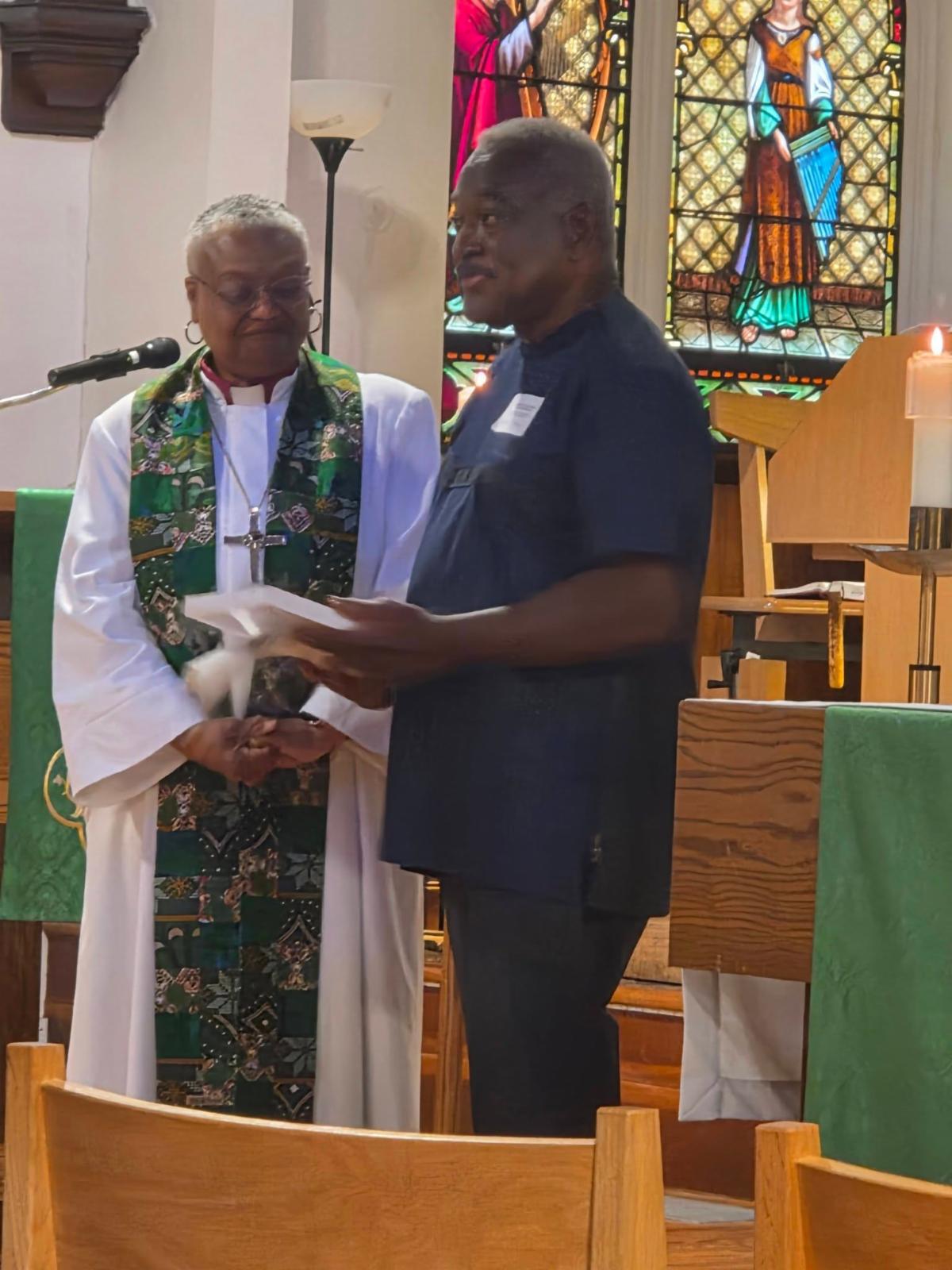
Pictured at left is Bishop Phyllis Milton of the Virginia Synod and Rev. Dr. James Thomas currently serving an interim in SEPA synod.


CIBL grew out of a conference held in Harare, Zimbabwe in September, 1986. The conference featured an assembly of 40 African and African American Lutheran theologians, church administrators and other leaders. The primary goal of the conference was to interpret and affirm an African and African American Lutheran understanding of Lutheran doctrine in which unity in diversity is celebrated with a culturally inclusive church.


The Rev. Dr. Richard Perry, Professor Emeritus of Church and Society and Urban Ministry at the Lutheran School of Theology at Chicago (LSTC) presented the keynote “Disrupting the River: A Story of CIBL, USA.” He focused on the spirit and connections with an early public expression of African Descent Lutheranism in the United States.

The Rev. Dr. James R. Thomas, currently serving as the interim pastor at Christ Lutheran Church, Upper Darby, PA, moderated the discussion.


Dr. Thomas is the author of A Rumor of Black Lutherans: The Formation of Black Lutherans in Early American Lutheranism(Fortress, 2024) and will be the featured speaker at a SEPA Antiracism event on September 22 being held at Reformation Lutheran Church, 1215 Vernon Road, Philadelphia.


Rev. Dr. Nelson Strobert, Professor Emeritus of Religious Education at the Lutheran Theological Seminary at Gettysburg (LTSG, now part of ULS) and also a key essayist for the Black and Lutheran History Project served as the liturgist while The Rev. Dr. Phyllis Blair Milton, Bishop for the Virginia Synod of the Evangelical Lutheran Church in America (ELCA) was the preacher.


A highlight of the day was the presentation to two recipients of the Pero/Moyo Legacy Award. Receiving the award posthumously was the Rev. Dr. Cheryl Stewart Pero, who is known as the “Mother of CIBL.” Dr. Stewart was the first African American Lutheran female to receive a PH.D. in Biblical Studies. Dr. Pero served as convener of CIBL USA for many years and worked to include women of color in theological education. She served as a parish pastor, campus pastor, and director of the Pero Center (now the Albert “Pete” Pero, Jr. and Cheryl Stewart Pero Center of Intersectionality Studies) at LSTC. 


The second recipient was the Rev. Dr. Kevin Dudley, senior pastor of Shiloh Baptist Church in Columbus, OH. Dr. Dudley has held the Trinity Lutheran Seminary Endowed Chair in Mission and Ministry and now serves as Mission and Ministry Chair and Instructor of Church and Society at the school. He holds Master of Divinity (M.Div.) and Master of Sacred Theology (STM) degrees from Trinity and a Doctor of Ministry Degree in Leadership from Ashland Theological Seminary. Dr. Dudley is an accomplished writer having recently published Anonymous Anointing: God’s Power Through Our Presence (June 2026, Highly Recommended Int’l)


LEARN MORE ABOUT CIBL

LEARN MORE ABOUT BLACK AND LUTHERAN